The best air purifier for wildfire smoke is not the model with the largest advertised room number. It is the one with enough smoke clean air delivery rate (CADR) for the room, tolerable noise at the speed you will actually run, replacement filters you can obtain during smoke season and an ownership cost you can sustain.
On that basis, the Blueair Blue Pure 211i Max has the strongest published smoke-specific throughput in this three-model shortlist. The Levoit Core 600S-P is a capable large-room alternative with clear CADR, noise and power specifications. The IQAir HealthPro Plus XE takes a different route, with separate particle and gas-and-odour stages, but its published maximum airflow is not a smoke CADR and should not be compared as if it were.
No portable purifier makes a home smoke-proof, guarantees a health outcome or replaces evacuation instructions, source control, suitable ventilation when outdoor air improves, or advice from public-health and medical professionals. The US Environmental Protection Agency's smoke guidance treats portable air cleaning as one part of a wider exposure-reduction plan.
Build the cleaner-air room before buying the machine
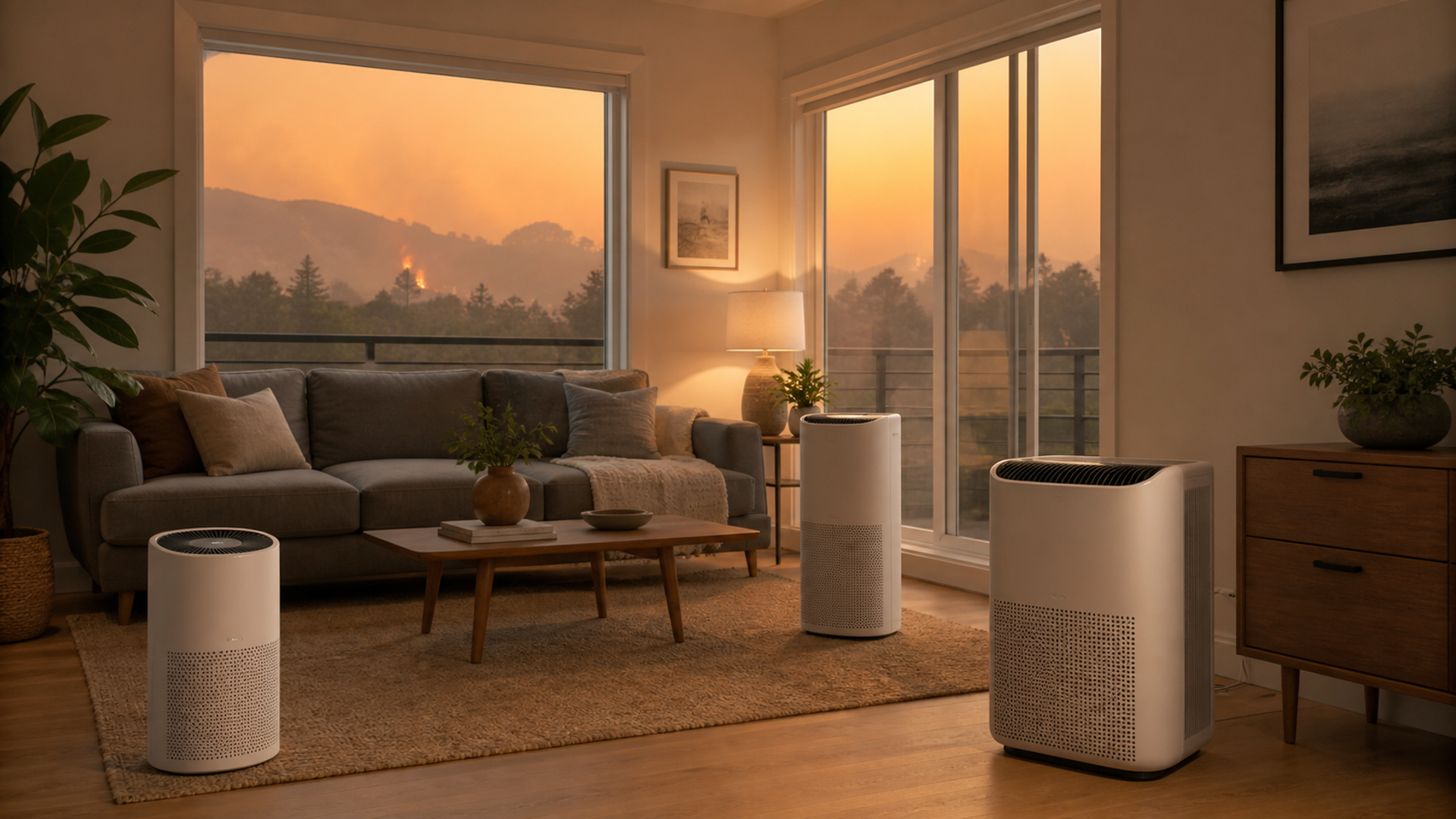
Start with one room rather than an entire open-plan property. EPA recommends creating a cleaner-air room large enough for the household, keeping doors and windows closed during smoky conditions, reducing activities that create particles indoors, and placing a portable cleaner where people spend the most time. Local air-quality information and emergency directions remain the operating authority.
Measure the room's length, width and ceiling height. Include connected spaces if doors remain open. A purifier marketed for a very large room at one air change per hour may be too slow for a smaller smoke-control target. Conversely, two appropriately placed units may serve an awkward or divided area better than one machine whose airflow is blocked by furniture or curtains.
Heat changes the plan. EPA's preparation guidance for smoke and heat says households should decide in advance how to remain cool with doors and windows closed. If the room cannot be kept at a safe temperature, moving to a cooler, cleaner-air location takes priority over continuing to run a purifier in an overheating space.
Before fire season, identify the outdoor-air intake and recirculation controls on any HVAC or air-conditioning system. EPA advises using a high-efficiency HVAC filter—MERV 13 or as high as the system can accommodate—and consulting an HVAC professional where compatibility is uncertain. A portable purifier supplements that system; it does not repair an excessively leaky room or an unsuitable ventilation setup.
Convert floor area into a smoke-CADR target
CADR expresses the volume of filtered air delivered for a defined particle category. For wildfire particles, use the tobacco-smoke CADR where it is published because that is the smallest-particle category on the AHAM label. Do not substitute fan airflow, a filtration percentage or a “covers up to” claim.
The AHAM Verifide directory says tobacco-smoke CADR should be at least two-thirds of the room's floor area in square feet, assuming an eight-foot ceiling. EPA's Guide to Air Cleaners in the Home gives almost the same sizing progression and advises stepping up for ceilings above eight feet.
| Room area | Minimum CADR from EPA's estimate | AHAM two-thirds check | Practical screening target |
|---|---|---|---|
| 100 ft² | 65 cfm | 67 cfm | At least 67 cfm |
| 200 ft² | 130 cfm | 133 cfm | At least 133 cfm |
| 300 ft² | 195 cfm | 200 cfm | At least 200 cfm |
| 400 ft² | 260 cfm | 267 cfm | At least 267 cfm |
| 500 ft² | 325 cfm | 333 cfm | At least 333 cfm |
| 600 ft² | 390 cfm | 400 cfm | At least 400 cfm |
These are screening values, not a promise of indoor air quality. High ceilings, open doors, air leakage, smoke intensity, purifier placement and reduced fan speed can all lower the real result. If noise forces you to run a unit well below its test speed, buy more capacity or consider multiple units rather than pretending the maximum specification applies.
CADR rates particle removal, not gas removal. Wildfire smoke is a mixture, and EPA notes that activated carbon or another sorbent medium is needed for gases; there is no equally widespread consumer performance rating for that function. Carbon presence alone does not reveal media quantity or gas-removal capacity.
Blueair Blue Pure 211i Max: the throughput-led choice
Blueair's current Blue Pure 211i Max specifications publish a smoke CADR of 435 cfm, alongside dust CADR of 452 cfm and pollen CADR of 450 cfm. The manufacturer associates that performance with a recommended 674 ft² room at 4.8 air changes per hour. It also lists 23–53 dB sound, 46 W energy consumption, integrated particle sensing and a choice of particle-and-carbon or SmokeBlock filters.
For a 600 ft² room with an eight-foot ceiling, 435 cfm clears the simple 400 cfm screening target. That makes Blueair the easiest of this shortlist to size from smoke-specific data. Its 360-degree intake and top outlet still need clearance, and the useful output at a quieter setting will be lower than the maximum CADR.
The filter decision belongs in the purchase. Blueair publishes different compatible filter types and says filter life can reach up to nine months using its usage-based tracking. Heavy smoke may shorten that interval; EPA advises checking filters frequently and replacing them when dirty. Price the standard and smoke-oriented replacements available in your market, and buy the required spare before regional demand surges.
Best fit: a large, conventional room where a high, explicit smoke CADR and straightforward particle-throughput comparison are the priorities. Do not infer that the smoke-specific filter name guarantees removal of every particle or gas, or that the purifier changes evacuation decisions.
Levoit Core 600S-P: clear large-room specifications in a compact footprint
The Levoit Core 600S-P product page lists a CADR of 391 cfm, a 606 ft² room at 4.8 air changes per hour, 26–55 dB noise, 49 W rated power and a three-stage filter with an activated-carbon stage. It also includes a PM2.5 display, automatic mode, app control and a filter-life indicator.
At 391 cfm, it matches EPA's estimated minimum for 600 ft² but sits just below AHAM's rounded two-thirds target of 400 cfm. That is not a defect declaration; it is a reason to choose a modestly smaller room, accept a lower target, or add capacity where smoke conditions and leakage justify it. Levoit's page does not break the displayed CADR into smoke, dust and pollen values, so confirm the relevant certified entry or label rather than silently treating its general figure as tobacco-smoke CADR.
Its smaller 12.3 by 12.3-inch floor footprint may simplify placement, while the top outlet still requires unobstructed circulation. Smart controls can make continuous operation easier, but an app is not filtration evidence. During an active smoke event, the meaningful questions are whether the unit is on, whether the selected speed delivers enough air, and whether the filter is loaded.
Best fit: a medium-to-large room where published overall CADR, compact placement and remote monitoring are useful, subject to confirming smoke-specific certification and filter supply. No connectivity feature should outrank room sizing.
IQAir HealthPro Plus XE: filtration depth with a comparison caveat
IQAir's current HealthPro Plus XE page describes three separate stages: a PreMax pre-filter, a V5-Cell gas-and-odour stage using activated carbon and impregnated alumina, and a HyperHEPA particle filter. It publishes six airflow levels up to 300 cfm, sound pressure from 27 to 59 dB(A), power from 8 to 134 W and average filter-life estimates tied to ten hours per day at speed three.
The production source pack also contains IQAir's official HealthPro Series technical specification PDF. That document is dated 2016, so it supports the established system architecture but should not override the current XE page or current regional documentation.
The crucial caveat is measurement. IQAir publishes maximum airflow on these pages, not a tobacco-smoke CADR. Airflow through a device and CADR are not interchangeable; CADR incorporates pollutant removal as well as air volume. A buyer should therefore request a current, comparable smoke-CADR or independent certification for the exact model before using the 300 cfm figure in the AHAM room formula.
Best fit: a buyer who prioritises a substantial, separately described gas-and-odour stage and is willing to verify current performance documentation and price three filter stages over time. It is not the cleanest choice for a simple CADR-per-pound comparison because the published metric differs.
Compare the three as operating systems
| Decision field | Blueair 211i Max | Levoit Core 600S-P | IQAir HealthPro Plus XE |
|---|---|---|---|
| Published particle metric | Smoke CADR 435 cfm | CADR 391 cfm; pollutant split not shown on cited page | Airflow up to 300 cfm; not CADR |
| Published room basis | 674 ft² at 4.8 ACH | 606 ft² at 4.8 ACH | Current page states coverage, but use comparable CADR before sizing |
| Published sound range | 23–53 dB | 26–55 dB | 27–59 dB(A) across six speeds |
| Published maximum/rated power | 46 W | 49 W | 134 W at highest listed speed |
| Gas-media description | Particle-and-carbon choices; SmokeBlock option | Activated-carbon stage | Dedicated V5-Cell carbon and alumina stage |
| Monitoring | Integrated sensors and app | PM2.5 display, auto mode and app | PM2.5 monitoring and AirVisual app on current XE |
| Main evidence strength | Explicit smoke CADR | Clear overall CADR and operating specs | Detailed stages; non-comparable airflow metric |
| Main buying risk | Filter choice and high-speed noise | Assuming general CADR is smoke CADR | Treating airflow or coverage as smoke CADR |
The shortlist does not declare an EPA endorsement. EPA explicitly says it does not certify or recommend specific brands or models. Manufacturer specifications should be cross-checked against the continuously updated AHAM directory, the product label and current regional manuals.
Make filter and electricity cost visible before smoke season
Use a twelve-month worksheet rather than the purifier's promotional price. Record the machine price, each required filter stage, realistic replacement intervals under smoky conditions, delivery charges, local electricity tariff and any pre-filter or sensor costs.
Annualised filter cost can be estimated as: current filter price × 12 ÷ realistic months of service. Add electricity as rated kilowatts × expected daily hours × 365 × local price per kWh. Run the calculation for a normal year and for a severe-smoke year with shorter filter intervals and longer high-speed operation.
Do not compare Blueair's single replacement assembly, Levoit's three-stage assembly and IQAir's separately timed stages as if the pack count were identical. Nor should a manufacturer's average life be treated as a guarantee. Actual loading depends on use and pollution; a dark, dirty or odorous filter may require earlier replacement.
Availability is part of resilience. Keep at least one compatible spare, store it sealed and confirm the exact model number. A purifier without a replacement filter during a prolonged event is depreciating furniture, however impressive its original specification.
Operate the room as carefully as you selected it
Place the unit where people spend time, with intake and outlet clear. During smoky conditions, EPA advises running a portable cleaner as often as possible at the highest practical speed, checking filters frequently, limiting particle-generating activities and monitoring official outdoor-air information. Use an indoor particle sensor as feedback about the room and setup, not as a medical device or proof that the air is harmless.
Keep the plan reversible. Know when outside air has improved enough to ventilate, when indoor heat requires relocation and where the household will go if local officials issue an evacuation order. A powerful purifier is useful equipment inside that plan; it is not the plan itself.
For adjacent preparedness decisions, the long-haul business travel accessories guide covers mobile contingency equipment, while the secure mobile phones guide addresses a separate communications decision. Both are operational reading, not claims about air quality.
The selection verdict
Choose the Blueair when smoke-specific CADR and high large-room throughput dominate. Choose the Levoit when its clear general CADR, footprint and controls fit a slightly smaller or more easily sealed room, after checking smoke certification. Consider the IQAir when its staged particle and gas-media design justifies the cost and you can obtain a comparable current performance figure.
Whichever model wins, size it from the real room, test noise at the required speed, secure filters in advance and retain a cooler-air and evacuation alternative. That is the defensible meaning of “best” during wildfire smoke: a machine that fits a measured plan, not a health guarantee printed on a box.