

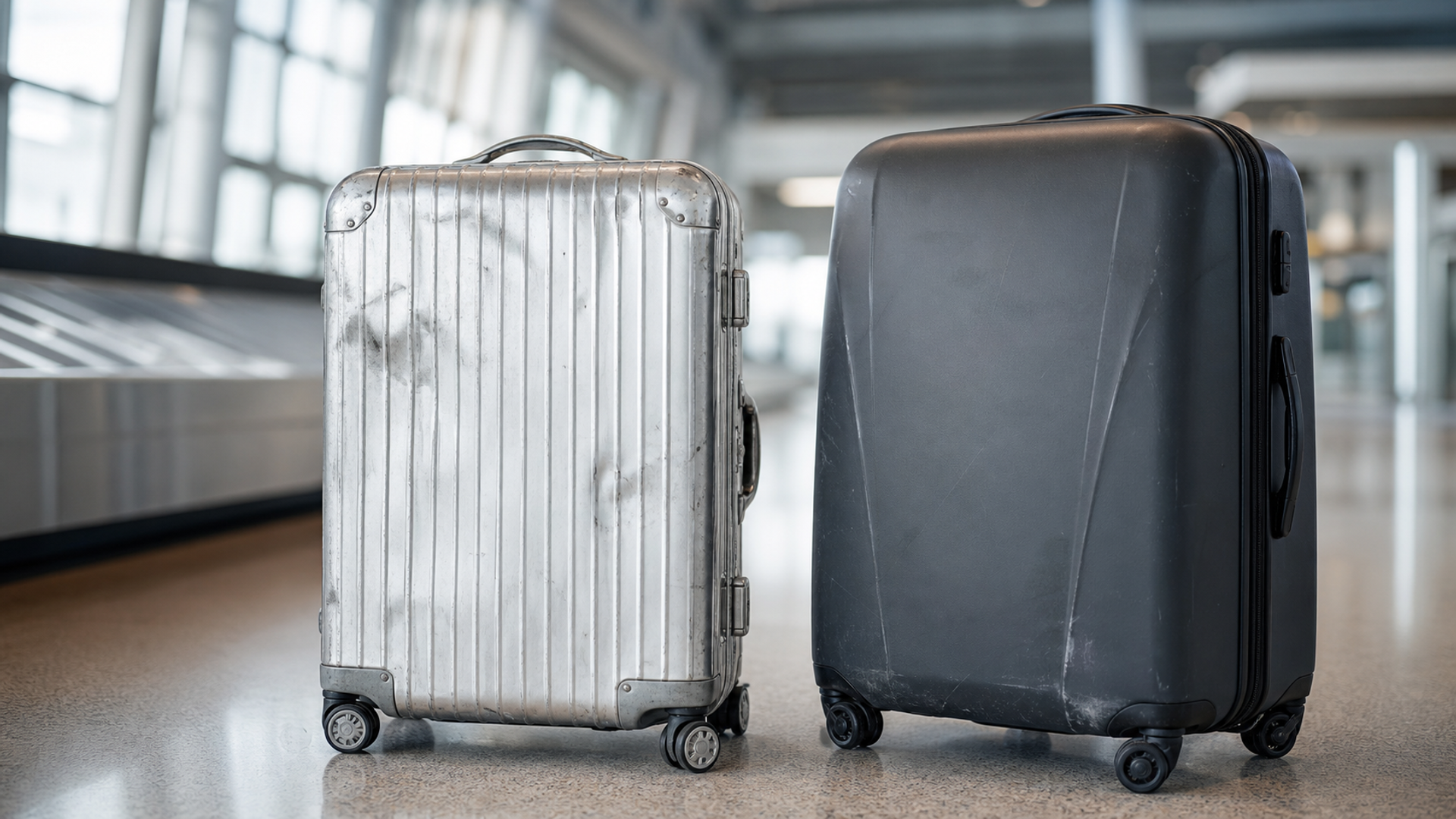
Aluminium and polycarbonate luggage protect belongings through different structural behaviour. Aluminium resists flex and develops visible dents and scratches. Polycarbonate can flex under impact, is often lighter and may show scuffs or stress around mouldings and zips. Frame or zip closure, wheel and handle repair, empty weight and airline limits often decide before shell prestige does.
Start with airline limits and handling
Choose aluminium when rigid structure, framed closure and a visible travel patina are worth extra empty weight and denting. Choose polycarbonate when lower weight and impact flex preserve packing allowance. Keep and repair the present case when wheels, handles, locks or lining can be restored without replacing a sound shell.
| Decision factor | Aluminium shell | Polycarbonate shell | Keep and repair the current case |
|---|---|---|---|
| Empty weight | Allowance remains after heavier shell and frame | Lower shell mass protects packing margin | Weigh the current packed case first |
| Impact | Dents and scratches are accepted as patina | Flex and scuffs are acceptable | Repair the existing shell or corner |
| Closure | Frame and latches fit security and packing style | Zip expansion and flexibility are useful | Replace lock or zip before the case |
| Cabin fit | Exact dimensions fit the recurring airline | Exact wheels and handles remain within the sizer | Use the present proven cabin case |
| Repair | Maker supports dent, wheel, handle and lock service | Parts and shell service remain available | Commission the repair before buying |
| Ageing | Visible metal patina is desirable | Scuffs and possible colour wear are acceptable | Use a cover or cleaning routine |
This aluminium vs polycarbonate luggage matrix is the article's working value object. Read the aluminium vs polycarbonate luggage rows together: the decisive failure mode depends on this topic's evidence, operating context and reader objective.
What metal and polymer change
Evidence 1. RIMOWA describes its aluminium luggage as a rigid metal construction intended to develop dents and scratches as part of use.
Evidence 2. An aluminium case's shell and frame can add empty weight, reducing the mass available for belongings under a fixed airline allowance.
Evidence 3. Samsonite's polycarbonate material guidance describes a moulded thermoplastic shell that can combine impact flexibility with relatively low weight.
Evidence 4. Airline sizers normally assess the complete external case, including wheels and handles, so nominal body measurements alone are insufficient.
Reader-visible sources checked for this article:
rimowa.com — reader-visible current or official evidence
samsonite.com — reader-visible current or official evidence
For aluminium vs polycarbonate luggage, these sources establish only the claims inside their documented scope. Recheck every changeable specification, availability condition, price, policy or service term in the relevant market before acting.
Pack and handle the exact case
Read empty weight as a stop/go test: allowance remains after heavier shell and frame supports the first option; lower shell mass protects packing margin supports the second; and weigh the current packed case first supports the third. Record which source proves the condition and when it was checked.
A buyer can resolve impact without starting from a brand preference. Ask whether dents and scratches are accepted as patina; compare that with whether flex and scuffs are acceptable; then use repair the existing shell or corner as the third route's safeguard. An unknown condition stays unknown.
On closure, popularity is not enough. The evidence for option one is that frame and latches fit security and packing style. Option two means zip expansion and flexibility are useful. Option three is rational where replace lock or zip before the case. Recheck any changeable term immediately before commitment.
The decision changes at cabin fit. Choose the first path only if exact dimensions fit the recurring airline; move to the second when exact wheels and handles remain within the sizer; use the third when use the present proven cabin case. Save the downside that would make this row fail.
For repair, the first route works when maker supports dent, wheel, handle and lock service; the second requires parts and shell service remain available. The control for the third is commission the repair before buying. Verify this row against the exact product, property, account or environment before it can reverse the decision.
The ageing row exposes a practical boundary. Route one assumes visible metal patina is desirable, while route two is defensible only when scuffs and possible colour wear are acceptable. Route three depends on use a cover or cleaning routine. If that evidence is absent, keep the more reversible option.
Facts that would reverse the current choice
Reversal control 1 — Empty weight. Before choosing Aluminium shell, write down how the decision changes if “Allowance remains after heavier shell and frame” proves false. Do the same for Polycarbonate shell and “Lower shell mass protects packing margin”. Keep the Keep and repair the current case route available until “Weigh the current packed case first” is verified. This control belongs to aluminium vs polycarbonate luggage; update it from the cited source or exact supplier rather than copying a generic checklist.
Reversal control 2 — Impact. Before choosing Aluminium shell, write down how the decision changes if “Dents and scratches are accepted as patina” proves false. Do the same for Polycarbonate shell and “Flex and scuffs are acceptable”. Keep the Keep and repair the current case route available until “Repair the existing shell or corner” is verified. This control belongs to aluminium vs polycarbonate luggage; update it from the cited source or exact supplier rather than copying a generic checklist.
Reversal control 3 — Closure. Before choosing Aluminium shell, write down how the decision changes if “Frame and latches fit security and packing style” proves false. Do the same for Polycarbonate shell and “Zip expansion and flexibility are useful”. Keep the Keep and repair the current case route available until “Replace lock or zip before the case” is verified. This control belongs to aluminium vs polycarbonate luggage; update it from the cited source or exact supplier rather than copying a generic checklist.
Reversal control 4 — Cabin fit. Before choosing Aluminium shell, write down how the decision changes if “Exact dimensions fit the recurring airline” proves false. Do the same for Polycarbonate shell and “Exact wheels and handles remain within the sizer”. Keep the Keep and repair the current case route available until “Use the present proven cabin case” is verified. This control belongs to aluminium vs polycarbonate luggage; update it from the cited source or exact supplier rather than copying a generic checklist.
Reversal control 5 — Repair. Before choosing Aluminium shell, write down how the decision changes if “Maker supports dent, wheel, handle and lock service” proves false. Do the same for Polycarbonate shell and “Parts and shell service remain available”. Keep the Keep and repair the current case route available until “Commission the repair before buying” is verified. This control belongs to aluminium vs polycarbonate luggage; update it from the cited source or exact supplier rather than copying a generic checklist.
Reversal control 6 — Ageing. Before choosing Aluminium shell, write down how the decision changes if “Visible metal patina is desirable” proves false. Do the same for Polycarbonate shell and “Scuffs and possible colour wear are acceptable”. Keep the Keep and repair the current case route available until “Use a cover or cleaning routine” is verified. This control belongs to aluminium vs polycarbonate luggage; update it from the cited source or exact supplier rather than copying a generic checklist.
Build an airline envelope
List the three airlines and fare types used most often, then record their current size and weight limits. Measure each candidate at the furthest wheels, handles and corners. Pack the same work kit and weigh it. A beautiful heavy shell can force checked baggage or remove the very clothing margin the buyer needs.
Inspect closure and frame
Open and close the case when fully packed. Check whether a rigid frame tolerates imperfect packing and whether latches remain aligned after pressure. For zip cases, inspect coil, sliders, seam, expansion panel and security route. Closure failure can end a trip even when the broad shell material survives.
Test handling geometry
Roll over kerbs, carpet, tile and ramps using realistic weight. Lift into a boot and overhead-height shelf. Check handle torsion, wheel replacement and balance on slopes. Aluminium versus polycarbonate matters less when an uncomfortable handle or exposed wheel becomes the first failure point.
Verify repair before purchase
Locate authorised and independent repair routes in home and frequent destinations. Ask for wheel, handle, lock, zip and lining parts, turnaround and shipping policy. Save serial number and proof of purchase. A repairable case can outlast several lighter purchases even when its shell collects marks.
Three travellers, three answers
Cabin-only traveller on strict weight limits
Polycarbonate may preserve useful packing margin when the exact case still fits the sizer. Define the fact that would reverse this recommendation before committing.
Frequent traveller who values rigid framed construction
Aluminium can be satisfying when added weight and visible dents are accepted from day one. Define the fact that would reverse this recommendation before committing.
Owner of a sound premium case with worn wheels
A documented repair is usually more rational than replacing the whole luggage system. Define the fact that would reverse this recommendation before committing.
Action checklist
List recurring airline limits.
Measure complete exterior.
Weigh empty case.
Pack the same kit.
Test latches or zip.
Roll on mixed surfaces.
Lift at travel weight.
Check wheel and handle parts.
Locate repair centres.
Save serial and receipt.
Continue the decision
The linked VERTU articles expand adjacent parts of the aluminium vs polycarbonate luggage decision. They do not substitute for the external evidence above.
The aluminium-polycarbonate verdict
Choose aluminium when rigid structure, framed closure and a visible travel patina are worth extra empty weight and denting. Choose polycarbonate when lower weight and impact flex preserve packing allowance. Keep and repair the present case when wheels, handles, locks or lining can be restored without replacing a sound shell.
Keep the aluminium vs polycarbonate luggage decision reversible until its material cost, safety, access, privacy and compatibility facts are verified. Unknown evidence stays unknown; it is never silently scored as favourable.
![How to Scan Receipts and Documents with Your Phone [Full Guide]](https://cdn.sanity.io/images/e0gp1l2g/production/0db13feec1d5e72b8a8a5f976d1f3e86619c9228-3840x1860.webp?w=180&h=180&q=78&auto=format&fit=crop)
![How to Scan Receipts and Documents with Your Phone [Full Guide]](https://cdn.sanity.io/images/e0gp1l2g/production/0db13feec1d5e72b8a8a5f976d1f3e86619c9228-3840x1860.webp?w=800&h=450&q=82&auto=format&fit=crop)
![Top 10 Two-Tone Carbon-Fibre Watches for Men [2026 List]](https://cdn.sanity.io/images/e0gp1l2g/production/18870799ba33fab0e038968359cd5772d7d7db30-1024x576.webp?w=800&h=450&q=82&auto=format&fit=crop)
![Top 10 Luxury Watches with Digital Complication Displays for Men [Latest]](https://cdn.sanity.io/images/e0gp1l2g/production/c4f6bf8c080f291c39f7cc85c7344ecff2fd3799-1024x553.webp?w=800&h=450&q=82&auto=format&fit=crop)