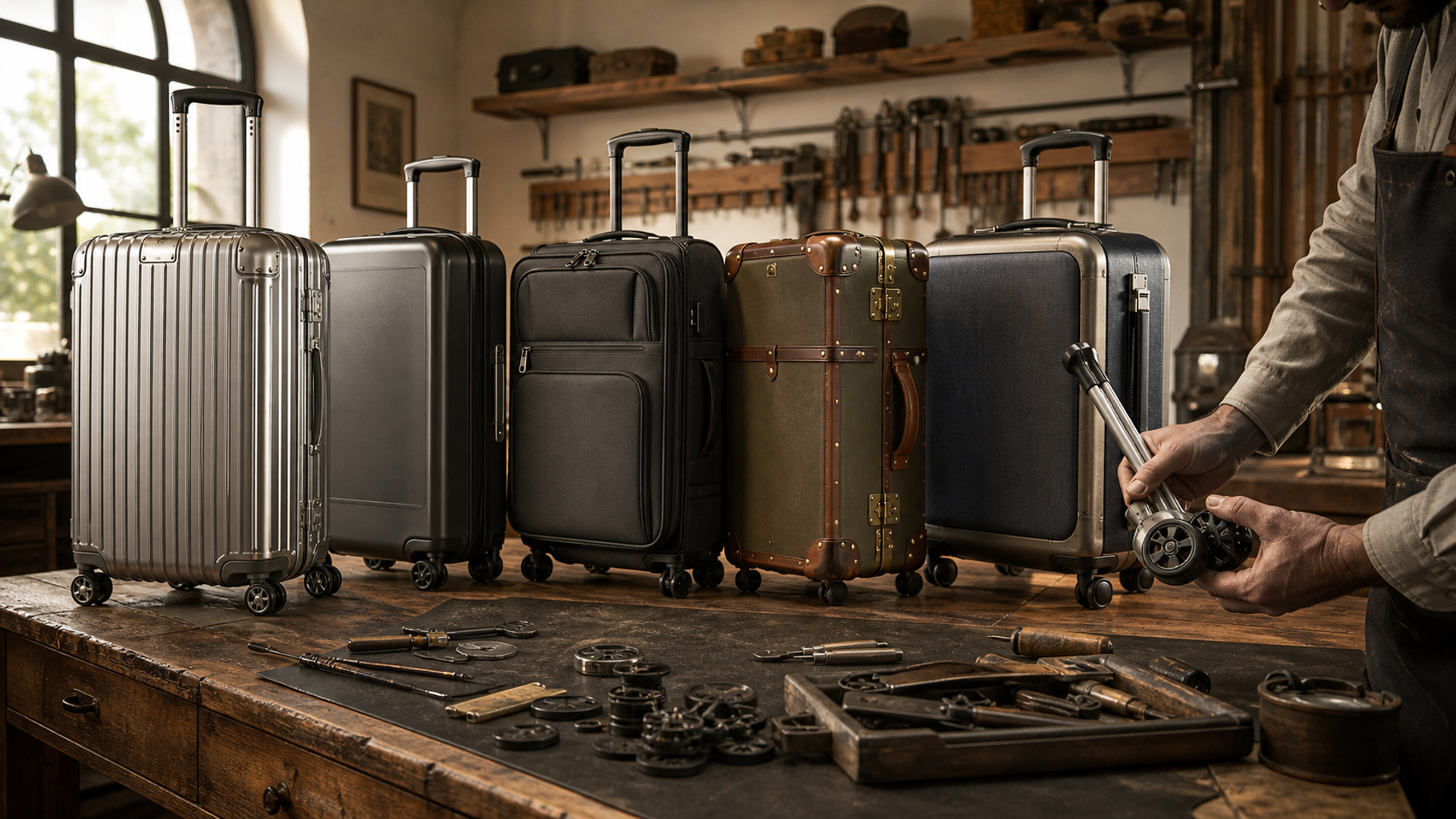
The best luxury luggage brand in 2026 is not necessarily the most expensive or recognisable. It is the brand whose case fits your airlines, survives your handling pattern and can be repaired without disrupting the next trip. RIMOWA, TUMI, Briggs & Riley, Globe-Trotter and Carl Friedrik each express luxury differently: engineered shell, organised business utility, expansive functional guarantee, hand-built heritage or modern hybrid construction.
This guide compares ownership systems rather than declaring one universal winner.
Five-brand ownership matrix
| Brand | Strongest buyer fit | Main construction language | Published support signal | Important trade-off |
|---|---|---|---|---|
| RIMOWA | Design-led frequent traveller | Aluminium and polycarbonate shells | Lifetime guarantee on qualifying new wheeled suitcases | Cosmetic wear excluded; aluminium can be heavy |
| TUMI | Mobile executive | Organised soft-sided, hard-sided and business systems | Five-year limited warranty for wheeled luggage/body-worn bags; first-year transit provision in current US terms | Airline mishandling no longer covered after year one |
| Briggs & Riley | Function-first frequent traveller | Ballistic nylon and practical expansion | Published lifetime repair guarantee, including airline damage | Some carry-ons are heavy and expansion can exceed airline limits |
| Globe-Trotter | Heritage collector and ceremonial traveller | Vulcanised-fibreboard cases made in England | Specialist repair service and long-life positioning | Repair logistics can centre on the UK; less forgiving of rough checking |
| Carl Friedrik | Minimalist hybrid-case buyer | Polycarbonate shell with aluminium frame and leather detail | Published lifetime warranty and parts-led repair options | Smaller service footprint; exact exclusions require review |
The matrix summarises current official pages observed in July 2026. Local terms, product eligibility and purchase dates can change the coverage.
What “luxury” should buy
Luxury luggage should deliver at least three of five benefits:
Better movement through airports, streets and hotels.
Repairable functional components.
Materials that age in a way the owner accepts.
A support pathway in the owner’s travel geography.
A packing system that reduces time and damage.
A logo without these benefits is decoration. An anonymous case with excellent wheels, repair access and the correct dimensions may be the more luxurious tool.
RIMOWA: for engineered shell ownership
RIMOWA remains the natural reference for aluminium luggage and minimalist hard-shell design. Its qualifying new suitcases purchased from 25 July 2022 carry a lifetime guarantee, while its owner manual excludes cosmetic wear, misuse and abuse.
Best for:
travellers who enjoy industrial design and visible patina;
owners who use packing cubes rather than external pockets;
cabin travellers who can manage the empty weight;
buyers with convenient access to authorised service.
Ownership questions:
Is the exact suitcase covered by the lifetime guarantee?
Are customised parts covered for the same period?
What counts as cosmetic rather than functional damage?
How long will a repair take in the cities you use?
Aluminium records dents and scratches. That is not automatically a defect. If a pristine surface is essential, buy polycarbonate or choose a finish whose ageing feels intentional.
TUMI: for organised business travel
TUMI’s strength is the system around the case: pockets, garment handling, briefcases, backpacks and body-worn accessories. The current US warranty states that wheeled luggage and body-worn bags carry five years of limited cover. During the first year, qualifying functional and structural damage from airline or transit mishandling is included; from years two to five it is not.
Best for:
travellers who need immediate access to documents and technology;
owners building a coordinated business-travel set;
soft-sided users who value expansion and external pockets;
buyers near TUMI stores or repair channels.
Ownership questions:
Does the exact item receive five years or two?
Is proof of purchase from an authorised seller available?
Will the repair be handled in store or shipped?
Does the expanded case remain cabin-compliant?
TUMI excludes cosmetic damage and consequential losses. A warranty does not insure the contents.
Briggs & Riley: for repair-first pragmatists
Briggs & Riley publishes one of the clearest functional propositions in luggage: its “Simple as that” lifetime guarantee says it will repair damage, including airline damage, for life, without proof of purchase. Product pages repeat that promise.
Best for:
very frequent travellers who prioritise function over fashion;
owners who check bags regularly;
buyers who value expansion and garment systems;
people who want a long functional repair commitment.
Ownership questions:
What repair location serves your country?
Who pays shipping in your market?
Does the expanded dimension exceed your airline limit?
Is the empty weight acceptable?
The brand’s own Essential 22-inch Carry-On page lists exterior dimensions of 22 × 14 × 9–11.5 inches and a weight of 10 pounds. That illustrates why “carry-on” is not a universal permission. Expanded depth and empty weight must be compared with each airline.
Globe-Trotter: for heritage and collectability
Globe-Trotter positions its cases as handmade in England and built for a lifetime of travel. Its repair page offers specialist repair through its London flagship and factory route, publishes indicative lead times and explains return-shipping charges by region.
Best for:
owners who value craft, history and a distinctive case;
rail, yacht, hotel and chauffeured journeys;
collectors willing to plan maintenance;
travellers who treat the luggage as an object, not disposable equipment.
Ownership questions:
Can the case be serviced locally or must it travel to the UK?
What is the current repair lead time?
Is the material appropriate for routine airline checking?
Can an airline-damage quotation be produced promptly?
Globe-Trotter’s published repair logistics are valuable because they make downtime visible. A three-to-four-week repair may be acceptable to a collector with multiple cases but difficult for a one-bag weekly traveller.
Carl Friedrik: for modern hybrid construction
Carl Friedrik’s hybrid luggage combines polycarbonate shells, aluminium frames and lock closures. The brand publishes a lifetime warranty and describes a process that may provide a part, repair the product or replace it after assessment. It also lists replacement components for certain aluminium-framed luggage.
Best for:
buyers who want a clean, contemporary hard case;
travellers who prefer latch closure to zips;
owners attracted to leather trim and restrained design;
shoppers prepared to verify a smaller service network.
Ownership questions:
Does the lifetime warranty cover travel damage or manufacturing defects only?
Which parts can be self-replaced?
Where is in-house repair performed?
What happens in a country without a store?
The availability of parts is promising, but the buyer should still document shipping, duties and downtime.
The cabin-fit calculator
Before evaluating brand prestige, calculate the remaining useful weight.
Packing allowance
= airline cabin weight limit − empty case weight
If an airline allows 8 kg and the case weighs 4.6 kg, only 3.4 kg remains for clothing, shoes and technology. That can be less useful than a lighter case with a less prestigious badge.
Also calculate dimension headroom:
Height headroom = airline maximum height − case height
Width headroom = airline maximum width − case width
Depth headroom = airline maximum depth − packed case depth
Any negative result is a failure. Check the most restrictive airline and regional aircraft on the itinerary, not the most generous carrier in the portfolio.
The repairability score
Score each case from one to five:
| Dimension | Weight |
|---|---|
| Wheel and handle replaceability | 20 |
| Warranty scope | 20 |
| Service access | 20 |
| Turnaround and shipping | 15 |
| Airline-damage treatment | 10 |
| Proof-of-purchase burden | 5 |
| Paid repair after warranty | 10 |
Multiply each rating by the weight and divide by five. A lifetime promise with difficult logistics can score below a five-year policy supported by a nearby store.
Ask for a current written answer on:
wheels;
trolley handle;
locks;
zips or frame;
shell cracks;
lining;
corner damage;
courier costs;
loan cases;
discontinued colours.
The cost-per-journey test
Ownership cost
= purchase price
+ repairs and shipping
+ overweight fees caused by empty weight
+ temporary replacement cost
+ unrecovered airline damage
− resale value
Cost per journey
= ownership cost ÷ journeys completed
This prevents two distortions. First, an expensive case can be good value if used and repaired for many years. Second, a “lifetime” case can be poor value if its weight causes fees or its dimensions force checking.
Use realistic resale evidence for the exact model and condition. Do not assume every limited edition appreciates.
Hard shell or soft shell?
Choose a hard shell when you want:
a rigid perimeter;
two-sided clamshell packing;
easier exterior cleaning;
strong weather resistance;
fewer external pockets.
Choose a soft shell when you want:
external access;
expansion;
one-lid opening in a small room;
some compression into a car or locker;
integrated business organisation.
Hard does not always mean stronger, and soft does not always mean lighter. Compare components and weight.
The airline-damage protocol
Photograph the case before handing it over. At arrival, inspect wheels, handles, shell, frame and zips before leaving baggage reclaim. File the airline report within its deadline, retain tags and receipts, and obtain a repair quotation.
Even when a luggage brand covers airline damage, the carrier may be the first responsible party. Starting the airline claim preserves options.
Never check medicines, passports, keys, irreplaceable jewellery, essential electronics or confidential documents merely because the suitcase is premium.
Final recommendations by traveller type
Design collector: RIMOWA or Globe-Trotter, after accepting visible ageing and repair logistics.
Weekly executive: TUMI, if organisation and store access outweigh the finite warranty.
Heavy-duty checked-bag user: Briggs & Riley, subject to size and weight.
Modern minimalist: Carl Friedrik, after verifying local service and exact exclusions.
Weight-restricted cabin traveller: whichever exact model leaves the most useful packing allowance and passes dimensions.
The verdict
RIMOWA offers the clearest luxury shell identity. TUMI offers the strongest business ecosystem. Briggs & Riley offers an unusually broad published functional guarantee. Globe-Trotter offers craft and collectability. Carl Friedrik offers a modern hybrid proposition.
The best purchase is the case that stays in service. Compare exact dimensions, empty weight, repair pathway, warranty exclusions and likely use over ten years. Luxury luggage should become a trusted travel instrument—not an expensive problem waiting at baggage reclaim.
The cabin purchased can change the baggage calculation materially; the VERTU Emirates Premium Economy versus Business Class guide illustrates why fare and baggage benefits should be evaluated together.