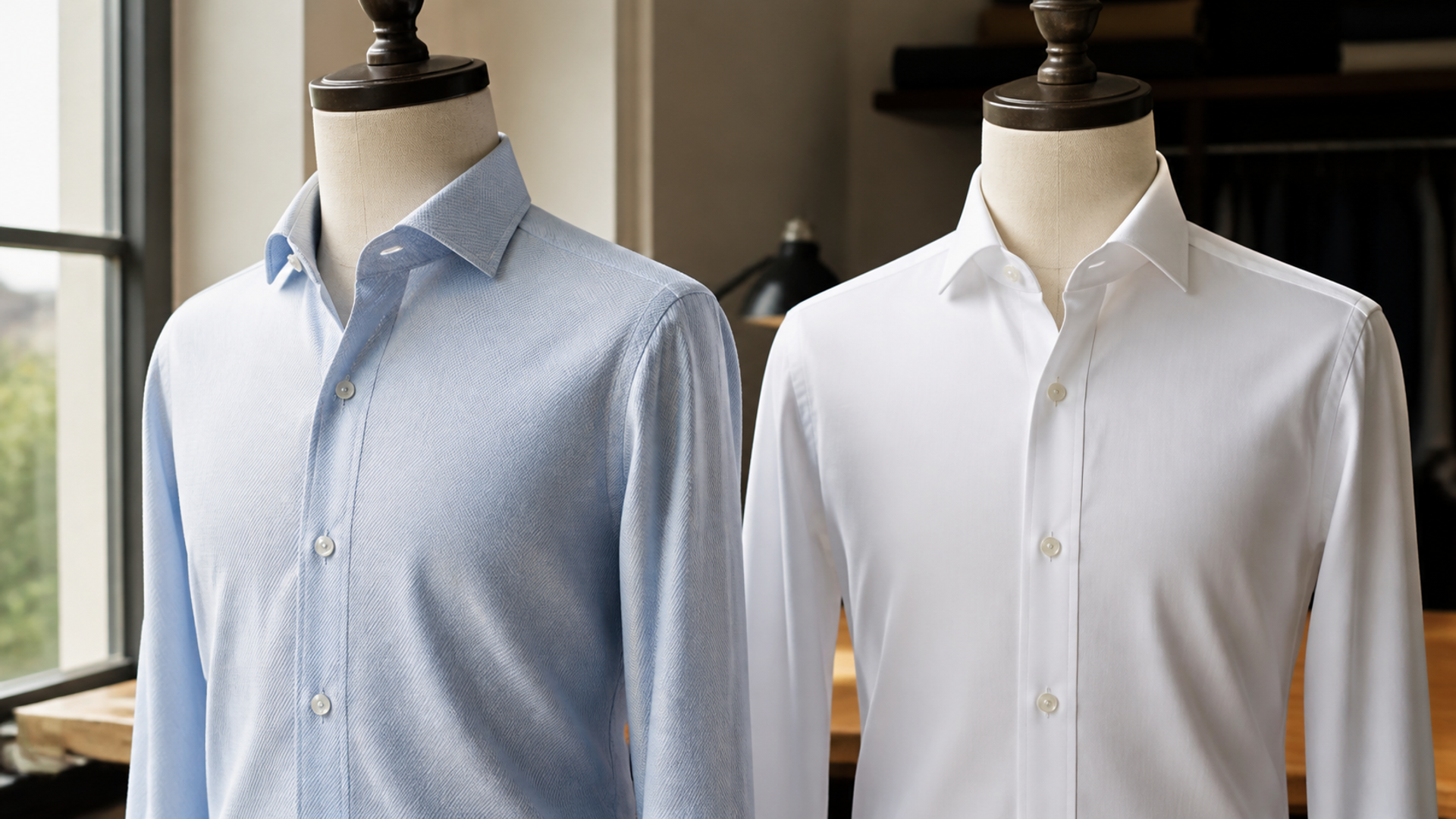
Twill and poplin are weave families, not complete shirt specifications. Twill shows a diagonal structure that often gives the cloth body, drape and some wrinkle resistance. Poplin uses a plain weave and is usually smoother, crisper and lighter, with patterns that can appear particularly sharp. Yarn quality, weight, finishing, colour, opacity, collar, cuffs, fit and laundering can reverse those tendencies. The choice should begin with climate, jacket use and the formality of the actual day.
Weave changes the surface and drape
Choose twill when drape, opacity, visible texture and easier recovery from creasing fit the wardrobe. Choose poplin when a crisp flat surface, lighter feel and sharp pattern presentation matter. Choose by exact fabric and occasion when weight, yarn, finish, colour and tailoring make a specific shirt behave differently from the weave stereotype.
| Decision factor | Twill shirt | Poplin shirt | Choose by fabric and occasion |
|---|---|---|---|
| Surface | Diagonal texture can be visible | Smooth plain-weave face | Inspect under natural light |
| Drape | Often softer and more fluid | Often crisper and flatter | Compare equal weights |
| Opacity | Can conceal more at similar colour | Light colours can be more transparent | Test over normal underlayers |
| Wrinkles | Diagonal structure can disguise creases | Crisp cloth can show creasing | Run a full-day wear test |
| Climate | Weight can feel substantial | Lighter versions can suit heat | Read grams or handle the cloth |
| Formality | Subtle twill can work with tailoring | Plain poplin can look clean and formal | Collar, cuffs and fit decide the ceiling |
This twill vs poplin shirt matrix is the article's working value object. Read the twill vs poplin shirt rows together: the decisive failure mode depends on this topic's evidence, operating context and reader objective.
Shirt details can outweigh the cloth
Evidence 1. Twill is identified by a diagonal weave structure, while poplin or broadcloth uses a simpler plain weave.
Evidence 2. Proper Cloth notes that twill commonly drapes easily and resists wrinkles, while broadcloth or poplin is smooth, thin and crisp but can show more creasing.
Evidence 3. Weave name alone does not establish fibre quality, yarn count, fabric weight, finishing or durability.
Evidence 4. White-shirt opacity depends on material, weight, yarn and finish, so it should be tested with the intended underlayer.
Reader-visible sources checked for this article:
propercloth.com — reader-visible current or official evidence
propercloth.com — reader-visible current or official evidence
propercloth.com — reader-visible current or official evidence
For twill vs poplin shirt, these sources establish only the claims inside their documented scope. Recheck every changeable specification, availability condition, price, policy or service term in the relevant market before acting.
Compare equal-colour samples
The surface row exposes a practical boundary. Route one assumes diagonal texture can be visible, while route two is defensible only when smooth plain-weave face. Route three depends on inspect under natural light. If that evidence is absent, keep the more reversible option.
Read drape as a stop/go test: often softer and more fluid supports the first option; often crisper and flatter supports the second; and compare equal weights supports the third. Record which source proves the condition and when it was checked.
A buyer can resolve opacity without starting from a brand preference. Ask whether can conceal more at similar colour; compare that with whether light colours can be more transparent; then use test over normal underlayers as the third route's safeguard. An unknown condition stays unknown.
On wrinkles, popularity is not enough. The evidence for option one is that diagonal structure can disguise creases. Option two means crisp cloth can show creasing. Option three is rational where run a full-day wear test. Recheck any changeable term immediately before commitment.
The decision changes at climate. Choose the first path only if weight can feel substantial; move to the second when lighter versions can suit heat; use the third when read grams or handle the cloth. Save the downside that would make this row fail.
For formality, the first route works when subtle twill can work with tailoring; the second requires plain poplin can look clean and formal. The control for the third is collar, cuffs and fit decide the ceiling. Verify this row against the exact product, property, account or environment before it can reverse the decision.
Facts that would reverse the current choice
Reversal control 1 — Surface. Before choosing Twill shirt, write down how the decision changes if “Diagonal texture can be visible” proves false. Do the same for Poplin shirt and “Smooth plain-weave face”. Keep the Choose by fabric and occasion route available until “Inspect under natural light” is verified. This control belongs to twill vs poplin shirt; update it from the cited source or exact supplier rather than copying a generic checklist.
Reversal control 2 — Drape. Before choosing Twill shirt, write down how the decision changes if “Often softer and more fluid” proves false. Do the same for Poplin shirt and “Often crisper and flatter”. Keep the Choose by fabric and occasion route available until “Compare equal weights” is verified. This control belongs to twill vs poplin shirt; update it from the cited source or exact supplier rather than copying a generic checklist.
Reversal control 3 — Opacity. Before choosing Twill shirt, write down how the decision changes if “Can conceal more at similar colour” proves false. Do the same for Poplin shirt and “Light colours can be more transparent”. Keep the Choose by fabric and occasion route available until “Test over normal underlayers” is verified. This control belongs to twill vs poplin shirt; update it from the cited source or exact supplier rather than copying a generic checklist.
Reversal control 4 — Wrinkles. Before choosing Twill shirt, write down how the decision changes if “Diagonal structure can disguise creases” proves false. Do the same for Poplin shirt and “Crisp cloth can show creasing”. Keep the Choose by fabric and occasion route available until “Run a full-day wear test” is verified. This control belongs to twill vs poplin shirt; update it from the cited source or exact supplier rather than copying a generic checklist.
Reversal control 5 — Climate. Before choosing Twill shirt, write down how the decision changes if “Weight can feel substantial” proves false. Do the same for Poplin shirt and “Lighter versions can suit heat”. Keep the Choose by fabric and occasion route available until “Read grams or handle the cloth” is verified. This control belongs to twill vs poplin shirt; update it from the cited source or exact supplier rather than copying a generic checklist.
Reversal control 6 — Formality. Before choosing Twill shirt, write down how the decision changes if “Subtle twill can work with tailoring” proves false. Do the same for Poplin shirt and “Plain poplin can look clean and formal”. Keep the Choose by fabric and occasion route available until “Collar, cuffs and fit decide the ceiling” is verified. This control belongs to twill vs poplin shirt; update it from the cited source or exact supplier rather than copying a generic checklist.
Compare cloth, not product photos
Order swatches or inspect shirts in daylight and warm indoor light. Compare texture, sheen, opacity and hand at similar colour and weight. For this twill versus poplin shirt decision, record the exact item, place, date, measurement and source in the evidence log. Keep observations separate from category shorthand, repeat the check in the environment that matters, and price the downside of a wrong choice. If the poplin is denser or the twill is unusually light, revise the generalisation. When that condition appears, reopen the choice instead of defending the original preference.
Run an occasion map
List suit meetings, jacket-free office days, travel, heat and formal evening use. Assign collar, cuff, placket and pocket requirements before selecting weave. For this twill versus poplin shirt decision, record the exact item, place, date, measurement and source in the evidence log. Keep observations separate from category shorthand, repeat the check in the environment that matters, and price the downside of a wrong choice. If one shirt cannot cover both extremes, build two focused roles. When that condition appears, reopen the choice instead of defending the original preference.
Test full-day wear
Wear each shirt through sitting, commuting, jacket use and normal movement. Photograph collar, elbows, waist and back after fixed intervals. For this twill versus poplin shirt decision, record the exact item, place, date, measurement and source in the evidence log. Keep observations separate from category shorthand, repeat the check in the environment that matters, and price the downside of a wrong choice. If the cloth loses shape or becomes uncomfortable, choose the better daily performer. When that condition appears, reopen the choice instead of defending the original preference.
Audit care
Wash and iron according to the label and record drying time, shrink, crease release and finish. Avoid judging easy-care claims before several cycles. For this twill versus poplin shirt decision, record the exact item, place, date, measurement and source in the evidence log. Keep observations separate from category shorthand, repeat the check in the environment that matters, and price the downside of a wrong choice. If maintenance prevents regular wear, the more elegant fabric has lower wardrobe value. When that condition appears, reopen the choice instead of defending the original preference.
Check tailoring
Measure neck, shoulder, chest, waist, sleeve and cuff and inspect pattern matching and seam quality. Evaluate the shirt under the normal jacket. For this twill versus poplin shirt decision, record the exact item, place, date, measurement and source in the evidence log. Keep observations separate from category shorthand, repeat the check in the environment that matters, and price the downside of a wrong choice. If fit is wrong, do not use weave to explain a tailoring problem. When that condition appears, reopen the choice instead of defending the original preference.
Four wardrobes, four answers
Hot formal day
A light opaque poplin can look crisp while limiting bulk. Define the fact that would reverse this recommendation before committing.
Travel-heavy business week
A suitable twill may hide wrinkles and drape reliably under a jacket. Define the fact that would reverse this recommendation before committing.
White office shirt
Opacity and underlayer testing should outrank weave mythology. Define the fact that would reverse this recommendation before committing.
Patterned shirt
Poplin can render checks and stripes sharply, but the exact finish still matters. Define the fact that would reverse this recommendation before committing.
Action checklist
Verify fibre.
Compare fabric weight.
Inspect weave.
Test opacity.
Inspect sheen.
Wear under a jacket.
Sit for an hour.
Check collar shape.
Wash by label.
Measure shrink.
Time ironing.
Calculate wears per month.
Continue the decision
The linked VERTU articles expand adjacent parts of the twill vs poplin shirt decision. They do not substitute for the external evidence above.
The twill-versus-poplin verdict
Choose twill when drape, opacity, visible texture and easier recovery from creasing fit the wardrobe. Choose poplin when a crisp flat surface, lighter feel and sharp pattern presentation matter. Choose by exact fabric and occasion when weight, yarn, finish, colour and tailoring make a specific shirt behave differently from the weave stereotype.
Keep the twill vs poplin shirt decision reversible until its material cost, safety, access, privacy and compatibility facts are verified. Unknown evidence stays unknown; it is never silently scored as favourable.