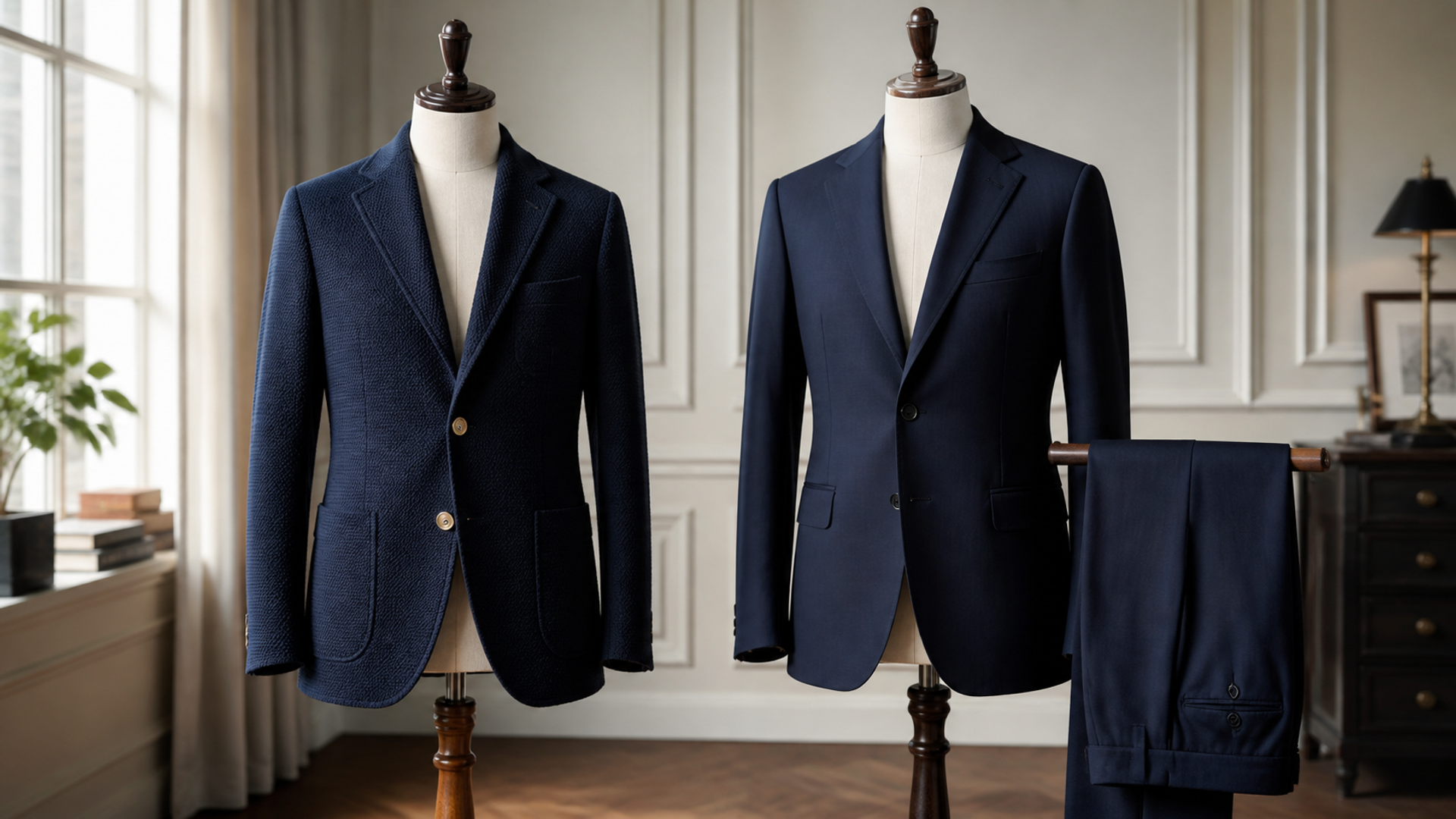
A blazer and a suit jacket can share lapels, canvas and tailoring skill, yet they are designed for different relationships with trousers. A suit jacket belongs to a matched suit cut from the same cloth and dye lot; a blazer or odd jacket is intended to stand alone with contrasting trousers. Texture, colour, pattern, pockets, buttons and structure determine whether the separation looks deliberate. Removing the trousers from a smooth navy business suit does not automatically create a versatile blazer, even if the jacket fits perfectly.
Start with the wardrobe role, not the lapel
Choose a blazer when repeat wear with contrasting trousers, knitwear and open-collar shirts is the brief. Choose a suit jacket when the matched suit's line, formality and cloth continuity matter. Commission a separate tailored jacket when neither category serves the real wardrobe: select cloth, pockets, buttons and construction specifically for separates rather than disguising an orphaned suit coat.
| Decision factor | Blazer | Suit jacket | Commission a separate tailored jacket |
|---|---|---|---|
| Relationship to trousers | Designed to contrast with separate trousers | Designed with matching suit trousers | Commission cloth and cut for separates |
| Cloth | Texture, pattern or colour can signal independence | Smooth worsted often relies on matching cloth | Choose a jacketing with enough visual identity |
| Details | Patch pockets and contrasting buttons support casuality | Flap or jetted pockets preserve suit formality | Use details that fit the dress code |
| Structure | Soft or moderate build can broaden wear | Structure is balanced with the whole suit | Fit and construction must match the wearer |
| Formality | Bridges smart casual and business separates | Creates a coherent formal business line | Do not force either into black tie |
| Alteration | Sleeves, waist and balance may be adjustable | Jacket and trousers should remain visually coherent | Major shoulder changes are rarely economic |
This blazer vs suit jacket matrix is the article's working value object. Read the blazer vs suit jacket rows together: the decisive failure mode depends on this topic's evidence, operating context and reader objective.
Cloth and construction reveal whether a jacket separates
Evidence 1. Lanieri describes the suit jacket as part of a matched set and the blazer as an independent garment with different styling and construction cues.
Evidence 2. Permanent Style explains that cloth texture, pattern, pockets and buttons help an odd jacket look separate rather than like half a suit.
Evidence 3. A navy colour alone does not make a blazer; a smooth business suiting and matching-style buttons can still read as an orphaned suit jacket.
Evidence 4. Fit remains independent of category: collar, shoulder, chest, balance, sleeve and length must work on the wearer before styling versatility matters.
Reader-visible sources checked for this article:
blog.lanieri.com — reader-visible current or official evidence
permanentstyle.com — reader-visible current or official evidence
For blazer vs suit jacket, these sources establish only the claims inside their documented scope. Recheck every changeable specification, availability condition, price, policy or service term in the relevant market before acting.
Try the jacket with real trousers and shoes
The decision changes at relationship to trousers. Choose the first path only if designed to contrast with separate trousers; move to the second when designed with matching suit trousers; use the third when commission cloth and cut for separates. Save the downside that would make this row fail.
For cloth, the first route works when texture, pattern or colour can signal independence; the second requires smooth worsted often relies on matching cloth. The control for the third is choose a jacketing with enough visual identity. Verify this row against the exact product, property, account or environment before it can reverse the decision.
The details row exposes a practical boundary. Route one assumes patch pockets and contrasting buttons support casuality, while route two is defensible only when flap or jetted pockets preserve suit formality. Route three depends on use details that fit the dress code. If that evidence is absent, keep the more reversible option.
Read structure as a stop/go test: soft or moderate build can broaden wear supports the first option; structure is balanced with the whole suit supports the second; and fit and construction must match the wearer supports the third. Record which source proves the condition and when it was checked.
A buyer can resolve formality without starting from a brand preference. Ask whether bridges smart casual and business separates; compare that with whether creates a coherent formal business line; then use do not force either into black tie as the third route's safeguard. An unknown condition stays unknown.
On alteration, popularity is not enough. The evidence for option one is that sleeves, waist and balance may be adjustable. Option two means jacket and trousers should remain visually coherent. Option three is rational where major shoulder changes are rarely economic. Recheck any changeable term immediately before commitment.
Facts that would reverse the current choice
Reversal control 1 — Relationship to trousers. Before choosing Blazer, write down how the decision changes if “Designed to contrast with separate trousers” proves false. Do the same for Suit jacket and “Designed with matching suit trousers”. Keep the Commission a separate tailored jacket route available until “Commission cloth and cut for separates” is verified. This control belongs to blazer vs suit jacket; update it from the cited source or exact supplier rather than copying a generic checklist.
Reversal control 2 — Cloth. Before choosing Blazer, write down how the decision changes if “Texture, pattern or colour can signal independence” proves false. Do the same for Suit jacket and “Smooth worsted often relies on matching cloth”. Keep the Commission a separate tailored jacket route available until “Choose a jacketing with enough visual identity” is verified. This control belongs to blazer vs suit jacket; update it from the cited source or exact supplier rather than copying a generic checklist.
Reversal control 3 — Details. Before choosing Blazer, write down how the decision changes if “Patch pockets and contrasting buttons support casuality” proves false. Do the same for Suit jacket and “Flap or jetted pockets preserve suit formality”. Keep the Commission a separate tailored jacket route available until “Use details that fit the dress code” is verified. This control belongs to blazer vs suit jacket; update it from the cited source or exact supplier rather than copying a generic checklist.
Reversal control 4 — Structure. Before choosing Blazer, write down how the decision changes if “Soft or moderate build can broaden wear” proves false. Do the same for Suit jacket and “Structure is balanced with the whole suit”. Keep the Commission a separate tailored jacket route available until “Fit and construction must match the wearer” is verified. This control belongs to blazer vs suit jacket; update it from the cited source or exact supplier rather than copying a generic checklist.
Reversal control 5 — Formality. Before choosing Blazer, write down how the decision changes if “Bridges smart casual and business separates” proves false. Do the same for Suit jacket and “Creates a coherent formal business line”. Keep the Commission a separate tailored jacket route available until “Do not force either into black tie” is verified. This control belongs to blazer vs suit jacket; update it from the cited source or exact supplier rather than copying a generic checklist.
Reversal control 6 — Alteration. Before choosing Blazer, write down how the decision changes if “Sleeves, waist and balance may be adjustable” proves false. Do the same for Suit jacket and “Jacket and trousers should remain visually coherent”. Keep the Commission a separate tailored jacket route available until “Major shoulder changes are rarely economic” is verified. This control belongs to blazer vs suit jacket; update it from the cited source or exact supplier rather than copying a generic checklist.
Audit the wardrobe
List trousers, shirts, knitwear, shoes and occasions the jacket must join. Photograph intended outfits and mark whether contrast is clear in daylight. For this blazer versus suit jacket decision, record the exact room, garment, vehicle, drink, device or configuration and the time of the check. Separate measured behaviour from category shorthand, then repeat the comparison in the intended setting rather than an ideal demonstration. If the jacket works with only its original trousers, keep it as a suit. Preserve the evidence that would reverse the choice: a material change in fit, specification, maintenance, safety, cost or environment must reopen the decision rather than inherit an old conclusion.
Read the cloth
Inspect texture, sheen, weight, pattern scale and seasonal performance at arm's length. Compare the jacket against flannel, denim, chinos and dress trousers rather than one shop mannequin. For this blazer versus suit jacket decision, record the exact room, garment, vehicle, drink, device or configuration and the time of the check. Separate measured behaviour from category shorthand, then repeat the comparison in the intended setting rather than an ideal demonstration. If cloth formality clashes with every separate, change the jacket. Preserve the evidence that would reverse the choice: a material change in fit, specification, maintenance, safety, cost or environment must reopen the decision rather than inherit an old conclusion.
Inspect construction and details
Check shoulder expression, canvas, lining, pockets, buttons, vents and edge finishing. Ask which details can be altered without unbalancing the garment. For this blazer versus suit jacket decision, record the exact room, garment, vehicle, drink, device or configuration and the time of the check. Separate measured behaviour from category shorthand, then repeat the comparison in the intended setting rather than an ideal demonstration. If converting the jacket requires multiple visible compromises, commission the right piece. Preserve the evidence that would reverse the choice: a material change in fit, specification, maintenance, safety, cost or environment must reopen the decision rather than inherit an old conclusion.
Test full movement
Wear the jacket over the thickest intended layer and sit, drive, reach and carry a bag. Check collar contact, sleeve pitch, button strain, front balance and rear vents. For this blazer versus suit jacket decision, record the exact room, garment, vehicle, drink, device or configuration and the time of the check. Separate measured behaviour from category shorthand, then repeat the comparison in the intended setting rather than an ideal demonstration. If comfort fails during the real routine, styling flexibility cannot rescue it. Preserve the evidence that would reverse the choice: a material change in fit, specification, maintenance, safety, cost or environment must reopen the decision rather than inherit an old conclusion.
Model cost per wear
Record plausible outfits, seasons, cleaning, pressing, alterations and repair over five years. Compare one versatile blazer with a suit plus a cheaper casual jacket. For this blazer versus suit jacket decision, record the exact room, garment, vehicle, drink, device or configuration and the time of the check. Separate measured behaviour from category shorthand, then repeat the comparison in the intended setting rather than an ideal demonstration. If theoretical versatility produces few actual wears, preserve budget for the correct occasion. Preserve the evidence that would reverse the choice: a material change in fit, specification, maintenance, safety, cost or environment must reopen the decision rather than inherit an old conclusion.
Four dress codes, four answers
Business-casual office
A textured navy blazer can combine authority with repeatable separates. Define the fact that would reverse this recommendation before committing.
Formal client meeting
The matched suit jacket and trousers create a cleaner line. Define the fact that would reverse this recommendation before committing.
Travel capsule
One unstructured odd jacket may cover more outfits if it resists creasing. Define the fact that would reverse this recommendation before committing.
Orphaned suit jacket
Change buttons only if cloth, cut and details already support separation. Define the fact that would reverse this recommendation before committing.
Action checklist
List occasions.
Photograph outfits.
Check trouser contrast.
Inspect cloth sheen.
Inspect pockets.
Inspect buttons.
Test thickest layer.
Check collar.
Check balance.
Price alterations.
Plan cleaning.
Count real wears.
Continue the decision
The linked VERTU articles expand adjacent parts of the blazer vs suit jacket decision. They do not substitute for the external evidence above.
The blazer-versus-suit-jacket verdict
Choose a blazer when repeat wear with contrasting trousers, knitwear and open-collar shirts is the brief. Choose a suit jacket when the matched suit's line, formality and cloth continuity matter. Commission a separate tailored jacket when neither category serves the real wardrobe: select cloth, pockets, buttons and construction specifically for separates rather than disguising an orphaned suit coat.
Keep the blazer vs suit jacket decision reversible until its material cost, safety, access, privacy and compatibility facts are verified. Unknown evidence stays unknown; it is never silently scored as favourable.