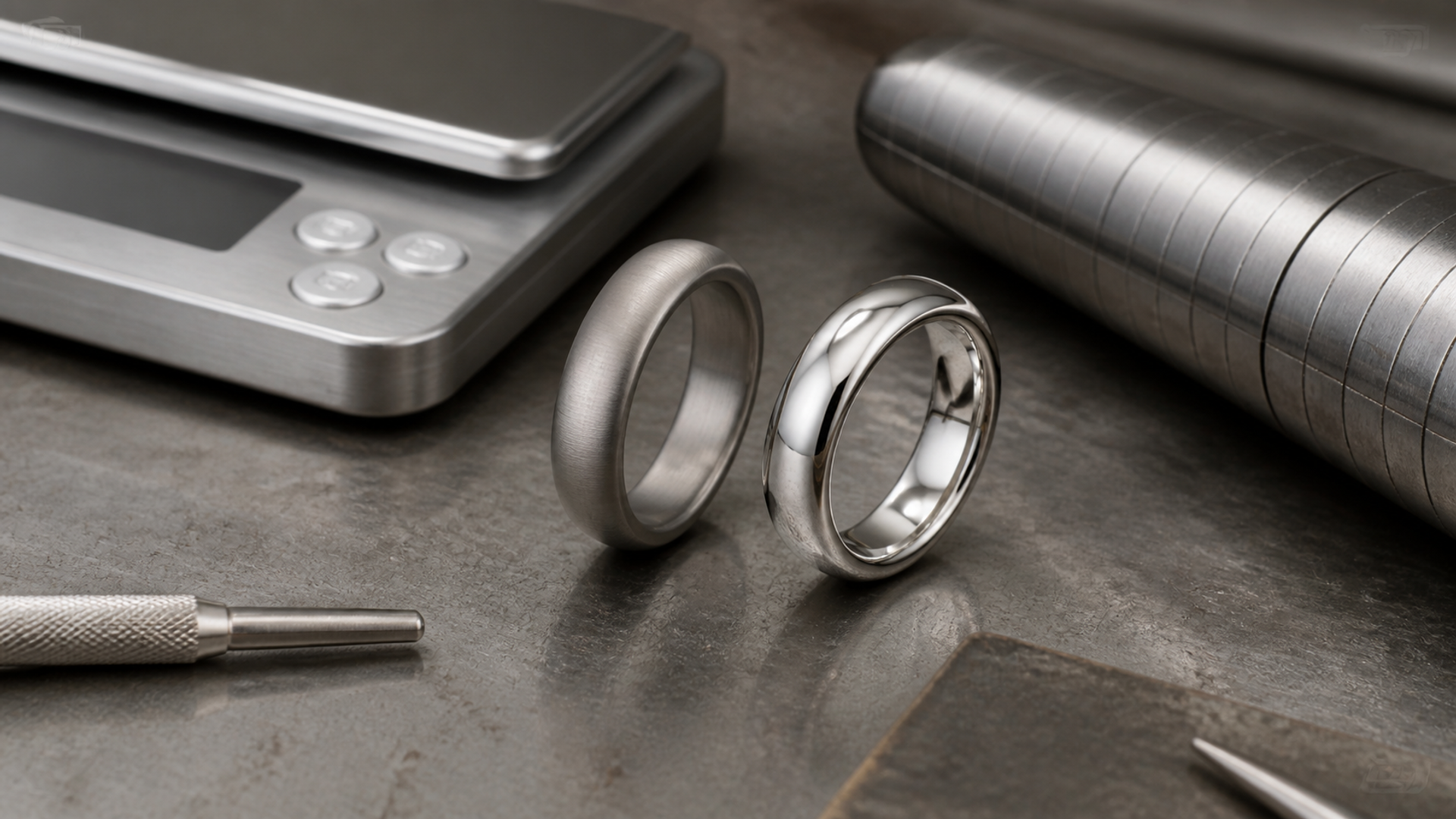
Titanium and platinum can both produce a cool grey-white ring, yet they behave very differently after purchase. Titanium is exceptionally light and usually machined; platinum is dense, precious and traditionally workable. The decisive question is not which metal is universally stronger. It is which ownership path fits the wearer's hand, budget and need for future resizing or repair.
The choice is really about reversibility
Choose titanium for minimal weight, contemporary finish and lower entry cost when the size is stable; platinum for heft, precious-metal status and long-term workshop serviceability; or postpone the final metal until a jeweller has tested width, profile and size through temperature change. Verify alloy, hallmark and workshop policy for the exact ring.
| Decision factor | Titanium ring | Platinum ring | Fit-first custom decision |
|---|---|---|---|
| Weight | A barely-there feel is preferred | Noticeable density and heft are desirable | Sample rings are worn before choosing |
| Resizing | Stable sizing and replacement risk are accepted | Conventional workshop resizing is expected | Future size uncertainty keeps the design open |
| Surface wear | A modern finish and harder feel suit the owner | Scratches and patina are accepted as part of ownership | Finish samples are compared after wear |
| Stone setting | A simple band avoids complex future work | A precious setting and repair route justify the metal | The jeweller chooses metal around the setting |
| Budget | Lower initial spend is central | Metal value and serviceability justify a premium | Total cost includes refinish, resize and replacement |
| Provenance | The exact alloy and maker disclosure are documented | Fineness and applicable hallmark are verified | Written specification precedes the order |
This titanium vs platinum ring matrix is the article's working value object. Read the titanium vs platinum ring rows together: the decisive failure mode depends on this topic's evidence, operating context and reader objective.
Material evidence and its limits
Evidence 1. FTC jewellery guides require truthful representation of precious-metal content and apply specific marking language to platinum products in the United States.
Evidence 2. Titanium ring construction is commonly machined, which contributes to different resizing and repair options from traditionally worked precious metals.
Evidence 3. Platinum's density produces substantially more mass than titanium for a similarly sized ring, so comfort cannot be inferred from dimensions alone.
Evidence 4. Scratch resistance, toughness and long-term metal loss are different properties; simple claims that one metal is 'more durable' hide the actual ownership trade-off.
Reader-visible sources checked for this article:
ecfr.gov — reader-visible current or official evidence
gia.edu — reader-visible current or official evidence
provencejewellery.com — reader-visible current or official evidence
brilliantearth.com — reader-visible current or official evidence
For titanium vs platinum ring, these sources establish only the claims inside their documented scope. Recheck every changeable specification, availability condition, price, policy or service term in the relevant market before acting.
Model a lifetime rather than a showroom
On weight, popularity is not enough. The evidence for option one is that a barely-there feel is preferred. Option two means noticeable density and heft are desirable. Option three is rational where sample rings are worn before choosing. Recheck any changeable term immediately before commitment.
The decision changes at resizing. Choose the first path only if stable sizing and replacement risk are accepted; move to the second when conventional workshop resizing is expected; use the third when future size uncertainty keeps the design open. Save the downside that would make this row fail.
For surface wear, the first route works when a modern finish and harder feel suit the owner; the second requires scratches and patina are accepted as part of ownership. The control for the third is finish samples are compared after wear. Verify this row against the exact product, property, account or environment before it can reverse the decision.
The stone setting row exposes a practical boundary. Route one assumes a simple band avoids complex future work, while route two is defensible only when a precious setting and repair route justify the metal. Route three depends on the jeweller chooses metal around the setting. If that evidence is absent, keep the more reversible option.
Read budget as a stop/go test: lower initial spend is central supports the first option; metal value and serviceability justify a premium supports the second; and total cost includes refinish, resize and replacement supports the third. Record which source proves the condition and when it was checked.
A buyer can resolve provenance without starting from a brand preference. Ask whether the exact alloy and maker disclosure are documented; compare that with whether fineness and applicable hallmark are verified; then use written specification precedes the order as the third route's safeguard. An unknown condition stays unknown.
Facts that would reverse the current choice
Reversal control 1 — Weight. Before choosing Titanium ring, write down how the decision changes if “A barely-there feel is preferred” proves false. Do the same for Platinum ring and “Noticeable density and heft are desirable”. Keep the Fit-first custom decision route available until “Sample rings are worn before choosing” is verified. This control belongs to titanium vs platinum ring; update it from the cited source or exact supplier rather than copying a generic checklist.
Reversal control 2 — Resizing. Before choosing Titanium ring, write down how the decision changes if “Stable sizing and replacement risk are accepted” proves false. Do the same for Platinum ring and “Conventional workshop resizing is expected”. Keep the Fit-first custom decision route available until “Future size uncertainty keeps the design open” is verified. This control belongs to titanium vs platinum ring; update it from the cited source or exact supplier rather than copying a generic checklist.
Reversal control 3 — Surface wear. Before choosing Titanium ring, write down how the decision changes if “A modern finish and harder feel suit the owner” proves false. Do the same for Platinum ring and “Scratches and patina are accepted as part of ownership”. Keep the Fit-first custom decision route available until “Finish samples are compared after wear” is verified. This control belongs to titanium vs platinum ring; update it from the cited source or exact supplier rather than copying a generic checklist.
Reversal control 4 — Stone setting. Before choosing Titanium ring, write down how the decision changes if “A simple band avoids complex future work” proves false. Do the same for Platinum ring and “A precious setting and repair route justify the metal”. Keep the Fit-first custom decision route available until “The jeweller chooses metal around the setting” is verified. This control belongs to titanium vs platinum ring; update it from the cited source or exact supplier rather than copying a generic checklist.
Reversal control 5 — Budget. Before choosing Titanium ring, write down how the decision changes if “Lower initial spend is central” proves false. Do the same for Platinum ring and “Metal value and serviceability justify a premium”. Keep the Fit-first custom decision route available until “Total cost includes refinish, resize and replacement” is verified. This control belongs to titanium vs platinum ring; update it from the cited source or exact supplier rather than copying a generic checklist.
Reversal control 6 — Provenance. Before choosing Titanium ring, write down how the decision changes if “The exact alloy and maker disclosure are documented” proves false. Do the same for Platinum ring and “Fineness and applicable hallmark are verified”. Keep the Fit-first custom decision route available until “Written specification precedes the order” is verified. This control belongs to titanium vs platinum ring; update it from the cited source or exact supplier rather than copying a generic checklist.
Wear the width before choosing the metal
The same internal diameter can feel different when band width, thickness, edge profile and mass change. Try representative rings through a normal day, not only for five minutes in a cool showroom. Fingers swell with heat, exercise and travel. Record the size, width and profile that remains comfortable before treating metal as the final variable.
Ask the workshop what can be reversed
Obtain written answers on resizing range, refinishing, stone tightening, engraving, repair and replacement. Titanium options may be limited or depend on remaking the ring; platinum is generally more workable but a complex design can still constrain service. The seller's actual workshop policy matters more than a generic metal article.
Separate appearance from wear history
Compare new polished, brushed and bead-blasted samples, then ask to see worn examples. Platinum can develop patina; titanium finishes can show wear differently and coated versions add another layer of service questions. Choose the ageing pattern deliberately rather than assuming a new-ring photograph will remain unchanged.
Build the lifetime-cost line
Add purchase price, likely resize, refinishing, shipping, insurance and the possibility of remaking. A low entry price can remain excellent value when sizing is stable, while a high platinum price can be rational when workshop service and sentimental continuity matter. The model should reflect the owner, not resale mythology.
Three ring-owner profiles
Minimal everyday band
Titanium fits when low weight, simple design and stable sizing dominate. Define the fact that would reverse this recommendation before committing.
Heirloom or stone-set ring
Platinum fits when workshop serviceability and precious-metal continuity justify the cost. Define the fact that would reverse this recommendation before committing.
Size or lifestyle uncertainty
A fit-first custom decision avoids locking the wearer into an irreversible design too early. Define the fact that would reverse this recommendation before committing.
Action checklist
Confirm exact alloy.
Verify fineness and hallmark claims.
Try the same width in both metals.
Ask the resizing range.
Request the repair policy.
Inspect worn finish samples.
Check stone-setting service.
Model insurance and shipping.
Record return or remake terms.
Keep the written specification.
Continue the decision
The linked VERTU articles expand adjacent parts of the titanium vs platinum ring decision. They do not substitute for the external evidence above.
Titanium or platinum: the decision
Choose titanium for minimal weight, contemporary finish and lower entry cost when the size is stable; platinum for heft, precious-metal status and long-term workshop serviceability; or postpone the final metal until a jeweller has tested width, profile and size through temperature change. Verify alloy, hallmark and workshop policy for the exact ring.
Keep the titanium vs platinum ring decision reversible until its material cost, safety, access, privacy and compatibility facts are verified. Unknown evidence stays unknown; it is never silently scored as favourable.