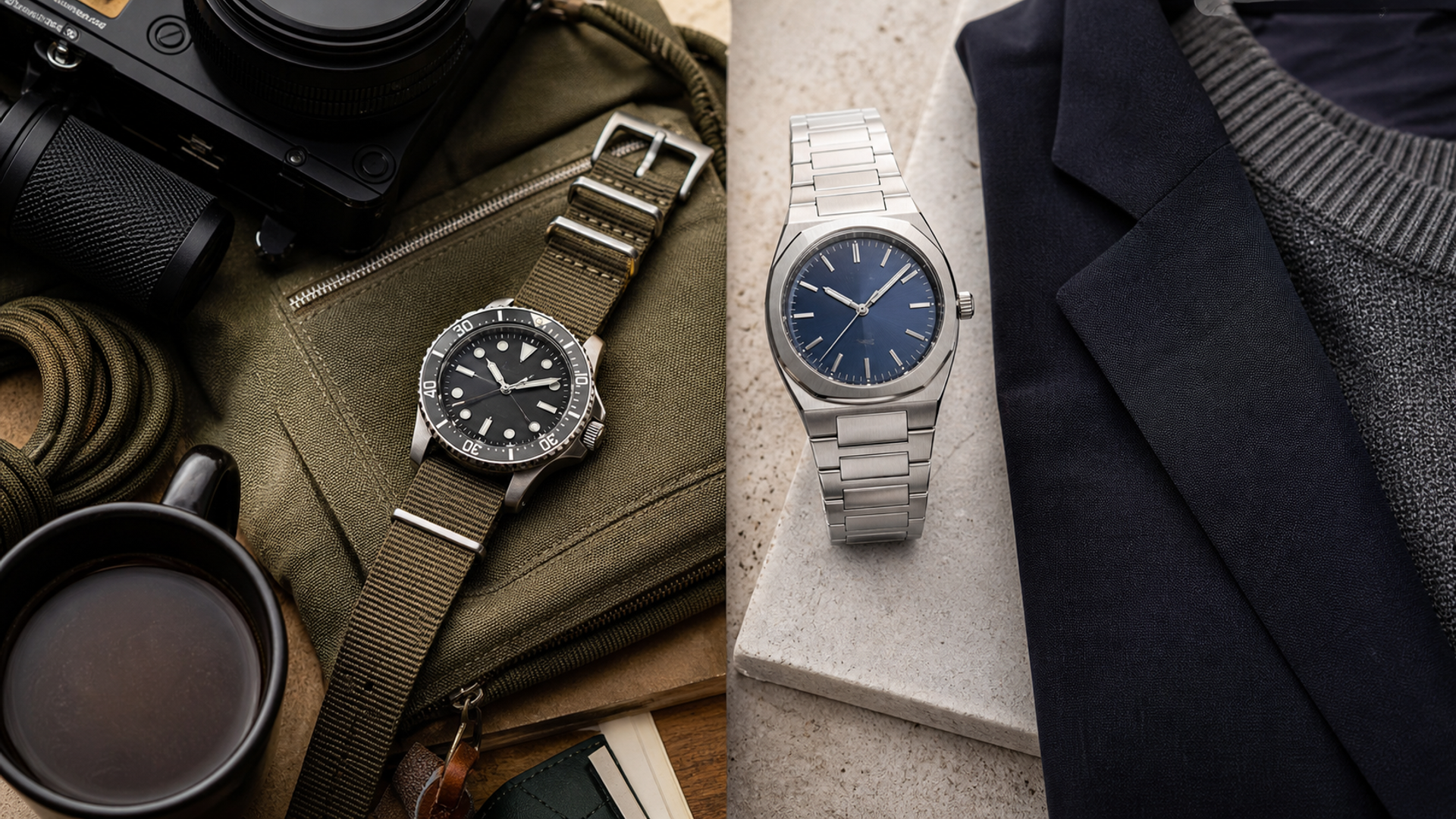
Seiko 5 Sports and Tissot PRX are often recommended to the same new collector, but they do not occupy the same rung. Seiko 5 is a broad, accessible automatic-watch family with field, SKX-inspired, GMT and everyday designs. PRX is a Swiss integrated-bracelet family offered in quartz and automatic forms, with a more architectural case and a higher price ceiling. One teaches mechanical-watch ownership with low risk; the other delivers a more finished design object.
Choose Seiko 5 if you want an automatic first watch, broad style choice, easy strap experimentation and a purchase that leaves budget for service or a second watch. Choose Tissot PRX quartz if the case-and-bracelet design matters more than owning a mechanical movement and you want grab-and-go accuracy. Choose PRX Powermatic 80 if you specifically want the integrated-bracelet look with a longer power reserve and accept the higher cost.
This is a family comparison, not a claim that every Seiko 5 beats every PRX. Both collections contain many sizes and configurations. Compare the exact references on current official pages before buying.
First-watch decision matrix
| Question | Seiko 5 Sports | Tissot PRX quartz | Tissot PRX automatic |
|---|---|---|---|
| Entry logic | Affordable mechanical ownership and many styles | Integrated-bracelet design with quartz convenience | Integrated-bracelet design plus automatic movement |
| Movement | Automatic mechanical across the core family; calibre varies by reference | Swiss quartz | Powermatic 80 on many references; other automatic and chronograph variants exist |
| Power and accuracy | Worn or wound; expect a broader mechanical accuracy range | Battery-powered and normally far more accurate over a month | Up to roughly 80 hours on named Powermatic models; verify exact calibre |
| Case and bracelet | Conventional lugs make strap changes easy; bracelet quality varies | Bracelet is central to the design; case and bracelet flow together | Same integrated-design advantage, with mechanical thickness and price |
| Style range | Field, dive-inspired, GMT, street and compact everyday models | 1970s-inspired sports-chic in many sizes and dials | Same language with more mechanical and material variants |
| Ownership risk | Lower acquisition cost; regulation and bracelet expectations should be realistic | Battery replacement and seals; less mechanical romance | Higher service cost, magnetism and accuracy expectations require context |
| Best first buyer | Curious about mechanical watches and still discovering personal taste | Wants one precise, visually distinctive daily watch | Knows the PRX design is the destination, not just a popular recommendation |
The official Seiko 5 Sports store currently groups the family into SKX, SNXS, Field and other styles. Tissot’s official PRX collection includes quartz and Powermatic 80 variants in multiple sizes, plus chronographs and special materials. This breadth makes any single-price comparison misleading.
The Seiko 5 proposition: learn cheaply, choose widely
Seiko 5’s advantage is optionality. The collection allows a buyer to discover whether they prefer a compact everyday case, a dive-inspired bezel, a field dial or GMT function without leaving the same accessible family. Conventional lugs also make straps part of the education. Leather, fabric, rubber and aftermarket bracelets can change the watch without changing the movement.
The compromise is consistency. Case finishing, bracelet feel, crystal material, water resistance and movement specification vary. Entry-level automatic movements can run within a wider daily rate than a quartz PRX. Alignment and bezel feel should be checked on the individual watch. These are not reasons to reject the collection; they are reasons to inspect the reference rather than buying the logo from a small photograph.
A Seiko 5 is a particularly good first mechanical watch if you want to observe winding, power reserve and rate variation without treating every scratch as a financial event. It can teach what “automatic” changes in daily life: the watch may stop after a period off the wrist, need its date corrected, and gain or lose time. That education is useful before spending more.
The PRX proposition: buy the design, then choose the movement
PRX is built around a case and bracelet derived from a 1978 design. The bracelet does not look added later; its broad first link and taper continue the geometry of the case. That creates much of the perceived quality and much of the fit risk. Integrated bracelets can wear wider than the nominal diameter suggests, and they offer fewer strap alternatives than conventional lugs.
Tissot currently offers quartz PRX models around the lower part of the family and automatic models with Powermatic 80 at a higher price. The US collection page showed common 40mm quartz references at $450 and 40mm automatic references around $850 when checked for this guide, but prices and stock are dynamic. Treat those as a dated US snapshot, not universal pricing.
The movement decision should follow the design decision. Quartz PRX is not a lesser-looking watch; it can be thinner, more accurate and easier to leave in a drawer. Powermatic 80 provides mechanical engagement and long enough reserve to survive much of a weekend. If you are choosing automatic only because online discussion frames quartz as inferior, buy neither until you decide what interaction you actually want.
Fit: integrated bracelets change the numbers
PRX is available in several sizes, but diameter alone does not predict fit. The first bracelet links can extend the visual length, and the flat case can show gaps on a curved wrist. A Seiko 5 with conventional lugs may articulate more quickly, although some references are thick or long in their own way.
Try three tests. First, photograph the watch from one metre away. Second, bend the wrist and check whether the case edge lifts. Third, loosen and tighten the bracelet around the size you would wear in summer. Ask whether half-links or micro-adjustment are available for the exact reference. A beautiful integrated bracelet that sits between two comfortable sizes becomes an everyday irritation.
For Seiko 5, check crown access, bezel grip where fitted and the gap between end links and case. For PRX, check whether the polished and brushed planes remain visually balanced on your wrist. Our watch-size guide provides a more reliable fitting method than copying another person’s wrist circumference.
Accuracy and power reserve without mythology
Quartz normally wins practical accuracy. A quartz PRX can be put on after days or weeks and still show the correct time, subject to battery condition. Mechanical Seiko 5 and automatic PRX models are affected by position, temperature, winding state and individual regulation. The exact manufacturer tolerance is the correct reference, not a stranger’s unusually good sample.
Power reserve is also behavioural. An 80-hour automatic reserve is valuable if you rotate the watch over a weekend and want it running on Monday. It creates little advantage if you wear the watch daily or leave it for two weeks. Seiko movements with shorter reserves may require more resets but can be familiar to independent watchmakers. Service availability should be checked locally rather than inferred from brand size.
Measure a mechanical watch over a full week using the same reference clock, including overnight positions. Do not judge it from six hours on the first day. If accuracy falls outside the published range, use the retailer or authorised service route before paying an independent regulator during warranty.
Bracelet, strap and surface wear
Seiko 5 usually wins strap flexibility. Standard lugs open a large market of options and make the watch easier to personalise. The original bracelet can be upgraded without abandoning the case design. That freedom is valuable to a beginner whose taste is still forming.
PRX wins bracelet integration. Its appearance depends on coherent brushing, taper and geometry. The cost is that damage or poor fit is harder to solve with a generic replacement. Polished surfaces can collect marks, while brushed planes show scuffs differently. Look at a pre-owned example to understand the future appearance.
Neither watch needs to remain cosmetically perfect. Avoid unnecessary polishing during routine service. Removing metal can soften edges and alter the transitions that define both cases. Clean according to the manufacturer’s water-resistance and care instructions, and have seals checked after case opening.
Service and five-year cost
A first-watch budget should include the first maintenance event. For Seiko 5 automatic, ask the local service centre for current inspection and movement-service pricing. For PRX quartz, include battery replacement, gasket testing and any bracelet work. For PRX automatic, request a current full-service estimate for the exact calibre.
Add the cost of sizing, extra links, straps and insurance only if relevant. Then divide by expected wearing days. A lower-priced watch worn twice a month can be poorer value than a higher-priced watch worn four days a week. Conversely, a PRX purchased as a trend object can become expensive if the integrated look no longer fits your style.
Resale should not be the main calculation. Common production watches are not guaranteed investments. Condition, completeness, reference demand and transaction fees matter. Keep the box, invoice, spare links and replaced parts because they preserve choice even when value does not rise.
The first-watch scorecard
Give each candidate zero to five points in these categories:
fit and comfort after fifteen minutes;
legibility in office and daylight;
movement interaction you genuinely prefer;
bracelet fit or strap flexibility;
water resistance for your routine;
local service confidence;
total five-year cost;
desire to wear it tomorrow, without thinking about resale.
Double the fit and “wear tomorrow” scores. A first serious watch should create habit, not obligation. If two references tie, choose the retailer with the better return, sizing and warranty support.
Verdict
Seiko 5 is the better first mechanical watch for experimentation. It offers broad design choice, conventional straps and a forgiving entry cost while teaching the real rhythm of an automatic movement. Tissot PRX quartz is the better first serious watch for someone who wants the integrated design, accuracy and low daily attention. PRX automatic is the better choice only when both the design and mechanical interaction are priorities worth the higher cost.
The useful comparison is therefore not Seiko versus Swiss. It is exploration versus commitment. Seiko 5 lets you learn what kind of collector you may become; PRX rewards a buyer who already knows that its case-and-bracelet architecture is the point.