A useful watch size guide needs more than a chart linking wrist circumference to case diameter. Two people with the same 17-centimetre wrist can wear the same 40-millimetre watch very differently because one wrist is broad and flat while the other is narrow and round. Two watches advertised as 40 millimetres can also fit differently because their lug-to-lug length, thickness, bezel, dial opening and strap attachment are not the same.
The best remote-buying method is therefore a sequence: measure the wrist, record its flat top width, collect the watch’s full dimensions, then judge visual scale and physical overhang separately. Diameter controls much of the first impression. Lug-to-lug length usually decides whether the case actually sits on the wrist. Thickness and centre of gravity decide whether it remains comfortable after several hours.
Quick answer:** Start with circumference, but do not buy from circumference alone. Require case diameter, lug-to-lug length and thickness; compare the lug span with the flat usable width of your wrist; then account for dial opening, bezel, case shape and how quickly the strap bends down.
The wrist-to-watch fit matrix
This matrix is a starting point, not a rule of taste. Longines’ current sizing guide uses broad diameter ranges of 32–36 mm for wrists below about 16 cm, 36–42 mm for 16–17.8 cm, and 42–46 mm above about 17.8 cm. Treat those ranges as a first filter. The second filter is the actual geometry.
| Wrist evidence | Watch evidence | Likely fit signal | What to verify next |
|---|---|---|---|
| Small circumference, narrow flat wrist | Short lug span, modest diameter, slim case | Balanced and easy to centre | Crown clearance and strap tail |
| Small circumference, broad flat wrist | Medium diameter with compact lugs | May wear larger than the circumference chart suggests | Dial opening and bracelet end links |
| Medium circumference, round wrist | Curved lugs and articulating strap | Comfortable even at a moderate lug span | Case-back shape and thickness |
| Medium circumference, flat wrist | Long straight lugs | Visually dramatic but possible overhang | Photograph from directly above |
| Large circumference, narrow top surface | Large diameter, long lugs | Can still overhang despite a large circumference | Measure wrist width, not only tape length |
| Any wrist | Integrated bracelet with rigid first links | Wears longer than the case specification implies | Effective end-link-to-end-link span |
| Any wrist | Thick case with small contact area | May rotate or feel top-heavy | Total weight and strap stiffness |
| Any wrist | Rectangular or tonneau case | Round-watch diameter charts become unreliable | Use full length and width dimensions |
Step 1: measure circumference consistently
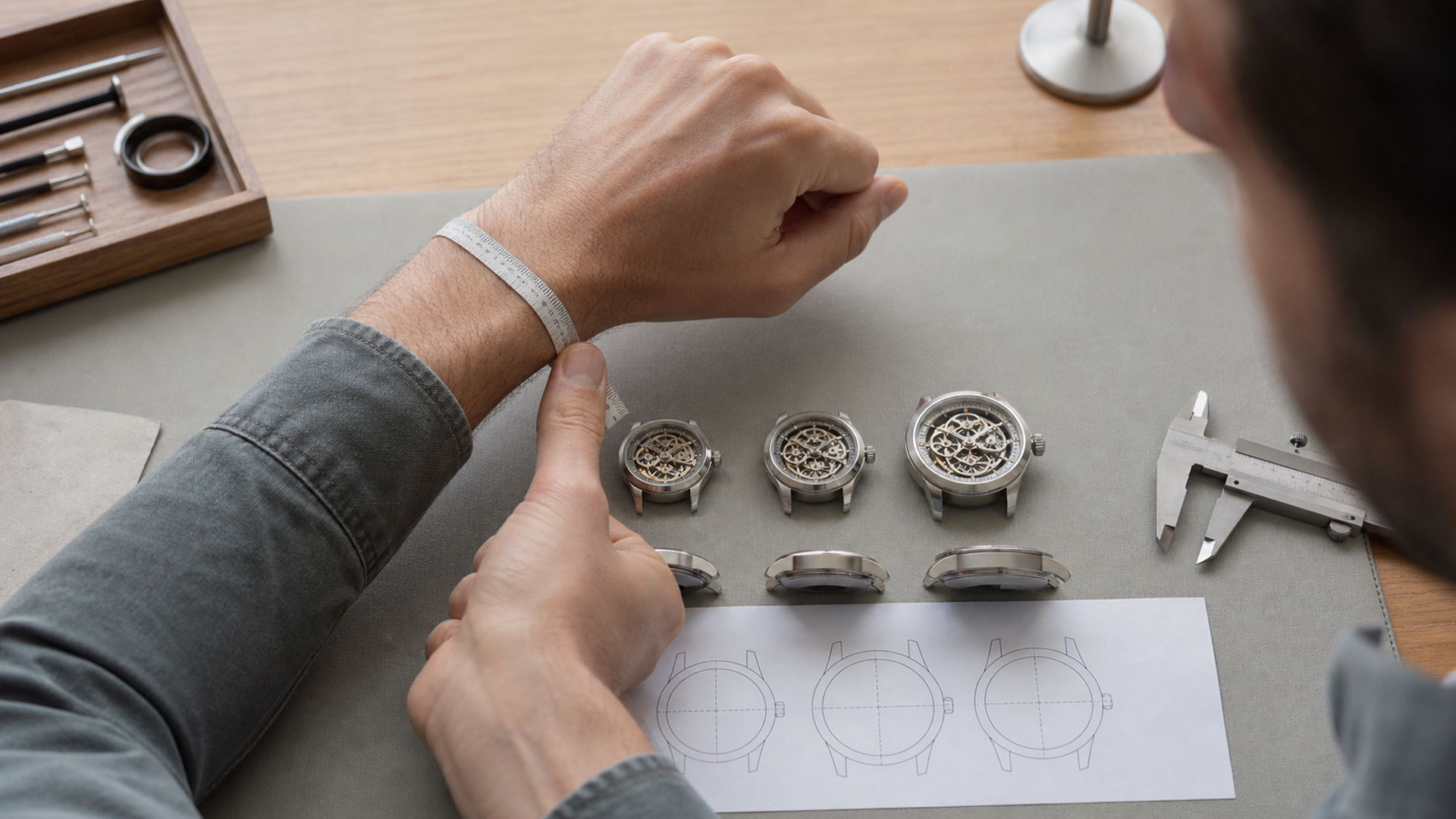
Use a soft tape at the point where the watch will sit, usually just behind the wrist bone. Keep the tape in contact with the skin without compressing it. Record the value in millimetres. If no tape is available, wrap a narrow strip of paper around the wrist, mark the overlap and measure it against a rigid ruler.
Consistency matters more than false precision. Measure at the same time of day twice, particularly if heat, travel or exercise causes the wrist to swell. A bracelet sized perfectly in a cool shop can become uncomfortable in summer. TAG Heuer’s printable sizing instructions recommend leaving enough room for an index finger when measuring for bracelet fit; that is useful for bracelet length, although personal comfort and bracelet design still control the final adjustment.
Record three states if the watch will be worn daily:
snug skin measurement;
comfortable wearing circumference;
warm-weather or post-exercise circumference.
Those values help a retailer size a bracelet with enough adjustment range. They do not determine case size by themselves.
Step 2: measure the flat top of the wrist
Look straight down at the wrist with the palm facing the floor. Measure the roughly flat surface from one edge to the other where the case will rest. This is not a medical measurement and does not need laboratory precision. It is a practical boundary for lug overhang.
A conservative fit keeps the visible tips of the lugs within that top surface. A curved lug can extend slightly farther because it follows the wrist downward; a straight lug projects its length visually and physically. The same principle applies to rigid bracelet end links: if they cannot turn down immediately, include them in the effective span.
The decisive comparison is therefore:
Effective watch length = lug-to-lug length + any non-articulating end-link extension.
Compare that with the usable top width of the wrist. If the watch length is clearly greater, request a side photograph or try the watch in person. If it is modestly smaller, the case is more likely to sit securely, although thickness and weight can still change the result.
Step 3: understand what case diameter hides
Case diameter usually excludes the crown. It is useful for round watches because it describes the broad visual scale, but it does not describe the dial. A thin bezel creates a large dial opening, making the watch look bigger. A thick diver’s bezel can make the same case diameter appear more compact. Dark dials often recede; light, high-contrast dials can appear broader.
Chronograph pushers and crown guards add visual width. A crown can also press into the hand on a short wrist, especially when the watch is worn low. Left-handed wearers or people who wear a watch on the right wrist should check whether the crown and pushers face the hand or the forearm.
Rectangular watches need both length and width. A 28 x 47 mm case cannot be translated meaningfully into a single round diameter. Tonneau and cushion cases need the same treatment: request the widest width, full case length and, if available, the lug or strap attachment span.
Step 4: account for thickness and centre of gravity
Thickness affects more than whether a cuff closes. A tall watch with a narrow case back places mass above the wrist and can roll towards the outside of the arm. A broad, curved case back can distribute the same weight more comfortably. Domed crystals, protruding bezels and case-back sensors may be included differently in specifications, so ask whether the published thickness is total height.
For formal wear, test the actual shirt cuff rather than relying on a generic “dress watch” label. A watch can be slim but catch the cuff because its bezel or crown is sharp. A thicker sports watch may slide more easily if its profile is rounded.
Weight interacts with strap choice. A heavy case on a thin, flexible strap can move. A stiff new leather strap can hold the case awkwardly above the wrist until it breaks in. A bracelet distributes mass but may need half-links or micro-adjustment to avoid being either tight or loose.
The remote-buying proportionality worksheet
Before purchasing without a fitting, collect this complete set. A retailer who supplies only diameter has not given enough information for a confident fit decision.
| Measurement | Your value | Watch value | Fit question |
|---|---|---|---|
| Wrist circumference | ___ mm | — | Is the strap or bracelet range sufficient? |
| Comfortable wearing circumference | ___ mm | — | Is there adjustment for heat and movement? |
| Flat wrist width | ___ mm | — | Will the lugs stay on the top surface? |
| Case diameter or width | — | ___ mm | Does the visual scale suit the intended style? |
| Lug-to-lug length | — | ___ mm | Is it shorter than the usable wrist width? |
| Rigid end-link extension | — | ___ mm | Does it increase the effective span? |
| Total thickness | — | ___ mm | Will it clear the cuff and remain stable? |
| Case and bracelet weight | — | ___ g | Is the mass proportionate to the contact area? |
| Strap taper and first bend | — | ___ | Can the strap turn down soon enough? |
| Return or exchange window | — | ___ days | Can fit be corrected without forcing the decision? |
Create a paper silhouette of the case using the published width and lug-to-lug measurements. Place it on the wrist and photograph it from directly above at normal camera distance. This cannot simulate thickness or curved lugs, but it is more honest than enlarging a product image until it “looks right”. Avoid wide-angle close-ups, which exaggerate the watch and narrow the wrist.
Why 36 mm, 40 mm and 42 mm are not identities
Online debate often treats diameter as a category of person: 36 mm is “classic”, 40 mm is “universal”, 42 mm is “sporty”. Those labels can be useful shorthand, but they are not fit evidence. A 42 mm watch with a short 47 mm lug span can fit more securely than a 40 mm watch with 51 mm straight lugs. A 36 mm watch with a broad bright dial can have more visual presence than a 39 mm diver with a thick bezel.
Style also changes the goal. A vintage-inspired dress watch may be intentionally discreet. A contemporary sports watch may be intentionally assertive. The fit line is not whether another collector approves of the diameter; it is whether the case stays centred, the lugs do not create unwanted overhang, the crown does not injure the hand and the watch can be worn for the intended duration.
For readers specifically shopping a smaller fit, VERTU’s existing guide to buying luxury watches for smaller wrists addresses product-selection context. This page owns the measurement method. The VERTU watch collection can then be filtered with the dimensions rather than by appearance alone.
Strap, bracelet and clasp effects
Leather and fabric straps usually articulate close to the lugs, which can make a long case more wearable on a rounded wrist. Thick padding can resist that bend. Rubber straps vary: some drop vertically, while others flare from the case and increase the effective width.
Bracelets require three additional checks:
Do the first end links articulate or remain fixed?
Are half-links available near the clasp?
Does the clasp provide tool-free or fine micro-adjustment?
A perfect case with an impossible bracelet is not a good fit. Conversely, precise micro-adjustment can make a substantial watch comfortable across temperature changes. Ask for the minimum bracelet circumference after removable links are taken out, especially on a small wrist.
The five-minute fitting test
When the watch is available in person, resist the mirror-only test. Fasten it to normal wearing tension and perform five checks:
Look from directly above: are the lugs visibly on the wrist?
Turn the wrist sideways: does the case back sit in contact or bridge above the skin?
Bend the hand backwards gently: does the crown or case edge press into the hand?
Walk for two minutes: does the watch rotate or migrate?
Put on the intended jacket or shirt: does the cuff catch?
Then take one photograph from normal viewing distance. Wrist shots taken inches from the case distort proportion. If the decision remains uncertain, wear the watch for longer in the shop rather than trying to reason from a single number.
Sources and verification
Sources were checked on 22 July 2026. Manufacturer ranges are guidance, not universal ergonomic standards. Confirm the exact dimensions and return terms for the individual watch.
Final decision
The right watch size is not the largest diameter a wrist can carry or the smallest diameter a forum calls elegant. It is the geometry that supports the intended style without creating overhang, instability or pressure. Measure circumference for the strap, flat wrist width for the case, lug-to-lug for physical fit and thickness for stability. Once those facts are known, diameter becomes what it should be: a style decision made inside a workable fit envelope.