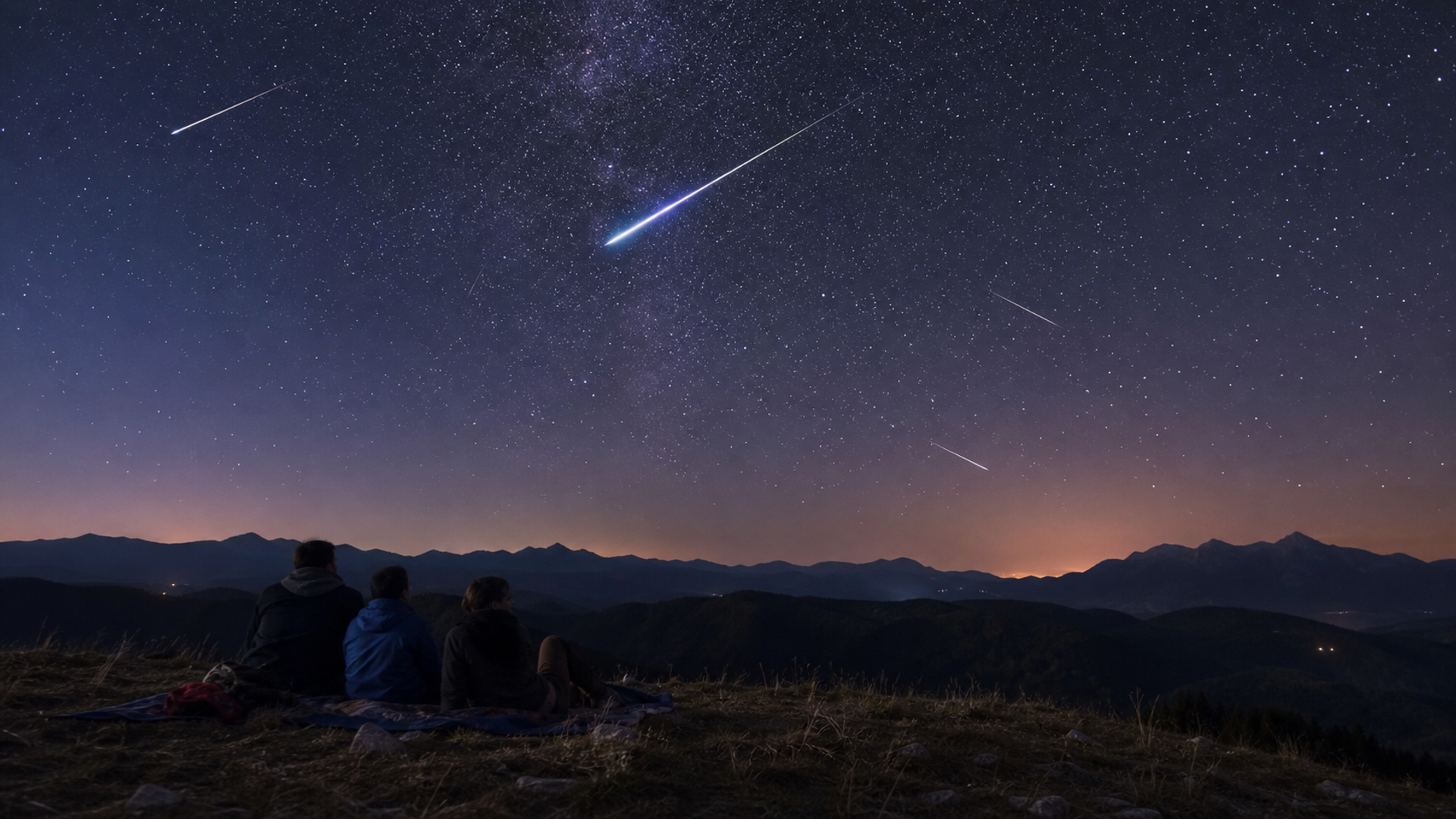
The Perseid meteor shower is active now and is expected to peak on the night of 12–13 August 2026. This year’s timing is unusually favourable because the peak falls close to a new Moon, reducing moonlight that can wash out fainter meteors. Under a genuinely dark, clear sky, experienced forecasts put the theoretical zenithal hourly rate near 90–100. Most observers will see fewer because of light pollution, cloud, horizon obstruction and the time spent looking away.
You do not need a telescope. The best equipment is a dark location, a wide view of the sky, enough time for your eyes to adapt and a safe way to remain comfortable after midnight.
The practical plan is simple: arrive before the strongest viewing period, face away from local light, allow at least 20 minutes for dark adaptation and watch a broad area rather than staring at the constellation Perseus.
Perseids 2026 at a glance
| Decision | 2026 planning answer | Why it matters |
|---|---|---|
| Peak | Night of 12–13 August; NASA’s technical forecast gives a maximum near 14:09 UTC on 13 August | Local night and dawn determine whether the theoretical maximum is visible |
| Best general hours | Late evening through pre-dawn, usually improving after midnight | The shower’s radiant rises and the observer’s side of Earth turns into the stream |
| Moon | Near new Moon | Darker skies make fainter meteors easier to see |
| Direction | Use the darkest, widest sky; do not stare directly at Perseus | Longer trails often appear away from the radiant |
| Equipment | Eyes, reclining seat, warm layers, red light | Telescopes narrow the field too much |
| Session length | At least 60–90 minutes | Meteor activity arrives in bursts and dark adaptation takes time |
| Photography | Tripod, manual control or night mode, repeated wide exposures | One perfect timed shutter press is unlikely to catch a meteor |
NASA’s 2026 meteoroid-environment forecast places the Perseid maximum at 14:09 UTC on 13 August with a forecast zenithal hourly rate of 92. NASA’s summer skywatching article describes the 12–13 August peak. Current coverage confirms that the shower is already under way, but the peak remains weeks ahead.
What “up to 100 meteors per hour” really means
The quoted rate is not a promise to an observer in a city park. Zenithal hourly rate is a standardised estimate for ideal conditions: the radiant overhead, excellent darkness and unobstructed sky. Real viewing conditions reduce the count.
If the radiant is low, trees block half the sky and nearby lights prevent full dark adaptation, a person may see a small fraction of the theoretical rate. Cloud can reduce it to zero. A bright phone screen can temporarily hide fainter meteors.
A satisfying session should not be judged minute by minute. Meteors arrive unevenly. Ten quiet minutes can be followed by several bright trails. Stay long enough for the sky to produce a representative sample.
Best viewing windows by region
The precise strongest local period depends on longitude, latitude and weather, but the broad rule is to watch from late evening into the pre-dawn hours of 13 August.
| Region | Suggested local window | Planning note |
|---|---|---|
| United Kingdom and Western Europe | Late 12 August through pre-dawn 13 August | Choose a dark northern or rural horizon and bring warm layers |
| US and Canada | Late 12 August through pre-dawn 13 August | Western and rural sites may offer excellent darkness; smoke and weather can change plans |
| Middle East | After midnight to pre-dawn 13 August | Heat, dust and haze can matter as much as artificial light |
| Singapore and Hong Kong | Late night to pre-dawn if cloud allows | Dense light pollution makes a darker coastal or rural site valuable |
| India | After midnight into early 13 August | Monsoon cloud is the main uncertainty in many regions |
| Australia | The Perseid radiant is less favourably placed than in the Northern Hemisphere | Use a local astronomy source and manage expectations; other showers may be better |
Do not convert the UTC maximum mechanically into a single “best minute”. The shower lasts for weeks and remains strong around the peak. If 12–13 August is cloudy, try the nights immediately before and after.
How to choose the location
Open a light-pollution map and weather forecast, then apply a safety filter. The darkest point is not automatically the best if access is unsafe, the road is restricted or there is no reliable mobile coverage.
Look for:
a broad, unobstructed sky;
distance from direct street lamps and car parks;
legal after-dark access;
stable ground for chairs or tripods;
safe parking and a clear return route;
forecast cloud, humidity, wind and smoke;
permission for parks, estates or private land;
a companion or check-in plan for remote sites.
Arrive before full darkness if the location is unfamiliar. Identify cliffs, water, traffic, animals and trip hazards. Do not cross barriers for a marginally darker horizon.
A nearby dark site you can reach safely may outperform a theoretically perfect location that consumes half the night in travel.
Where to look
The Perseids appear to radiate from the constellation Perseus, which gives the shower its name. That does not mean every meteor appears inside Perseus. Trails farther from the radiant can look longer and more dramatic.
Lie back and watch a wide area roughly halfway between the horizon and directly overhead. Face the darkest portion of the sky and move direct lights behind you. If a nearby town creates a bright glow in one direction, turn away from it.
Use a stargazing app only to orient yourself, then dim or lock the phone. A red-light mode helps preserve dark adaptation, but any bright screen will reduce sensitivity.
Your eyes need time. In the first minutes, only bright stars and meteors may be visible. After 20–30 minutes, the sky becomes richer. Looking at a white screen resets part of that progress.
A 90-minute viewing plan
T–20 minutes: Arrive, secure the site, set out chairs and add warm layers. Finish navigation and messages before dark adaptation.
T0–20 minutes: Put devices away. Learn the dark horizon and allow vision to adapt. Do not worry if the first period is quiet.
T20–60 minutes: Watch continuously. One person can call out the time and direction of bright meteors without everyone reaching for a phone.
T60–75 minutes: Take a short movement and warm-drink break without using bright light.
T75–90 minutes: Resume watching. Decide whether cloud, fatigue and activity justify staying longer.
If driving afterwards, safety takes precedence over the peak. A tired observer should rest or use alternative transport.
Weather can defeat the calendar
Cloud forecast is the most important last-minute signal. Check hourly cloud cover rather than the daily weather icon. High thin cloud can reduce contrast even when no rain is forecast.
Humidity and dew affect comfort and camera lenses. Bring a lens cloth and avoid breathing directly onto cold glass. Wind can shake tripods and make a mild temperature feel much colder.
Wildfire smoke, dust or urban haze can obscure faint meteors. In affected regions, air-quality guidance may also make outdoor viewing unwise.
Create a primary and backup site separated enough to have different cloud or light conditions, but do not spend the peak driving between them. Make the decision before dark adaptation begins.
What to bring
The essential kit is modest:
reclining chair or insulated ground mat;
layered clothing, hat and blanket;
water and a simple warm drink;
red-light torch;
charged phone with offline map;
insect protection appropriate to the location;
small first-aid kit;
portable battery stored and used according to manufacturer guidance;
tripod only if photographing.
Binoculars and telescopes are poor meteor tools because they show a narrow field. They can enrich the evening by revealing other objects before the main session, but put them down when meteor watching begins.
Avoid loud audio and bright torches that disturb other observers. A good dark site is a shared resource.
Photographing without missing the shower
Photography and watching compete for attention. Set the camera or phone to run repeated exposures, then return your eyes to the sky.
Use a sturdy tripod, clean the lens, disable flash and frame a wide sky with a small landscape anchor. Manual-camera users can begin with a wide aperture, high but controlled ISO and an exposure short enough to keep stars reasonably sharp. Phone users should use a supported manual mode, astrophotography mode or repeated night exposures rather than hand-holding.
Our phone astrophotography setup for the Perseids provides a settings and failure-diagnosis matrix. It avoids promising that every phone’s “night mode” behaves the same way.
How to identify a Perseid
Trace the meteor’s path backwards. If it points towards Perseus, it is likely a Perseid. A meteor moving in another direction may belong to a different shower or be a random sporadic meteor.
Satellites usually move steadily for many seconds. Aircraft blink and follow a persistent path. Meteors appear suddenly and cross part of the sky in a fraction of a second or a few seconds; a bright one may leave a glowing train.
Do not assume every streak in a long-exposure image is a meteor. Aircraft lights and satellites can create lines. Multiple frames and visual observation help classify the result.
If the peak night is cloudy
The Perseids build and decline around the peak rather than switching on for one evening. Try a nearby clear night, preferably after midnight. The rate may be lower, but a dark transparent sky can produce a better experience than the nominal peak under cloud.
Use the cancelled session to scout a site, practise camera controls or plan a future shower. NASA’s meteor facts page explains why annual showers recur as Earth passes through debris streams.
Do not chase distant gaps in severe weather. Meteor watching is optional; safe travel is not.
The verdict
For the Perseids 2026, plan around the night of 12–13 August, favour the post-midnight to pre-dawn period, and prioritise dark sky over specialised equipment. The near-new-Moon conditions make this a promising year, but local cloud and light pollution will determine the actual count.
Give the sky at least an hour, protect your dark adaptation and look broadly rather than directly at Perseus. Choose a safe site with a backup weather plan. If you photograph, automate the camera so the screen does not replace the experience.
The peak is a window, not an appointment. A patient observer under a clear dark sky has the best chance of seeing why the Perseids remain the Northern Hemisphere’s most anticipated summer meteor shower.