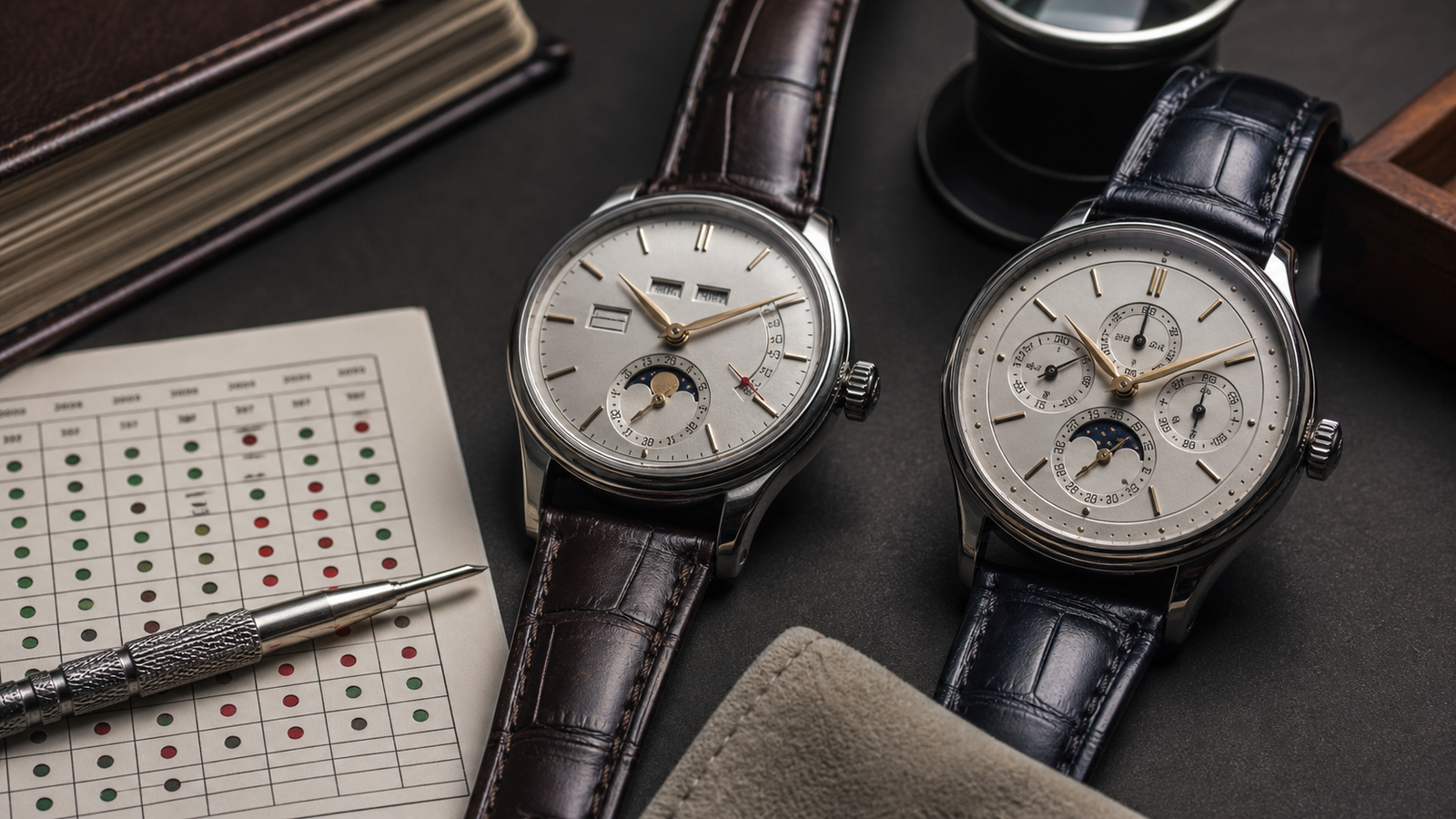
The central difference in COSC vs METAS vs Superlative Chronometer is the object being tested. Standard COSC chronometer certification tests the mechanical movement before it is cased. METAS Master Chronometer certification starts with an ISO 3159-qualified movement and then tests the completed watch for rate, magnetic resistance, power reserve and water resistance under a system independently monitored by Switzerland's Federal Institute of Metrology. Rolex first sends its movements to COSC, then applies its own Superlative Chronometer tests to the finished watch.
Their rate tolerances are not a simple strictness ladder. COSC's familiar mechanical-movement range is −4/+6 seconds per day. Rolex publishes a tighter finished-watch target of −2/+2 seconds per day. METAS requires a non-negative average daily rate, but its ceiling is +5, +6 or +7 seconds per day depending on movement-size category—not +5 for every watch. METAS also specifies exposure to 1.5 tesla, or 15,000 gauss; Rolex's strengthened 2026 certification adds resistance to magnetism, reliability and sustainability, but its public announcement does not state a directly comparable magnetic-field threshold.
For a buyer, COSC is a valuable independent precision baseline, METAS is the most transparent broad finished-watch protocol of the three, and Superlative Chronometer is a demanding Rolex-specific system with the tightest published average-rate window here. None proves that a used watch remains within specification today, and none replaces inspection, service history or a current water-resistance test.
The first distinction: movement certificate or finished-watch certificate
A mechanical movement can perform differently after it is fitted with a dial and hands, cased, sealed and attached to an automatic winding system. Casing can alter rate; a complete watch also introduces claims that a bare movement cannot prove, including water resistance, usable power reserve and performance after magnetic exposure.
The standard COSC Chronometer Certified process is movement testing. Each movement is individually identified and timed through position and temperature changes. That is meaningful independent evidence about the calibre, but it does not by itself pressure-test the assembled case or verify the watch's final winding efficiency.
The METAS Master Chronometer programme is a certification of the watch head—the completed watch without the strap or bracelet. The manufacturer's approved laboratory tests every movement and watch; METAS audits the quality system, analyses results and performs sample checks. This is independent certification and monitoring, not a claim that a METAS employee personally conducts every production measurement.
Rolex uses both stages. Its movement receives official chronometer certification, then Rolex tests the assembled watch under its own Superlative Chronometer protocol. Current Rolex product specifications describe the result plainly as “official chronometer certification + Rolex certification after casing”. The external and in-house layers should not be collapsed into one.
Side-by-side certification protocol, tolerance and buyer relevance
The table covers the ordinary mechanical-watch programmes named in the title. It does not apply COSC's mechanical tolerances to quartz watches, and it does not assume that every brand's separate house standard is equivalent.
| Test question | COSC Chronometer Certified | METAS Master Chronometer | Rolex Superlative Chronometer | Buyer relevance |
|---|---|---|---|---|
| Who defines or certifies it? | COSC, an official neutral Swiss authority, under ISO 3159 for balance-spring wristwatch movements | METAS defines the N001 requirements, certifies compliance, audits the applicant's laboratory and performs statistical monitoring plus sample checks | Rolex defines and runs the finished-watch protocol; the movement is first COSC-certified. Rolex says the strengthened certification is strictly controlled by independent Swiss entities | Independent scope matters, but so does transparency about who performs each production test |
| What is physically tested? | The individual movement before casing | Every qualifying movement and completed watch head in final sale configuration | Every completed Rolex after its COSC-certified movement is cased; 2026 additions also apply through design and manufacturing stages | A movement certificate cannot directly prove case water resistance or final assembly performance |
| Published timing protocol | 15 days; five positions; temperatures of 8°C, 23°C and 38°C; seven eliminating criteria | Multiple cycles on the final watch, including four daily-rate simulations, six-position instantaneous-rate checks at full wind and at one-third reserve remaining | Rolex states that finished-watch testing simulates conditions of wear; its public consumer pages do not disclose an equivalently complete cycle schedule | Detailed protocols make unlike claims easier to compare; unpublished detail should not be invented |
| Published average-rate tolerance | −4 to +6 seconds per day for the standard mechanical wristwatch test | 0 to +5 s/day for category 1a, 0 to +6 for 1b, and 0 to +7 for category 2; categories depend on movement fitting diameter and surface | −2 to +2 seconds per day after casing | Rolex has the tightest stated two-sided window here; METAS avoids an average losing rate but gives smaller movements a higher positive ceiling |
| Positions and temperature | Five static positions and three temperatures | Six-position instantaneous measurements; daily-rate simulation includes different positions at 23°C and 33°C | Rolex describes simulated wear conditions but does not publish the full position-and-temperature sequence on the current consumer page | Position spread can explain why a watch behaves differently on the wrist and on a bedside table |
| Magnetic resistance | Temperature and position testing are central; the standard COSC process compared here does not certify the completed watch to 15,000 gauss | Movement and watch are exposed to 1.5 T / 15,000 G; they must not stop, and the post-exposure daily-rate change is limited to 5 s/day | Rolex added resistance to magnetism as a certification criterion in 2026, but the public page reviewed gives no field strength or acceptance number | METAS supplies the clearest numeric anti-magnetism evidence. Do not translate Rolex's new criterion into 15,000 gauss without a source |
| Power reserve | Not a finished-watch power-reserve validation | Watch must still operate for the manufacturer's declared reserve; rate is also checked at reduced reserve | Declared autonomy is validated on the finished watch | Useful for owners who rotate watches or expect the stated reserve to survive normal downtime |
| Water resistance | Not established by the uncased movement test | Finished watch undergoes an overpressure sequence based on its declared rating plus a condensation check | Waterproofness is tested on the finished watch | Certification evidence at manufacture is not proof that ageing seals remain watertight years later |
| Self-winding | Not a final watch-level test | The public N001 acceptance table focuses on rate, magnetism, reserve and water resistance rather than a separately named winding-efficiency criterion | Self-winding performance is one of Rolex's finished-watch pillars | Relevant to real-world reserve, but buyers should compare what is explicitly tested rather than a marketing summary |
| Breadth and availability | Used by many Swiss brands and therefore useful as a cross-brand baseline | Open to all qualifying Swiss Made brands with an ISO 3159-certified movement and an approved process | Exclusive to Rolex watches | Cross-brand comparability favours COSC and METAS; brand-specific integration favours Rolex within its own catalogue |
| What it does not prove | Current finished-watch condition, water resistance, magnetic immunity or future accuracy | Decades of durability, finishing quality, shock resistance in every use, service quality or resale value | Publicly comparable thresholds for every 2026 pillar, future condition, or superiority in craft and collector value | Certification answers defined test questions; it is not a universal quality score |
What COSC actually measures over 15 days
COSC's process is more substantial than one average-rate number. The official test sequence uses five positions—three vertical, dial up and dial down—and three temperatures. The movement is wound and measured in 24-hour cycles. COSC then assesses seven criteria, including mean rate variation, the greatest rate difference, horizontal-versus-vertical difference, temperature response and rate resumption.
The −4/+6 seconds-per-day figure is the permitted average daily rate for the standard mechanical wristwatch test, not a promise that the movement gains exactly six seconds or less on every individual day in every possible position. The other criteria exist because stability matters. A movement with a respectable average but wild positional swings is not equivalent to one that remains regular.
COSC is also independent and individually traceable. The movement receives a unique identification and COSC issues a certificate to the brand. Buyers should know the access limitation: COSC says the analytical results belong to its client, the watch company, and COSC cannot disclose them directly to a retail buyer. Supplying the paper certificate or detailed results is the brand's choice.
That makes COSC particularly useful when comparing movements across manufacturers. It proves that an independently tested movement cleared an established Swiss chronometer standard at a defined moment. It does not prove that the case, crown, gaskets or bracelet were part of that examination.
What METAS adds—and why “0/+5” needs a footnote
METAS N001 begins with a qualification gate: the watch must be Swiss Made, and its movement must satisfy ISO 3159 chronometer criteria through an ISO/IEC 17025-accredited laboratory. COSC is the familiar way to achieve that movement-level foundation, but the current requirement is written around accredited ISO compliance rather than naming COSC as the only possible laboratory.
The final watch then enters cycles that test much more than static rate. The METAS N001 protocol exposes the movement and watch to a 1.5-tesla magnetic field, measures the daily-rate change, simulates wear in different positions and temperatures, checks instantaneous rate in six positions at different states of wind, verifies the declared power reserve and tests water resistance against the declared pressure.
The popular shorthand “Master Chronometer means 0/+5” is incomplete. Version 1.2 divides watches by movement fitting size. Category 1a must average between 0 and +5 seconds per day, category 1b between 0 and +6, and category 2 between 0 and +7. The categories also have different limits for positional spread and rate change across power states. A buyer comparing exact references should therefore consult the brand's result or certificate rather than applying the largest-calibre tolerance to every watch.
METAS's organisational model also deserves precision. The applicant or its authorised laboratory tests the full production lot. METAS is the certifying body: it approves and audits the quality system, receives results for statistical analysis and performs sample checks. That structure combines production-scale testing with independent metrological oversight.
What Rolex Superlative Chronometer adds after COSC
Rolex's sequence starts with the same movement-level concept: an individual movement goes to COSC. After casing, Rolex measures the finished watch to a published −2/+2 seconds-per-day tolerance and verifies waterproofness, self-winding and power reserve. The green seal denotes the status, and current Rolex specifications couple it with the brand's five-year international guarantee.
The critical comparison is scope, not just the smaller number. Rolex's ±2-second range applies after casing, while COSC's −4/+6 range applies to the movement. Rolex's test is brand-specific and conducted using equipment and methods developed inside the manufacture. That allows close integration with its cases, calibres and winding systems, but it is not a cross-brand certification available to another watchmaker.
In 2026, Rolex strengthened Superlative Chronometer certification with three additional criteria: resistance to magnetism, reliability and sustainability, implemented during design and manufacturing. These supplement precision, waterproofness, self-winding and power reserve on the finished watch. The update is material, but its public page does not disclose a magnetic flux density, duration, reliability cycle or numeric sustainability threshold. It would therefore be inaccurate to call it equivalent to METAS's 15,000-gauss test—or weaker—on the available public evidence.
Rolex's current precision explanation confirms the two-stage logic: −4/+6 seconds per day at the movement-certification stage, followed by −2/+2 after casing under a protocol intended to simulate wear. This makes Superlative Chronometer strong evidence about the factory state of a finished Rolex, while leaving the usual ownership caveat: shock, magnetism, wear, intervention and lubrication ageing can change performance later.
Which certification should a buyer value most?
Value COSC when you want a neutral, established and portable precision baseline across Swiss brands. It is especially useful when two watches use different calibres and one maker supplies no transparent house standard. The limitation is equally clear: ordinary COSC certification primarily tells you about the movement at certification, not the fully assembled watch in its present condition.
Value METAS when magnetic exposure, water resistance, declared reserve and final-watch performance are material to your use. Its published protocol lets a technically minded buyer see the test cycles and category limits. Do not reduce the entire system to anti-magnetism, however; the integration of rate, reserve and pressure testing is the more complete story.
Value Superlative Chronometer when buying a Rolex because it is the relevant system for that finished product. The ±2-second tolerance is easy to understand, and the post-casing checks cover practical ownership functions. It is not a neutral way to rank Rolex against every METAS-certified watch, because the protocols disclose different details and test different acceptance criteria.
Certification should sit inside the broader purchase, not replace it. A first-time buyer also needs a realistic five-year watch ownership budget for service, insurance, straps, storage and water-resistance checks. A tighter factory rate does not offset poor fit, missing service support or an ownership cost that makes the watch uncomfortable to wear.
The collector's verification checklist
Before treating a dial inscription or product-page badge as evidence, record the following:
Exact reference and production period. Standards evolve; Rolex's 2026 additions should not be backdated to every older watch without evidence.
Exact certification name. “Chronometer”, “Master Chronometer” and “Superlative Chronometer” are not interchangeable.
Object tested. Ask whether the evidence covers the movement, watch head or finished watch.
Published tolerance and category. For METAS, establish the applicable size category rather than assuming 0/+5.
Serial-linked evidence. Request the brand certificate, result access or documentation available for that reference; COSC does not release client results directly to buyers.
Service and intervention history. Regulation, movement replacement, casing work and magnetism after certification can alter performance.
Current rate observation. For a used watch, compare it with a reliable time reference over several days and positions; a timegrapher reading is useful but not identical to on-wrist performance.
Current water-resistance evidence. A factory pressure test does not make gaskets permanent. Obtain a model-appropriate current test before water use.
Intended use. Decide whether magnetic resistance, reserve, water exposure or maximum rate precision actually matters to your routine.
Certification is evidence, not a lifetime guarantee
COSC itself compares chronometer status to a qualification earned at a particular moment: the title remains, although performance can change. That is the right way to read all three systems. They preserve evidence of a test outcome; they do not freeze a mechanical object in factory condition.
The most useful conclusion in COSC vs METAS vs Superlative Chronometer is therefore not that one badge always wins. COSC gives an independent movement baseline. METAS publishes a broad, independently monitored finished-watch protocol with numeric magnetic resistance. Rolex combines COSC with a tighter in-house finished-watch rate target and a strengthened 2026 set of brand-specific criteria. Choose the evidence that matches your intended use, then verify the condition of the actual watch you are buying.