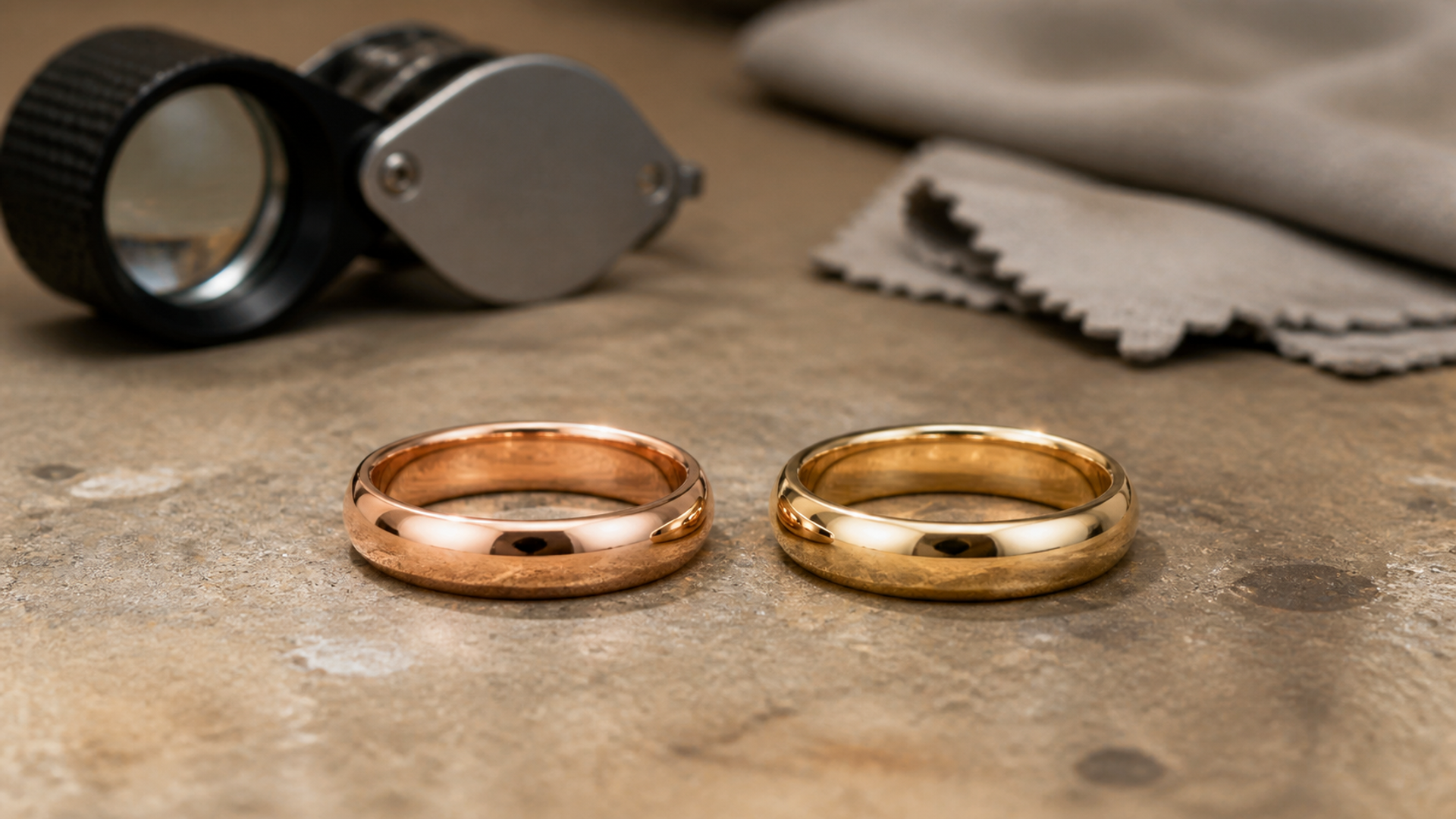
Rose gold and yellow gold are both gold alloys, not different levels of luxury. Karat states the proportion of gold; the remaining metals create colour and change hardness, wear behaviour and possible skin response. Rose gold typically gains its pink tone from copper, sometimes with silver, while yellow-gold alloy recipes are designed to preserve a classic warm colour. Comparing 14K rose with 18K yellow confuses colour with purity. The useful comparison holds karat, construction and intended wear as constant as possible, then examines the exact piece.
Hold karat constant before comparing colour
Choose rose gold when its blush colour, stronger copper contribution and interaction with the stone fit the wearer. Choose yellow gold when a classic warm appearance, cultural continuity or easier visual matching with an existing collection matters. Compare the exact alloy and piece when sensitivity, solder, plating, hollow construction or repairability could reverse a colour preference.
| Decision factor | Rose gold | Yellow gold | Compare the exact alloy and piece |
|---|---|---|---|
| Gold content | Compare at the same stated karat | Compare at the same stated karat | Verify hallmark and invoice |
| Colour | Copper-rich alloy creates pink to red warmth | Alloy aims for a traditional yellow tone | View daylight, office and evening light |
| Wear | Copper can add hardness but patina and scratches remain | Wear depends on karat and alloy recipe | Inspect thickness and construction |
| Skin response | Copper or other alloy metals may matter | Copper, silver or other alloys may matter | Ask for composition if sensitive |
| Stone appearance | Pink reflections can warm a colourless stone | Yellow reflections can warm a colourless stone | View the actual setting, not a loose sample |
| Service | Matching solder and repair colour require skill | Repair and refinishing still require alloy control | Confirm the maker's service route |
This rose gold vs yellow gold matrix is the article's working value object. Read the rose gold vs yellow gold rows together: the decisive failure mode depends on this topic's evidence, operating context and reader objective.
Alloy changes hue, wear and skin response
Evidence 1. GIA explains rose gold as a gold-copper alloy, sometimes including silver, and notes that copper proportion affects the pink colour.
Evidence 2. At the same karat, rose and yellow gold contain the same proportion of pure gold even though their alloy mixtures and appearance differ.
Evidence 3. GIA notes that a mounting's colour can reflect into a diamond, so the metal can change how the centre stone appears.
Evidence 4. Hallmark, invoice, construction, solder, plating and treatment disclosure are separate from the broad colour name.
Reader-visible sources checked for this article:
4cs.gia.edu — reader-visible current or official evidence
4cs.gia.edu — reader-visible current or official evidence
For rose gold vs yellow gold, these sources establish only the claims inside their documented scope. Recheck every changeable specification, availability condition, price, policy or service term in the relevant market before acting.
Inspect the whole jewel under real light
The gold content row exposes a practical boundary. Route one assumes compare at the same stated karat, while route two is defensible only when compare at the same stated karat. Route three depends on verify hallmark and invoice. If that evidence is absent, keep the more reversible option.
Read colour as a stop/go test: copper-rich alloy creates pink to red warmth supports the first option; alloy aims for a traditional yellow tone supports the second; and view daylight, office and evening light supports the third. Record which source proves the condition and when it was checked.
A buyer can resolve wear without starting from a brand preference. Ask whether copper can add hardness but patina and scratches remain; compare that with whether wear depends on karat and alloy recipe; then use inspect thickness and construction as the third route's safeguard. An unknown condition stays unknown.
On skin response, popularity is not enough. The evidence for option one is that copper or other alloy metals may matter. Option two means copper, silver or other alloys may matter. Option three is rational where ask for composition if sensitive. Recheck any changeable term immediately before commitment.
The decision changes at stone appearance. Choose the first path only if pink reflections can warm a colourless stone; move to the second when yellow reflections can warm a colourless stone; use the third when view the actual setting, not a loose sample. Save the downside that would make this row fail.
For service, the first route works when matching solder and repair colour require skill; the second requires repair and refinishing still require alloy control. The control for the third is confirm the maker's service route. Verify this row against the exact product, property, account or environment before it can reverse the decision.
Facts that would reverse the current choice
Reversal control 1 — Gold content. Before choosing Rose gold, write down how the decision changes if “Compare at the same stated karat” proves false. Do the same for Yellow gold and “Compare at the same stated karat”. Keep the Compare the exact alloy and piece route available until “Verify hallmark and invoice” is verified. This control belongs to rose gold vs yellow gold; update it from the cited source or exact supplier rather than copying a generic checklist.
Reversal control 2 — Colour. Before choosing Rose gold, write down how the decision changes if “Copper-rich alloy creates pink to red warmth” proves false. Do the same for Yellow gold and “Alloy aims for a traditional yellow tone”. Keep the Compare the exact alloy and piece route available until “View daylight, office and evening light” is verified. This control belongs to rose gold vs yellow gold; update it from the cited source or exact supplier rather than copying a generic checklist.
Reversal control 3 — Wear. Before choosing Rose gold, write down how the decision changes if “Copper can add hardness but patina and scratches remain” proves false. Do the same for Yellow gold and “Wear depends on karat and alloy recipe”. Keep the Compare the exact alloy and piece route available until “Inspect thickness and construction” is verified. This control belongs to rose gold vs yellow gold; update it from the cited source or exact supplier rather than copying a generic checklist.
Reversal control 4 — Skin response. Before choosing Rose gold, write down how the decision changes if “Copper or other alloy metals may matter” proves false. Do the same for Yellow gold and “Copper, silver or other alloys may matter”. Keep the Compare the exact alloy and piece route available until “Ask for composition if sensitive” is verified. This control belongs to rose gold vs yellow gold; update it from the cited source or exact supplier rather than copying a generic checklist.
Reversal control 5 — Stone appearance. Before choosing Rose gold, write down how the decision changes if “Pink reflections can warm a colourless stone” proves false. Do the same for Yellow gold and “Yellow reflections can warm a colourless stone”. Keep the Compare the exact alloy and piece route available until “View the actual setting, not a loose sample” is verified. This control belongs to rose gold vs yellow gold; update it from the cited source or exact supplier rather than copying a generic checklist.
Reversal control 6 — Service. Before choosing Rose gold, write down how the decision changes if “Matching solder and repair colour require skill” proves false. Do the same for Yellow gold and “Repair and refinishing still require alloy control”. Keep the Compare the exact alloy and piece route available until “Confirm the maker's service route” is verified. This control belongs to rose gold vs yellow gold; update it from the cited source or exact supplier rather than copying a generic checklist.
Compare like with like
Place pieces of the same karat, mass range and construction side by side. Exclude plated samples when the purchase brief is solid alloy and inspect hallmarks under magnification. For this rose gold versus yellow gold decision, record the exact room, garment, vehicle, drink, device or configuration and the time of the check. Separate measured behaviour from category shorthand, then repeat the comparison in the intended setting rather than an ideal demonstration. If one piece wins because it is heavier or better finished, do not assign that advantage to colour. Preserve the evidence that would reverse the choice: a material change in fit, specification, maintenance, safety, cost or environment must reopen the decision rather than inherit an old conclusion.
View the wearer and stone
Observe the piece on the wearer beside everyday clothing and existing jewellery. Use diffuse daylight, warm evening light and office lighting at conversation distance. For this rose gold versus yellow gold decision, record the exact room, garment, vehicle, drink, device or configuration and the time of the check. Separate measured behaviour from category shorthand, then repeat the comparison in the intended setting rather than an ideal demonstration. If the preferred hue depends on jewellery-store spotlights, retest the decision. Preserve the evidence that would reverse the choice: a material change in fit, specification, maintenance, safety, cost or environment must reopen the decision rather than inherit an old conclusion.
Investigate sensitivities
Ask the maker for alloy composition and solder information where skin reaction is a concern. Use medical guidance for known allergies rather than treating colour as a hypoallergenic guarantee. For this rose gold versus yellow gold decision, record the exact room, garment, vehicle, drink, device or configuration and the time of the check. Separate measured behaviour from category shorthand, then repeat the comparison in the intended setting rather than an ideal demonstration. If composition is unavailable, choose a documented alternative. Preserve the evidence that would reverse the choice: a material change in fit, specification, maintenance, safety, cost or environment must reopen the decision rather than inherit an old conclusion.
Inspect construction
Check wall thickness, prongs, shank, clasp, hinge and previous repair under magnification. Compare solid, hollow and plated structures separately and price future refinishing. For this rose gold versus yellow gold decision, record the exact room, garment, vehicle, drink, device or configuration and the time of the check. Separate measured behaviour from category shorthand, then repeat the comparison in the intended setting rather than an ideal demonstration. If the design cannot be repaired without visible colour mismatch, serviceability may dominate. Preserve the evidence that would reverse the choice: a material change in fit, specification, maintenance, safety, cost or environment must reopen the decision rather than inherit an old conclusion.
Plan long ownership
Record cleaning, polishing, resizing and maker-service terms before purchase. Keep the invoice, hallmark photographs and any stone report together. For this rose gold versus yellow gold decision, record the exact room, garment, vehicle, drink, device or configuration and the time of the check. Separate measured behaviour from category shorthand, then repeat the comparison in the intended setting rather than an ideal demonstration. If expected resizing or inheritance makes repair difficult, choose a simpler construction. Preserve the evidence that would reverse the choice: a material change in fit, specification, maintenance, safety, cost or environment must reopen the decision rather than inherit an old conclusion.
Four jewellery briefs, four answers
Warm-toned everyday ring
Rose gold may create the intended softness if the alloy is documented. Define the fact that would reverse this recommendation before committing.
Classic heirloom-style band
Yellow gold can align with long-established jewellery language. Define the fact that would reverse this recommendation before committing.
Colourless diamond centre
Mounting reflections should be judged on the actual stone. Define the fact that would reverse this recommendation before committing.
Sensitive skin or frequent resizing
Composition and service evidence outrank colour preference. Define the fact that would reverse this recommendation before committing.
Action checklist
Match karat.
Verify hallmark.
Ask alloy composition.
View three lights.
Try on wearer.
Inspect construction.
Check prongs.
Ask repair route.
Price resizing.
Record plating.
Keep invoice.
Choose exact piece.
Continue the decision
The linked VERTU articles expand adjacent parts of the rose gold vs yellow gold decision. They do not substitute for the external evidence above.
The rose-gold-versus-yellow-gold verdict
Choose rose gold when its blush colour, stronger copper contribution and interaction with the stone fit the wearer. Choose yellow gold when a classic warm appearance, cultural continuity or easier visual matching with an existing collection matters. Compare the exact alloy and piece when sensitivity, solder, plating, hollow construction or repairability could reverse a colour preference.
Keep the rose gold vs yellow gold decision reversible until its material cost, safety, access, privacy and compatibility facts are verified. Unknown evidence stays unknown; it is never silently scored as favourable.