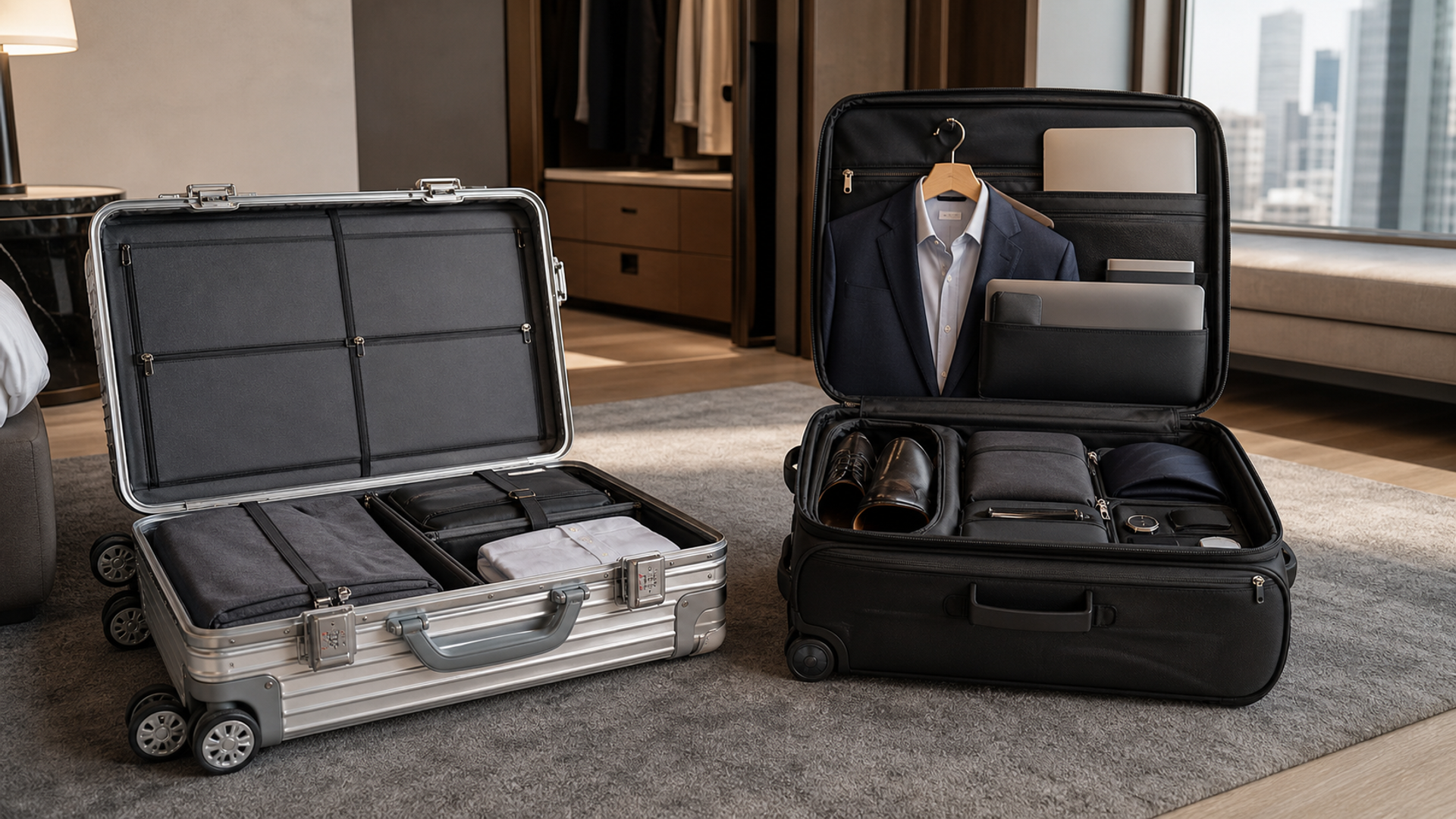
Choose RIMOWA if you primarily want a rigid shell, distinctive engineering and a long-term repair relationship. Choose TUMI if you primarily want organised business utility, a broader soft-sided ecosystem and a clearly defined five-year warranty for wheeled luggage and body-worn bags. Neither brand is automatically better: the correct purchase depends on aircraft, packing style, tolerance for cosmetic wear and access to service.
The comparison should be made at model level. “RIMOWA versus TUMI” is too broad unless the buyer compares two cases of similar size, material and intended use.
The short decision matrix
| Ownership question | RIMOWA tends to suit | TUMI tends to suit |
|---|---|---|
| Preferred construction | Aluminium or polycarbonate hard shell | Ballistic-style nylon, fabric, leather, aluminium or mixed business cases |
| Packing style | Two-sided clamshell and compression | Pockets, compartments and business organisation |
| Visual ageing | Willing to accept dents, scratches and patina | Prefers understated wear, while accepting fabric scuffs or stains |
| Warranty priority | Lifetime functional guarantee on qualifying new suitcases | Five-year limited warranty on wheeled luggage/body-worn bags |
| First-year transit damage | Read exact RIMOWA exclusions and carrier claim process | TUMI says its first-year cover includes qualifying airline/transit mishandling |
| Cabin fit | Select exact Cabin variant against the airline limit | Select exact international/domestic carry-on dimensions |
| Brand language | Industrial, architectural and iconic | Executive, organised and system-led |
| Best use case | Design-led frequent traveller | Mobile professional carrying technology and documents |
Warranty language varies by product, purchase date and market. Always retain proof of purchase and read the local terms before treating coverage as part of the value.
Start with the actual bag, not the brand
Compare:
External dimensions including wheels and handles.
Empty weight.
Internal capacity and layout.
Material.
Lock and zipper design.
Handle positions.
Wheel replacement pathway.
Warranty attached to that product.
Repair access in the cities you use.
Return rules if the case does not fit your packing system.
A large TUMI expandable carry-on and a compact RIMOWA Cabin are not a fair comparison. Match the maximum external dimensions first, then compare usable volume and weight.
Cabin fit is a route problem
There is no universal “international carry-on” size. Airlines publish their own limits and may impose lower weights than many premium cases weigh when empty.
Use this fit worksheet:
| Check | Your value |
|---|---|
| Most restrictive airline in next 12 months | |
| Maximum height × width × depth | |
| Maximum cabin weight | |
| Case external dimensions | |
| Case empty weight | |
| Remaining packing weight | |
| Expansion permitted? | |
| Regional aircraft sectors? |
Subtract the empty case weight from the airline limit. If the result is too small for the normal packing list, a beautifully engineered case becomes a check-in liability.
Expansion can create another problem. A soft-sided case may fit when closed and exceed the depth limit when expanded. Measure the packed case at its fullest point, including protruding pockets.
RIMOWA’s ownership proposition
RIMOWA’s current US lifetime-guarantee page says new suitcases purchased from 25 July 2022 are covered by a lifetime guarantee. The owner manual states that cosmetic wear and tear, misuse and abuse are not covered. That distinction matters because aluminium and polycarbonate cases inevitably record journeys.
The guarantee should be understood as functional support, not a promise to keep a case visually new. Scratches, stickers, small dents and surface changes may become part of the object’s patina. Buyers who want a pristine surface should decide whether that ageing language suits them before choosing aluminium.
RIMOWA strengths:
recognisable shell design;
a focused suitcase range;
replaceable functional components subject to service assessment;
a long guarantee for qualifying purchases;
clamshell packing and compression systems;
strong appeal to collectors of designed travel objects.
RIMOWA trade-offs:
aluminium can be heavy before packing;
hard shells lack external pockets;
clamshell cases require floor or bed space to open;
visible wear is part of ownership;
airport or airline damage may require a carrier claim depending on terms;
local repair timing can still interrupt travel.
The practical buyer should map the nearest authorised service points in home, hub and frequent destination cities. A lifetime guarantee has more real-world value when the repair pathway is accessible.
TUMI’s ownership proposition
TUMI’s current US warranty page states that wheeled luggage and body-worn bags receive a five-year limited warranty, while selected accessories receive two years. It describes the first year as “worry-free”, including qualifying functional or structural damage from airline or transit mishandling. From years two to five, airline and transit mishandling are no longer covered, while qualifying functional or structural failures, manufacturing defects, workmanship issues and wear-related damage remain subject to the terms.
TUMI excludes aesthetic damage such as scratches, dents, stains and tears, as well as misuse and consequential losses. Proof of purchase from an authorised seller is important.
TUMI strengths:
strong internal and external organisation;
many business-oriented formats;
soft-sided cases that can be easier to access in tight rooms;
defined first-year transit-damage provision in current US terms;
store and repair pathways;
integrated backpacks, briefcases and accessories.
TUMI trade-offs:
a five-year term is shorter than RIMOWA’s qualifying lifetime guarantee;
multiple materials and collections make brand-level comparisons imprecise;
pockets can encourage overpacking;
fabric can stain or abrade;
later airline damage is excluded from warranty and should be claimed from the carrier;
cosmetic damage is not covered.
For a traveller carrying a laptop, chargers, documents and a change of clothing, organisation may save more time than shell strength. For someone who packs with removable pouches and wants a durable outer structure, RIMOWA may be more coherent.
Material: aluminium, polycarbonate or fabric
Aluminium
Aluminium offers rigidity, visual identity and a tactile sense of permanence. It also dents and scratches. It is often heavier and can transmit force rather than flex. Buy it if patina is acceptable and the weight budget works.
Polycarbonate
Polycarbonate is lighter and can flex under impact. It may be more practical for weight-restricted travel, though finishes still scratch and components still require service.
Fabric and ballistic-style nylon
Fabric cases can include external pockets and expansion. They may compress into tight spaces but are less resistant to liquids and sharp abrasion. The construction quality of zips, seams, handles and corners matters more than the material label alone.
No material is “most durable” in every failure mode. Define the expected abuse: conveyor impact, rain, overpacking, kerbs, cobblestones, car boots or cabin-only use.
The ten-year ownership-cost model
Luxury luggage value is better measured over years and journeys.
Ten-year ownership cost
= purchase price
+ paid repairs
+ shipping and travel to service
+ temporary replacement or rental
+ airline damage not recovered
+ value of lost use
− resale value
Cost per journey
= ten-year ownership cost ÷ completed journeys
Example: a £1,300 case lasts ten years and 150 journeys, receives £200 of out-of-warranty service and retains £250 of resale value. Ignoring time value, the ownership cost is £1,250, or about £8.33 per journey.
A £750 case replaced after four years and 60 journeys may cost more per journey if it has little resale value and cannot be economically repaired. Conversely, a lighter, less expensive case may prevent recurring overweight fees and become the better investment.
Do not insert speculative resale values. Use completed sale evidence for the exact model, size, material and condition.
Repairability test before purchase
Ask both brands:
Is the wheel replaceable?
Is the telescopic handle replaceable?
Are locks, zips and corner pieces serviceable?
Must the case be shipped?
Is walk-in assessment available?
What proof of purchase is required?
What is the current estimated turnaround?
Is a loan case available?
What happens if the colour or model is discontinued?
Which damage must be claimed from the airline?
Record the response in writing. Warranty length without turnaround and logistics is an incomplete ownership metric.
Airline damage protocol
Inspect checked luggage before leaving the reclaim area. Photograph all sides before the flight and immediately after discovering damage. Report the issue to the airline within its stated deadline and retain the baggage tag, boarding pass, report and receipts.
Do not wait for a brand assessment if doing so risks missing the carrier’s claim window. Brand warranty and carrier liability are separate routes.
For high-value contents, remember that luggage warranties usually do not cover the contents or consequential loss. Keep medicines, keys, identity documents, essential electronics and irreplaceable valuables in personal control.
Which should you buy?
Choose RIMOWA when:
shell design is part of the pleasure;
you accept cosmetic patina;
you want a qualifying lifetime functional guarantee;
you pack with pouches rather than external pockets;
the weight works for your airlines;
authorised repair is convenient.
Choose TUMI when:
business organisation is central;
external access saves time;
you want coordinated briefcases, backpacks and luggage;
the current first-year transit provision is valuable;
soft-sided utility fits your travel;
a five-year warranty is sufficient.
Choose neither until the exact case passes your airline and packing test.
The verdict
RIMOWA sells a designed shell and a long relationship with the object. TUMI sells an organised travel system with a strong business orientation. The more luxurious purchase is the one that creates less friction over hundreds of journeys.
Match external dimensions, empty weight, packing architecture, warranty exclusions and repair pathway. Then buy the case whose ownership system fits the way you already travel—not the case that merely photographs best in an airport.
Cabin selection also determines baggage allowance and whether a case must be checked; see the VERTU Emirates Premium Economy versus Business Class comparison for a route-specific example.