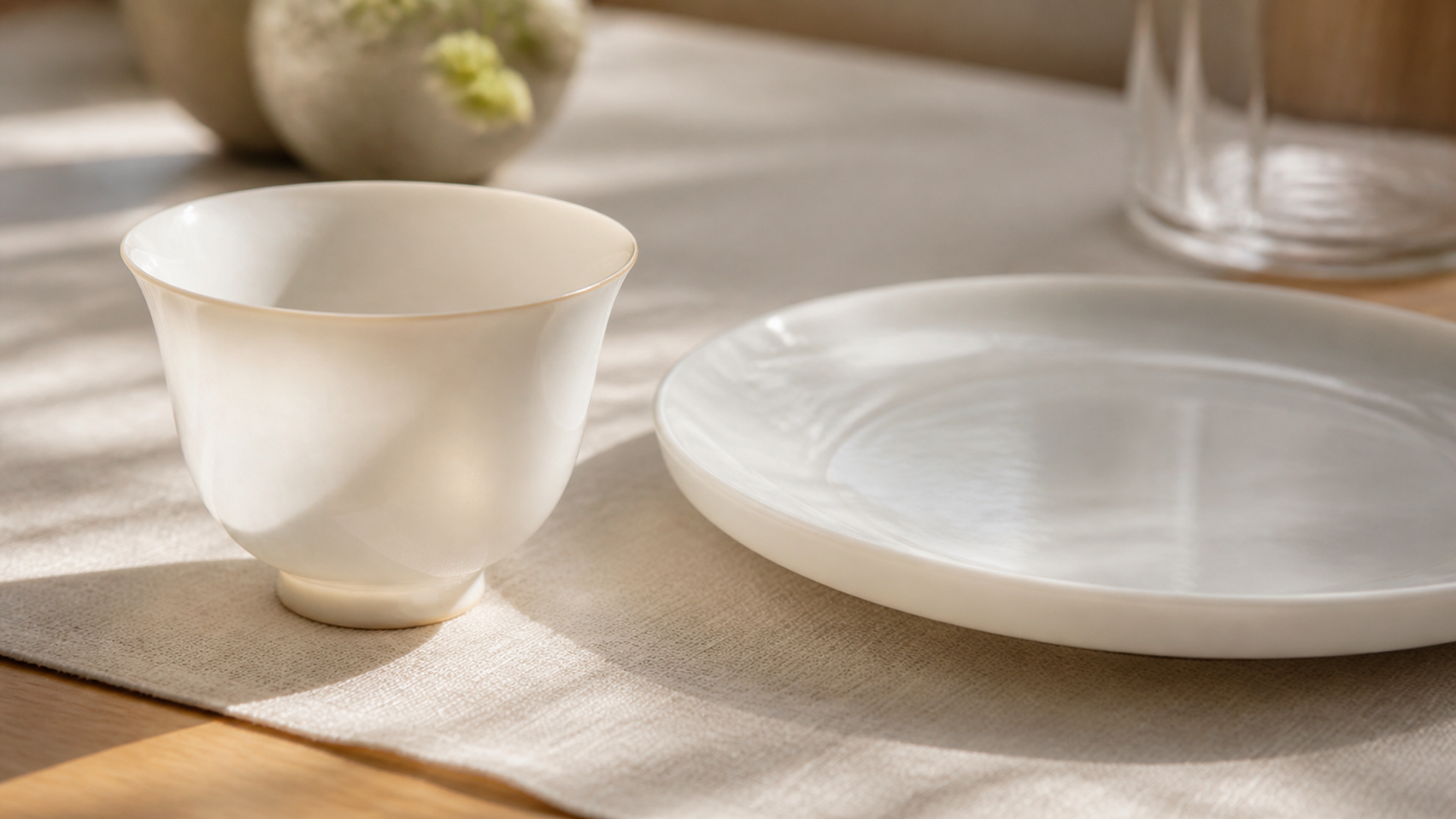
Bone china and porcelain are related ceramic families with different recipes and traditions, but the name alone does not predict whether a cup chips, stacks or survives a dishwasher. Body composition, firing, wall thickness, glaze, foot design and shape determine the exact piece. A thin bone-china cup can be strong in normal use yet vulnerable at an exposed rim.
Choose the tableware task
Choose bone china when low weight, translucency and a refined thin profile enhance frequent use and replacements are available. Choose porcelain when the exact form, weight, price and broader design range better suit the table. Buy a small mixed service first when handles, stacking, cutlery marks or dishwasher layout could reverse the collection decision.
| Decision factor | Bone china | Porcelain | Buy a small mixed service first |
|---|---|---|---|
| Weight and feel | Thin light pieces remain stable in hand | A more substantial porcelain form feels secure | Test one place setting through a full meal |
| Translucency | Lightness is part of the desired aesthetic | Opacity or decorated surface matters more | View both under the dining light |
| Edge risk | Fine rims suit careful daily use | Thicker or protected edges fit the household | Start with replaceable pieces |
| Dishwasher | The maker approves the exact decoration and cycle | The exact glaze and decoration are approved | Hand washing is realistically sustainable |
| Stacking | Cup handles and plate feet stack without pressure | The porcelain shapes fit storage | Measure shelves before buying a service |
| Continuity | Open-stock replacements are credible | The pattern or whiteware remains available | A mixed neutral service reduces lock-in |
This porcelain vs bone china matrix is the article's working value object. Read the porcelain vs bone china rows together: the decisive failure mode depends on this topic's evidence, operating context and reader objective.
What body, firing and form change
Evidence 1. UK government tariff guidance classifies fine bone china within porcelain or china tableware and identifies an exact article by appearance and intended use.
Evidence 2. UK government classification guidance treats porcelain or china as a broad non-porous ceramic category that includes bone china, not one universal thickness or durability.
Evidence 3. Impact resistance depends on form and stress concentration, so a thin rim or protruding handle can fail even when the fired body is strong.
Evidence 4. Gold, platinum, lustre, transfer decoration and glaze condition can change dishwasher and microwave suitability; the exact maker instruction controls.
Reader-visible sources checked for this article:
gov.uk — reader-visible current or official evidence
gov.uk — reader-visible current or official evidence
For porcelain vs bone china, these sources establish only the claims inside their documented scope. Recheck every changeable specification, availability condition, price, policy or service term in the relevant market before acting.
Handle and wash the exact pieces
Read weight and feel as a stop/go test: thin light pieces remain stable in hand supports the first option; a more substantial porcelain form feels secure supports the second; and test one place setting through a full meal supports the third. Record which source proves the condition and when it was checked.
A buyer can resolve translucency without starting from a brand preference. Ask whether lightness is part of the desired aesthetic; compare that with whether opacity or decorated surface matters more; then use view both under the dining light as the third route's safeguard. An unknown condition stays unknown.
On edge risk, popularity is not enough. The evidence for option one is that fine rims suit careful daily use. Option two means thicker or protected edges fit the household. Option three is rational where start with replaceable pieces. Recheck any changeable term immediately before commitment.
The decision changes at dishwasher. Choose the first path only if the maker approves the exact decoration and cycle; move to the second when the exact glaze and decoration are approved; use the third when hand washing is realistically sustainable. Save the downside that would make this row fail.
For stacking, the first route works when cup handles and plate feet stack without pressure; the second requires the porcelain shapes fit storage. The control for the third is measure shelves before buying a service. Verify this row against the exact product, property, account or environment before it can reverse the decision.
The continuity row exposes a practical boundary. Route one assumes open-stock replacements are credible, while route two is defensible only when the pattern or whiteware remains available. Route three depends on a mixed neutral service reduces lock-in. If that evidence is absent, keep the more reversible option.
Facts that would reverse the current choice
Reversal control 1 — Weight and feel. Before choosing Bone china, write down how the decision changes if “Thin light pieces remain stable in hand” proves false. Do the same for Porcelain and “A more substantial porcelain form feels secure”. Keep the Buy a small mixed service first route available until “Test one place setting through a full meal” is verified. This control belongs to porcelain vs bone china; update it from the cited source or exact supplier rather than copying a generic checklist.
Reversal control 2 — Translucency. Before choosing Bone china, write down how the decision changes if “Lightness is part of the desired aesthetic” proves false. Do the same for Porcelain and “Opacity or decorated surface matters more”. Keep the Buy a small mixed service first route available until “View both under the dining light” is verified. This control belongs to porcelain vs bone china; update it from the cited source or exact supplier rather than copying a generic checklist.
Reversal control 3 — Edge risk. Before choosing Bone china, write down how the decision changes if “Fine rims suit careful daily use” proves false. Do the same for Porcelain and “Thicker or protected edges fit the household”. Keep the Buy a small mixed service first route available until “Start with replaceable pieces” is verified. This control belongs to porcelain vs bone china; update it from the cited source or exact supplier rather than copying a generic checklist.
Reversal control 4 — Dishwasher. Before choosing Bone china, write down how the decision changes if “The maker approves the exact decoration and cycle” proves false. Do the same for Porcelain and “The exact glaze and decoration are approved”. Keep the Buy a small mixed service first route available until “Hand washing is realistically sustainable” is verified. This control belongs to porcelain vs bone china; update it from the cited source or exact supplier rather than copying a generic checklist.
Reversal control 5 — Stacking. Before choosing Bone china, write down how the decision changes if “Cup handles and plate feet stack without pressure” proves false. Do the same for Porcelain and “The porcelain shapes fit storage”. Keep the Buy a small mixed service first route available until “Measure shelves before buying a service” is verified. This control belongs to porcelain vs bone china; update it from the cited source or exact supplier rather than copying a generic checklist.
Reversal control 6 — Continuity. Before choosing Bone china, write down how the decision changes if “Open-stock replacements are credible” proves false. Do the same for Porcelain and “The pattern or whiteware remains available”. Keep the Buy a small mixed service first route available until “A mixed neutral service reduces lock-in” is verified. This control belongs to porcelain vs bone china; update it from the cited source or exact supplier rather than copying a generic checklist.
Buy one place setting
Use a dinner plate, bowl, cup and saucer for two weeks. Record weight, lip feel, heat, handle clearance, cutlery sound and whether portions fit the shapes.
Audit the dishwasher
Measure rack spacing, spray-arm clearance and detergent. Photograph contact points and inspect decoration, foot rings and glaze after approved cycles.
Test storage geometry
Stack the intended quantity on the real shelf, avoiding pressure on handles and raised decoration. Include separators and the weight of a full stack.
Check collection continuity
Ask for open-stock policy, pattern history and replacement lead time. Save exact shape and pattern codes because white pieces from one maker may not share dimensions.
Three table settings
Formal service used often
Bone china can reward daily handling when the light profile is valued and replacements are planned. Define the fact that would reverse this recommendation before committing.
Busy family table
A robust exact porcelain line with replaceable pieces may beat a delicate-looking collection regardless of category prestige. Define the fact that would reverse this recommendation before committing.
Small urban kitchen
A mixed trial should decide according to stack height, dishwasher fit and multi-purpose shapes. Define the fact that would reverse this recommendation before committing.
Action checklist
Handle one place setting.
Check rim and handle.
View translucency.
Read decoration care.
Measure dishwasher rack.
Measure shelf height.
Inspect foot rings.
Price open-stock replacements.
Save pattern codes.
Avoid buying display-only quantities.
Continue the decision
The linked VERTU articles expand adjacent parts of the porcelain vs bone china decision. They do not substitute for the external evidence above.
The bone-china-porcelain verdict
Choose bone china when low weight, translucency and a refined thin profile enhance frequent use and replacements are available. Choose porcelain when the exact form, weight, price and broader design range better suit the table. Buy a small mixed service first when handles, stacking, cutlery marks or dishwasher layout could reverse the collection decision.
Keep the porcelain vs bone china decision reversible until its material cost, safety, access, privacy and compatibility facts are verified. Unknown evidence stays unknown; it is never silently scored as favourable.