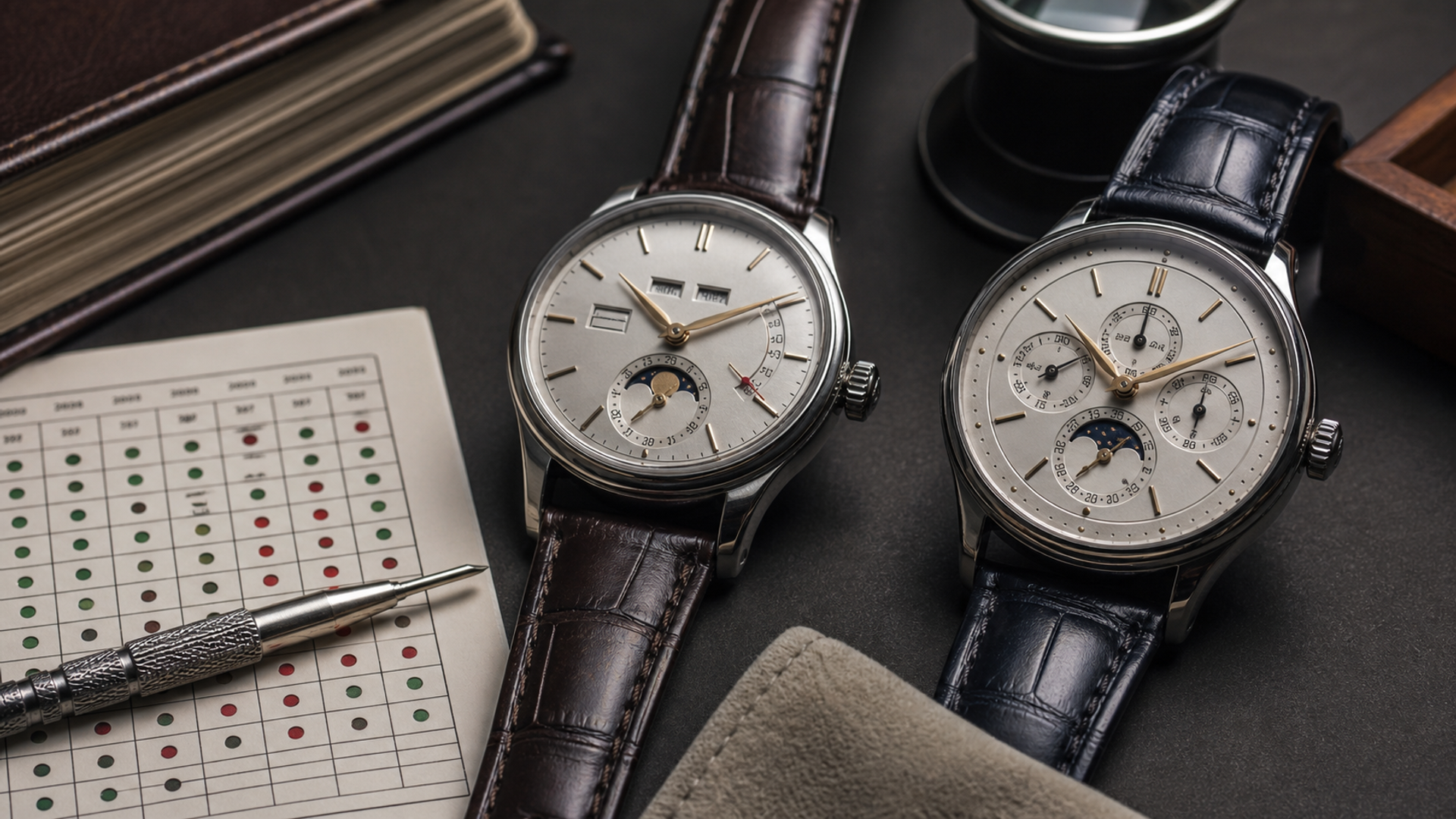
An annual calendar watch distinguishes 30-day and 31-day months but normally needs one manual correction at the end of February. A perpetual calendar also tracks February and the leap-year cycle, so it can display the correct date for decades while it keeps running. The perpetual mechanism is more complete; the annual calendar is often easier to read, set, service and wear.
Choose an annual calendar if you want a useful mechanical complication, wear the watch regularly and do not mind one correction each year. Choose a perpetual calendar if the compression of a four-year calendar into gears is itself the attraction and you are prepared for careful setting, higher service exposure and the need to keep the watch running or reset it correctly. Choose a simple date if calendar convenience is the only goal: a connected phone is more accurate and requires no delicate mechanism.
The ownership decision is not “more complication equals better”. It is whether the additional logic produces delight often enough to justify its operational cost.
Calendar complication matrix
| Type | What it recognises | Normal manual correction | Main ownership advantage | Main compromise |
|---|---|---|---|---|
| Simple date | Counts to 31 | After every month shorter than 31 days | Clear, common and relatively simple | Five corrections in a normal year plus February |
| Complete calendar | Often day, date and month, but not month length | Similar to a simple date unless specified otherwise | Rich display without full calendar logic | More indications do not necessarily mean more automation |
| Annual calendar | 30-day and 31-day months | Once a year, normally after February | High practical value with manageable complexity | Does not independently account for February’s changing length |
| Perpetual calendar | Month length and leap-year cycle | Normally no correction until the secular exception if continuously running | Extraordinary mechanical logic and collector significance | Expensive, sensitive to incorrect setting and time-consuming after stopping |
| Centennial or secular calendar | Adds the Gregorian century exception | Designed to handle years such as 2100 | Extreme horological completeness | Exceptional rarity, cost and complexity |
Patek Philippe’s official calendar-watch explanation describes its annual calendar as requiring one correction at the end of February and its perpetual calendar as accounting for varying month lengths and leap years. It also notes the secular exception: 2100 is not a leap year, so an ordinary perpetual calendar will need adjustment then.
How the annual calendar solves the useful problem
A simple date mechanism advances through 31 positions. It does not know whether the current month ends on day 30, 31, 28 or 29. The owner corrects it after short months. An annual calendar adds month-length logic for 30 and 31 days. February remains the exception, so the wearer corrects the watch once each year.
That is an elegant balance. The complication removes most date corrections without requiring the full four-year programme of a perpetual calendar. Patek Philippe introduced and patented its wristwatch annual calendar in 1996, but other manufacturers now implement the concept in different layouts and mechanisms. The phrase does not guarantee one architecture.
For a frequently worn watch, the annual correction can become a pleasant ritual. It is also easy to remember: check the calendar at the transition from February to March. If the watch stops for a week, however, it still needs to be advanced to the current date. The complication’s convenience depends on power reserve and wearing habit.
Why the perpetual calendar is mechanically different
A perpetual calendar contains a mechanical programme that represents the four-year leap cycle. It determines which months have 30 or 31 days and when February receives a 29th day. Displays commonly include day, date, month and leap-year indication; moon phase is often paired with the calendar but is a separate mechanism.
The achievement is not that the watch knows a fact available on every phone. It is that levers, cams, wheels and springs perform calendar logic using stored mechanical relationships. Patek Philippe states that it made the first perpetual-calendar wristwatch in 1925 using a movement produced in 1898. The complication’s value is historical and intellectual as much as practical.
That complexity creates risk. Calendar mechanisms can be damaged when corrected during the hours in which gears are already engaging to change the date. The forbidden window differs by movement. Some modern watches include safer correction systems, but no universal rule replaces the exact manual.
Setting is part of the purchase
Ask the retailer to demonstrate a full reset from a stopped state. Note the sequence: time, year or leap-year position, month, date, day and moon phase where applicable. Identify every pusher and whether it requires a stylus. Ask which hours are unsafe for correction and what to do after moving the hands backwards past midnight.
Never press a calendar corrector at random. Never use a metal object that can slip and mark the case. Keep the supplied tool and manual together. If the watch is far out of date and the sequence is unclear, an authorised service point is cheaper than damaged calendar work.
Some perpetual calendars use a single corrector that advances all indications together; others have separate pushers. A watch can be technically magnificent and operationally frustrating. The demonstration should be considered part of the fitting.
Power reserve and the stopped-watch problem
A perpetual calendar produces its full convenience only while running. If it stops for months, restoring the correct date can require many careful advances. A watch winder may keep an automatic calendar running, but it introduces its own setting, wear and security considerations. Manual-wind calendars require regular attention regardless.
Power reserve therefore has unusual value. A watch that survives a weekend off the wrist avoids resetting. But longer reserve does not solve a collection in which the calendar sits unworn for weeks. Be honest about rotation.
An annual calendar is usually less burdensome to restore, though the exact mechanism still matters. A simple date is easier again. The rational hierarchy reverses the mechanical one: less complicated watches can be more convenient for occasional wear.
Dial design: information versus calm
Calendar information can be displayed through apertures, subdials, retrograde hands, pointer dates or linear windows. Legibility is not guaranteed by complication level. A perpetual calendar with four subdials may be difficult to read quickly; an annual calendar with three apertures can be immediate. Conversely, a sparse dial may hide a complicated setting state.
Test the watch in ordinary light without magnification. Can you read the date and month? Can you identify the leap-year indication? Does a hand obscure another display at certain times? Does the dial remain balanced on the case size? The best calendar is one you can interpret without remembering a diagram.
If eyesight changes, service cannot enlarge the printing. A loupe may be part of collecting, but it should not be required for the information you intend to use daily.
Service and financial exposure
More parts and tighter interactions can increase service complexity. Ask for current manufacturer estimates for routine service and calendar repair, not only the suggested interval. Confirm whether the movement returns to a central workshop, how long service normally takes and whether refinishing is optional.
Perpetual calendars often sit in precious-metal cases and at high values, adding insurance, transport and security costs. An annual calendar can also be expensive, but the category spans a broader range. Neither is guaranteed to appreciate. Rarity, brand, reference, condition, provenance and market taste affect resale.
Keep every setting tool, corrector, spare part, invoice and service record. A missing pusher or manual creates practical inconvenience and can reduce confidence for a future buyer. Avoid cosmetic polishing unless necessary; preserving case geometry is more important than removing every mark.
Annual calendar vs perpetual calendar scorecard
Score the exact references from zero to five:
dial legibility;
setting safety and clarity;
power reserve relative to your rotation;
local service route;
five-year service budget;
case fit and comfort;
delight in the mechanical idea;
willingness to reset after a long stop.
Double “delight” for a complication-led collection. Double setting and power reserve for an everyday watch. Reject a watch if you cannot confidently explain its correction sequence after the retailer demonstration.
Who should choose the annual calendar
The annual calendar suits a collector who wants mechanical usefulness without making ownership revolve around protection of a four-year programme. It is especially strong as a daily or weekly watch with enough power reserve to remain running through normal rotation. The February correction connects the owner to the mechanism without becoming a recurring burden.
It can also offer a cleaner dial or lower service exposure, depending on reference. Do not assume it is inexpensive; compare the specific movement and case.
Who should choose the perpetual calendar
The perpetual calendar suits a collector fascinated by encoded time. It is compelling when the movement’s architecture, historical importance and display are the reason for the purchase. The owner should enjoy learning the setting system and accept that convenience depends on continuous operation.
It is a poor purchase when chosen only as a status tier above annual calendar. If you dislike setting watches, avoid service logistics or rarely wear the piece, the mechanism can become an obligation hidden behind an impressive name.
For context on movement, case and brand priorities outside complications, see our automatic-watch quality guide.
Verdict
The annual calendar is the better ownership tool. One correction after February is a small price for eliminating the rest of the year’s month-length adjustments, and the mechanism can remain legible and serviceable. The perpetual calendar is the greater mechanical statement, but it rewards curiosity more than convenience.
Buy annual calendar for use; buy perpetual calendar for the idea—unless a particular reference reverses that equation through exceptional design. In either case, the true luxury is not never touching the calendar. It is understanding exactly what happens when you do.