An art auction record tells you what a buyer paid on one night; provenance tells you what still needs to be understood about the object. Vincent van Gogh’s Châtaigniers en fleurs sold for $190,430,000 at Sotheby’s New York on 18 November 2026, an auction record for the artist. Yet a public dispute over an earlier transfer made the painting’s ownership history part of the story. Collectors should read the price and the documentary trail together, while keeping a sale result separate from a legal or ethical conclusion.
Key Takeaways
- Sotheby’s reported a $190.43 million result for the Van Gogh painting, its highest auction result for the artist; that is an artist record, not an all-time record for every work of art.
- Provenance is the documented history of an object’s ownership, not simply a prestigious list of names.
- Sotheby’s announced an agreement ahead of the 18 November sale; the public announcement alone does not disclose every term or settle every historical question for an outside reader.
- Before bidding, compare the catalog’s ownership timeline with dated documents, gaps, condition, authenticity, export requirements and the auction’s terms.
- An auction result is evidence of a transaction under particular conditions, not a reliable forecast of resale value.
What happened at the November 2026 Van Gogh auction?
Sotheby’s says Châtaigniers en fleurs, painted in May 1890, reached $190,430,000 in its New York sale on 18 November. The auction house described the sum as the highest price achieved by a Van Gogh work at auction. That is a precise claim with a precise boundary: it does not mean the painting is the most expensive artwork ever sold, nor does it reveal the bidder’s full reasoning. A headline should preserve both the amount and the scope of the record.
The sale also followed a public challenge concerning an earlier ownership transfer. In a 17 November announcement, Sotheby’s said an agreement had been reached ahead of the auction. Reporting on the dispute identified questions from descendants of a Jewish owner about the circumstances of a 1936 transfer. The existence of a claim, the auction house’s announcement and the eventual sale are separate facts. A reader should not turn any one of them into an unsupported finding about coercion, title or compensation.
That distinction is useful well beyond this painting. A spectacular number attracts attention, but the complete collector question is broader: what object was offered, what documentation accompanied it, what terms governed the sale, and what unresolved issues would matter to a later owner? Those questions remain relevant whether the work sells for millions or for a far smaller amount.
Why does provenance matter when a painting sets an art auction record?
Provenance matters because a price is a snapshot of demand while an ownership history helps explain what, exactly, a buyer can responsibly acquire and later transfer. The J. Paul Getty Museum defines provenance as an object’s ownership history assembled from clues in archives, databases and the object itself. It notes that gaps can remain even after careful research. Therefore a short catalog sentence saying “private collection” should prompt a request for dates and supporting records, rather than automatic confidence or automatic suspicion.
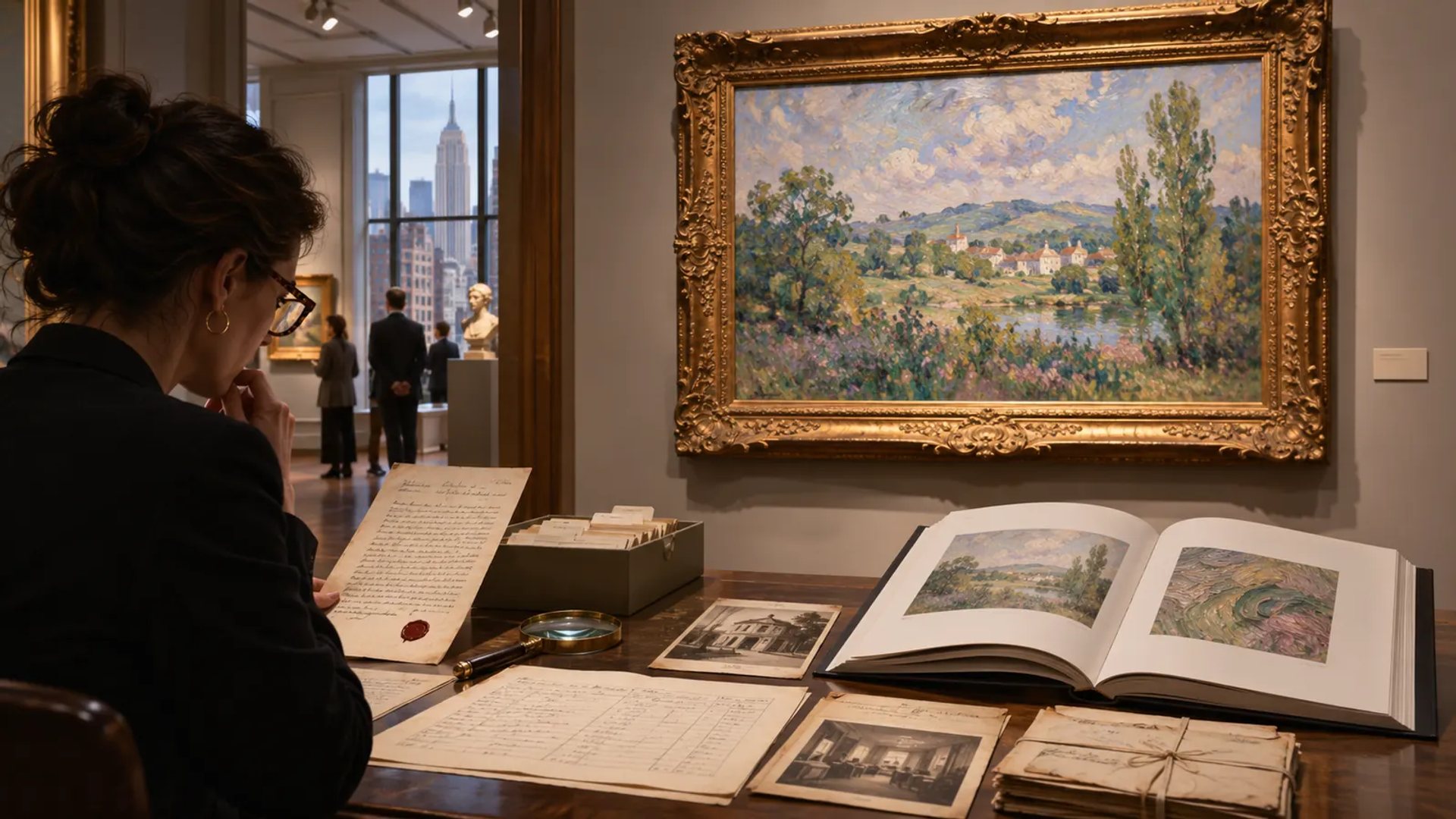
The evidence can include invoices, estate inventories, exhibition catalogues, photographs, customs records, insurance schedules, correspondence and marks on the work’s reverse. These records do different jobs. A photograph can place an object in a room at a point in time, while a dated invoice may document a transaction; neither alone necessarily proves that every prior transfer was voluntary and lawful. Compare the evidence across each transition in ownership. If an object leaves a documented collection in 1936 and appears in another in 1950, ask what records account for the period between those dates.
Provenance also changes how a collector describes an object. “Formerly owned by” is an attributable historical claim; “free of all claims” is a much stronger statement requiring a different level of review. Catalog language, contract warranties and independent research should not be collapsed into one reassuring phrase. The stronger the claim, the more clearly the supporting documents and responsible party should be identified.
What did the agreement before the sale establish?
Publicly, it established that Sotheby’s announced an agreement before the sale proceeded. It did not publish a complete record of negotiations or give outside readers a basis to infer all legal terms. A settlement may allow a transaction to proceed, but the existence of a settlement should not be recast as proof that a disputed historical transfer was either proper or improper. If a buyer needs certainty about the scope of a release or warranty, the actual transaction documents matter more than a headline.
The Washington Conference Principles on Nazi-Confiscated Art provide a helpful ethical framework for cases involving the Holocaust era. Endorsed in 1998, these are non-binding principles; they call for research, access to records and just and fair solutions, while recognizing that laws differ by country. The principles explicitly acknowledge that unavoidable gaps may exist because of the passage of time and the circumstances of the era. They should guide careful inquiry, not be mistaken for a single automatic legal outcome in every case.
This is why precise language is essential. A report of an ownership dispute is a report of a dispute. An auction-house statement about an agreement is a statement about an agreement. Neither licenses a publisher to identify a person as a wrongdoer, declare a claimant successful or describe confidential compensation without independent evidence. The same discipline protects collectors from drawing conclusions that their documents cannot support.
How should a buyer check provenance before bidding?
Start with a timeline rather than a narrative paragraph. Record each named owner, location, acquisition and transfer date, then place the cited evidence beside that entry. Ask the seller or specialist which documents are available for inspection and whether any name, place or date is an inference. Where the catalog has a gap, note it explicitly. A missing document is a research question; it is not, by itself, proof of wrongdoing.
| Question | Document to request | Why it matters |
|---|---|---|
| Who held it, and when? | Dated invoices, inventories, collection records | Tests the continuity of the ownership timeline |
| How was it identified? | Photographs, dimensions, catalog references | Helps distinguish this object from a similar work |
| Was it displayed or published? | Exhibition and literature records | Places the object in a verifiable context |
| Were transfers restricted? | Export papers, applicable sale terms, specialist advice | Clarifies whether possession and cross-border movement are straightforward |
| Are there claims or gaps? | Claim correspondence, settlement scope, written warranties | Identifies matters requiring independent legal review |
Next, distinguish evidence of identity from evidence of ownership. A painting that looks right and appears in a historic photograph may still have an incomplete chain of transfer. Conversely, an old invoice may name an artist but fail to identify the exact work if dimensions or images are absent. For a material purchase, an independent specialist can compare the object, records and catalog description. Counsel with relevant jurisdictional expertise can address questions about title, restrictions or claims; a general article cannot decide them.
Finally, read the conditions of sale before treating the hammer price as your total commitment. Buyer’s premium, taxes, shipping, storage, insurance and conservation costs can alter the amount paid and the cost of holding a work. Auction results are often reported as a price inclusive of premium; confirm the auction house’s definition before comparing two results. The sensible comparison is between like measures, at stated dates, for works with comparable condition and documentation.
Does an art auction record prove the work is valuable to every collector?
No. It proves that this transaction cleared at that price under the conditions of that sale. A single result can reflect competition among a small number of bidders, a rare opportunity to buy a particular work, confidence in the seller’s documentation, the sale’s presentation and wider market conditions. It cannot guarantee a future buyer at a similar price. Even within one artist’s market, medium, date, subject, condition, size and provenance can differ enough to make a simple price comparison misleading.
For a reader assessing value, “why did this object command a premium?” is more useful than “will the next object do the same?” Trace the evidence that is distinctive and repeatable: documented attribution, recognized place in the artist’s career, condition reports and exhibition history. Then identify what is contingent, such as a particular evening’s bidding rivalry. A price chart cannot tell you whether a historic ownership gap has been examined well enough for your purposes.
The distinction also matters for luxury objects outside fine art. Craft, rarity and story can attract interest, but a story becomes useful evidence only when the object and its history are documented. A distinctive modern collectible may come with edition records, maker records and service history; an old painting may require many archives to reconstruct a single transfer. Different objects demand different research, yet the principle is the same: do not substitute a compelling narrative for a checkable record.
What should a collector do when provenance is incomplete?
Ask which gap matters, and why. A missing domestic invoice from a recent decade is not identical to a missing transfer in Europe during the period of Nazi persecution. The Washington Principles specifically call for sensitivity to unavoidable gaps in Holocaust-era research. That does not mean abandoning scrutiny; it means weighing context, available archives and the reliability of surviving evidence rather than applying a simplistic “complete or reject” rule.
- Mark the start and end dates of each gap in the ownership timeline.
- List the records already checked and the archives still available.
- Ask the auction house what independent research supports its catalog wording.
- Seek specialist review when a gap intersects a claim, an export restriction or a high-stakes transfer.
- Document your decision and keep copies of the materials relied on.
That last step is often overlooked. A collector’s file should preserve the catalog version, condition report, correspondence, invoices and any specialist opinion as they existed at the time of acquisition. Online descriptions can change or disappear. The file supports future stewardship, insurance discussions and a later sale, and it lets a new question be investigated without rebuilding the entire history from memory.
How can readers separate a record-price headline from a sound decision?
Use a three-column note: confirmed fact, open question and decision consequence. In the Van Gogh case, the reported $190,430,000 result and the 17 November Sotheby’s agreement announcement belong in the confirmed column. The full documentary implications of a historic transfer belong in the open-question column unless the underlying materials are available and assessed. The consequence column asks what a particular buyer must verify before acting. This method keeps news reporting, provenance research and purchase judgment from merging into a single claim.
For a casual reader, the right conclusion may be simply that price and history deserve equal attention. For a bidder, it is a prompt to review the actual file and terms. For a publisher, it is a reminder to attribute contentious statements and preserve uncertainty. Record sales make a memorable headline; trustworthy collecting depends on the less visible work of checking what the documents show.
Frequently asked questions
What is provenance in an art auction?
Provenance is the documented ownership history of an artwork. It can draw on invoices, inventories, exhibition records, photographs and archives. A famous prior owner is only one part of that history; the dates and evidence connecting each transfer matter.
Was the November 2026 Van Gogh price a world art auction record?
No. Sotheby’s called the $190,430,000 result an auction record for Vincent van Gogh. That claim should be reported as an artist-specific record, not as the highest price ever paid for any work of art.
Does a settlement prove that an artwork had clear title?
Not by itself. A public statement that an agreement was reached confirms the announcement, but its legal scope depends on the actual documents and applicable law. Do not infer undisclosed terms or a definitive historical judgment from a short press statement.
Can an incomplete ownership history still be researched responsibly?
Yes. Identify the precise gap, search relevant archives, compare the surviving records and document remaining uncertainty. A gap calls for proportionate investigation, particularly when it covers a period linked to persecution or forced transfers.
What should I request before bidding on a work with a disputed history?
Request the full available provenance, catalog references, condition report, written sale terms and a clear account of any known claim or settlement scope. For significant legal uncertainty, seek independent specialist and legal advice before bidding.
Sources and editorial note
Sale amount and artist record: Sotheby’s auction report. Pre-sale agreement: Sotheby’s 17 November statement. Definition and research method: J. Paul Getty Museum provenance notes. Ethical framework: Washington Conference Principles. Dispute context: Associated Press reporting. This article is an editorial analysis of published sources as of 20 November 2026, not an independent examination of the painting or legal advice.