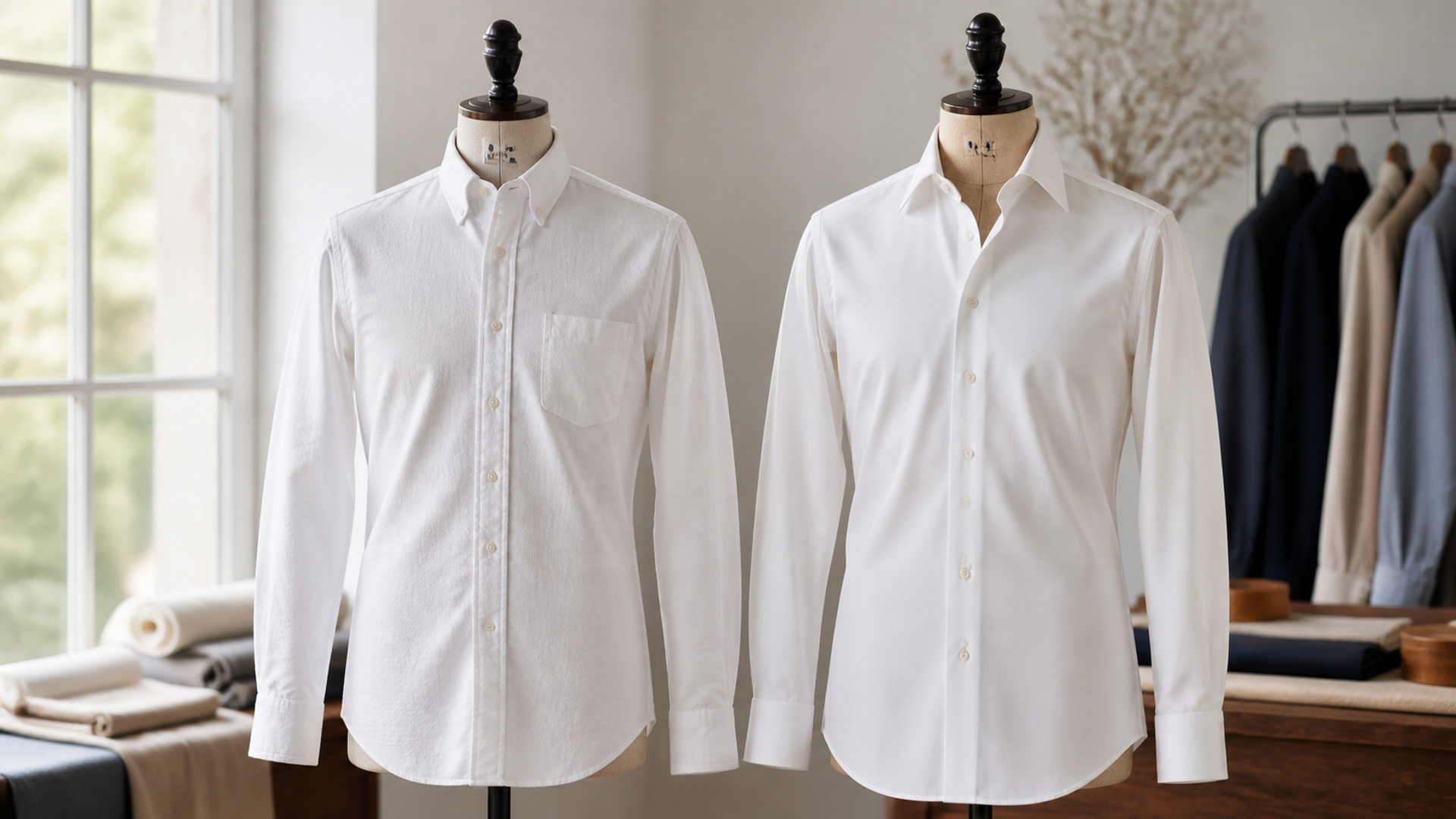
An Oxford shirt and a dress shirt are not strict opposites. Oxford names a basket-weave cloth commonly used in casual button-down shirts; dress shirt describes a garment role that can use poplin, twill, pinpoint, royal Oxford and other fabrics. A refined Oxford can work in business settings, while a soft dress-shirt pattern can look casual. Weave, collar, placket, pocket, cuffs, fit, colour and the surrounding suit determine formality. The useful comparison is therefore outfit-led, not label-led.
Oxford describes cloth, dress describes role
Choose a classic Oxford cloth shirt when texture, durability, a softer button-down collar and business-casual versatility fit the day. Choose a formal dress shirt when a smooth or refined fabric, structured collar and precise suit relationship are required. Build separate roles when one shirt would be forced to compromise both relaxed wear and formal presentation.
| Decision factor | Oxford cloth shirt | Dress shirt | Build separate casual and formal roles |
|---|---|---|---|
| Definition | Usually an Oxford-cloth garment | A role spanning several dress fabrics | Read cloth and construction separately |
| Texture | Basket weave is visible and substantial | Can range from smooth poplin to textured twill | Inspect the exact fabric |
| Collar | Soft button-down is common | Spread, point and formal collars are common | Match jacket and tie |
| Pocket and placket | Casual details often fit the tradition | Cleaner fronts can raise formality | Judge the complete shirt |
| Care | Can tolerate a relaxed rumple by style | Formal presentation often needs pressing | Test the real routine |
| Use | Business casual and smart weekend | Suit, ceremony and formal office | Respect the event dress code |
This oxford shirt vs dress shirt matrix is the article's working value object. Read the oxford shirt vs dress shirt rows together: the decisive failure mode depends on this topic's evidence, operating context and reader objective.
Collar and construction set formality
Evidence 1. Oxford cloth uses a basket-weave structure and is generally heavier and more textured than smooth broadcloth or poplin.
Evidence 2. Pinpoint Oxford uses finer yarn and a tighter weave and can sit higher on the formality scale than classic Oxford cloth.
Evidence 3. Dress shirts are made from multiple weave families, so the phrase does not identify one fabric.
Evidence 4. Collar stiffness, cuff, pocket, placket, fit, colour and pairing with tailoring can change formality independently of weave.
Reader-visible sources checked for this article:
propercloth.com — reader-visible current or official evidence
propercloth.com — reader-visible current or official evidence
propercloth.com — reader-visible current or official evidence
For oxford shirt vs dress shirt, these sources establish only the claims inside their documented scope. Recheck every changeable specification, availability condition, price, policy or service term in the relevant market before acting.
Test the complete outfit
Read definition as a stop/go test: usually an Oxford-cloth garment supports the first option; a role spanning several dress fabrics supports the second; and read cloth and construction separately supports the third. Record which source proves the condition and when it was checked.
A buyer can resolve texture without starting from a brand preference. Ask whether basket weave is visible and substantial; compare that with whether can range from smooth poplin to textured twill; then use inspect the exact fabric as the third route's safeguard. An unknown condition stays unknown.
On collar, popularity is not enough. The evidence for option one is that soft button-down is common. Option two means spread, point and formal collars are common. Option three is rational where match jacket and tie. Recheck any changeable term immediately before commitment.
The decision changes at pocket and placket. Choose the first path only if casual details often fit the tradition; move to the second when cleaner fronts can raise formality; use the third when judge the complete shirt. Save the downside that would make this row fail.
For care, the first route works when can tolerate a relaxed rumple by style; the second requires formal presentation often needs pressing. The control for the third is test the real routine. Verify this row against the exact product, property, account or environment before it can reverse the decision.
The use row exposes a practical boundary. Route one assumes business casual and smart weekend, while route two is defensible only when suit, ceremony and formal office. Route three depends on respect the event dress code. If that evidence is absent, keep the more reversible option.
Facts that would reverse the current choice
Reversal control 1 — Definition. Before choosing Oxford cloth shirt, write down how the decision changes if “Usually an Oxford-cloth garment” proves false. Do the same for Dress shirt and “A role spanning several dress fabrics”. Keep the Build separate casual and formal roles route available until “Read cloth and construction separately” is verified. This control belongs to oxford shirt vs dress shirt; update it from the cited source or exact supplier rather than copying a generic checklist.
Reversal control 2 — Texture. Before choosing Oxford cloth shirt, write down how the decision changes if “Basket weave is visible and substantial” proves false. Do the same for Dress shirt and “Can range from smooth poplin to textured twill”. Keep the Build separate casual and formal roles route available until “Inspect the exact fabric” is verified. This control belongs to oxford shirt vs dress shirt; update it from the cited source or exact supplier rather than copying a generic checklist.
Reversal control 3 — Collar. Before choosing Oxford cloth shirt, write down how the decision changes if “Soft button-down is common” proves false. Do the same for Dress shirt and “Spread, point and formal collars are common”. Keep the Build separate casual and formal roles route available until “Match jacket and tie” is verified. This control belongs to oxford shirt vs dress shirt; update it from the cited source or exact supplier rather than copying a generic checklist.
Reversal control 4 — Pocket and placket. Before choosing Oxford cloth shirt, write down how the decision changes if “Casual details often fit the tradition” proves false. Do the same for Dress shirt and “Cleaner fronts can raise formality”. Keep the Build separate casual and formal roles route available until “Judge the complete shirt” is verified. This control belongs to oxford shirt vs dress shirt; update it from the cited source or exact supplier rather than copying a generic checklist.
Reversal control 5 — Care. Before choosing Oxford cloth shirt, write down how the decision changes if “Can tolerate a relaxed rumple by style” proves false. Do the same for Dress shirt and “Formal presentation often needs pressing”. Keep the Build separate casual and formal roles route available until “Test the real routine” is verified. This control belongs to oxford shirt vs dress shirt; update it from the cited source or exact supplier rather than copying a generic checklist.
Reversal control 6 — Use. Before choosing Oxford cloth shirt, write down how the decision changes if “Business casual and smart weekend” proves false. Do the same for Dress shirt and “Suit, ceremony and formal office”. Keep the Build separate casual and formal roles route available until “Respect the event dress code” is verified. This control belongs to oxford shirt vs dress shirt; update it from the cited source or exact supplier rather than copying a generic checklist.
Name the dress code
Write the event, industry, venue, jacket, tie and footwear before opening the wardrobe. Use the strictest credible expectation as the ceiling. For this Oxford shirt versus dress shirt decision, record the exact item, place, date, measurement and source in the evidence log. Keep observations separate from category shorthand, repeat the check in the environment that matters, and price the downside of a wrong choice. If a formal host or client standard applies, choose the cleaner dress-shirt route. When that condition appears, reopen the choice instead of defending the original preference.
Inspect the cloth
Compare Oxford, pinpoint, poplin and twill in daylight for texture, opacity and sheen. Handle equal-colour shirts rather than relying on photography. For this Oxford shirt versus dress shirt decision, record the exact item, place, date, measurement and source in the evidence log. Keep observations separate from category shorthand, repeat the check in the environment that matters, and price the downside of a wrong choice. If a refined pinpoint meets the brief, the Oxford label may not be the blocker. When that condition appears, reopen the choice instead of defending the original preference.
Build the outfit
Try the shirt with the actual suit or trousers, belt, shoes and tie. Check collar spread, tie space, cuff reveal and jacket bulk. For this Oxford shirt versus dress shirt decision, record the exact item, place, date, measurement and source in the evidence log. Keep observations separate from category shorthand, repeat the check in the environment that matters, and price the downside of a wrong choice. If the collar collapses or the cloth bunches, change the shirt construction. When that condition appears, reopen the choice instead of defending the original preference.
Test movement and care
Sit, reach and wear the shirt for a full working day, then launder by the label. Record shrink, collar shape and pressing time. For this Oxford shirt versus dress shirt decision, record the exact item, place, date, measurement and source in the evidence log. Keep observations separate from category shorthand, repeat the check in the environment that matters, and price the downside of a wrong choice. If upkeep keeps the shirt unworn, assign it a narrower role. When that condition appears, reopen the choice instead of defending the original preference.
Audit fit
Measure neck, shoulders, chest, waist, sleeve and cuff and inspect pulling and excess cloth. Judge the silhouette both with and without a jacket. For this Oxford shirt versus dress shirt decision, record the exact item, place, date, measurement and source in the evidence log. Keep observations separate from category shorthand, repeat the check in the environment that matters, and price the downside of a wrong choice. If fit is poor, solve tailoring before changing weave. When that condition appears, reopen the choice instead of defending the original preference.
Four occasions, four answers
Business-casual office
An Oxford cloth button-down can look grounded and deliberate without a tie. Define the fact that would reverse this recommendation before committing.
Formal ceremony
A smooth or refined dress shirt with the right collar and cuffs is safer. Define the fact that would reverse this recommendation before committing.
Travel capsule
A durable Oxford can cover smart casual days while one formal shirt protects the dress-code ceiling. Define the fact that would reverse this recommendation before committing.
Creative client meeting
Either can work when fit and the complete outfit communicate the intended level. Define the fact that would reverse this recommendation before committing.
Action checklist
Name the dress code.
Identify the fabric.
Inspect texture.
Test opacity.
Choose collar.
Choose cuffs.
Check pocket and placket.
Try the jacket.
Test seated fit.
Wash by label.
Measure pressing time.
Assign a clear wardrobe role.
Continue the decision
The linked VERTU articles expand adjacent parts of the oxford shirt vs dress shirt decision. They do not substitute for the external evidence above.
The Oxford-versus-dress-shirt verdict
Choose a classic Oxford cloth shirt when texture, durability, a softer button-down collar and business-casual versatility fit the day. Choose a formal dress shirt when a smooth or refined fabric, structured collar and precise suit relationship are required. Build separate roles when one shirt would be forced to compromise both relaxed wear and formal presentation.
Keep the oxford shirt vs dress shirt decision reversible until its material cost, safety, access, privacy and compatibility facts are verified. Unknown evidence stays unknown; it is never silently scored as favourable.