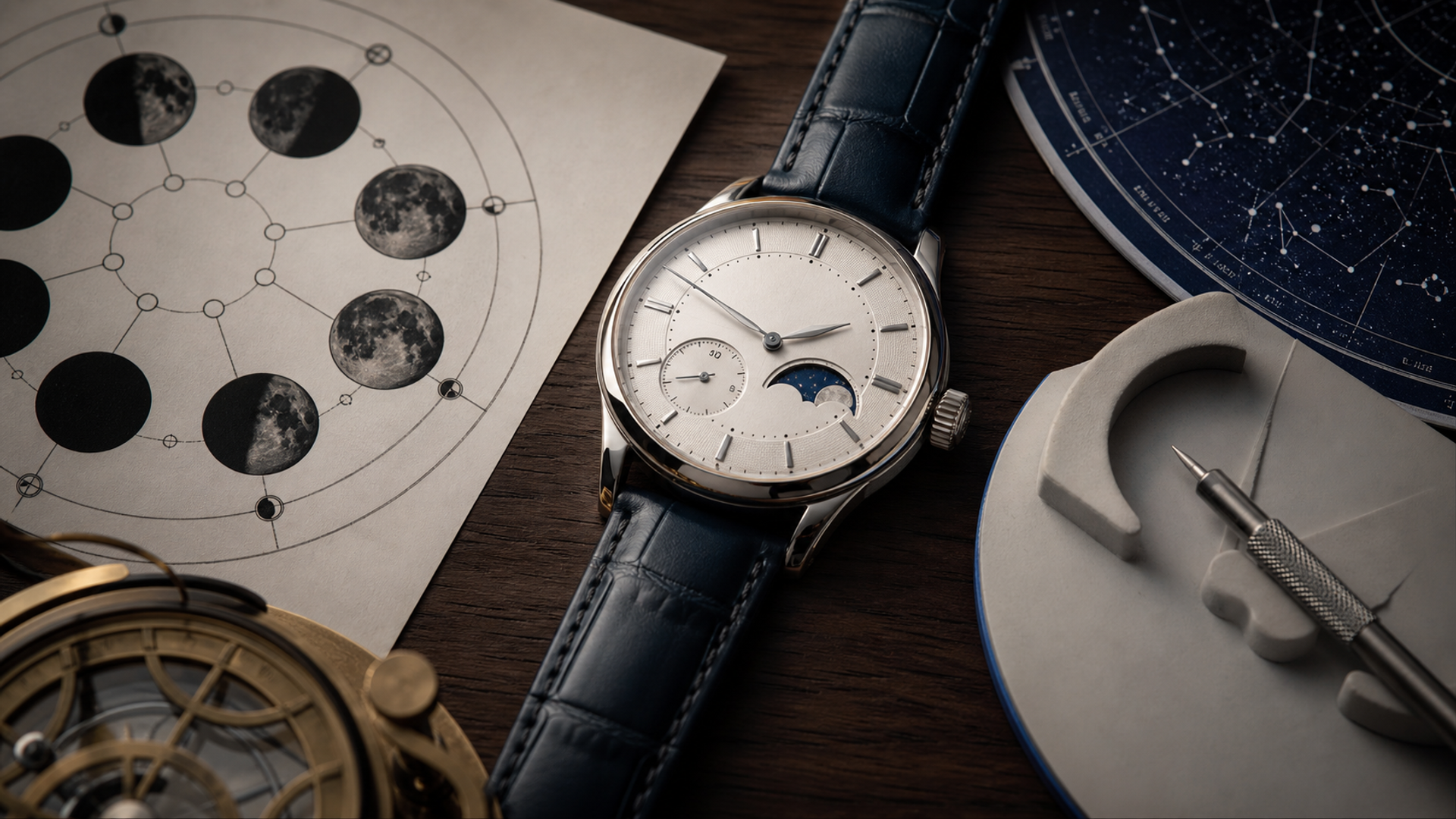
A moon phase watch displays the illuminated portion of the Moon as seen from Earth. In the common design, a disc carrying two moons turns behind a shaped aperture. A 59-tooth mechanism advances once per day, approximating two lunar cycles of about 29.53 days each. The display is romantic, but it is also an exercise in translating astronomy into a compact gear ratio.
Choose a moon phase watch if you enjoy the visual rhythm and will take pleasure in setting it. Do not choose one because it improves timekeeping or provides precise astronomical navigation. Basic mechanisms can drift by roughly one day in a little under three years if kept running; high-accuracy implementations use more elaborate ratios and can remain close for far longer. The manufacturer’s exact specification decides.
Moon phase is also separate from a day/night indicator. A rotating sun-and-moon graphic that changes every 24 hours may show AM and PM without tracking the 29.53-day lunar cycle.
Moon phase mechanisms at a glance
| Type | What you see | Typical mechanism | Ownership implication |
|---|---|---|---|
| Traditional aperture | Moon disc appears and disappears behind two curved humps | Often a 59-tooth wheel carrying two moons | Classic, easy to recognise, modest long-term accuracy |
| Precision moon phase | Similar display with a higher-ratio gear train | Manufacturer-specific wheel counts and correction interval | Less frequent correction if the watch remains running |
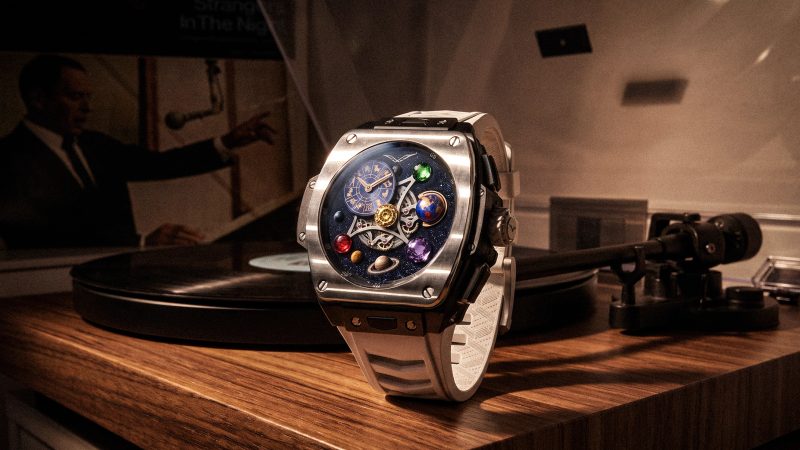
| Orbital or astronomical display | Moon or celestial body moves through a larger dial architecture | Complex, reference-specific mechanism | Spectacle and engineering, usually higher service exposure |
| Day/night indicator | Sun and moon alternate over 24 hours | Linked to the hour cycle, not the synodic month | Useful for setting or dual time, but not a lunar-phase display |
| Digital moon phase | Graphic calculated electronically | Software and sensor clock | Potentially accurate and location-aware, but not a mechanical complication |
Jaeger-LeCoultre’s official moon-phase explanation describes the rotating disc and gear train behind the aperture. That architecture is widespread, but wheel count, setting method and claimed correction interval vary.
Why 59 teeth creates an approximation
The synodic month—the interval from one new moon to the next—is about 29 days, 12 hours, 44 minutes and 3 seconds. A common moon-phase disc shows two moons and completes one rotation in 59 days, making each displayed cycle 29.5 days. The difference is small each month but accumulates.
That does not make the mechanism defective. It is an elegant, durable approximation using an integer tooth count and a daily advance. Precision moon phases introduce a gear ratio closer to the astronomical cycle, sometimes producing correction intervals measured in more than a century. Marketing claims can assume continuous running; if the watch stops, the display still needs resetting regardless of theoretical drift.
Accuracy should be expressed as time to one day of error, not simply “accurate moon phase”. Ask whether the claim refers to the mechanism’s theoretical ratio and whether it assumes one advance at a precise time each day.
How to set a moon phase safely
The exact manual overrides every general method. Calendar and moon-phase gears can be engaged during a night-time change window; operating a corrector then can damage the movement. Some watches have protection, others do not.
A cautious general sequence is:
Read the manual and identify the forbidden correction hours.
Move the hands forward to a safe daytime position specified by the manufacturer, commonly around 6am or another clearly non-changeover time.
Find the date and time of the most recent full moon or new moon from a reliable astronomical source for your location.
Use the correct pusher or crown position to place the display exactly at that phase.
Advance the display by the number of elapsed days, following the manufacturer’s direction and limits.
Set the date, then the current time, observing AM/PM so the calendar changes at midnight rather than noon.
Check the display over the next date change.
Do not press recessed correctors with a pen, knife or improvised metal pin. Use the supplied soft tool. Do not force a crown or advance backwards unless the manual explicitly permits it. If the phase is many months out and the procedure is unclear, ask an authorised retailer to set it.
Full moon reference and the limits of visual setting
Setting from a known full moon is convenient because the disc has an obvious centred position. An astronomical calendar or observatory source provides the date and time. Because the display normally advances in daily steps rather than continuously showing the Moon’s exact illumination, it is not expected to reproduce the sky minute by minute.
Location affects moonrise and what you can see, but the global phase occurs at the same moment. A watch’s phase display is therefore not a moonrise indicator. Some advanced astronomical watches add sunrise, sunset, tide or location-specific functions; verify each separately.
If you want the display aesthetically close rather than astronomically exact, the previous full moon date is usually sufficient. If the watch claims a very long correction interval, take the extra time to set it accurately and record the setting date.
Moon phase plus calendar: more information, more coupling
Moon phase is frequently combined with complete, annual or perpetual calendars. These mechanisms may share correctors or setting sequences, increasing the cost of a mistake. A perpetual calendar can know leap years while the moon phase follows a different gear ratio; the two are mechanically related through the movement but solve different cycles.
When buying a combined watch, ask the salesperson to reset it from a fully stopped state. Watch every step. Identify whether the indications advance together or separately, and ask what happens if one pusher is pressed too many times. A watch that takes fifteen anxious minutes to reset may not suit an occasional rotation.
Our annual versus perpetual calendar guide explains the calendar side of the decision. Do not assume that “perpetual” in the calendar automatically describes the moon-phase correction interval.
Power reserve and watch winders
The most accurate moon phase is wrong after a stopped watch is put on without correction. A long power reserve can carry the watch through a weekend. A winder can keep an automatic watch running, but it must be set for the movement’s winding direction and turns per day, stored securely and used according to manufacturer guidance.
Constant winding does not eliminate service, and an incorrect winder setting can create unnecessary operation. A manual-wind moon phase needs regular attention anyway. Many collectors simply keep the full-moon date in a phone note and enjoy resetting the display when the watch returns to rotation.
That ritual is not a failure of convenience. It may be the point. Decide whether you want continuous display accuracy or occasional interaction before paying for a century-scale gear ratio.
Dial design matters more than the moon painting
Moon-phase displays range from restrained blue discs to engraved gold moons, realistic lunar surfaces and oversized astronomical scenes. Evaluate the complete dial. Can you read the time when the moon aperture is visually dominant? Does the date hand cross the display? Is the phase visible without a loupe? Does the design remain balanced on your wrist size?
Under strong shop lighting, metallic moons and aventurine-like dials can look dramatic. View the watch in ordinary office light and near darkness. Check reflections from the crystal and whether the painted stars appear refined or theatrical with your clothing.
The aperture shape also affects interpretation. The classic double-hump mask approximates waxing and waning, while some displays use a realistic horizon or orbital path. Choose clarity or art deliberately.
Service, setting tools and provenance
A moon-phase module adds parts and setting interfaces. Ask whether the movement is integrated or modular, where it will be serviced, the current expected turnaround and whether calendar repair is included in a normal service estimate. Confirm water-resistance testing after case work.
Keep the corrector tool, manual, setting chart, box and invoices. A missing tool encourages damaging improvisation; a missing manual makes future setting harder. Record the reference and calibre because instructions for a similar-looking model may differ.
Do not polish automatically during service. Case edges and pusher recesses can lose definition. Request the work scope and replacement-parts policy in writing. Moon-phase watches are not guaranteed investments; buy the display and mechanism you will enjoy rather than a forecast.
Buyer scorecard
Score the exact watch from zero to five on:
phase-display legibility;
beauty in normal light;
setting clarity;
protection against setting errors;
theoretical correction interval;
power reserve relative to rotation;
local service confidence;
case fit;
pleasure in the reset ritual.
Double beauty for an art-led purchase. Double setting and service for an everyday watch. Reject a watch if you cannot describe its safe correction window after the demonstration.
Who does not need a moon phase
If you need accurate lunar data for tides, astronomy or field operations, use an appropriate current source and instrument. If you dislike decorative complications, a clean time-only watch will provide more visual calm. If you rotate many watches and hate resetting them, choose a simple movement or a digital implementation.
A moon phase has little practical advantage over a phone. Its value is that the dial turns a slow natural cycle into a daily object. That value can be substantial, but it is personal.
Verdict
A traditional 59-tooth moon phase is worth owning when you enjoy its image and accept occasional correction. A precision mechanism is worth the premium when the engineering story itself matters and the watch will stay running enough to preserve the benefit. Neither should be purchased from the correction interval alone.
The best moon phase watch is the one you can set without fear, read without a loupe and still enjoy when the Moon is not full. Its achievement is not replacing an astronomical app. It is making you notice a month passing.