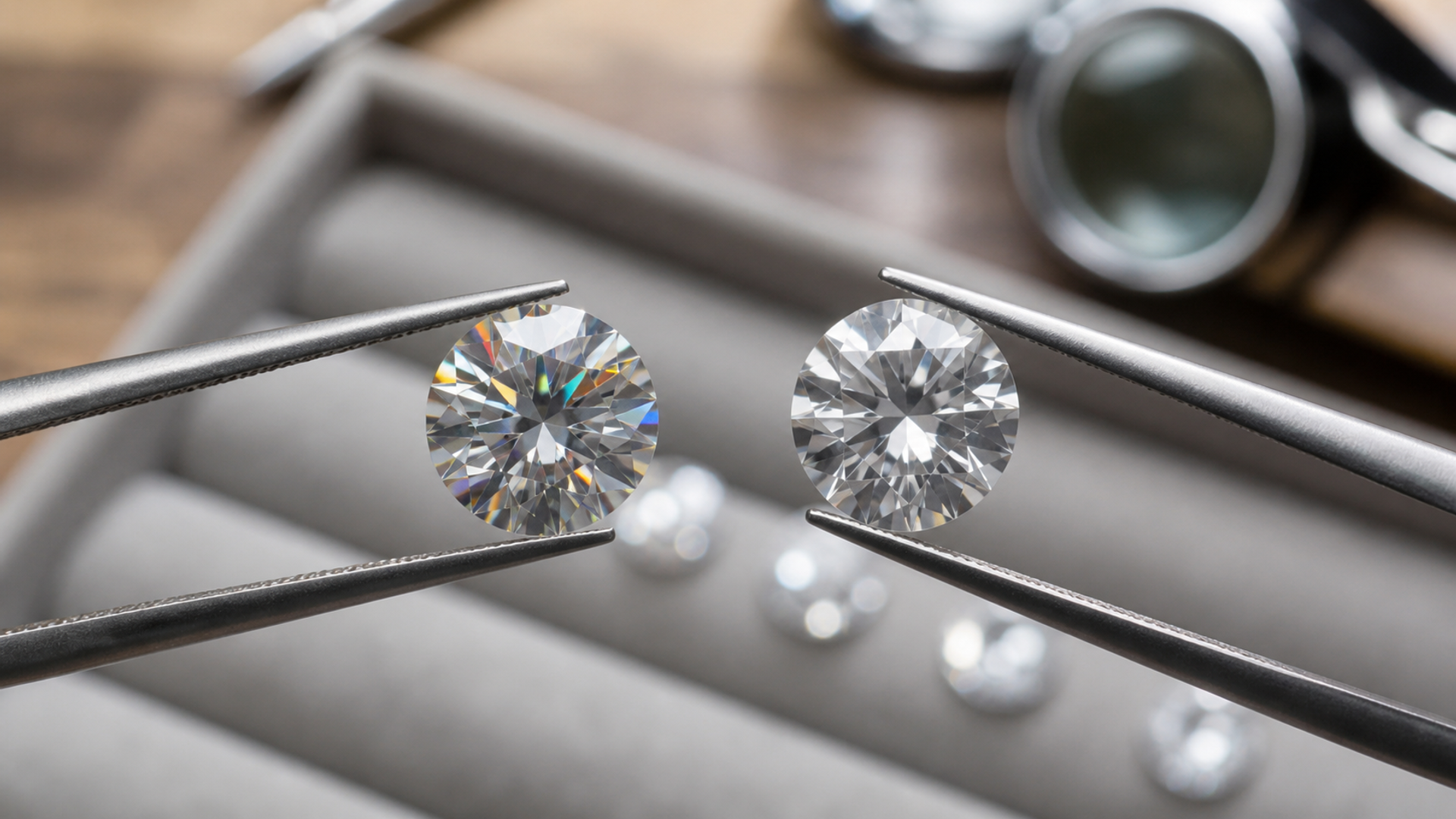
Moissanite and cubic zirconia are distinct manufactured gem materials, not grades of diamond. Synthetic moissanite is silicon carbide and is known for high brilliance, strong dispersion and durable wear. Cubic zirconia is zirconium oxide, often inexpensive, bright and available in many colours, but with different density, hardness and long-term surface behaviour. Neither should be sold as diamond; transparent identification, setting quality and intended wear matter more than a vague claim that one looks real.
Start with the optical character
Choose moissanite when strong rainbow fire, durable frequent wear and a higher-value setting fit the brief. Choose cubic zirconia when low replacement cost, fashion use or a temporary design matters most. Choose another disclosed stone when the wearer wants diamond's optical character, a natural coloured gem or a different durability profile rather than asking either simulant to imitate an identity it does not have.
| Decision factor | Moissanite | Cubic zirconia | Choose another disclosed stone |
|---|---|---|---|
| Optical character | Strong dispersion creates conspicuous fire | Broad bright flashes can look diamond-like at first glance | Compare in daylight and warm indoor light |
| Daily wear | Higher hardness supports frequent wear | Surface wear and scratching may appear sooner | Use protective setting and periodic inspection |
| Weight | Lower density changes size-for-weight feel | Higher density feels heavier at equal dimensions | Compare millimetres, not stated carats |
| Disclosure | Identify synthetic moissanite explicitly | Identify cubic zirconia explicitly | Reject ambiguous diamond language |
| Setting economics | Durable metal and service may be rational | Simple replaceable setting may fit the brief | Do not overspend on a disposable centre |
| Verification | Use a qualified gemmologist and report where warranted | Basic identification may be sufficient for fashion use | Match documentation to the actual stone |
This moissanite vs cubic zirconia matrix is the article's working value object. Read the moissanite vs cubic zirconia rows together: the decisive failure mode depends on this topic's evidence, operating context and reader objective.
Identity and durability are different questions
Evidence 1. GIA describes moissanite and cubic zirconia as diamond imitations with distinct physical and optical properties.
Evidence 2. Synthetic moissanite can show strong double refraction and dispersion, while cubic zirconia differs in density and hardness.
Evidence 3. A generic diamond tester may not be enough for reliable identification across all simulants and mounted stones.
Evidence 4. Material identity does not prove cut quality, setting security, metal fineness, treatment disclosure or commercial value.
Reader-visible sources checked for this article:
gia.edu — reader-visible current or official evidence
gia.edu — reader-visible current or official evidence
For moissanite vs cubic zirconia, these sources establish only the claims inside their documented scope. Recheck every changeable specification, availability condition, price, policy or service term in the relevant market before acting.
Inspect loose stones and finished settings
On optical character, popularity is not enough. The evidence for option one is that strong dispersion creates conspicuous fire. Option two means broad bright flashes can look diamond-like at first glance. Option three is rational where compare in daylight and warm indoor light. Recheck any changeable term immediately before commitment.
The decision changes at daily wear. Choose the first path only if higher hardness supports frequent wear; move to the second when surface wear and scratching may appear sooner; use the third when use protective setting and periodic inspection. Save the downside that would make this row fail.
For weight, the first route works when lower density changes size-for-weight feel; the second requires higher density feels heavier at equal dimensions. The control for the third is compare millimetres, not stated carats. Verify this row against the exact product, property, account or environment before it can reverse the decision.
The disclosure row exposes a practical boundary. Route one assumes identify synthetic moissanite explicitly, while route two is defensible only when identify cubic zirconia explicitly. Route three depends on reject ambiguous diamond language. If that evidence is absent, keep the more reversible option.
Read setting economics as a stop/go test: durable metal and service may be rational supports the first option; simple replaceable setting may fit the brief supports the second; and do not overspend on a disposable centre supports the third. Record which source proves the condition and when it was checked.
A buyer can resolve verification without starting from a brand preference. Ask whether use a qualified gemmologist and report where warranted; compare that with whether basic identification may be sufficient for fashion use; then use match documentation to the actual stone as the third route's safeguard. An unknown condition stays unknown.
Facts that would reverse the current choice
Reversal control 1 — Optical character. Before choosing Moissanite, write down how the decision changes if “Strong dispersion creates conspicuous fire” proves false. Do the same for Cubic zirconia and “Broad bright flashes can look diamond-like at first glance”. Keep the Choose another disclosed stone route available until “Compare in daylight and warm indoor light” is verified. This control belongs to moissanite vs cubic zirconia; update it from the cited source or exact supplier rather than copying a generic checklist.
Reversal control 2 — Daily wear. Before choosing Moissanite, write down how the decision changes if “Higher hardness supports frequent wear” proves false. Do the same for Cubic zirconia and “Surface wear and scratching may appear sooner”. Keep the Choose another disclosed stone route available until “Use protective setting and periodic inspection” is verified. This control belongs to moissanite vs cubic zirconia; update it from the cited source or exact supplier rather than copying a generic checklist.
Reversal control 3 — Weight. Before choosing Moissanite, write down how the decision changes if “Lower density changes size-for-weight feel” proves false. Do the same for Cubic zirconia and “Higher density feels heavier at equal dimensions”. Keep the Choose another disclosed stone route available until “Compare millimetres, not stated carats” is verified. This control belongs to moissanite vs cubic zirconia; update it from the cited source or exact supplier rather than copying a generic checklist.
Reversal control 4 — Disclosure. Before choosing Moissanite, write down how the decision changes if “Identify synthetic moissanite explicitly” proves false. Do the same for Cubic zirconia and “Identify cubic zirconia explicitly”. Keep the Choose another disclosed stone route available until “Reject ambiguous diamond language” is verified. This control belongs to moissanite vs cubic zirconia; update it from the cited source or exact supplier rather than copying a generic checklist.
Reversal control 5 — Setting economics. Before choosing Moissanite, write down how the decision changes if “Durable metal and service may be rational” proves false. Do the same for Cubic zirconia and “Simple replaceable setting may fit the brief”. Keep the Choose another disclosed stone route available until “Do not overspend on a disposable centre” is verified. This control belongs to moissanite vs cubic zirconia; update it from the cited source or exact supplier rather than copying a generic checklist.
Reversal control 6 — Verification. Before choosing Moissanite, write down how the decision changes if “Use a qualified gemmologist and report where warranted” proves false. Do the same for Cubic zirconia and “Basic identification may be sufficient for fashion use”. Keep the Choose another disclosed stone route available until “Match documentation to the actual stone” is verified. This control belongs to moissanite vs cubic zirconia; update it from the cited source or exact supplier rather than copying a generic checklist.
Define the visual brief
Decide whether the wearer wants white brilliance, rainbow fire, a restrained diamond-like look or a coloured design. View comparable sizes face-up, tilted and moving under daylight, spot and warm room light. Record the exact product, material, room, garment, vehicle, water report or operating condition and the time of the check. Separate observed behaviour from marketing language, and repeat the comparison in the intended setting rather than an ideal demonstration. If the preferred look disappears outside jewellery lighting, reject that individual stone. Preserve the evidence that would reverse the choice: a change in fit, specification, maintenance, safety, price or environment must reopen the decision rather than inherit an old conclusion.
Verify identity
Ask for the material name in writing and reconcile any report, invoice and laser inscription. Use a competent gemmologist when value, resale, insurance or a complex mounted stone justifies it. Record the exact product, material, room, garment, vehicle, water report or operating condition and the time of the check. Separate observed behaviour from marketing language, and repeat the comparison in the intended setting rather than an ideal demonstration. If the seller uses only diamond-equivalent language, pause the purchase. Preserve the evidence that would reverse the choice: a change in fit, specification, maintenance, safety, price or environment must reopen the decision rather than inherit an old conclusion.
Engineer the setting
Inspect prongs, girdle clearance, gallery, metal fineness and access for cleaning. Check whether replacement dimensions are standard and whether the maker will service a non-diamond centre. Record the exact product, material, room, garment, vehicle, water report or operating condition and the time of the check. Separate observed behaviour from marketing language, and repeat the comparison in the intended setting rather than an ideal demonstration. If the setting cost cannot be supported by the stone's intended life, redesign it. Preserve the evidence that would reverse the choice: a change in fit, specification, maintenance, safety, price or environment must reopen the decision rather than inherit an old conclusion.
Model ownership
Compare cleaning, inspection, insurance, replacement and emotional expectations over the intended wear period. Document whether the piece is heirloom, daily, travel, fashion or proposal jewellery. Record the exact product, material, room, garment, vehicle, water report or operating condition and the time of the check. Separate observed behaviour from marketing language, and repeat the comparison in the intended setting rather than an ideal demonstration. If the wearer expects diamond identity or resale, neither simulant should be presented as a substitute fact. Preserve the evidence that would reverse the choice: a change in fit, specification, maintenance, safety, price or environment must reopen the decision rather than inherit an old conclusion.
Three jewellery briefs, three answers
Daily engagement ring with visible fire
Well-cut moissanite in a secure setting can fit the brief. Define the fact that would reverse this recommendation before committing.
Low-cost travel or fashion piece
Cubic zirconia can make replacement risk manageable. Define the fact that would reverse this recommendation before committing.
Heirloom purchase centred on provenance
A different documented gemstone may be the honest answer. Define the fact that would reverse this recommendation before committing.
Action checklist
Name the material.
Set visual brief.
Compare equal dimensions.
View three lights.
Inspect setting.
Verify metal.
Ask service policy.
Price replacement.
Keep documentation.
Reject ambiguous disclosure.
Continue the decision
The linked VERTU articles expand adjacent parts of the moissanite vs cubic zirconia decision. They do not substitute for the external evidence above.
The moissanite-versus-CZ verdict
Choose moissanite when strong rainbow fire, durable frequent wear and a higher-value setting fit the brief. Choose cubic zirconia when low replacement cost, fashion use or a temporary design matters most. Choose another disclosed stone when the wearer wants diamond's optical character, a natural coloured gem or a different durability profile rather than asking either simulant to imitate an identity it does not have.
Keep the moissanite vs cubic zirconia decision reversible until its material cost, safety, access, privacy and compatibility facts are verified. Unknown evidence stays unknown; it is never silently scored as favourable.