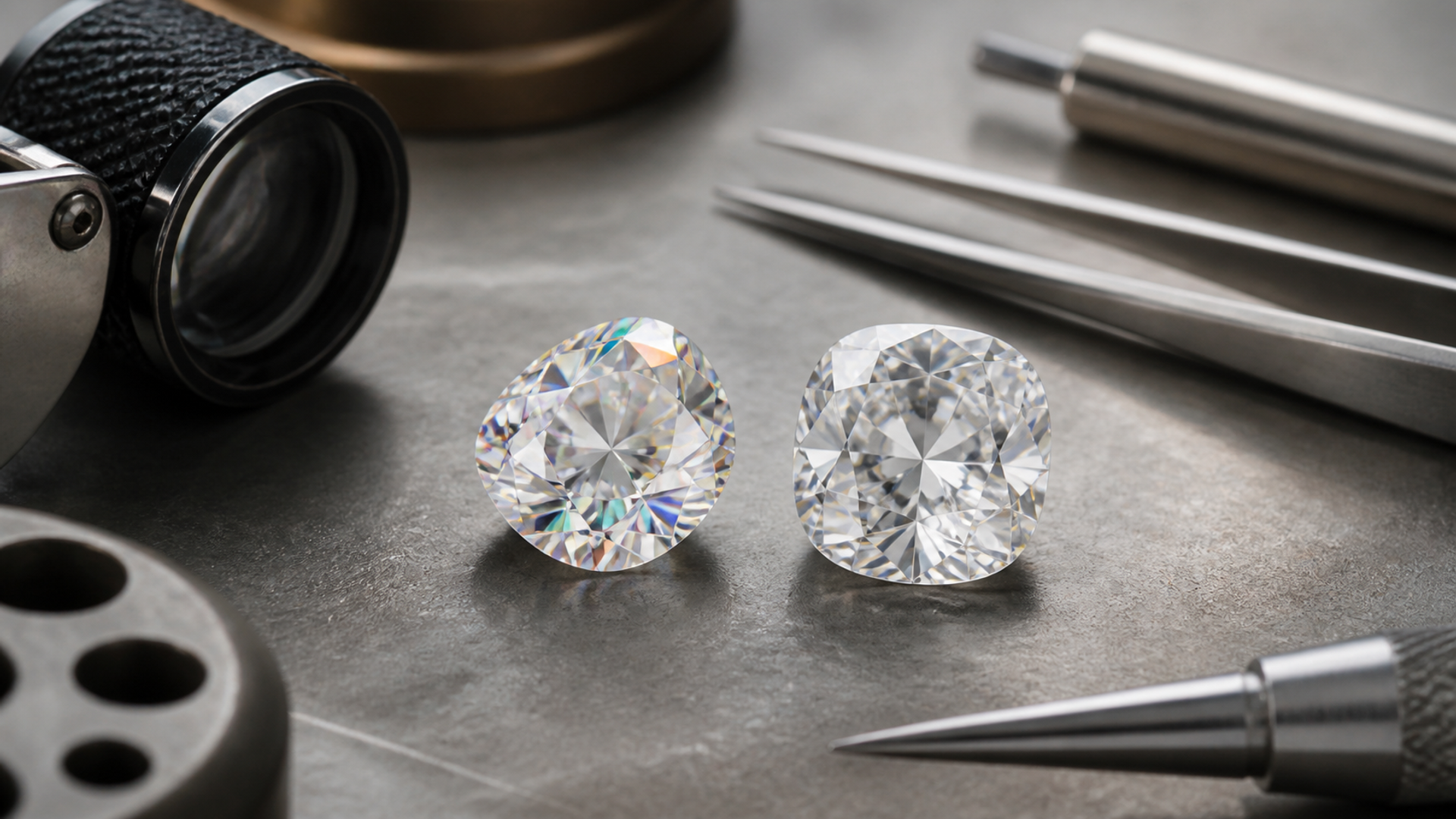
Moissanite and laboratory-grown diamond can both create a bright colourless centre stone, but they are not the same material and do not produce the same optical character. The best choice is not a referendum on whether one is ‘real’; it is a decision about composition, fire, grading, setting security, replacement cost and what the buyer wants the jewellery to represent.
Name the material before choosing
Choose moissanite when high fire, generous face-up size and a lower replacement cost matter most. Choose a laboratory-grown diamond when diamond composition, diamond grading and more familiar brilliance matter. Rebalance size and setting when durability, daily wear or budget would otherwise be compromised.
| Decision factor | Moissanite | Lab-grown diamond | Rebalance size and setting |
|---|---|---|---|
| Material identity | Silicon carbide simulant | Laboratory-grown carbon crystal | Verify stone and report before setting |
| Light return | More coloured fire is welcome | Diamond-like brilliance is preferred | View both in daylight and indoor light |
| Documentation | Seller disclosure is sufficient for the budget | Independent laboratory report matters | Match inscription, report and invoice |
| Setting | Prongs protect the chosen dimensions | Diamond setting suits the exact cut | Allocate budget to secure construction |
| Replacement risk | Lower replacement cost matters | Diamond identity matters more | Insure or keep reserve budget |
| Budget allocation | More visual size leads | Cut and report lead | Reduce carat before reducing cut quality |
This moissanite vs lab grown diamond matrix is the article's working value object. Read the moissanite vs lab grown diamond rows together: the decisive failure mode depends on this topic's evidence, operating context and reader objective.
What gem evidence establishes
Evidence 1. GIA distinguishes moissanite as a diamond simulant with a different atomic structure from diamond.
Evidence 2. GIA describes laboratory-grown diamonds as having the same carbon crystal structure as natural diamonds while being produced by HPHT or CVD growth.
Evidence 3. Visual appearance alone is not a reliable identity test; scientific screening and a matched report provide stronger evidence.
Evidence 4. A centre-stone decision should include the setting, prong condition and replacement plan rather than treating the loose stone as the whole purchase.
Reader-visible sources checked for this article:
discover.gia.edu — reader-visible current or official evidence
gia.edu — reader-visible current or official evidence
For moissanite vs lab grown diamond, these sources establish only the claims inside their documented scope. Recheck every changeable specification, availability condition, price, policy or service term in the relevant market before acting.
Balance optics, setting and ownership
The material identity row exposes a practical boundary. Route one assumes silicon carbide simulant, while route two is defensible only when laboratory-grown carbon crystal. Route three depends on verify stone and report before setting. If that evidence is absent, keep the more reversible option.
Read light return as a stop/go test: more coloured fire is welcome supports the first option; diamond-like brilliance is preferred supports the second; and view both in daylight and indoor light supports the third. Record which source proves the condition and when it was checked.
A buyer can resolve documentation without starting from a brand preference. Ask whether seller disclosure is sufficient for the budget; compare that with whether independent laboratory report matters; then use match inscription, report and invoice as the third route's safeguard. An unknown condition stays unknown.
On setting, popularity is not enough. The evidence for option one is that prongs protect the chosen dimensions. Option two means diamond setting suits the exact cut. Option three is rational where allocate budget to secure construction. Recheck any changeable term immediately before commitment.
The decision changes at replacement risk. Choose the first path only if lower replacement cost matters; move to the second when diamond identity matters more; use the third when insure or keep reserve budget. Save the downside that would make this row fail.
For budget allocation, the first route works when more visual size leads; the second requires cut and report lead. The control for the third is reduce carat before reducing cut quality. Verify this row against the exact product, property, account or environment before it can reverse the decision.
Facts that would reverse the current choice
Reversal control 1 — Material identity. Before choosing Moissanite, write down how the decision changes if “Silicon carbide simulant” proves false. Do the same for Lab-grown diamond and “Laboratory-grown carbon crystal”. Keep the Rebalance size and setting route available until “Verify stone and report before setting” is verified. This control belongs to moissanite vs lab grown diamond; update it from the cited source or exact supplier rather than copying a generic checklist.
Reversal control 2 — Light return. Before choosing Moissanite, write down how the decision changes if “More coloured fire is welcome” proves false. Do the same for Lab-grown diamond and “Diamond-like brilliance is preferred”. Keep the Rebalance size and setting route available until “View both in daylight and indoor light” is verified. This control belongs to moissanite vs lab grown diamond; update it from the cited source or exact supplier rather than copying a generic checklist.
Reversal control 3 — Documentation. Before choosing Moissanite, write down how the decision changes if “Seller disclosure is sufficient for the budget” proves false. Do the same for Lab-grown diamond and “Independent laboratory report matters”. Keep the Rebalance size and setting route available until “Match inscription, report and invoice” is verified. This control belongs to moissanite vs lab grown diamond; update it from the cited source or exact supplier rather than copying a generic checklist.
Reversal control 4 — Setting. Before choosing Moissanite, write down how the decision changes if “Prongs protect the chosen dimensions” proves false. Do the same for Lab-grown diamond and “Diamond setting suits the exact cut”. Keep the Rebalance size and setting route available until “Allocate budget to secure construction” is verified. This control belongs to moissanite vs lab grown diamond; update it from the cited source or exact supplier rather than copying a generic checklist.
Reversal control 5 — Replacement risk. Before choosing Moissanite, write down how the decision changes if “Lower replacement cost matters” proves false. Do the same for Lab-grown diamond and “Diamond identity matters more”. Keep the Rebalance size and setting route available until “Insure or keep reserve budget” is verified. This control belongs to moissanite vs lab grown diamond; update it from the cited source or exact supplier rather than copying a generic checklist.
Reversal control 6 — Budget allocation. Before choosing Moissanite, write down how the decision changes if “More visual size leads” proves false. Do the same for Lab-grown diamond and “Cut and report lead”. Keep the Rebalance size and setting route available until “Reduce carat before reducing cut quality” is verified. This control belongs to moissanite vs lab grown diamond; update it from the cited source or exact supplier rather than copying a generic checklist.
Compare the optical character in ordinary light
View both candidates away from jewellery spotlights. Rotate them in daylight, warm indoor light and lower light. Moissanite can show more rainbow fire; a diamond may show a different balance of white brilliance and fire. Preference is legitimate, but it should be based on the exact stones rather than a category photograph.
Audit identity and documentation
Ask what the stone is, who identified it, whether it has a report and whether any inscription matches that report. Keep the invoice language precise. A laboratory-grown diamond is a diamond of laboratory origin; moissanite is a different gem material. Clear documentation protects maintenance, insurance and later resale conversations.
Build the setting around the stone
Ask the jeweller to assess girdle, cut, dimensions, prong geometry and wear pattern. A larger face-up stone changes leverage and exposure. Halo, bezel and prong settings create different cleaning and inspection needs. Budget for workmanship before using every available pound or dollar on apparent size.
Plan ownership without promising resale
Prices, supply and second-hand demand can change. Buy for wear and fit first. Record the report, metal, ring size and service history; schedule inspections appropriate to the setting. Treat any future value estimate as variable rather than a guaranteed return.
Three stone-buying situations
Maximum visual presence
Moissanite can suit a buyer who enjoys lively fire and wants a larger look without diverting budget from the setting. Define the fact that would reverse this recommendation before committing.
Diamond identity without mined origin
A laboratory-grown diamond fits when carbon crystal identity and diamond grading are central. Define the fact that would reverse this recommendation before committing.
Daily-wear priority
A smaller well-cut stone in a secure setting can be the better luxury decision than maximum face-up size. Define the fact that would reverse this recommendation before committing.
Action checklist
View exact stones in mixed lighting.
Confirm material identity in writing.
Match report and inscription where present.
Compare face-up millimetres, not carat alone.
Inspect cut and girdle.
Choose setting for daily wear.
Price future prong checks and cleaning.
Record metal and ring size.
Avoid guaranteed resale claims.
Keep documentation together.
Continue the decision
The linked VERTU articles expand adjacent parts of the moissanite vs lab grown diamond decision. They do not substitute for the external evidence above.
The stone verdict
Choose moissanite when high fire, generous face-up size and a lower replacement cost matter most. Choose a laboratory-grown diamond when diamond composition, diamond grading and more familiar brilliance matter. Rebalance size and setting when durability, daily wear or budget would otherwise be compromised.
Keep the moissanite vs lab grown diamond decision reversible until its material cost, safety, access, privacy and compatibility facts are verified. Unknown evidence stays unknown; it is never silently scored as favourable.