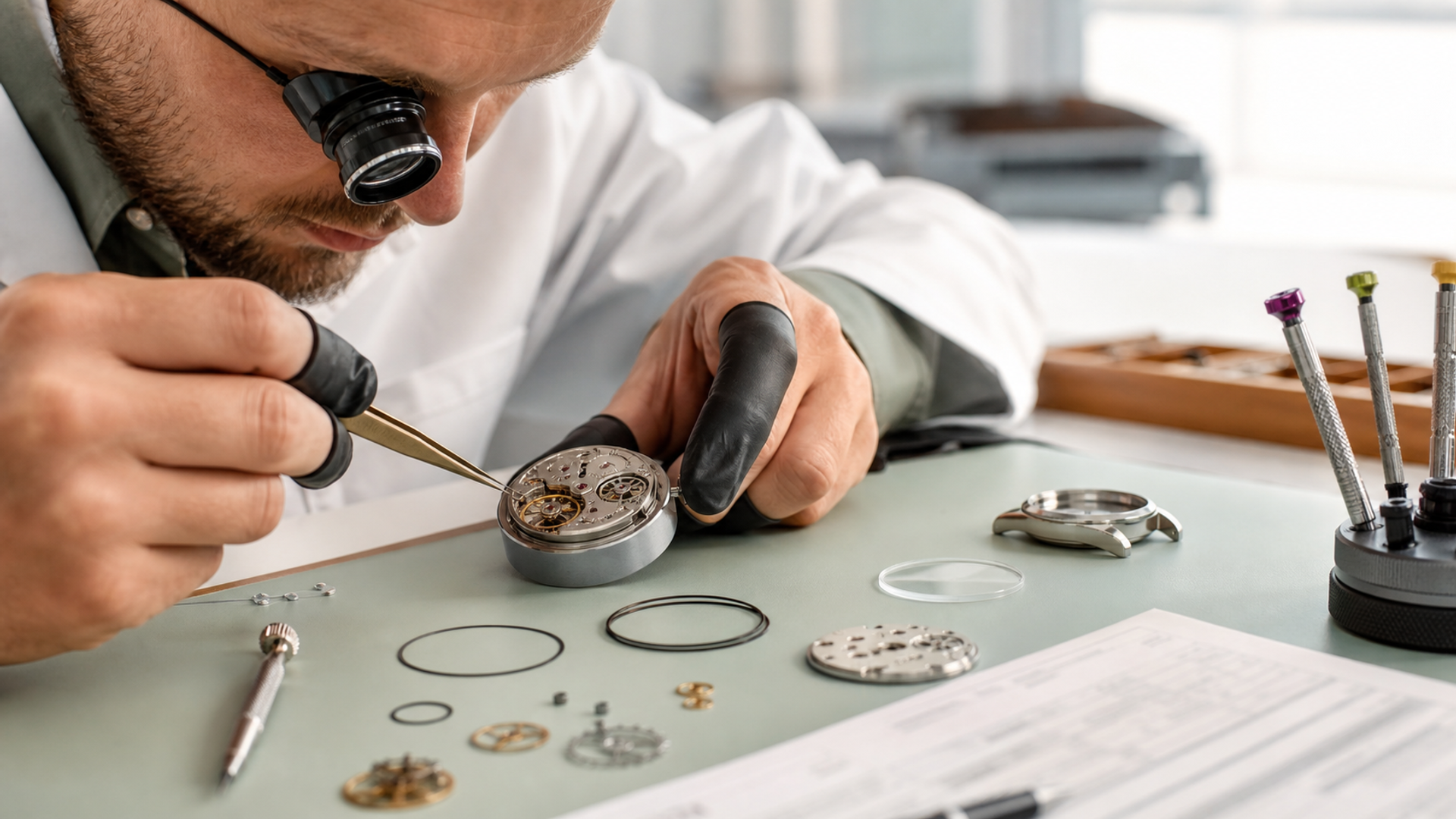
Using official tariffs observed on 22 July 2026, a sensible planning range is £230–£600 for a current quartz or straightforward mechanical full service, rising to roughly £460–£1,420 when chronographs, in-house calibres and haute horlogerie enter the job. Vintage restoration, serious damage and grand complications are often quote-only. These are budgeting bands drawn from dated manufacturer examples, not a universal market price list.
Nor is there one correct service interval. Current manufacturer guidance ranges from about five or six years to approximately ten years, and every brand qualifies its advice by model, use, condition or symptoms. The practical answer is to begin with the maker's guidance, keep a reserve based on the movement and service channel, and act sooner when accuracy, winding, power reserve, water resistance or visible moisture changes.
The short ownership decision: identify the exact movement, choose the service channel before setting the budget, add a transparent uncertainty reserve, and approve work only after receiving an itemised estimate. The cost of servicing is not just a workshop fee; it is a controlled decision about parts, originality, water resistance, finish and future serviceability.
Luxury watch service cost: a 2026 range model
Published prices are useful anchors, but only if their inclusions and currencies remain visible. The Longines UK service-pricing table, for example, listed full service at £230 for a two- or three-hand quartz watch, £350 for a mechanical watch with small complications and £460 for a mechanical chronograph or great complication when observed on 22 July 2026. VAT was included; shipping and additional components were not.
TAG Heuer's March 2026 UK service tariff showed £270 for a quartz complete service, £410 for a mechanical watch, £495 for a mechanical chronograph, £600 for an in-house or COSC mechanical calibre and £1,420 for haute horlogerie. Its vintage table ran from £645 for quartz to £1,365 for mechanical, before an optional £370 case-and-bracelet refurbishment. The document calls the figures non-binding and sends unlisted repairs or parts to an estimate.
At the upper end, Patek Philippe's service-cost schedule listed maximum public prices, excluding tax, of CHF 600 for quartz, CHF 900 for manual-wind mechanical, CHF 1,000 for self-winding mechanical, and CHF 1,500–CHF 2,700 across three complication levels. Grand complications and watches over 20 years old were on request. Those Swiss-franc figures should not be silently converted into pounds: exchange rates, tax and local service arrangements change the payable total.
Official price anchors observed on 22 July 2026
| Movement or job | Dated official example | What the figure does not settle |
|---|---|---|
| Current quartz, simple display | Longines UK £230; TAG Heuer UK £270 | Battery leakage, damaged electronics, case work and non-standard parts can change the quote. |
| Quartz chronograph | Longines UK £330; TAG Heuer UK £355 | The tariff is brand- and calibre-specific, not a sector-wide rate. |
| Current simple mechanical | Longines UK £350; TAG Heuer UK £410 | An in-house calibre, visible damage or parts outside the standard package can move the price. |
| Mechanical chronograph | Longines UK £460; TAG Heuer UK £495 | More complex or manufacture calibres may sit in a different service category. |
| In-house/COSC mechanical | TAG Heuer UK £600 | This category belongs to one manufacturer's tariff and cannot price another brand by analogy. |
| Haute horlogerie or advanced complication | TAG Heuer UK £1,420; Patek Philippe CHF 1,500–CHF 2,700 | Currency, tax, exact complication and required components remain decisive. |
| Vintage mechanical or restoration | TAG Heuer UK £1,365 for vintage mechanical; Patek Philippe over-20-year watches on request | Dial, hands, case geometry, scarce parts and conservation choices require an individual scope. |
These examples reveal the shape of the cost curve: movement architecture establishes the first band; complication and age can move the watch to a specialist bench; condition and parts determine how far the final estimate travels beyond the listed service.
The five-input service-cost model
Use the following as a planning worksheet. “Reserve” means money set aside by the owner, not a prediction that the workshop will charge it.
| Cost input | How to model it | Planning treatment |
|---|---|---|
| 1. Movement | Start with a current official tariff for the exact reference where available. If not, use the nearest same-brand movement category only as a provisional band. | Current quartz examples: £230–£355. Current straightforward mechanical examples: £350–£410. Do not transfer these bands to an unlisted brand as if they were its quote. |
| 2. Complication | Replace the simple-movement band with the relevant chronograph, manufacture-calibre or haute-horlogerie band; do not add both bands together. | Published examples move from £460–£600 for mechanical chronograph/in-house categories to £1,420 or CHF 1,500–CHF 2,700 for higher complication tiers. |
| 3. Condition | Add an owner-chosen contingency when service history is absent, performance has deteriorated or impact/moisture is suspected. | A 20% cash reserve is a cautious personal budgeting rule used in the worked examples below. It is not a manufacturer fee or an estimate of likely damage. |
| 4. Parts and finish | Read what the base service includes, then leave separately quoted components, dial work, crystal, bracelet, case repair and optional polishing outside the base. | Use the actual written quote. Do not assume “full service” makes every cosmetic or structural part inclusive. |
| 5. Service channel | Manufacturer/authorised network: use its tariff or inspection estimate. Independent specialist: use that workshop's written scope. Restoration atelier: treat as quote-only. | Apply no automatic “independent discount”. Parts access, tooling, warranty, forwarding fees, insurance and conservation skill matter more than a generic multiplier. |
The calculation is deliberately simple:
Planned service cash = selected movement/complication band + owner-chosen condition reserve + separately quoted parts/finish + tax and uninsured logistics
Suppose a current in-house mechanical watch maps to TAG Heuer's £600 example. A 20% owner reserve adds £120, producing a £720 planning balance before separately quoted parts or logistics. If inspection finds no extras, the reserve remains yours. If the watch has impact damage, corrosion or scarce components, £720 is not a cap; only the accepted estimate is.
For a high complication, the same method must stay in the quoted currency. Patek Philippe's CHF 2,100 Complication II example plus a 20% owner reserve is CHF 2,520 before local tax and chargeable extras. That arithmetic is a liquidity plan, not a prediction of what any particular reference will cost.
Why the estimate can depart from the tariff
A service tariff normally assumes a defined maintenance package. Longines says its full service includes movement disassembly or replacement, cleaning, reassembly, oiling, worn spare parts, water-resistance work where applicable and testing, yet it also states that additional components are charged separately. TAG Heuer's tariff includes wearing components and consumables within its stated overhaul but sends unlisted repairs or parts to an estimate. Patek Philippe includes a specified set of routinely replaced supplies and certain components where necessary, while dial, bracelet or crystal may cost extra.
Condition changes the job because two visually similar watches can arrive with different histories. One may need routine lubrication and seals; another may have water ingress, an impact-distorted component or an earlier intervention that altered the movement. Rolex therefore does not publish a single service price on its consumer FAQ: it says cost depends on the service required and the state of the watch, with an estimate issued after evaluation. That Rolex service guidance is a useful reminder that diagnosis precedes approval.
Cosmetic work also needs its own decision. A service may include refinishing, offer it as an option or exclude it. Patek Philippe lists case and bracelet refreshing separately; TAG Heuer includes metal-surface refurbishment in its modern complete service but prices vintage refurbishment as an additional operation. A collector who wants edges, engraving, patina or prior finishing preserved should put that instruction in writing before the watch reaches the polishing stage.
Finally, a starting price is not a total-cost guarantee. Cartier's Netherlands schedule, for example, showed a complete service from €430, while restoration was estimate-only and polishing started at €425. “From”, “maximum”, “non-binding” and “subject to change” are not small-print noise; they define how the figure may be used.
There is no universal luxury-watch service interval
The idea that every mechanical watch must be serviced on the same anniversary is not supported by manufacturers' own guidance.
Longines recommends a full service every six to eight years to optimise reliability and lifespan. TAG Heuer says the interval depends on wear and storage, then gives approximately five to six years or sooner when there is a malfunction. Breitling's current after-sales guidance recommends a complete service every four to six years and a lighter maintenance service every two years. Rolex recommends approximately ten years, depending on model and real-life use.
Those intervals are brand guidance for their watches, not competing universal laws. A modern sealed watch worn at a desk, a frequently immersed dive watch, a manually wound vintage piece and a minute repeater do not share one risk profile. The model's instructions, warranty terms and service centre advice should take precedence over an internet rule of thumb.
Water-resistance checks can also run on a different cadence from a movement overhaul. TAG Heuer advises a water-resistance test every two years for watches regularly exposed to water because seals age. Passing such a test does not prove the movement needs no future service; failing it does not automatically establish the scope of a full overhaul. It answers a narrower question about the case's current sealing performance.
Signals that justify an earlier inspection
Do not wait for a calendar date when the watch gives a reason to investigate:
condensation or visible moisture under the crystal;
a sudden or sustained change from the watch's established timekeeping pattern;
materially shorter power reserve under comparable winding and use;
rough winding, abnormal resistance or difficulty setting functions;
a chronograph that fails to start, stop or reset normally;
impact damage, a loose crown or pusher, or a failed water-resistance test;
a depleted quartz battery, especially if the watch will be stored.
These signs do not diagnose the fault. They justify stopping risky use and asking a qualified service provider to inspect it. Moisture, in particular, turns a future maintenance decision into a prompt assessment rather than a wait-until-the-anniversary exercise.
Choose the service channel before comparing prices
The cheapest headline is not necessarily the lowest-risk route, and the manufacturer is not automatically the best answer for every vintage conservation problem. Define the ownership objective first.
Manufacturer or authorised service network. This route offers brand procedures, specified parts access, reference-specific tooling and a service warranty under that network's terms. It is often the clearest choice for a modern watch under warranty, a proprietary calibre, a complex case or a watch whose future buyer will value official records. Patek Philippe states that its two-year service warranty expires after interventions by unauthorised third parties; other brands have their own terms, which should be checked rather than assumed.
Authorised retailer or intake point. Ask whether the watch is serviced on site, forwarded to the manufacturer or sent to another approved workshop. The answer affects lead time, communication, shipping, insurance and potentially the estimate. Confirm who issues the warranty and who has authority to approve additions.
Independent specialist. A credible specialist may be appropriate for a widely serviceable calibre, a vintage watch needing a conservation-led approach or an owner who wants closer communication with the bench. Request evidence of experience with the exact calibre, parts access, pressure-testing capability where relevant, insurance, warranty and a documented parts/finish policy. Do not budget an assumed percentage saving; use the specialist's written quote.
Manufacture restoration or rare-complication atelier. Treat this as its own project. Archival research, hand-made components, dial conservation and case work can alter both price and time. The correct budget state is “estimate pending”, not the top of a generic online range.
Approve the scope, not just the total
Before authorising work, turn the estimate into a record that another owner—or you five years later—can understand.
Confirm the reference, serial number and movement or calibre recorded at intake.
Separate the base movement service from required parts, optional parts and cosmetic work.
Mark polishing or refinishing as accepted, declined or subject to a second approval.
Ask which seals, crowns, pushers, hands or other components are included in the base category.
Set a maximum authorised amount and require approval before exceeding it.
Record expected lead time, shipping method, transit insurance and liability limits.
Ask what happens, and whether a reassembly or estimate fee applies, if you decline the work.
Require post-service test results appropriate to the watch, plus the written service warranty.
Retain the estimate, final invoice, service description and dated photographs with the watch's records.
For collector-sensitive watches, add instructions about returning replaced parts where the provider's policy and law permit, preserving the dial and hands, and avoiding case work without consent. A workshop may be unable to return some exchange parts, so the useful step is to clarify the policy before approval, not argue after completion.
Turn the next service into an ownership budget
A service reserve is more useful than a vague fear of a four-figure invoice. Once you select a defensible planning total, divide it by your chosen funding period—not by a claimed universal service interval.
If the planning balance is £720 and you want it available in six years, save £10 per month. A £1,420 haute-horlogerie example funded over five years requires about £23.67 per month. These are cash-flow scenarios: an earlier fault may accelerate the spend, while a later service leaves the reserve intact.
The service line also belongs inside the broader ownership picture. Insurance, secure storage, straps, authentication, shipping and transaction costs can exceed or arrive before movement work. Our five-year luxury-watch ownership budget places those costs beside servicing so a buyer can judge the whole commitment rather than the purchase price alone.
Review the reserve annually against current official tariffs, especially when the watch is complicated, vintage or serviced in another currency. Do not convert a 2026 page into a permanent promise. The model remains useful because its inputs can be replaced: new tariff, current condition, actual parts quote, chosen channel and present tax/logistics.
The ownership answer
There is no single luxury watch service cost and no interval that fits every watch. Dated 2026 manufacturer examples support a practical starting map—from the low hundreds for straightforward current watches to four figures for haute horlogerie, with vintage, damage and grand complications moving to individual estimates. The defensible number is the one built from the exact movement, complication, condition, parts scope and service channel.
Set the reserve, monitor the watch, and insist on an itemised approval. That approach protects cash flow without pretending the future can be priced to the pound—and protects the watch by making technical and conservation choices explicit before work begins.