The first luxury-watch budget is usually built around the price in the window. Ownership begins after that number. Insurance, a bracelet adjustment, a second strap, pressure testing, routine service, accidental damage, secure storage and the spread between buying and selling can exceed the amount a new collector expects. A discounted watch can be expensive to own; a more costly watch with strong service support can be easier to keep.
A five-year ledger does not predict the future or turn a personal object into an investment. It makes the hidden obligations visible before purchase. It also forces a buyer to distinguish maintenance that preserves function from cosmetic work that may alter collector value. The result is a more honest affordability test: not ‘Can I pay today?’ but ‘Can I own, protect and eventually exit this watch without compromising the reasons I bought it?’
> The short answer: Set aside purchase price plus a documented five-year reserve for service, insurance, fit, storage and transaction costs. If the watch is only affordable when service, damage and resale spread are assumed to be zero, it is not comfortably affordable.
What is confirmed, and what is not
Rolex currently recommends professional servicing approximately every ten years depending on model and real-life use, while noting that cost follows assessment and a full overhaul can take at least four to six weeks. Other brands, complications and vintage pieces follow different schedules. A five-year budget should therefore model a reserve rather than invent a universal service date.
The ledger is not a recommendation to polish, replace parts or open a watch unnecessarily. Manufacturer, independent specialist and collector priorities can diverge. For a vintage or rare example, agree in writing what may be replaced or refinished before authorising work.
five-year watch ownership ledger
| Check | Evidence or current signal | Decision use |
|---|---|---|
| Acquisition basis | All-in purchase price, tax, currency, buyer fee, shipping and initial inspection | Record cost basis |
| Service reserve | Brand or specialist guidance, complication, age, history and actual symptoms | Fund uncertainty |
| Water-resistance and testing | Use case and current pressure-test evidence | Separate from full service |
| Insurance | Agreed or replacement value, geographic scope, unattended-item clauses and excess | Read policy wording |
| Fit, straps and accessories | Bracelet sizing, links, clasp, strap life and tool requirements | Price actual wear |
| Storage and travel | Home security, humidity, magnetism, transport and wearing pattern | Budget the system |
| Cosmetic intervention | Written instruction covers polishing, dial, hands, crown, crystal and replaced parts | Collector-value gate |
| Exit spread | Realistic net resale after dealer margin, auction fee, consignment and market movement | Do not call it guaranteed value |
A strong score in one row cannot cancel a hard failure in identity, safety, permission or recovery. Date every fact that can change and keep market, account, device or object configuration attached to the evidence.
Acquisition basis
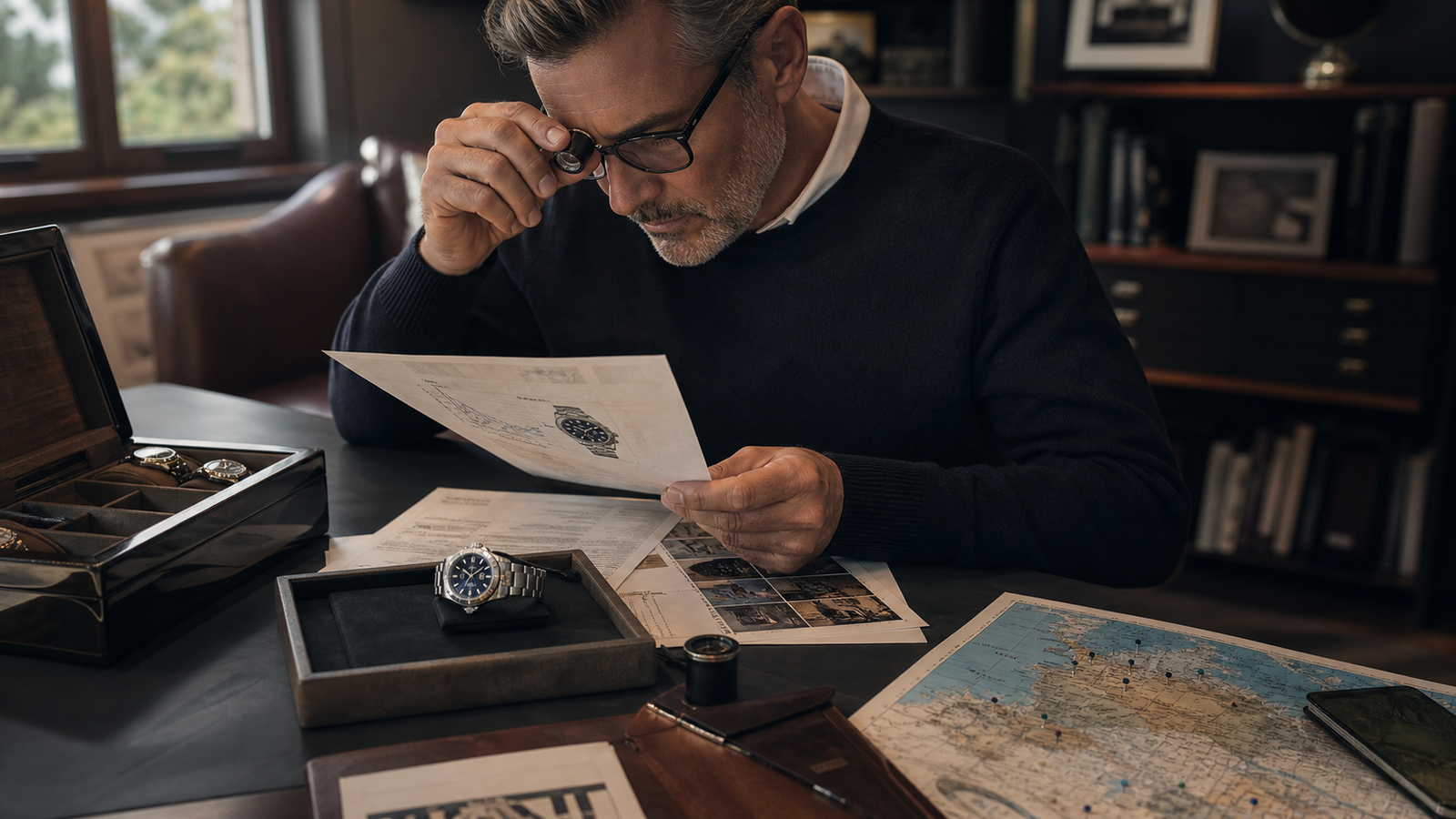
Use the amount required to put the correct watch safely on your wrist, not the hammer or sticker alone. Include auction premium, import charges, card or exchange-rate cost, insured delivery and an independent inspection if appropriate. Keep invoice, serial and condition evidence privately. For a used watch, price any immediately necessary service rather than treating it as a surprise in year one.
Decision use: Record cost basis. Evidence to keep: All-in purchase price, tax, currency, buyer fee, shipping and initial inspection.
Service reserve
Do not apply one internet service interval to every movement. A simple modern automatic, high complication and vintage watch carry different labour and parts risk. Ask for the brand’s current guidance and an estimate policy. Reserve a range, not a fictional exact bill. If the watch has no credible service history, assume that uncertainty belongs in the acquisition decision.
Decision use: Fund uncertainty. Evidence to keep: Brand or specialist guidance, complication, age, history and actual symptoms.
Water-resistance and testing
Water resistance is not permanent. Seals age and crowns or pushers can be damaged. If swimming is part of the plan, ask an authorised or competent watchmaker what test is appropriate and how often for that model. Do not infer present resistance from a historical rating or case-back engraving. A test may be cheaper than a movement repair, but it is not permission to use a vintage piece in water.
Decision use: Separate from full service. Evidence to keep: Use case and current pressure-test evidence.
Insurance
Model annual premium and one excess event. Check whether travel, mysterious disappearance, theft from a vehicle, hotel safe, accidental damage and pairs or sets are covered. Understand evidence and valuation renewal. A bank account or household policy may impose single-item limits. The cheapest premium is not useful if the normal way you wear or travel with the watch falls outside the terms.
Decision use: Read policy wording. Evidence to keep: Agreed or replacement value, geographic scope, unattended-item clauses and excess.
Fit, straps and accessories
A first adjustment, missing links or proprietary strap can change comfort and future saleability. Keep removed links and original parts. Leather straps are consumables and wear faster with heat, sweat and water. If the watch is sold on an aftermarket strap, preserve the original. Do not use cheap tools on valuable lugs merely to avoid a modest fitting fee.
Decision use: Price actual wear. Evidence to keep: Bracelet sizing, links, clasp, strap life and tool requirements.
Storage and travel
A safe, insurance compliance, travel pouch or secure storage may be part of ownership. A watch winder is not automatically required; some collectors prefer the watch stopped. Keep the object away from avoidable moisture, shock and strong magnetic fields according to maker guidance. When travelling, carry only the documentation needed and avoid displaying a full collection inventory on a phone that travels with the watches.
Decision use: Budget the system. Evidence to keep: Home security, humidity, magnetism, transport and wearing pattern.
Cosmetic intervention
A service centre may aim to return a watch to functional and aesthetic specification, while a collector may prioritise original surfaces and components. Discuss the trade-off before work. Request return of replaced parts where policy allows and keep the service record. Never assume polishing raises value. For some watches, original wear is evidence; for others, damage undermines both use and price.
Decision use: Collector-value gate. Evidence to keep: Written instruction covers polishing, dial, hands, crown, crystal and replaced parts.
Exit spread
The gap between retail purchase and immediate sale can be substantial. Model a conservative net value, not a current asking price, and do not rely on appreciation to make ownership affordable. Provenance, condition, completeness and liquidity affect the exit. Five-year enjoyment can justify cost, but the ledger should show that cost honestly.
Decision use: Do not call it guaranteed value. Evidence to keep: Realistic net resale after dealer margin, auction fee, consignment and market movement.
Put the framework into a real decision
Build five rows for each year: planned, possible and exit. Planned costs include insurance and ordinary strap replacement. Possible costs include service, accidental damage or a new valuation. Exit costs include dealer spread, consignment fee, shipping and preparation. Use low, base and high scenarios.
Then calculate cost per year of ownership: acquisition and ownership costs minus realistic net exit value, divided by years held. This is not a financial return; it is a way to compare two watches that demand different service and liquidity assumptions. Add an ‘enjoyment requirement’ in plain language: daily wear, formal occasions, travel, collection completion or family handover. If the watch will remain in a safe because loss anxiety is too high, the ownership plan and the purchase story are misaligned.
A decision record another person can audit
Create a dated record containing the exact object, device, system or route; the source URL and access time; the person responsible for verification; and the condition that would change the recommendation. Preserve earlier observations instead of overwriting them when facts move. For product, policy and service claims, record the market and configuration. For private identifiers, store a redacted public copy and a controlled private copy.
End with one of four outcomes: proceed, wait, request evidence or decline. State the reason in one sentence, list the unresolved risk and name the next review date. This makes later performance review more honest: an editor can see what was knowable at publication rather than judging the decision with hindsight.
Action checklist
Record the all-in acquisition cost.
Obtain model-specific service guidance.
Fund a service range rather than a single guess.
Verify water resistance for the intended use.
Read insurance clauses and model one excess.
Preserve links, original straps and replaced parts.
Approve cosmetic work in writing.
Budget storage and travel.
Use conservative net resale, not asking price.
Related VERTU reading
These links cover adjacent decisions. They do not replace the current primary source or the exact configuration under review.
Sources and verification
Sources were accessed on 21 July 2026. Product availability, software features, laws, official alerts, policies, prices and service terms can change. Recheck the live source before acting. Legal, financial, insurance, health, travel-security and conservation references are general information rather than individual professional advice.
Final view
A first luxury watch should fit the life around it. Price acquisition, service uncertainty, insurance, fit, storage and exit before choosing the dial. The five-year ledger does not reduce collecting to arithmetic; it protects the emotional purchase from avoidable financial and maintenance surprises. A watch that remains comfortably ownable is more likely to be worn, cared for and kept for the reasons that mattered at the beginning.