The artificial intelligence landscape entered a new competitive phase with OpenAI's release of GPT-5.2 and xAI's Grok 4.1. Both models represent significant advances in language understanding, reasoning capabilities, and multimodal generation. But which model delivers better performance for real-world applications, and more importantly, which offers superior value for your investment?
This comprehensive analysis examines benchmark results, pricing structures, feature sets, and practical use cases to help you make an informed decision between these two flagship AI models.
The Battle for AI Supremacy: OpenAI vs xAI
OpenAI and xAI are locked in fierce competition for dominance in the large language model space. While OpenAI has maintained a leadership position since the original GPT release, xAI's Grok series has emerged as a formidable challenger, particularly in emotional intelligence and text-based tasks.
GPT-5.2 represents OpenAI's latest iteration, building upon the strong foundation established by GPT-5 and GPT-5.1. The model focuses on reliability, safety, and performance across diverse benchmarks.
Grok 4.1, meanwhile, emphasizes personality, emotional intelligence, and real-time information access. The model was specifically optimized for creative, emotional, and collaborative interactions through large-scale reinforcement learning.
Understanding which model performs better requires examining both quantitative benchmark data and qualitative real-world performance.
Benchmark Showdown: Where GPT-5.2 Leads
Early benchmark results reveal GPT-5.2's commanding lead across most categories. While independent verification is still emerging, OpenAI's disclosed results paint a clear picture of performance superiority.
Creative Writing Performance
The Creative Writing v3 benchmark demonstrates GPT-5.2's significant advantage in narrative generation, marketing copy, and stylistic editing. GPT-5.2 achieved an ELO score of 1675.5 compared to Grok 4.1's 1268.6, representing a substantial lead for content creators and marketers requiring high-quality written output.
This margin suggests GPT-5.2 excels at understanding nuanced writing requirements, maintaining consistent tone, and producing polished prose across various formats.
Graduate-Level Science Reasoning
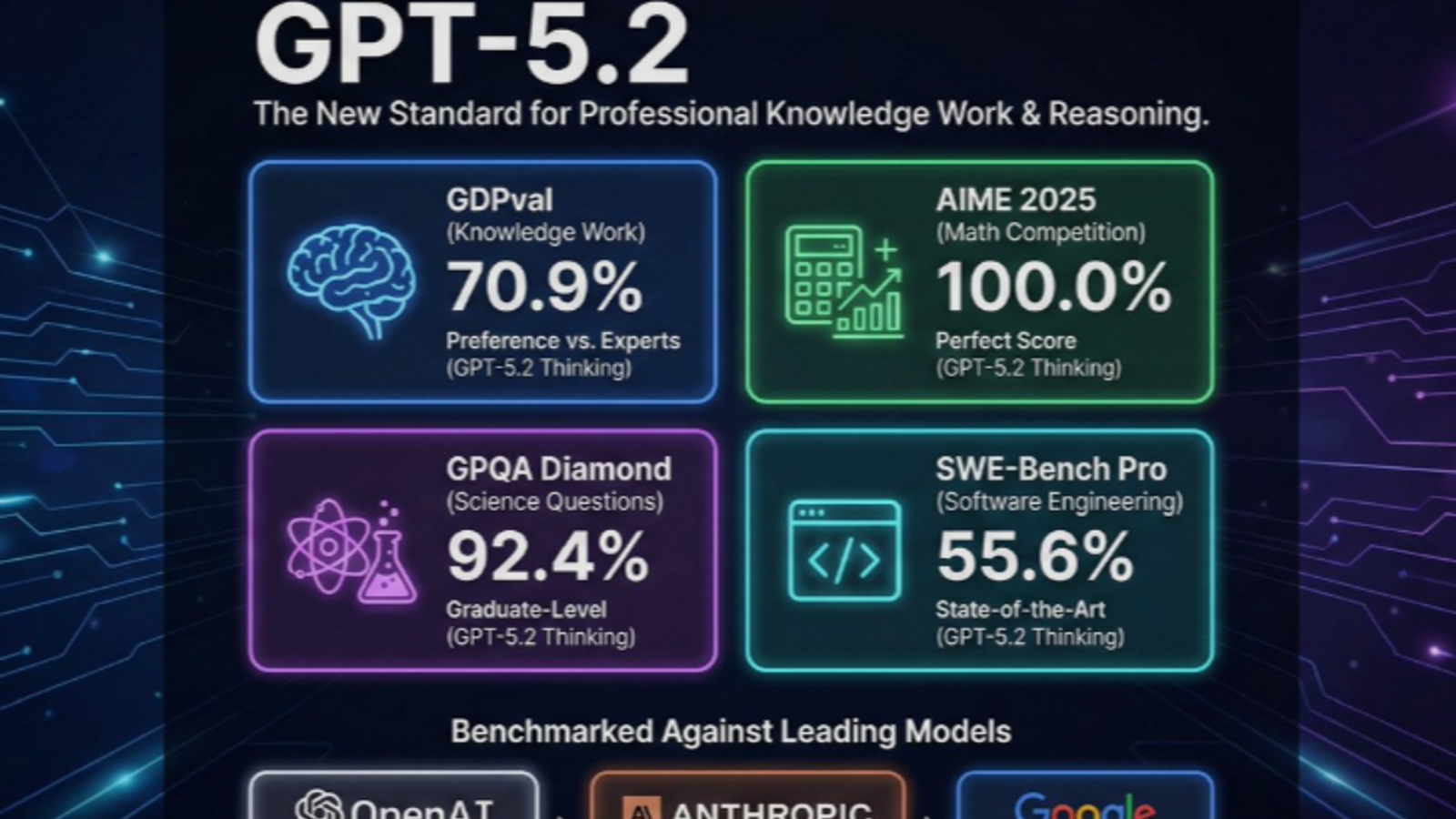
GPQA Diamond tests graduate-level scientific knowledge and reasoning capabilities. GPT-5.2 scored 90.3% while Grok 4 achieved 87.7%, a narrower gap that indicates both models handle complex academic material competently, though GPT-5.2 maintains an edge.
For researchers, academics, and professionals working with technical scientific content, this difference may matter when accuracy is paramount.
Mathematical Excellence
Mathematics represents a critical domain for AI models, particularly in fields like engineering, finance, and scientific computing. On AIME 2025, a high-school level mathematics competition benchmark, GPT-5.1 scored 95.7% compared to Grok's 92.7%. Given that GPT-5.2 represents an advancement over GPT-5.1, it likely extends this lead further.
GPT-5 achieved 100% accuracy on the newly generated AIME 2025 benchmark when using thinking mode with Python tools, representing unprecedented performance on mathematical reasoning tasks.
Advanced Mathematical Research
FrontierMath evaluates performance on cutting-edge mathematical problems. OpenAI reports GPT-5.2 achieves significantly higher accuracy than Grok 4, making it more suitable for quantitative researchers and professionals working on complex mathematical challenges.
Analytical Reasoning
The GPQA-AA benchmark, which measures factual knowledge and analytical reasoning under pressure, shows GPT-5.2 at 1474 compared to Grok's 1041. This substantial difference indicates greater reliability for tasks requiring careful analysis and fact-based decision-making.
Where Grok 4.1 Excels: Text and Emotional Intelligence
Despite GPT-5.2's dominance across most benchmarks, Grok 4.1 demonstrates exceptional performance in specific domains that may be decisive for certain use cases.
Text Arena Leadership
Grok 4.1 Thinking holds the number one overall position in LMArena's Text Arena with 1483 ELO, a commanding 31-point margin over the highest non-xAI model. Even in non-reasoning mode, Grok 4.1 ranks second at 1465 ELO.
This dominance on text-focused leaderboards suggests Grok 4.1 excels at conversational tasks, dialog generation, and text-based interactions where personality and engagement matter.
Emotional Intelligence
Grok 4.1 was specifically optimized for creative, emotional, and collaborative interactions through large-scale reinforcement learning, making it uniquely positioned for applications requiring empathy, emotional understanding, and interpersonal skills.
The model achieves high scores on EQ-Bench, which evaluates active emotional intelligence, empathy, and interpersonal abilities through challenging roleplay scenarios. For customer service applications, mental health support tools, or any domain where emotional resonance matters, Grok 4.1's specialization provides advantages GPT-5.2 may not match.
Context Window Size
Grok 4.1 offers a massive 2 million token context window—significantly larger than GPT-5.2's 400,000 tokens. This expanded memory allows Grok to process entire codebases, extensive documents, or very long conversations in a single session.
However, as one analysis notes, larger context windows don't always translate to better performance. Models can sometimes lose track of information provided hundreds of thousands of tokens earlier, limiting the practical value of extreme context sizes.
Pricing: GPT-5.2 Offers Superior Value
Cost considerations play a crucial role in model selection, particularly for businesses deploying AI at scale or individuals working within budget constraints.
Subscription-Based Access
Access to GPT-5.2 requires a ChatGPT subscription starting at twenty dollars per month, with higher tiers offering increased limits and enterprise features. This positions GPT-5.2 as the more affordable option for most users.
Grok's free tier restricts users to Grok 4, not Grok 4.1, requiring a paid subscription for the latest model. SuperGrok subscriptions start at thirty dollars per month and can reach three hundred dollars for extensive usage.
The ten-dollar monthly difference may seem modest for individual users, but for organizations deploying AI across teams, the cost differential becomes substantial. A 50-person team would pay $1,000 monthly for GPT-5.2 Pro versus $1,500 for SuperGrok—a $6,000 annual difference.
API Pricing
For developers building applications on top of these models, API pricing matters more than subscription costs. GPT-5.2 offers competitive pricing at approximately $1.25 per million input tokens and $10 per million output tokens.
Grok 4 Fast, which shares the same context window as Grok 4.1, costs roughly $0.20 input and $0.50 output per million tokens. While this makes Grok remarkably affordable for certain API use cases, users should note that Grok 4.1 itself may not be available at these same rates.
The pricing structure means cost-conscious developers running high-volume applications might prefer Grok for specific tasks, while those prioritizing subscription-based access will find GPT-5.2 more economical.
Feature Comparison: Multimodal Capabilities
Both models offer multimodal capabilities, but their implementations differ in important ways.
GPT-5.2 Features
GPT-5.2 includes image generation capabilities and can create videos through integration with Sora 2, OpenAI's video generation pipeline. The model handles text, images, and now video output, making it versatile for content creators needing diverse media formats.
The 400,000 token context window, while smaller than Grok's, proves sufficient for most practical applications including extensive code analysis, multi-document synthesis, and long-form content generation.
Grok 4.1 Features
Grok 4.1 provides image and video generation through its Grok Imagine platform. The model's conversational strengths and personality make it particularly engaging for interactive applications.
The 2 million token context window represents the largest in the comparison, allowing analysis of massive documents or very long conversation histories. Grok also benefits from more recent training data, with a November 2024 knowledge cutoff compared to earlier cutoffs for competing models.
Real-World Performance Considerations
Benchmarks provide valuable data points, but real-world performance depends on specific use cases and workflows.
When to Choose GPT-5.2
GPT-5.2 emerges as the optimal choice for:
High-Volume Analytical Tasks : The combination of strong reasoning capabilities and competitive pricing makes GPT-5.2 ideal for businesses processing large volumes of data analysis, research synthesis, or complex problem-solving.
Creative Content Generation : The substantial lead in creative writing benchmarks translates to better marketing copy, narrative generation, and stylistic editing. Content creators, marketers, and writers will appreciate the quality improvements.
Scientific and Technical Work : Graduate-level scientific reasoning, mathematical capabilities, and structured analytical thinking make GPT-5.2 well-suited for academics, researchers, and technical professionals.
Budget-Conscious Teams : The lower subscription cost matters for organizations deploying AI across many users. The $10 monthly savings per seat accumulates quickly at scale.
Multi-Domain Versatility : Strong performance across diverse benchmarks means GPT-5.2 handles varied tasks competently without requiring multiple specialized models.
When to Choose Grok 4.1
Grok 4.1 proves superior for:
Text-Heavy Conversational Applications : The top ranking in text leaderboards makes Grok the better choice for dialog systems, interactive narratives, or applications where conversational quality matters most.
Emotional Intelligence Requirements : Customer service tools, mental health applications, or any domain requiring empathy and emotional understanding benefit from Grok's specialized training in emotional intelligence.
Massive Context Requirements : When you need to process extremely long documents, entire codebases, or maintain very long conversation histories, Grok's 2 million token window provides advantages GPT-5.2 cannot match.
Real-Time Information Access : Grok's more recent training data and integration with real-time information sources make it better for applications requiring current events awareness or trending topic analysis.
API Cost Optimization : For specific high-volume API workloads where Grok 4 Fast's pricing applies, the dramatic cost savings may justify using the Grok ecosystem despite GPT-5.2's benchmark advantages.
The Verdict: Context Determines the Winner
The question "which model is better" lacks a universal answer because optimal choice depends entirely on your specific needs, use cases, and constraints.
For most general users and businesses , GPT-5.2 offers the best combination of performance, versatility, and value. Its commanding lead across diverse benchmarks, coupled with lower subscription costs, makes it the safer default choice for organizations requiring strong all-around capabilities.
For specialized applications emphasizing emotional intelligence, conversational quality, or extreme context requirements, Grok 4.1 delivers capabilities GPT-5.2 cannot match. The model's personality and empathetic responses provide advantages in specific domains despite lower scores on traditional benchmarks.
The pragmatic approach involves testing both models with your actual workloads. Run identical prompts through each platform, enable relevant tools and features, and evaluate results over a week of real work. Benchmarks establish expectations, but your specific data and workflows ultimately determine which model performs better for you.
Future Outlook and Model Evolution
The AI model landscape continues evolving rapidly, with both OpenAI and xAI committed to regular updates and improvements.
GPT-5.2 represents a relatively new release, meaning independent benchmark verification is still emerging. As more researchers test the model across diverse scenarios, our understanding of its capabilities will deepen.
Grok 4.1 benefits from xAI's continued investment in reinforcement learning techniques that optimize personality and emotional intelligence. Future iterations may narrow the performance gap while maintaining conversational advantages.
Both companies are likely to release additional models, updates, and variants that change the competitive landscape. Staying informed about new releases and benchmark results helps ensure you're using the best tools available.
Making Your Decision
Consider these key factors when choosing between GPT-5.2 and Grok 4.1:
Budget : If cost matters, GPT-5.2's lower subscription price ($20 vs $30 monthly) provides better value for most users.
Primary Use Case : For general analytical work, content creation, and diverse tasks, choose GPT-5.2. For emotionally intelligent conversations, text-focused applications, or massive context requirements, choose Grok 4.1.
Team Size : Organizations deploying AI across many users benefit more from GPT-5.2's cost advantage, which multiplies across seats.
Performance Requirements : When you need top-tier performance across diverse benchmarks, GPT-5.2 delivers. When conversational quality and emotional resonance matter most, Grok 4.1 excels.
Existing Ecosystem : If you're already invested in OpenAI's ecosystem with API integrations and workflows, staying with GPT-5.2 minimizes transition friction. Similarly, X platform integration may favor Grok for some users.
Risk Tolerance : GPT-5.2's broader benchmark superiority makes it the lower-risk choice for mission-critical applications. Grok 4.1's specialization brings higher performance in specific domains but may underperform in others.
Conclusion: Excellence in Different Directions
Both GPT-5.2 and Grok 4.1 represent remarkable achievements in artificial intelligence, pushing the boundaries of what language models can accomplish. Neither model is objectively "better"—they excel in different areas reflecting their creators' priorities and optimization choices.
GPT-5.2 dominates traditional benchmarks, offers superior general-purpose performance, and provides better value for most users. Its strong showings across creative writing, mathematical reasoning, scientific analysis, and diverse tasks make it the safe default choice.
Grok 4.1 leads in emotional intelligence, conversational quality, and text-focused applications. Its specialized training delivers capabilities in empathy and personality that benchmarks struggle to capture but users immediately notice.
The AI field benefits from this competition, as each company's different approach pushes the entire industry forward. Users benefit from having multiple excellent options, each with distinct strengths that serve different needs.
Test both models if you can. Let your actual work, not marketing claims or benchmark scores, determine which AI assistant becomes your primary tool. The best model is the one that makes you most productive, creative, and effective at the work you care about.