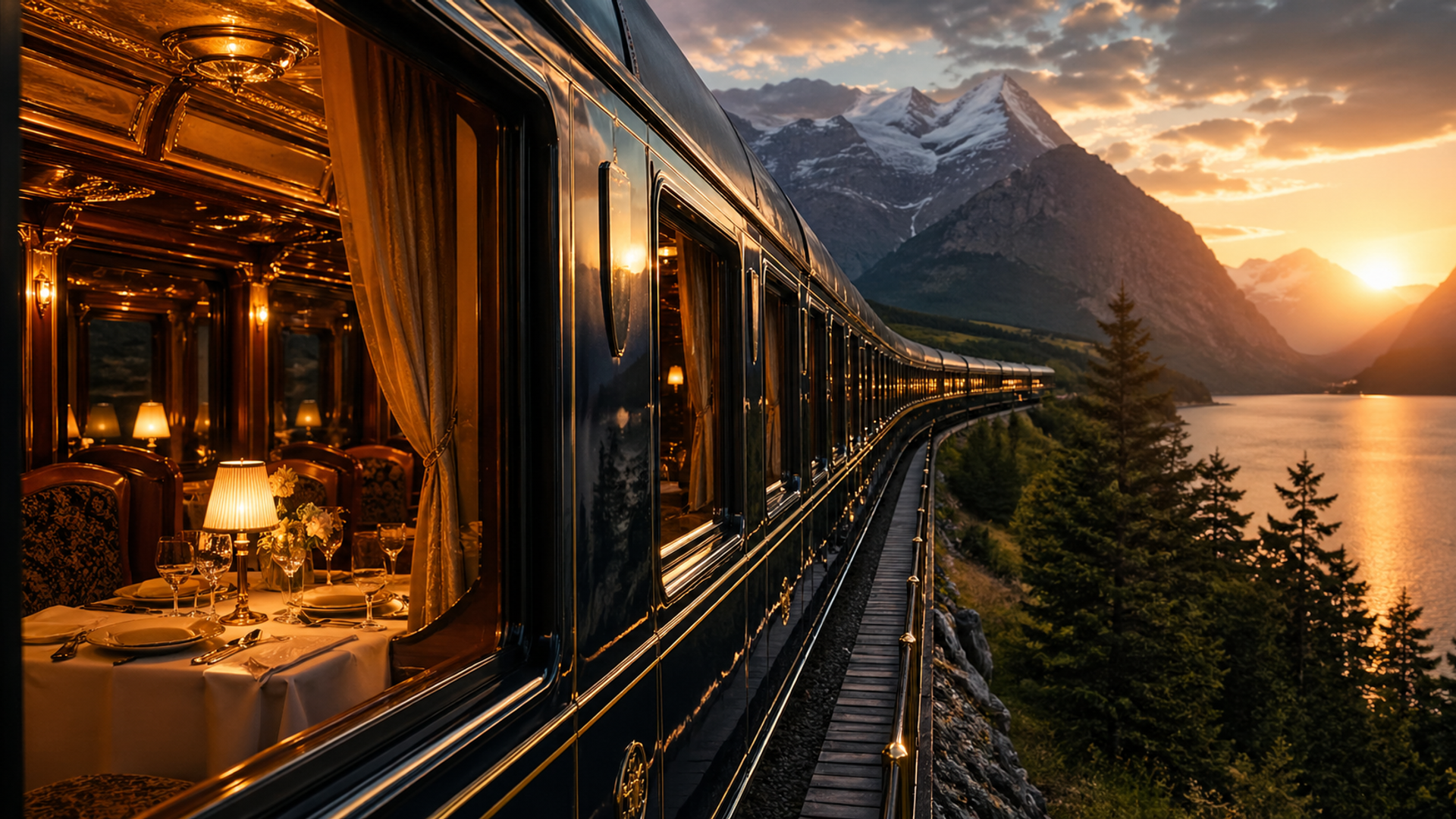
There is a quiet shift happening in the way the world’s most discerning travellers move. Speed, once the ultimate luxury, is no longer the only measure of prestige. In its place, something more deliberate has emerged — a desire to savour the journey itself.
Luxury train travel sits at the centre of this evolution. It offers not just transportation but a rare kind of immersion: time reclaimed, landscapes unfolding slowly, and service delivered with an almost-forgotten level of attention. Unlike private jets or first-class cabins, these trains invite you to engage with the journey, not bypass it.
In many ways, a luxury train is closer to a private members’ club on rails — or a boutique hotel that moves with purpose. From Europe’s heritage routes to Asia’s opulent itineraries, these journeys redefine what it means to travel well. This guide explores the finest luxury train services around the world, including what to expect on board, how much they cost, and how best to secure a place.
What Defines a Luxury Train Service?
Not all first-class rail experiences qualify as luxury in the true sense. The distinction lies in the details — and, more importantly, in the intent behind them.
A genuine luxury train service is designed around space and privacy. Cabins are often suites rather than compartments, with generous proportions, fine materials, and thoughtful layouts. Some offer full double beds, marble bathrooms, and private dining areas — closer to a hotel suite than a train carriage.
Service is equally defining. Dedicated stewards anticipate needs before they are expressed, while onboard teams operate with the discretion expected in high-end hospitality. It is not uncommon to have a personal butler assigned to your suite.
Dining is another cornerstone. Menus are typically curated by leading chefs, with an emphasis on regional ingredients and seasonal produce. Meals are served in elegant dining cars, often with dress codes that elevate the experience into an occasion.
Perhaps most importantly, luxury trains are not simply about moving from one city to another. They are built around curated itineraries — with private excursions, cultural access, and experiences that would be difficult to arrange independently. This is travel designed as a narrative, not a transfer.
The Most Iconic Luxury Train Journeys in Europe
Venice Simplon-Orient-Express
Few names carry the same sense of romance as the Venice Simplon-Orient-Express. Restored 1920s and 1930s carriages, polished wood, Lalique glass, and soft lamplight create an atmosphere that feels entirely removed from modern life.
Routes vary, but the classic journey between London and Venice remains the most sought-after. Evenings are formal, with black-tie dinners and a sense of occasion that is rarely found in contemporary travel.
Prices typically begin at around £3,000 per person for a one-night journey, rising significantly for suites and longer itineraries. For many, the appeal lies not just in the destination, but in stepping briefly into a different era.
Belmond Royal Scotsman
In contrast to the theatrical glamour of the Orient Express, the Royal Scotsman offers something more intimate. With capacity for fewer than 40 guests, it feels closer to a private club than a train.
Journeys wind through the Scottish Highlands, with stops for whisky tastings, castle visits, and outdoor pursuits. The inclusion of a spa carriage — an unusual feature even among luxury trains — adds a further layer of indulgence.
Prices generally range from £4,000 to over £10,000, depending on the itinerary. The experience is understated but deeply refined, appealing to those who value privacy as much as spectacle.
Golden Eagle Danube Express
For travellers seeking a broader cultural sweep, the Golden Eagle Danube Express offers multi-country journeys across Central and Eastern Europe.
These itineraries combine the comfort of a luxury train with access to destinations that are less frequently explored. Private tours, expert guides, and seamless logistics allow guests to experience multiple countries without the friction of traditional travel.
Pricing typically starts at around £6,000, reflecting the depth and complexity of the journeys.
Luxury Train Journeys in North America
Rocky Mountaineer
The Rocky Mountaineer offers a distinctive take on luxury rail. Rather than focusing on heritage or opulence, it centres on landscape.
Glass-domed carriages provide uninterrupted views of the Canadian Rockies, while onboard hosts narrate the journey with insight and care. The experience is daylight-only, with guests staying in premium hotels overnight.
Prices range from $1,500 to $5,000, depending on the level of service and itinerary. It is particularly well suited to travellers who prioritise scenery over formality.
Luxury Train Experiences in Asia
Maharajas’ Express
India’s Maharajas’ Express is often cited as one of the most luxurious trains in the world — and with good reason. Designed to echo the opulence of royal travel, it features richly decorated interiors, fine dining, and an emphasis on cultural immersion.
Routes include highlights such as Rajasthan, Agra, and Delhi, with private access to palaces, monuments, and local experiences.
Prices range from approximately $4,000 to over $13,000 per person, depending on the suite category and duration. It is a journey that blends spectacle with depth, offering a layered view of India’s heritage.
Eastern & Oriental Express
Running between Singapore, Malaysia, and Thailand, the Eastern & Oriental Express delivers a different kind of luxury — one shaped by tropical landscapes and colonial-era design.
Open-air observation cars, slow-moving jungle scenery, and a relaxed rhythm define the experience. It is less formal than its European counterparts, yet no less considered.
Prices typically begin at around $3,500, making it one of the more accessible entries into the world of luxury rail.
What Is Included in a Luxury Train Ticket?
One of the defining aspects of luxury train travel is its all-inclusive nature. While details vary, most journeys cover:
- Accommodation in a private cabin or suite
- All meals, often at a fine-dining standard
- A curated selection of wines, spirits, and beverages
- Off-train excursions with expert guides
- Personalised service, including butlers or dedicated stewards
- Seamless luggage handling and transfers
This structure allows guests to disengage from logistics entirely. Once on board, the experience unfolds without interruption — a level of ease that is increasingly rare.
How Much Do Luxury Train Journeys Cost?
Pricing in luxury rail reflects both the exclusivity of the experience and the complexity of delivering it.
Shorter European journeys typically begin at around £3,000 per person, while multi-day itineraries can exceed £10,000. In Asia, the range is broader, with entry points around $3,500 and top-tier suites reaching well beyond $10,000.
Several factors influence cost:
- Duration of the journey
- Suite category and level of privacy
- Inclusion of exclusive excursions
- Seasonality and demand
For many travellers, the question is not simply cost, but value. When considered as a fully curated, all-inclusive experience — combining accommodation, dining, and private travel — luxury trains often compare favourably with high-end resort stays or bespoke tours.
How to Book a Luxury Train Experience
Securing a place on a luxury train requires a degree of foresight. Popular routes often sell out months in advance, particularly during peak seasons.
There are three primary ways to book:
Directly with operators
Many trains can be booked through their official platforms, offering transparency and access to the full range of itineraries.
Through specialist travel advisors
For those seeking a more tailored experience, high-end travel agencies can curate entire journeys, combining rail with private transfers, hotels, and exclusive access.
Via concierge services
Through platforms such as Vertu Concierge, travel becomes part of a fully integrated lifestyle. Reservations, priority access, private transfers, and even last-minute itinerary changes are handled discreetly — often without the need for direct involvement.
This approach ensures that a luxury train journey is not an isolated booking, but part of a seamless, continuous experience — from departure to arrival, and everything in between.
Who Chooses Luxury Train Travel Today?
The audience for luxury rail is more diverse than it once was, yet certain patterns remain.
High-net-worth individuals continue to form the core market, drawn by the combination of exclusivity, comfort, and curated access. Honeymooners and milestone travellers are also well represented, using these journeys to mark significant moments.
There is also a growing segment of culturally engaged travellers — individuals who value depth over speed, and who see travel as a means of understanding rather than escape.
Notably, luxury trains appeal to those who value discretion. In an age of constant connectivity, the ability to step away — while still enjoying exceptional service — has become a form of luxury in itself.
The Future of Luxury Rail Travel
Looking ahead, luxury train travel is poised to grow in relevance rather than decline.
Sustainability is one factor. Rail travel, even at the highest level, carries a lower environmental impact than private aviation, aligning with the evolving values of many affluent travellers.
There is also a broader cultural shift towards slower, more intentional experiences. As travel becomes increasingly accessible, true luxury lies in differentiation — in journeys that feel considered, personal, and rare.
Technology will play a role, but discreetly. The focus is likely to remain on enhancing service rather than replacing it, ensuring that the human element — so central to these experiences — is preserved.
Conclusion
Luxury train travel offers something that few other forms of transport can match: a sense of continuity between journey and destination.
It allows time to stretch, landscapes to unfold, and experiences to deepen. More than that, it reflects a broader philosophy of travel — one that values how you move through the world as much as where you arrive.
For those willing to embrace a slower pace, the reward is not just comfort or exclusivity, but a richer, more considered way of seeing the world.

![Top 10 Luxury Watches for a Dubai Desert Resort Escape [New]](https://cdn.sanity.io/images/e0gp1l2g/production/8b5e5b21db42a1c5f040e828bd041857353a8eb2-2560x1382.webp?w=800&h=450&q=82&auto=format&fit=crop)