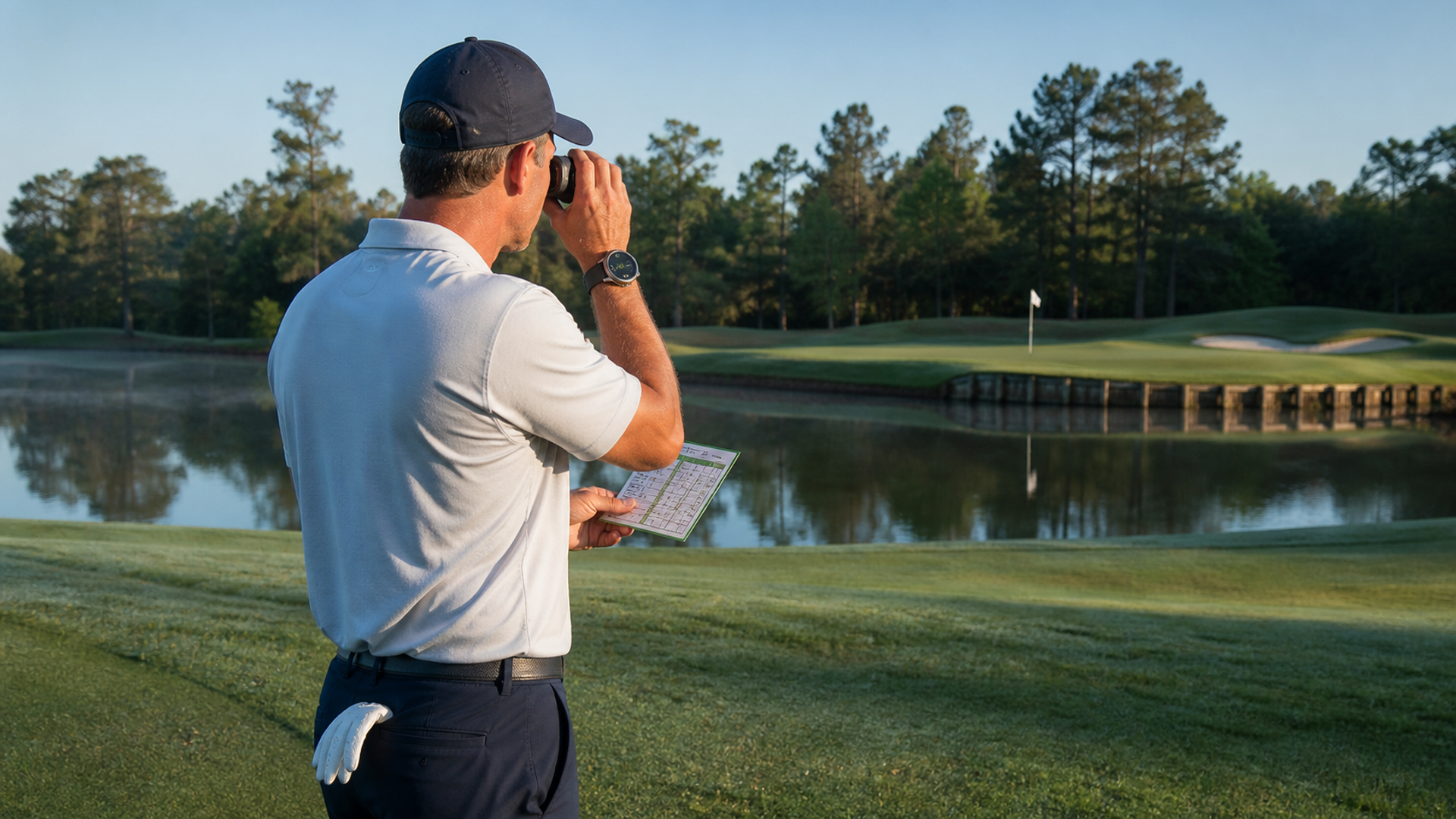
A golf rangefinder should shorten a decision, not add another screen to manage. The most useful device locks the intended target quickly, presents a clear distance in changing light and makes slope assistance unmistakably disabled when the rules or committee require it. Maximum advertised range is less important than repeatability on a flag at the distances you actually play.
The short answer by player
Choose a pure laser model for fast, direct yardage and simple tournament handling; a stabilised laser when hand movement or long targets make acquisition difficult; or a laser-GPS hybrid when front, middle and back context materially improves strategy. Confirm the event's local rule before relying on any distance-measuring device.
| Decision factor | Pure laser | Stabilised laser | Laser-GPS hybrid |
|---|---|---|---|
| Primary need | Fast flag distance dominates | Steady acquisition is difficult | Green context and hazards change club choice |
| Slope use | Simple visible off mode is enough | Slope plus stabilisation is useful in practice | Plays-like data is used only when permitted |
| Optics | Brightness and dioptre suit the player | Image stabilisation justifies weight and cost | Display remains legible with map context |
| Course type | Open sight lines dominate | Long or visually busy targets dominate | Blind hazards and large greens dominate |
| Tournament control | Conforming mode is obvious | Stabilisation remains while slope is off | Connected features can be disabled correctly |
| Battery and workflow | Replaceable battery simplicity matters | Battery plan supports the round | Charging, app and pairing are maintained |
This best golf rangefinders 2026 matrix is the article's working value object. Read the best golf rangefinders 2026 rows together: the decisive failure mode depends on this topic's evidence, operating context and reader objective.
Understand legal distance information
Evidence 1. The Rules of Golf permit committees to adopt local rules concerning distance-measuring devices, so players must check the competition condition rather than assume every feature is allowed.
Evidence 2. Garmin's Approach Z30 manual states that tournament mode disables its PlaysLike feature and describes pin lock, distance and connected green information.
Evidence 3. Bushnell's Pro X3+ manual documents slope-related settings and device configuration, illustrating why a buyer should practise the physical competition-mode control.
Evidence 4. A rangefinder's ability to reach a reflective object at long distance does not prove reliable flag acquisition through rain, haze, trees or hand movement.
Reader-visible sources checked for this article:
randa.org — reader-visible current or official evidence
usga.org — reader-visible current or official evidence
www8.garmin.com — reader-visible current or official evidence
bushnellgolf.com — reader-visible current or official evidence
For best golf rangefinders 2026, these sources establish only the claims inside their documented scope. Recheck every changeable specification, availability condition, price, policy or service term in the relevant market before acting.
Test target lock with your own hands and eyes
For primary need, the first route works when fast flag distance dominates; the second requires steady acquisition is difficult. The control for the third is green context and hazards change club choice. Verify this row against the exact product, property, account or environment before it can reverse the decision.
The slope use row exposes a practical boundary. Route one assumes simple visible off mode is enough, while route two is defensible only when slope plus stabilisation is useful in practice. Route three depends on plays-like data is used only when permitted. If that evidence is absent, keep the more reversible option.
Read optics as a stop/go test: brightness and dioptre suit the player supports the first option; image stabilisation justifies weight and cost supports the second; and display remains legible with map context supports the third. Record which source proves the condition and when it was checked.
A buyer can resolve course type without starting from a brand preference. Ask whether open sight lines dominate; compare that with whether long or visually busy targets dominate; then use blind hazards and large greens dominate as the third route's safeguard. An unknown condition stays unknown.
On tournament control, popularity is not enough. The evidence for option one is that conforming mode is obvious. Option two means stabilisation remains while slope is off. Option three is rational where connected features can be disabled correctly. Recheck any changeable term immediately before commitment.
The decision changes at battery and workflow. Choose the first path only if replaceable battery simplicity matters; move to the second when battery plan supports the round; use the third when charging, app and pairing are maintained. Save the downside that would make this row fail.
Facts that would reverse the current choice
Reversal control 1 — Primary need. Before choosing Pure laser, write down how the decision changes if “Fast flag distance dominates” proves false. Do the same for Stabilised laser and “Steady acquisition is difficult”. Keep the Laser-GPS hybrid route available until “Green context and hazards change club choice” is verified. This control belongs to best golf rangefinders 2026; update it from the cited source or exact supplier rather than copying a generic checklist.
Reversal control 2 — Slope use. Before choosing Pure laser, write down how the decision changes if “Simple visible off mode is enough” proves false. Do the same for Stabilised laser and “Slope plus stabilisation is useful in practice”. Keep the Laser-GPS hybrid route available until “Plays-like data is used only when permitted” is verified. This control belongs to best golf rangefinders 2026; update it from the cited source or exact supplier rather than copying a generic checklist.
Reversal control 3 — Optics. Before choosing Pure laser, write down how the decision changes if “Brightness and dioptre suit the player” proves false. Do the same for Stabilised laser and “Image stabilisation justifies weight and cost”. Keep the Laser-GPS hybrid route available until “Display remains legible with map context” is verified. This control belongs to best golf rangefinders 2026; update it from the cited source or exact supplier rather than copying a generic checklist.
Reversal control 4 — Course type. Before choosing Pure laser, write down how the decision changes if “Open sight lines dominate” proves false. Do the same for Stabilised laser and “Long or visually busy targets dominate”. Keep the Laser-GPS hybrid route available until “Blind hazards and large greens dominate” is verified. This control belongs to best golf rangefinders 2026; update it from the cited source or exact supplier rather than copying a generic checklist.
Reversal control 5 — Tournament control. Before choosing Pure laser, write down how the decision changes if “Conforming mode is obvious” proves false. Do the same for Stabilised laser and “Stabilisation remains while slope is off”. Keep the Laser-GPS hybrid route available until “Connected features can be disabled correctly” is verified. This control belongs to best golf rangefinders 2026; update it from the cited source or exact supplier rather than copying a generic checklist.
Reversal control 6 — Battery and workflow. Before choosing Pure laser, write down how the decision changes if “Replaceable battery simplicity matters” proves false. Do the same for Stabilised laser and “Battery plan supports the round”. Keep the Laser-GPS hybrid route available until “Charging, app and pairing are maintained” is verified. This control belongs to best golf rangefinders 2026; update it from the cited source or exact supplier rather than copying a generic checklist.
Test repeatability, not one successful reading
Range the same flag five times from 100, 150 and 200 yards, then compare a tree immediately behind it. Note acquisition time, vibration or visual confirmation and the spread of readings. Repeat in low sun and with glasses if worn. A device that occasionally displays a distant background is slower than its specification suggests. Check whether the dioptre holds its setting and whether the button force moves the view at the moment of measurement.
Separate legal distance from practice assistance
The player's responsibility is to know the event condition. Learn how to disable slope or plays-like information and how the device indicates that state to a marker or official. Connected weather, wind, elevation and club suggestions may be useful in practice yet restricted in competition. Do not wait until the first tee to find a buried menu. Save a competition preset and verify it after firmware updates.
Use GPS context only when it changes strategy
Front, middle and back distances help on deep greens, blind approaches and carries where a flag laser alone hides the safe target. They also add pairing, course downloads, battery and possible subscription considerations. Decide whether the information arrives on the rangefinder, watch or phone and avoid duplicating three devices. A laser-GPS hybrid earns its place when context changes club or aim, not because more numbers appear.
Plan handling for a four-hour round
Check case access, magnet placement, rain resistance, battery state and one-handed use. A strong cart magnet is convenient but can be forgotten at return. Keep owner details in the case rather than on the optical body. Clean lenses with suitable material and avoid leaving the device in extreme vehicle heat. Carry a legal backup—yardage markers, course book or watch—so one flat battery does not disturb pace of play.
Three rounds that change the recommendation
The club competitor
A pure laser with an unmistakable conforming mode reduces operational ambiguity and keeps the pre-shot routine short. Define the fact that would reverse this recommendation before committing.
The player with unsteady acquisition
A stabilised optic can be worth more than extra maximum range when it locks the correct object faster. Define the fact that would reverse this recommendation before committing.
The travelling strategy player
A laser-GPS hybrid helps on unfamiliar, deep or blind greens if course data, battery and competition controls are reliable. Define the fact that would reverse this recommendation before committing.
Action checklist
Check the event's local rule.
Test repeated flag lock at real distances.
Compare target and background discrimination.
Adjust the dioptre with normal eyewear.
Practise disabling slope or plays-like data.
Check battery for a full round.
Verify GPS course coverage if relevant.
Test rain and low-light visibility.
Choose secure case or cart storage.
Carry a legal distance backup.
Continue the decision
The linked VERTU articles expand adjacent parts of the best golf rangefinders 2026 decision. They do not substitute for the external evidence above.
The rangefinder verdict
Choose a pure laser model for fast, direct yardage and simple tournament handling; a stabilised laser when hand movement or long targets make acquisition difficult; or a laser-GPS hybrid when front, middle and back context materially improves strategy. Confirm the event's local rule before relying on any distance-measuring device.
Keep the best golf rangefinders 2026 decision reversible until its material cost, safety, access, privacy and compatibility facts are verified. Unknown evidence stays unknown; it is never silently scored as favourable.