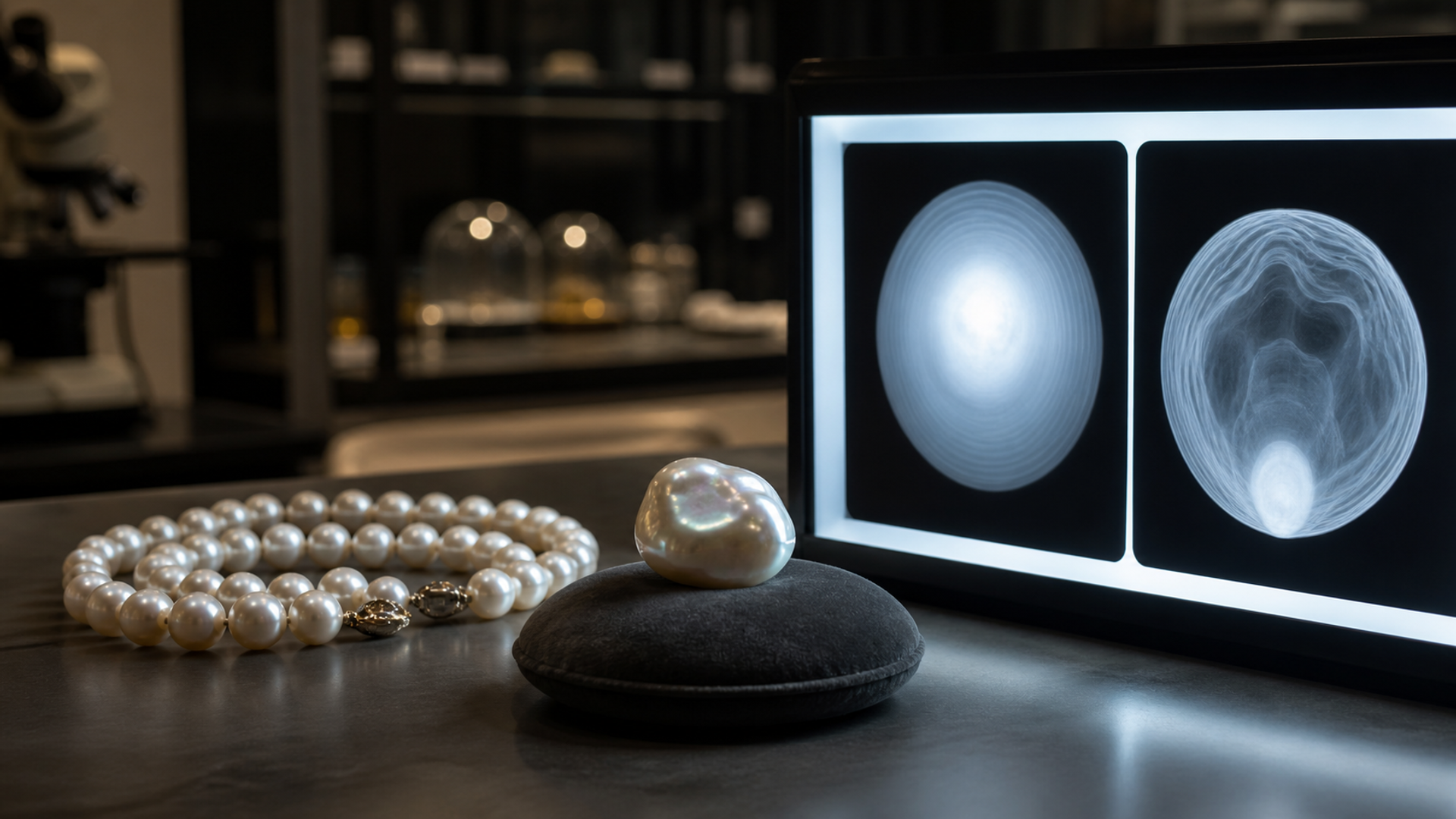
Cultured and natural pearls both form inside molluscs, but cultured pearl growth begins with deliberate human intervention while natural pearl growth occurs without that cultivation step. Surface appearance alone is not a reliable way to separate them. Gem laboratories use observation and internal-structure evidence, including X-radiography, to support identification. Natural origin can create rarity and historical value, but lustre, surface, shape, colour, nacre, matching, condition and provenance still determine whether a specific jewel deserves its price.
Formation and identification are separate questions
Choose cultured pearls when documented quality, design and wearability are the objective; they represent most pearls available in the modern jewellery market. Choose natural pearls only when rarity and provenance justify specialist identification and a larger evidentiary burden. Buy neither at a consequential price until the report, treatments, condition and return terms match the seller's claims.
| Decision factor | Cultured pearls | Natural pearls | Buy only after independent identification |
|---|---|---|---|
| Formation | Human intervention starts cultivation | Forms without cultivation intervention | Do not infer from appearance |
| Availability | Makes up most modern pearl jewellery | Considerably rarer in the market | Rarity needs documentation |
| Identification | Internal structures reflect culturing method | Internal structures can support natural origin | Use an independent laboratory |
| Value | Lustre, surface, shape, colour and matching matter | The same factors plus rarity and provenance matter | Compare like-for-like quality |
| Treatments | Dye, bleaching and enhancement may require disclosure | Treatments and repairs also need disclosure | Read the laboratory comments |
| Ownership | Routine wear can suit documented quality | Historic pieces may need specialist care and insurance | Record condition before wear |
This cultured pearls vs natural pearls matrix is the article's working value object. Read the cultured pearls vs natural pearls rows together: the decisive failure mode depends on this topic's evidence, operating context and reader objective.
Rarity does not replace quality evidence
Evidence 1. GIA explains that natural pearls form without human intervention, while cultured pearls result from a process initiated by people inside a mollusc.
Evidence 2. GIA uses X-radiography and other gemmological observations to analyse internal structures and support pearl identification.
Evidence 3. GIA's pearl description framework evaluates factors including size, shape, colour, lustre, surface, nacre and matching.
Evidence 4. Natural origin alone does not prove condition, treatment history, provenance or fair value; those claims require their own evidence.
Reader-visible sources checked for this article:
gia.edu — reader-visible current or official evidence
gia.edu — reader-visible current or official evidence
gia.edu — reader-visible current or official evidence
For cultured pearls vs natural pearls, these sources establish only the claims inside their documented scope. Recheck every changeable specification, availability condition, price, policy or service term in the relevant market before acting.
Verify with reports and radiography
A buyer can resolve formation without starting from a brand preference. Ask whether human intervention starts cultivation; compare that with whether forms without cultivation intervention; then use do not infer from appearance as the third route's safeguard. An unknown condition stays unknown.
On availability, popularity is not enough. The evidence for option one is that makes up most modern pearl jewellery. Option two means considerably rarer in the market. Option three is rational where rarity needs documentation. Recheck any changeable term immediately before commitment.
The decision changes at identification. Choose the first path only if internal structures reflect culturing method; move to the second when internal structures can support natural origin; use the third when use an independent laboratory. Save the downside that would make this row fail.
For value, the first route works when lustre, surface, shape, colour and matching matter; the second requires the same factors plus rarity and provenance matter. The control for the third is compare like-for-like quality. Verify this row against the exact product, property, account or environment before it can reverse the decision.
The treatments row exposes a practical boundary. Route one assumes dye, bleaching and enhancement may require disclosure, while route two is defensible only when treatments and repairs also need disclosure. Route three depends on read the laboratory comments. If that evidence is absent, keep the more reversible option.
Read ownership as a stop/go test: routine wear can suit documented quality supports the first option; historic pieces may need specialist care and insurance supports the second; and record condition before wear supports the third. Record which source proves the condition and when it was checked.
Facts that would reverse the current choice
Reversal control 1 — Formation. Before choosing Cultured pearls, write down how the decision changes if “Human intervention starts cultivation” proves false. Do the same for Natural pearls and “Forms without cultivation intervention”. Keep the Buy only after independent identification route available until “Do not infer from appearance” is verified. This control belongs to cultured pearls vs natural pearls; update it from the cited source or exact supplier rather than copying a generic checklist.
Reversal control 2 — Availability. Before choosing Cultured pearls, write down how the decision changes if “Makes up most modern pearl jewellery” proves false. Do the same for Natural pearls and “Considerably rarer in the market”. Keep the Buy only after independent identification route available until “Rarity needs documentation” is verified. This control belongs to cultured pearls vs natural pearls; update it from the cited source or exact supplier rather than copying a generic checklist.
Reversal control 3 — Identification. Before choosing Cultured pearls, write down how the decision changes if “Internal structures reflect culturing method” proves false. Do the same for Natural pearls and “Internal structures can support natural origin”. Keep the Buy only after independent identification route available until “Use an independent laboratory” is verified. This control belongs to cultured pearls vs natural pearls; update it from the cited source or exact supplier rather than copying a generic checklist.
Reversal control 4 — Value. Before choosing Cultured pearls, write down how the decision changes if “Lustre, surface, shape, colour and matching matter” proves false. Do the same for Natural pearls and “The same factors plus rarity and provenance matter”. Keep the Buy only after independent identification route available until “Compare like-for-like quality” is verified. This control belongs to cultured pearls vs natural pearls; update it from the cited source or exact supplier rather than copying a generic checklist.
Reversal control 5 — Treatments. Before choosing Cultured pearls, write down how the decision changes if “Dye, bleaching and enhancement may require disclosure” proves false. Do the same for Natural pearls and “Treatments and repairs also need disclosure”. Keep the Buy only after independent identification route available until “Read the laboratory comments” is verified. This control belongs to cultured pearls vs natural pearls; update it from the cited source or exact supplier rather than copying a generic checklist.
Reversal control 6 — Ownership. Before choosing Cultured pearls, write down how the decision changes if “Routine wear can suit documented quality” proves false. Do the same for Natural pearls and “Historic pieces may need specialist care and insurance”. Keep the Buy only after independent identification route available until “Record condition before wear” is verified. This control belongs to cultured pearls vs natural pearls; update it from the cited source or exact supplier rather than copying a generic checklist.
Define the claim
Write whether the seller claims natural origin, saltwater or freshwater culture, mollusc type, geographic origin, treatment or period. Require each material claim to appear consistently on invoice and report. In this cultured versus natural pearls comparison, preserve the exact item, setting, date and test condition in the evidence log. Keep measured results separate from category shorthand and repeat the check in the intended environment. If the paperwork uses vague words such as genuine without formation detail, pause the purchase. When that reversal condition appears, reopen the choice instead of defending the original preference.
Read the laboratory report
Match report number, measurements, weight, photographs and comments to the actual jewel. Verify the report through the issuing laboratory where a lookup is available. In this cultured versus natural pearls comparison, preserve the exact item, setting, date and test condition in the evidence log. Keep measured results separate from category shorthand and repeat the check in the intended environment. If the item and report cannot be reconciled, treat the identity as unverified. When that reversal condition appears, reopen the choice instead of defending the original preference.
Inspect quality and condition
Evaluate lustre, surface, shape, colour, nacre appearance, matching, drill holes, repairs and strand condition under neutral light. Use magnification and a qualified specialist for consequential purchases. In this cultured versus natural pearls comparison, preserve the exact item, setting, date and test condition in the evidence log. Keep measured results separate from category shorthand and repeat the check in the intended environment. If damage or treatment explains the low price, revise value and care expectations. When that reversal condition appears, reopen the choice instead of defending the original preference.
Establish provenance
Separate documented ownership and dated records from an attractive verbal story. Keep auction, laboratory, repair and insurance records together. In this cultured versus natural pearls comparison, preserve the exact item, setting, date and test condition in the evidence log. Keep measured results separate from category shorthand and repeat the check in the intended environment. If provenance carries a premium but cannot be corroborated, remove that premium from the decision. When that reversal condition appears, reopen the choice instead of defending the original preference.
Plan wear and storage
Avoid impact, harsh chemicals, dry heat and abrasive contact and check stringing before wear. Photograph condition and arrange specialist cleaning or restringing as needed. In this cultured versus natural pearls comparison, preserve the exact item, setting, date and test condition in the evidence log. Keep measured results separate from category shorthand and repeat the check in the intended environment. If the intended lifestyle cannot protect a rare piece, choose a robust cultured alternative for regular wear. When that reversal condition appears, reopen the choice instead of defending the original preference.
Four purchases, four answers
Daily pearl earrings
High-quality cultured pearls can deliver documented beauty and practical availability. Define the fact that would reverse this recommendation before committing.
Antique natural-pearl jewel
Independent identification, condition and provenance become essential. Define the fact that would reverse this recommendation before committing.
Gift purchase
A clear report and return policy can matter more than an unsupported rarity story. Define the fact that would reverse this recommendation before committing.
Investment claim
Liquidity, fees, provenance and specialist market access should be tested before accepting the label. Define the fact that would reverse this recommendation before committing.
Action checklist
Define natural or cultured.
Record mollusc and environment.
Ask about treatments.
Match the report.
Verify the report number.
Inspect lustre.
Inspect surface.
Inspect drill holes.
Assess matching.
Document provenance.
Review return terms.
Photograph condition.
Continue the decision
The linked VERTU articles expand adjacent parts of the cultured pearls vs natural pearls decision. They do not substitute for the external evidence above.
The cultured-versus-natural-pearl verdict
Choose cultured pearls when documented quality, design and wearability are the objective; they represent most pearls available in the modern jewellery market. Choose natural pearls only when rarity and provenance justify specialist identification and a larger evidentiary burden. Buy neither at a consequential price until the report, treatments, condition and return terms match the seller's claims.
Keep the cultured pearls vs natural pearls decision reversible until its material cost, safety, access, privacy and compatibility facts are verified. Unknown evidence stays unknown; it is never silently scored as favourable.