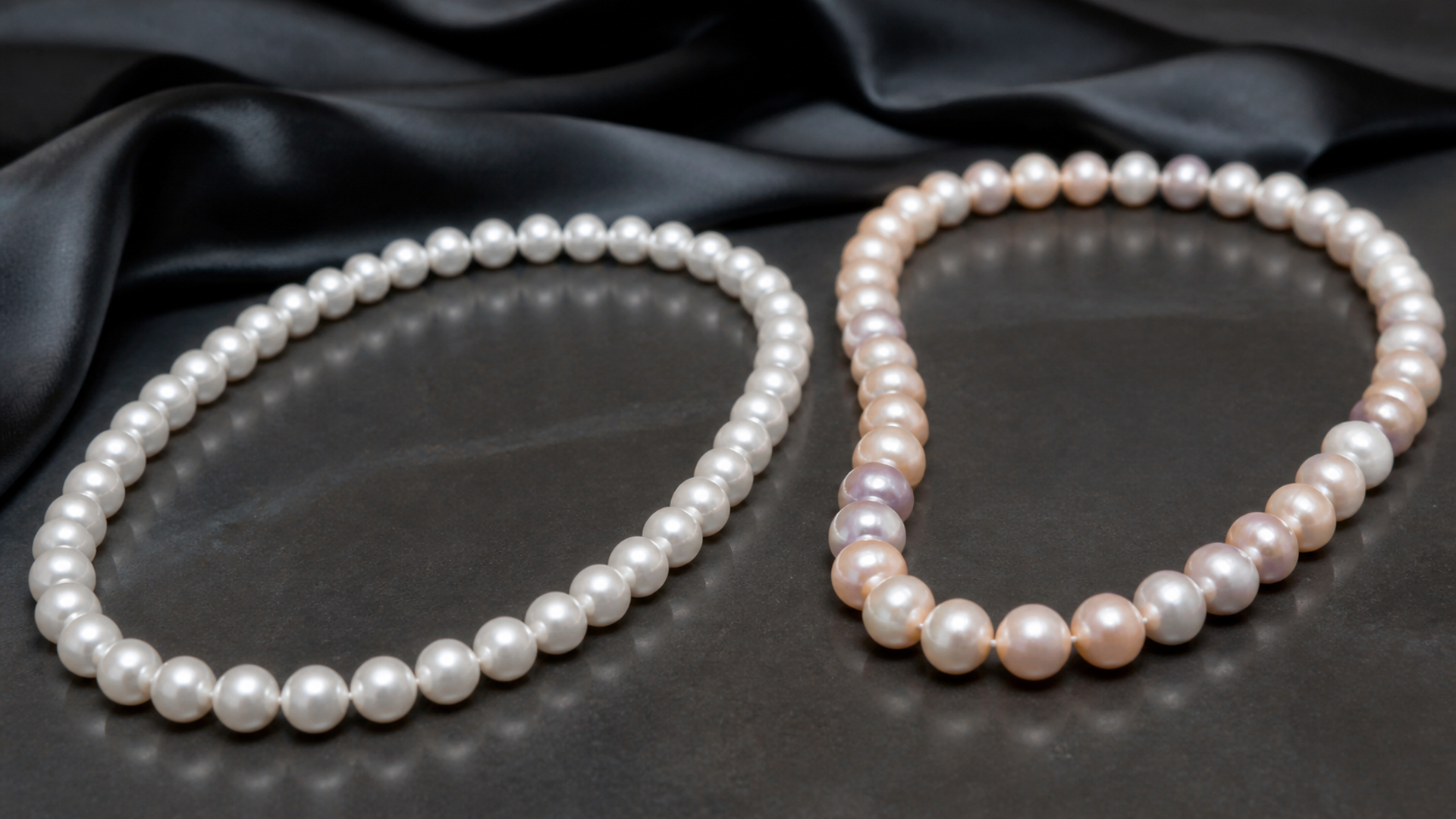
Akoya and freshwater cultured pearls come from different production environments and often present different combinations of size, roundness, colour, nacre and price. Akoya strands are commonly associated with highly round pearls, close matching and a bright mirror-like lustre. Freshwater cultivation can produce a wider range of shapes, natural colours and sizes, with many strong contemporary strands now showing impressive roundness and lustre. Category averages are not purchase grades: one excellent freshwater strand can outperform a weak Akoya strand on the qualities a wearer actually sees.
Start with the look of the whole strand
Choose Akoya when a classic, closely matched, round white strand with sharp lustre is the brief and the documentation supports identity. Choose freshwater pearls when variety in shape, colour, scale or value creates the desired design. Compare individual strands when quality matters, because lustre, surface, matching, nacre, drilling, clasp and restringing service can reverse a category-level assumption.
| Decision factor | Akoya cultured pearls | Freshwater cultured pearls | Compare individual strands |
|---|---|---|---|
| Lustre | Often selected for sharp mirror-like reflections | Ranges from soft glow to strong modern lustre | Compare reflections at equal distance |
| Shape | Round matching is a common premium brief | Round, near-round and expressive shapes are available | Choose design before category |
| Colour | White and cream with overtone are classic | White, cream, peach, pink and other tones broaden choice | View against the wearer's skin and clothing |
| Size | Traditional strands occupy a familiar range | Broader production can offer varied dimensions | Compare millimetres and graduated design |
| Matching | Tight uniform matching can drive value | Deliberate variation can be a design feature | Inspect every third pearl, not just the centre |
| Disclosure | Ask for cultured-pearl type and any treatment | Ask for cultured-pearl type and any treatment | Use a laboratory report where value warrants |
This akoya vs freshwater pearls matrix is the article's working value object. Read the akoya vs freshwater pearls rows together: the decisive failure mode depends on this topic's evidence, operating context and reader objective.
Origin labels do not replace quality grading
Evidence 1. GIA describes Akoya and freshwater as different cultured-pearl types and explains that environment, mollusc and cultivation influence their appearance.
Evidence 2. GIA warns that terms resembling 'freshwater Akoya' can be misleading when they blur pearl type or origin.
Evidence 3. Pearl value assessment includes size, shape, colour, lustre, surface, nacre and matching rather than species name alone.
Evidence 4. Bleaching, dyeing or other treatment disclosure, clasp metal, string condition and knotting are separate purchase facts.
Reader-visible sources checked for this article:
gia.edu — reader-visible current or official evidence
gia.edu — reader-visible current or official evidence
For akoya vs freshwater pearls, these sources establish only the claims inside their documented scope. Recheck every changeable specification, availability condition, price, policy or service term in the relevant market before acting.
Inspect matching, drill work and documentation
On lustre, popularity is not enough. The evidence for option one is that often selected for sharp mirror-like reflections. Option two means ranges from soft glow to strong modern lustre. Option three is rational where compare reflections at equal distance. Recheck any changeable term immediately before commitment.
The decision changes at shape. Choose the first path only if round matching is a common premium brief; move to the second when round, near-round and expressive shapes are available; use the third when choose design before category. Save the downside that would make this row fail.
For colour, the first route works when white and cream with overtone are classic; the second requires white, cream, peach, pink and other tones broaden choice. The control for the third is view against the wearer's skin and clothing. Verify this row against the exact product, property, account or environment before it can reverse the decision.
The size row exposes a practical boundary. Route one assumes traditional strands occupy a familiar range, while route two is defensible only when broader production can offer varied dimensions. Route three depends on compare millimetres and graduated design. If that evidence is absent, keep the more reversible option.
Read matching as a stop/go test: tight uniform matching can drive value supports the first option; deliberate variation can be a design feature supports the second; and inspect every third pearl, not just the centre supports the third. Record which source proves the condition and when it was checked.
A buyer can resolve disclosure without starting from a brand preference. Ask whether ask for cultured-pearl type and any treatment; compare that with whether ask for cultured-pearl type and any treatment; then use use a laboratory report where value warrants as the third route's safeguard. An unknown condition stays unknown.
Facts that would reverse the current choice
Reversal control 1 — Lustre. Before choosing Akoya cultured pearls, write down how the decision changes if “Often selected for sharp mirror-like reflections” proves false. Do the same for Freshwater cultured pearls and “Ranges from soft glow to strong modern lustre”. Keep the Compare individual strands route available until “Compare reflections at equal distance” is verified. This control belongs to akoya vs freshwater pearls; update it from the cited source or exact supplier rather than copying a generic checklist.
Reversal control 2 — Shape. Before choosing Akoya cultured pearls, write down how the decision changes if “Round matching is a common premium brief” proves false. Do the same for Freshwater cultured pearls and “Round, near-round and expressive shapes are available”. Keep the Compare individual strands route available until “Choose design before category” is verified. This control belongs to akoya vs freshwater pearls; update it from the cited source or exact supplier rather than copying a generic checklist.
Reversal control 3 — Colour. Before choosing Akoya cultured pearls, write down how the decision changes if “White and cream with overtone are classic” proves false. Do the same for Freshwater cultured pearls and “White, cream, peach, pink and other tones broaden choice”. Keep the Compare individual strands route available until “View against the wearer's skin and clothing” is verified. This control belongs to akoya vs freshwater pearls; update it from the cited source or exact supplier rather than copying a generic checklist.
Reversal control 4 — Size. Before choosing Akoya cultured pearls, write down how the decision changes if “Traditional strands occupy a familiar range” proves false. Do the same for Freshwater cultured pearls and “Broader production can offer varied dimensions”. Keep the Compare individual strands route available until “Compare millimetres and graduated design” is verified. This control belongs to akoya vs freshwater pearls; update it from the cited source or exact supplier rather than copying a generic checklist.
Reversal control 5 — Matching. Before choosing Akoya cultured pearls, write down how the decision changes if “Tight uniform matching can drive value” proves false. Do the same for Freshwater cultured pearls and “Deliberate variation can be a design feature”. Keep the Compare individual strands route available until “Inspect every third pearl, not just the centre” is verified. This control belongs to akoya vs freshwater pearls; update it from the cited source or exact supplier rather than copying a generic checklist.
Reversal control 6 — Disclosure. Before choosing Akoya cultured pearls, write down how the decision changes if “Ask for cultured-pearl type and any treatment” proves false. Do the same for Freshwater cultured pearls and “Ask for cultured-pearl type and any treatment”. Keep the Compare individual strands route available until “Use a laboratory report where value warrants” is verified. This control belongs to akoya vs freshwater pearls; update it from the cited source or exact supplier rather than copying a generic checklist.
Set the visual brief
Choose length, size range, roundness, colour, overtone and whether perfect matching or expressive variation is desired. View strands on the wearer in daylight and warm indoor light from conversation distance. Record the exact product, material, room, garment, vehicle, water report or operating condition and the time of the check. Separate observed behaviour from marketing language, and repeat the comparison in the intended setting rather than an ideal demonstration. If the strand looks lifeless at normal distance, a premium category label cannot rescue it. Preserve the evidence that would reverse the choice: a change in fit, specification, maintenance, safety, price or environment must reopen the decision rather than inherit an old conclusion.
Inspect strand quality
Roll and rotate the strand to compare reflections, surface, shape, drill alignment and matching. Check knots, silk tension, clasp security, metal marks and whether the strand hangs freely. Record the exact product, material, room, garment, vehicle, water report or operating condition and the time of the check. Separate observed behaviour from marketing language, and repeat the comparison in the intended setting rather than an ideal demonstration. If poor drilling or stringing threatens wear, serviceability can reverse the purchase. Preserve the evidence that would reverse the choice: a change in fit, specification, maintenance, safety, price or environment must reopen the decision rather than inherit an old conclusion.
Verify disclosure
Ask the seller to state cultured-pearl type, claimed origin, treatments and any laboratory report in writing. Match report, invoice and strand and avoid hybrid marketing terms that obscure identification. Record the exact product, material, room, garment, vehicle, water report or operating condition and the time of the check. Separate observed behaviour from marketing language, and repeat the comparison in the intended setting rather than an ideal demonstration. If identity language is inconsistent, pause until a qualified laboratory or gemmologist resolves it. Preserve the evidence that would reverse the choice: a change in fit, specification, maintenance, safety, price or environment must reopen the decision rather than inherit an old conclusion.
Plan pearl care
Keep pearls away from harsh chemicals, wipe after wear and store to avoid abrasion and dehydration extremes. Ask when the strand should be inspected or restrung and whether replacement matching is available. Record the exact product, material, room, garment, vehicle, water report or operating condition and the time of the check. Separate observed behaviour from marketing language, and repeat the comparison in the intended setting rather than an ideal demonstration. If the owner cannot support delicate wear and maintenance, a different jewellery format may be wiser. Preserve the evidence that would reverse the choice: a change in fit, specification, maintenance, safety, price or environment must reopen the decision rather than inherit an old conclusion.
Three jewellery wardrobes, three answers
Classic formal white strand
A well-matched Akoya strand can deliver the traditional look. Define the fact that would reverse this recommendation before committing.
Modern large or subtly coloured design
Freshwater pearls can offer broader design range. Define the fact that would reverse this recommendation before committing.
High-value gift purchased remotely
Independent documentation and return inspection become decisive. Define the fact that would reverse this recommendation before committing.
Action checklist
Set length.
Set millimetres.
Choose colour.
Compare lustre.
Inspect surfaces.
Check matching.
Verify disclosure.
Inspect clasp.
Ask restringing.
Store and wear carefully.
Continue the decision
The linked VERTU articles expand adjacent parts of the akoya vs freshwater pearls decision. They do not substitute for the external evidence above.
The Akoya-versus-freshwater verdict
Choose Akoya when a classic, closely matched, round white strand with sharp lustre is the brief and the documentation supports identity. Choose freshwater pearls when variety in shape, colour, scale or value creates the desired design. Compare individual strands when quality matters, because lustre, surface, matching, nacre, drilling, clasp and restringing service can reverse a category-level assumption.
Keep the akoya vs freshwater pearls decision reversible until its material cost, safety, access, privacy and compatibility facts are verified. Unknown evidence stays unknown; it is never silently scored as favourable.