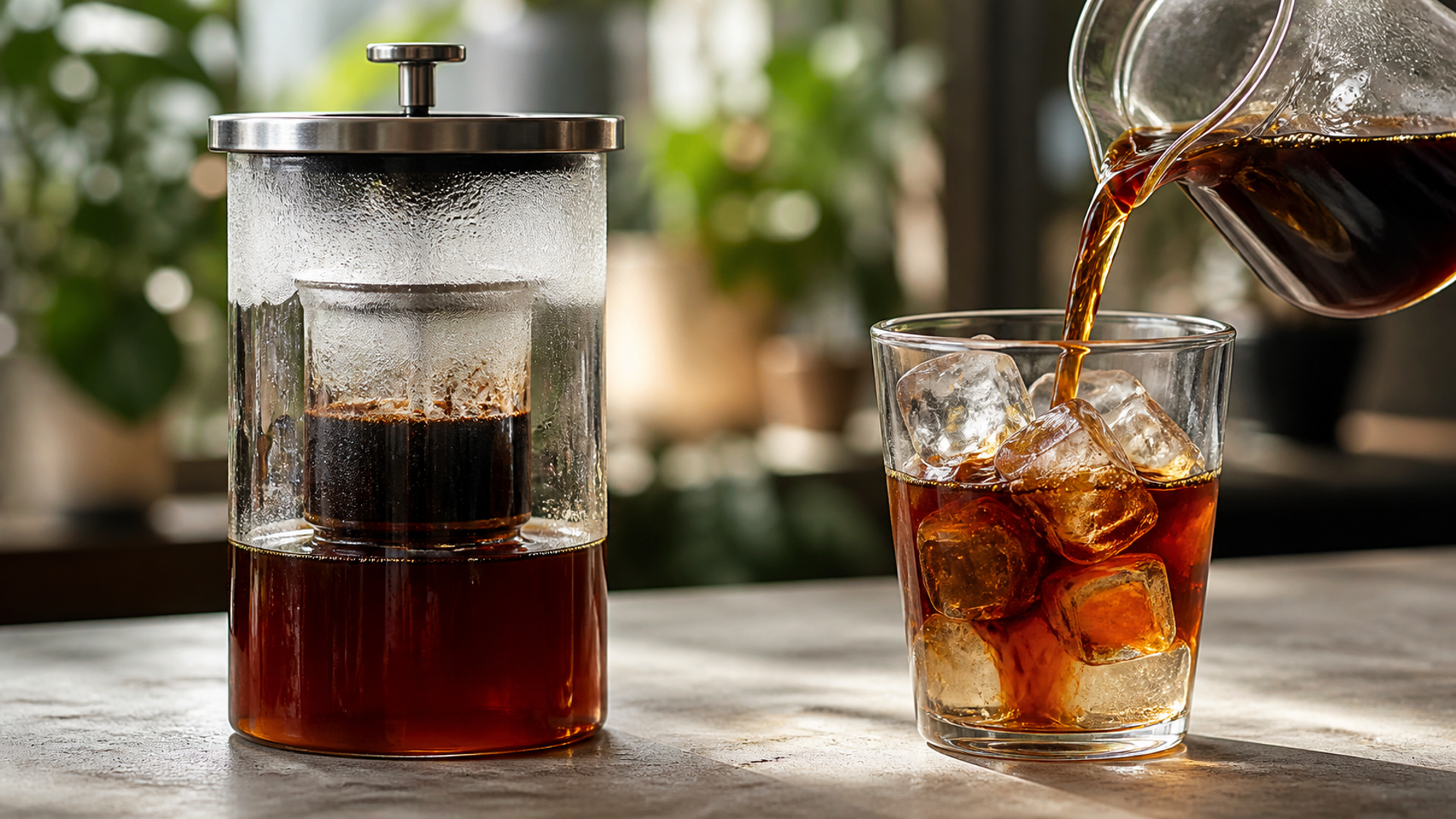
Cold brew and iced coffee are not two names for coffee with ice. Cold brew extracts coffee with cool or room-temperature water over a long contact time and is often prepared as a concentrate. Iced coffee begins with hot extraction, then is chilled or brewed directly over ice. Roast, grind, water, ratio, time and dilution can shift either cup, so familiar claims that one is always smoother, sweeter or stronger need testing under a controlled recipe.
Brewing temperature changes the method
Choose cold brew when a make-ahead concentrate, low-temperature extraction and a rounder flavour profile suit the service. Choose hot-brewed iced coffee when aromatic definition, fast preparation and a familiar filter workflow matter. Choose by service workflow when refrigerator space, batch life, dilution, rush speed and repeatable recipe are more important than the category label.
| Decision factor | Cold brew | Hot-brewed iced coffee | Choose by service workflow |
|---|---|---|---|
| Extraction | Cool water and long contact time | Hot extraction followed by chilling | Control coffee, water, grind and time |
| Service speed | Batch ahead, then dilute and pour | Brew fresh or pre-chill by plan | Match the rush pattern |
| Aroma | Cold extraction can emphasise a different profile | Hot brewing can capture volatile aromatics | Taste at equal strength |
| Dilution | Concentrate needs a declared ratio | Ice melt is part of the recipe | Weigh beverage and ice |
| Storage | Prepared batches need cold, clean handling | Fresh brewing reduces holding time | Use a food-safe discard rule |
| Equipment | Vessel, filter and refrigerator space matter | Brewer, kettle and rapid chilling matter | Choose the simpler repeatable path |
This cold brew vs iced coffee matrix is the article's working value object. Read the cold brew vs iced coffee rows together: the decisive failure mode depends on this topic's evidence, operating context and reader objective.
Dilution and concentration control the glass
Evidence 1. The Specialty Coffee Association has published sensory work comparing cold and hot extraction under controlled conditions rather than treating category folklore as settled fact.
Evidence 2. The National Coffee Association describes cold brew as coffee steeped in cold or room-temperature water for an extended period.
Evidence 3. Perceived acidity, bitterness and sweetness depend on bean, roast, extraction and serving strength, so method alone does not guarantee a sensory outcome.
Evidence 4. Caffeine comparisons require equal serving size and recipe information because concentrate strength and dilution vary widely.
Reader-visible sources checked for this article:
sca.coffee — reader-visible current or official evidence
ncausa.org — reader-visible current or official evidence
For cold brew vs iced coffee, these sources establish only the claims inside their documented scope. Recheck every changeable specification, availability condition, price, policy or service term in the relevant market before acting.
Run a controlled side-by-side brew
A buyer can resolve extraction without starting from a brand preference. Ask whether cool water and long contact time; compare that with whether hot extraction followed by chilling; then use control coffee, water, grind and time as the third route's safeguard. An unknown condition stays unknown.
On service speed, popularity is not enough. The evidence for option one is that batch ahead, then dilute and pour. Option two means brew fresh or pre-chill by plan. Option three is rational where match the rush pattern. Recheck any changeable term immediately before commitment.
The decision changes at aroma. Choose the first path only if cold extraction can emphasise a different profile; move to the second when hot brewing can capture volatile aromatics; use the third when taste at equal strength. Save the downside that would make this row fail.
For dilution, the first route works when concentrate needs a declared ratio; the second requires ice melt is part of the recipe. The control for the third is weigh beverage and ice. Verify this row against the exact product, property, account or environment before it can reverse the decision.
The storage row exposes a practical boundary. Route one assumes prepared batches need cold, clean handling, while route two is defensible only when fresh brewing reduces holding time. Route three depends on use a food-safe discard rule. If that evidence is absent, keep the more reversible option.
Read equipment as a stop/go test: vessel, filter and refrigerator space matter supports the first option; brewer, kettle and rapid chilling matter supports the second; and choose the simpler repeatable path supports the third. Record which source proves the condition and when it was checked.
Facts that would reverse the current choice
Reversal control 1 — Extraction. Before choosing Cold brew, write down how the decision changes if “Cool water and long contact time” proves false. Do the same for Hot-brewed iced coffee and “Hot extraction followed by chilling”. Keep the Choose by service workflow route available until “Control coffee, water, grind and time” is verified. This control belongs to cold brew vs iced coffee; update it from the cited source or exact supplier rather than copying a generic checklist.
Reversal control 2 — Service speed. Before choosing Cold brew, write down how the decision changes if “Batch ahead, then dilute and pour” proves false. Do the same for Hot-brewed iced coffee and “Brew fresh or pre-chill by plan”. Keep the Choose by service workflow route available until “Match the rush pattern” is verified. This control belongs to cold brew vs iced coffee; update it from the cited source or exact supplier rather than copying a generic checklist.
Reversal control 3 — Aroma. Before choosing Cold brew, write down how the decision changes if “Cold extraction can emphasise a different profile” proves false. Do the same for Hot-brewed iced coffee and “Hot brewing can capture volatile aromatics”. Keep the Choose by service workflow route available until “Taste at equal strength” is verified. This control belongs to cold brew vs iced coffee; update it from the cited source or exact supplier rather than copying a generic checklist.
Reversal control 4 — Dilution. Before choosing Cold brew, write down how the decision changes if “Concentrate needs a declared ratio” proves false. Do the same for Hot-brewed iced coffee and “Ice melt is part of the recipe”. Keep the Choose by service workflow route available until “Weigh beverage and ice” is verified. This control belongs to cold brew vs iced coffee; update it from the cited source or exact supplier rather than copying a generic checklist.
Reversal control 5 — Storage. Before choosing Cold brew, write down how the decision changes if “Prepared batches need cold, clean handling” proves false. Do the same for Hot-brewed iced coffee and “Fresh brewing reduces holding time”. Keep the Choose by service workflow route available until “Use a food-safe discard rule” is verified. This control belongs to cold brew vs iced coffee; update it from the cited source or exact supplier rather than copying a generic checklist.
Reversal control 6 — Equipment. Before choosing Cold brew, write down how the decision changes if “Vessel, filter and refrigerator space matter” proves false. Do the same for Hot-brewed iced coffee and “Brewer, kettle and rapid chilling matter”. Keep the Choose by service workflow route available until “Choose the simpler repeatable path” is verified. This control belongs to cold brew vs iced coffee; update it from the cited source or exact supplier rather than copying a generic checklist.
Standardise the beans
Use the same coffee, roast date, water and target beverage strength for both methods. Record dose, grind, water, temperature, time, filtration, ice and final mass. In this cold brew versus iced coffee comparison, preserve the exact item, setting, date and test condition in the evidence log. Keep measured results separate from category shorthand and repeat the check in the intended environment. If strength differs, correct dilution before making a flavour claim. When that reversal condition appears, reopen the choice instead of defending the original preference.
Control the chill
Measure the temperature at first sip and after ten minutes. For iced coffee, include meltwater in the designed brew ratio rather than treating it as accidental. In this cold brew versus iced coffee comparison, preserve the exact item, setting, date and test condition in the evidence log. Keep measured results separate from category shorthand and repeat the check in the intended environment. If one cup warms or dilutes much faster, redesign the serving vessel or ice load. When that reversal condition appears, reopen the choice instead of defending the original preference.
Score sensory dimensions
Taste blind and score aroma, acidity, sweetness, bitterness, body, clarity and aftertaste separately. Repeat with milk or sweetener only if that is the normal serve. In this cold brew versus iced coffee comparison, preserve the exact item, setting, date and test condition in the evidence log. Keep measured results separate from category shorthand and repeat the check in the intended environment. If preference changes with the normal addition, choose for that drink rather than the black-coffee test. When that reversal condition appears, reopen the choice instead of defending the original preference.
Audit batch handling
Map brew time, filtration, transfer, refrigeration, labelling and discard timing. Clean every surface that touches the finished drink and follow applicable food-safety guidance. In this cold brew versus iced coffee comparison, preserve the exact item, setting, date and test condition in the evidence log. Keep measured results separate from category shorthand and repeat the check in the intended environment. If the workflow cannot keep a batch controlled, favour fresh preparation. When that reversal condition appears, reopen the choice instead of defending the original preference.
Price the cup
Include coffee dose, labour, filters, ice, refrigeration and waste. Compare cost at the actual serving size and dilution. In this cold brew versus iced coffee comparison, preserve the exact item, setting, date and test condition in the evidence log. Keep measured results separate from category shorthand and repeat the check in the intended environment. If concentrate losses erase convenience, reduce batch size or change method. When that reversal condition appears, reopen the choice instead of defending the original preference.
Four coffee moments, four answers
Morning queue
A documented cold-brew batch can shorten service once dilution is standardised. Define the fact that would reverse this recommendation before committing.
Single expressive coffee
Fresh hot brewing over ice can preserve the character the drinker wants. Define the fact that would reverse this recommendation before committing.
Milk-based summer drink
Either method can work, but concentration and body should be tested with the milk. Define the fact that would reverse this recommendation before committing.
Small kitchen
The method that uses available refrigerator and brewing space may win. Define the fact that would reverse this recommendation before committing.
Action checklist
Use one coffee.
Record roast date.
Weigh dose and water.
Record grind.
Measure extraction time.
Measure final strength.
Design ice dilution.
Taste blind.
Test normal additions.
Label batches.
Define discard time.
Price the actual cup.
Continue the decision
The linked VERTU articles expand adjacent parts of the cold brew vs iced coffee decision. They do not substitute for the external evidence above.
The cold-brew-versus-iced-coffee verdict
Choose cold brew when a make-ahead concentrate, low-temperature extraction and a rounder flavour profile suit the service. Choose hot-brewed iced coffee when aromatic definition, fast preparation and a familiar filter workflow matter. Choose by service workflow when refrigerator space, batch life, dilution, rush speed and repeatable recipe are more important than the category label.
Keep the cold brew vs iced coffee decision reversible until its material cost, safety, access, privacy and compatibility facts are verified. Unknown evidence stays unknown; it is never silently scored as favourable.