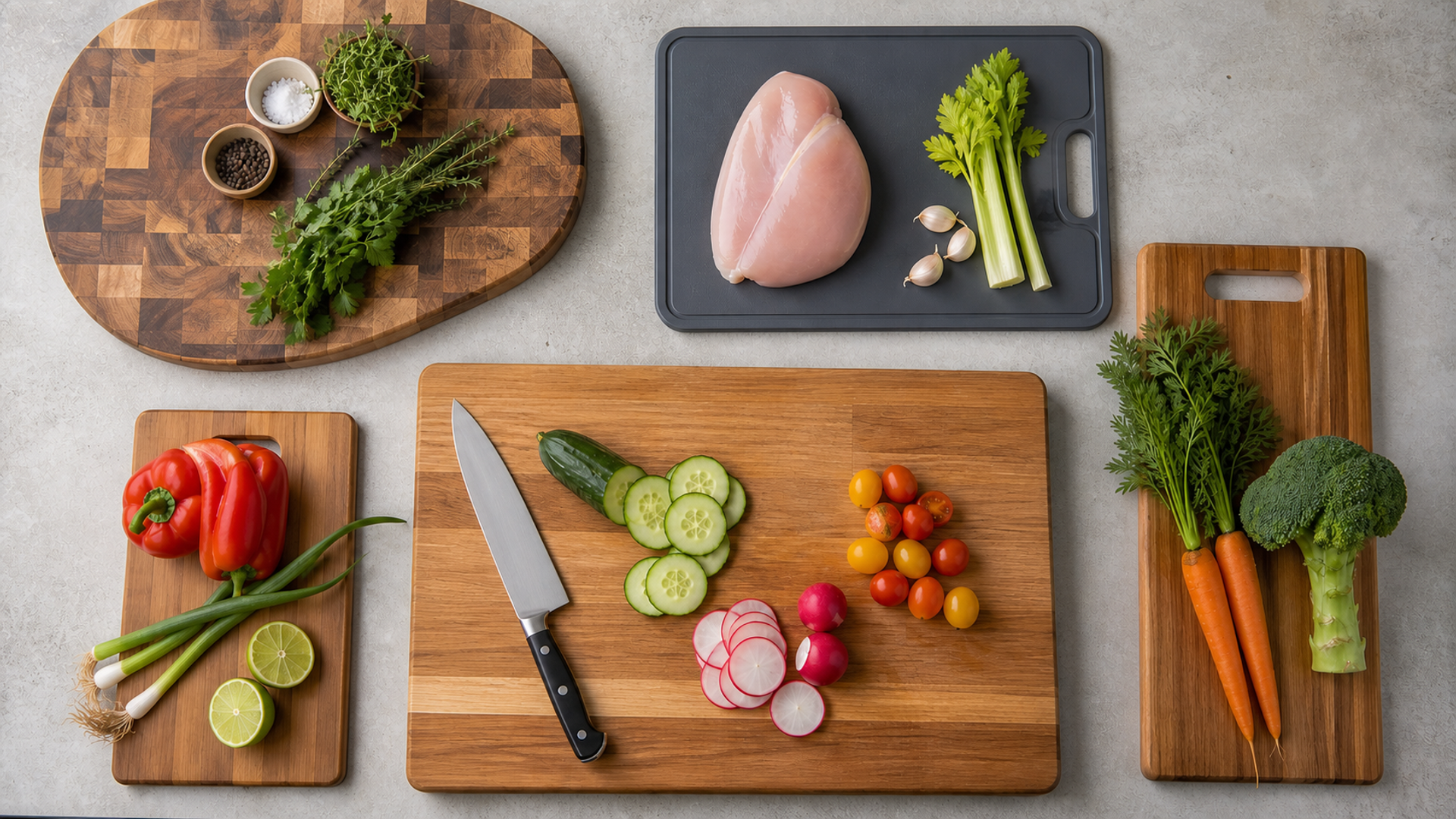
A cutting board is simultaneously a food-contact surface, a workbench and the landing zone for a knife edge. That makes the 'best' board task-dependent. A huge end-grain block can be excellent for repeated vegetable work but impractical to wash in a small sink; a light polymer board can be easy to sanitise but move under force or develop deep grooves. The safest setup often uses more than one board with an explicit separation routine.
Choose by task and cleaning route
Choose the largest stable board that can still be washed and dried properly in the real kitchen. Use a separate board for raw meat, poultry or seafood, clean it promptly and replace boards that become excessively worn or develop hard-to-clean grooves. End-grain or edge-grain wood can suit knife-heavy work when maintenance is accepted; dishwasher-safe polymer is useful where sanitation throughput and task separation dominate.
| Decision factor | Wood workhorse | Polymer sanitation board | Separated multi-board system |
|---|---|---|---|
| Primary task | Repeated knife work and serving | Raw-protein or high-turnover preparation | Tasks are explicitly separated |
| Knife edge | Construction feels forgiving under chopping | Surface is not unnecessarily glass-hard | Most knife work stays on the friendlier board |
| Sanitation | Full hand washing and drying are realistic | Approved dishwasher cycle is available | Contaminated board never crosses roles |
| Size and weight | Stable block still fits the sink | Light board remains nonslip | Each board fits its station |
| Maintenance | Oiling or resurfacing is accepted | Damage inspection and replacement are easy | Different care routines are documented |
| Damage trigger | Cracks, delamination or warp end service | Deep grooves or shedding end service | Either board can be retired independently |
| Storage | Both faces dry with airflow | Board is not trapped damp after washing | Roles stay visible in storage |
This best cutting board matrix is the article's working value object. Read the best cutting board rows together: the decisive failure mode depends on this topic's evidence, operating context and reader objective.
Food-safety controls that apply to every material
Evidence 1. USDA guidance recommends using one cutting board for fresh produce and bread and a separate board for raw meat, poultry and seafood to reduce cross-contamination risk.
Evidence 2. USDA states that nonporous acrylic, plastic, glass and solid wood boards can be used and advises discarding boards that become excessively worn or develop hard-to-clean grooves.
Evidence 3. The FDA Food Code provides a regulatory model for food-contact surfaces and sanitation in food establishments, but a household still has to follow the board maker's care instructions and local food-safety guidance.
Evidence 4. Knife-edge friendliness, stability and cleanability are separate variables; no material label guarantees all three without considering construction, finish, damage and cleaning access.
Reader-visible sources checked for this article:
fsis.usda.gov — reader-visible current or official evidence
fda.gov — reader-visible current or official evidence
For best cutting board, these sources establish only the claims inside their documented scope. Recheck every changeable specification, availability condition, price, policy or service term in the relevant market before acting.
Protect the knife edge without losing sanitation
A buyer can resolve primary task without starting from a brand preference. Ask whether repeated knife work and serving; compare that with whether raw-protein or high-turnover preparation; then use tasks are explicitly separated as the third route's safeguard. An unknown condition stays unknown.
On knife edge, popularity is not enough. The evidence for option one is that construction feels forgiving under chopping. Option two means surface is not unnecessarily glass-hard. Option three is rational where most knife work stays on the friendlier board. Recheck any changeable term immediately before commitment.
The decision changes at sanitation. Choose the first path only if full hand washing and drying are realistic; move to the second when approved dishwasher cycle is available; use the third when contaminated board never crosses roles. Save the downside that would make this row fail.
For size and weight, the first route works when stable block still fits the sink; the second requires light board remains nonslip. The control for the third is each board fits its station. Verify this row against the exact product, property, account or environment before it can reverse the decision.
The maintenance row exposes a practical boundary. Route one assumes oiling or resurfacing is accepted, while route two is defensible only when damage inspection and replacement are easy. Route three depends on different care routines are documented. If that evidence is absent, keep the more reversible option.
Read damage trigger as a stop/go test: cracks, delamination or warp end service supports the first option; deep grooves or shedding end service supports the second; and either board can be retired independently supports the third. Record which source proves the condition and when it was checked.
A buyer can resolve storage without starting from a brand preference. Ask whether both faces dry with airflow; compare that with whether board is not trapped damp after washing; then use roles stay visible in storage as the third route's safeguard. An unknown condition stays unknown.
Facts that would reverse the current choice
Reversal control 1 — Primary task. Before choosing Wood workhorse, write down how the decision changes if “Repeated knife work and serving” proves false. Do the same for Polymer sanitation board and “Raw-protein or high-turnover preparation”. Keep the Separated multi-board system route available until “Tasks are explicitly separated” is verified. This control belongs to best cutting board; update it from the cited source or exact supplier rather than copying a generic checklist.
Reversal control 2 — Knife edge. Before choosing Wood workhorse, write down how the decision changes if “Construction feels forgiving under chopping” proves false. Do the same for Polymer sanitation board and “Surface is not unnecessarily glass-hard”. Keep the Separated multi-board system route available until “Most knife work stays on the friendlier board” is verified. This control belongs to best cutting board; update it from the cited source or exact supplier rather than copying a generic checklist.
Reversal control 3 — Sanitation. Before choosing Wood workhorse, write down how the decision changes if “Full hand washing and drying are realistic” proves false. Do the same for Polymer sanitation board and “Approved dishwasher cycle is available”. Keep the Separated multi-board system route available until “Contaminated board never crosses roles” is verified. This control belongs to best cutting board; update it from the cited source or exact supplier rather than copying a generic checklist.
Reversal control 4 — Size and weight. Before choosing Wood workhorse, write down how the decision changes if “Stable block still fits the sink” proves false. Do the same for Polymer sanitation board and “Light board remains nonslip”. Keep the Separated multi-board system route available until “Each board fits its station” is verified. This control belongs to best cutting board; update it from the cited source or exact supplier rather than copying a generic checklist.
Reversal control 5 — Maintenance. Before choosing Wood workhorse, write down how the decision changes if “Oiling or resurfacing is accepted” proves false. Do the same for Polymer sanitation board and “Damage inspection and replacement are easy”. Keep the Separated multi-board system route available until “Different care routines are documented” is verified. This control belongs to best cutting board; update it from the cited source or exact supplier rather than copying a generic checklist.
Reversal control 6 — Damage trigger. Before choosing Wood workhorse, write down how the decision changes if “Cracks, delamination or warp end service” proves false. Do the same for Polymer sanitation board and “Deep grooves or shedding end service”. Keep the Separated multi-board system route available until “Either board can be retired independently” is verified. This control belongs to best cutting board; update it from the cited source or exact supplier rather than copying a generic checklist.
Reversal control 7 — Storage. Before choosing Wood workhorse, write down how the decision changes if “Both faces dry with airflow” proves false. Do the same for Polymer sanitation board and “Board is not trapped damp after washing”. Keep the Separated multi-board system route available until “Roles stay visible in storage” is verified. This control belongs to best cutting board; update it from the cited source or exact supplier rather than copying a generic checklist.
Build a two-board safety system
Colour alone does not prevent cross-contamination; behaviour does. Assign one board to raw animal products and another to ready-to-eat food, then store them so the roles stay obvious. Move raw packaging, utensils and hands through the same separation logic. The system fails if a clean produce board receives a contaminated knife or if a washed board is stacked while damp. Marking one edge or using visibly different materials can make the rule easier to follow.
Understand wood construction
End-grain boards present fibre ends to the knife and often feel forgiving, but they are thick, heavy and more demanding to manufacture. Edge-grain boards are usually thinner and less expensive. Species, glue-up, moisture balance and finish all matter. A decorative board with open cracks, unstable feet or an unknown surface coating is not improved by a premium timber name. Check whether both faces can dry and whether resurfacing is practical.
Use polymer where workflow rewards it
A food-safe polymer board can be light, colour coded and dishwasher compatible if the manufacturer allows that treatment. Thin sheets are easy to move but can curl or slide. Very hard surfaces may be less kind to edges, while heavily scored plastic can become difficult to clean. Inspect the board under side light. When knife channels trap debris or the surface sheds, replacement is a hygiene decision, not an aesthetic one.
Size the board around the sink and knife
The useful area should hold the ingredient and leave a landing zone for the knife without forcing food off the edge. Yet the board must fit the sink, dishwasher or cleaning station. A board too large to clean completely invites shortcuts. Add a damp towel or purpose-made nonslip mat under a flat board when appropriate, but do not use an unstable warped surface. Juice grooves help only when their capacity and cleanability match the task.
Maintain and replace deliberately
Wash after use according to the material instructions, rinse away cleaner, dry fully and keep wood away from prolonged soaking. Use only finishes intended for food-contact board maintenance. Check seams, feet, handles and grooves regularly. Resurface suitable wood before damage becomes structural; retire delaminated, cracked, badly warped or excessively scored boards. The replacement decision should be documented by condition, not calendar age alone.
Three kitchen-board systems
Knife-focused vegetable preparation
A stable end-grain or well-made edge-grain wood board can provide ample area and a forgiving cutting feel, provided it can be washed, dried and maintained in the kitchen. Define the fact that would reverse this recommendation before committing.
Fast raw-protein cleanup
A separate dishwasher-safe polymer board can simplify task isolation and sanitation. Confirm dishwasher approval and retire it when deep damage becomes hard to clean. Define the fact that would reverse this recommendation before committing.
Small kitchen with one sink
Use two manageable boards rather than one oversized showpiece. Stability, full sink access and vertical drying are more useful than maximum thickness. Define the fact that would reverse this recommendation before committing.
Action checklist
Assign separate raw-protein and ready-to-eat boards.
Measure the sink and dishwasher before board size.
Check the board sits flat without rocking.
Inspect seams, cracks and surface coating.
Match board hardness to valuable knife edges.
Confirm dishwasher approval rather than assuming.
Clean promptly after each food task.
Dry both faces with airflow.
Resurface suitable wood when appropriate.
Discard excessively worn or hard-to-clean boards.
Continue the decision
The linked VERTU articles expand adjacent parts of the best cutting board decision. They do not substitute for the external evidence above.
The cutting-board verdict
Choose the largest stable board that can still be washed and dried properly in the real kitchen. Use a separate board for raw meat, poultry or seafood, clean it promptly and replace boards that become excessively worn or develop hard-to-clean grooves. End-grain or edge-grain wood can suit knife-heavy work when maintenance is accepted; dishwasher-safe polymer is useful where sanitation throughput and task separation dominate.
Keep the best cutting board decision reversible until its material cost, safety, access, privacy and compatibility facts are verified. Unknown evidence stays unknown; it is never silently scored as favourable.