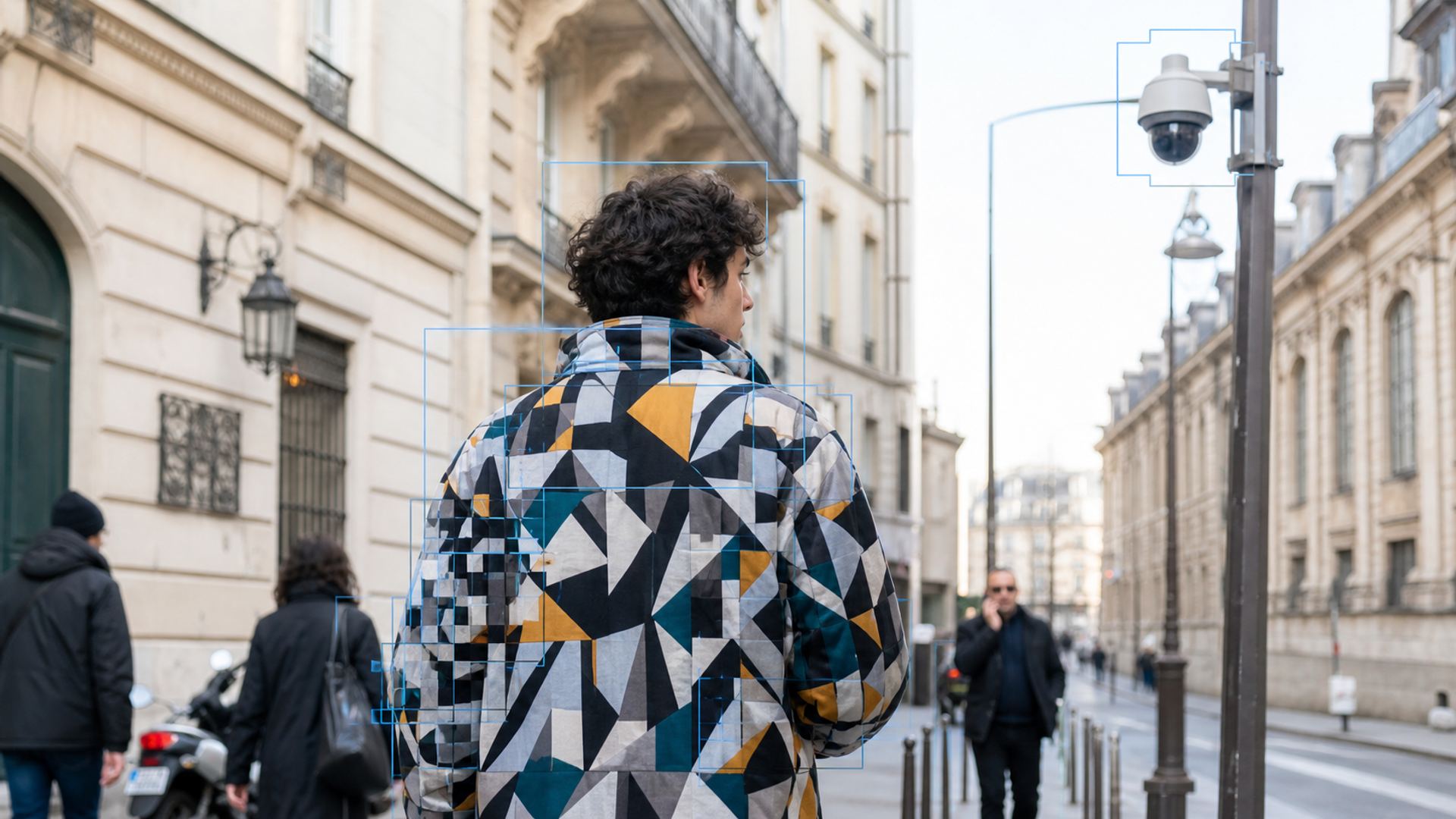
Anti-surveillance clothing can confuse some AI person detectors under tested conditions. It does not make the wearer invisible to cameras, people or every recognition system. That distinction matters as Leipzig start-up Urban Privacy attracts attention for jackets using face-like patterns, asymmetric cuts and shielded phone pockets.
The clothing turns an abstract machine-learning weakness into a physical object. It also risks promising more than any garment can deliver. Real surveillance systems combine cameras, people, location, time, movement and sometimes several models. A pattern that disrupts one detector may fail under another camera, angle or software update.
Detection, recognition and tracking are not the same
Privacy products often collapse three separate tasks:
Person detection: Does software find a human-shaped object in the frame?
Face or attribute recognition: Can it estimate identity or characteristics from visible features?
Tracking: Can a system connect the same person or object across frames and locations?
Adversarial clothing research often targets person detectors. A successful miss in that model does not prove that a face is hidden, a human operator cannot see the wearer or another camera cannot track movement.
What the research demonstrates
Peer-reviewed work has shown that printable patterns can reduce the performance of particular neural-network detectors. A 2022 CVPR paper introduced repeatable adversarial textures intended to work across clothing shapes and viewing angles. A 2023 follow-up explored more natural-looking camouflage textures through 3D modelling. A 2024 CVPR paper reported physical-world results for dynamic adversarial patches against selected detector setups.
These are meaningful security findings. They reveal that computer vision can be sensitive to deliberately optimised physical patterns. They are not universal product certifications. Results depend on model architecture, training data, distance, pose, lighting, print quality and the attacker's knowledge of the target system.
The evidence matrix
| Claim | Evidence supports it? | Important limitation |
|---|---|---|
| A printed pattern can disrupt some AI person detectors | Yes, in published experiments | Results are model- and setup-dependent |
| One jacket defeats all surveillance cameras | No | Cameras and analytic stacks vary |
| Loose or asymmetric clothing may reduce attribute confidence | Plausible in some systems | It does not prevent human observation |
| A shielded pocket can reduce wireless communication | Depends on construction and frequency | It may also block calls, location and emergency contact |
| The wearer becomes legally anonymous | No | Identity can be inferred from many other signals |
| The same pattern will work after model retraining | Unknown | Defenders can adapt models and combine sensors |
The honest product language is therefore “designed to hinder certain automated detection or tracking methods”, not “invisibility cloak”.
Why real streets are harder than a laboratory
A research experiment controls the target model, camera and evaluation method. A city environment adds rain, fabric folds, backpacks, vehicles, changing illumination and multiple viewing angles. The pattern itself may make the wearer more memorable to a human or attract additional attention.
Modern systems can also combine person detection with gait, clothing colour, device identifiers, payment records or access logs. Blocking one input does not erase the rest. A privacy strategy that depends entirely on a jacket becomes fragile.
The phone pocket creates a separate trade-off
Urban Privacy's concept includes pockets intended to shield a phone. Radio-frequency shielding can reduce unwanted communication when properly constructed, but it also interferes with legitimate connectivity. A phone inside an effective shield may miss calls, messages, navigation updates and emergency alerts.
It also does not erase records created before shielding. The mobile network, apps and services may already have location or account data. Use airplane mode, operating-system permissions and account controls deliberately rather than treating fabric as a substitute for configuration.
A practical privacy threat model
| Concern | Most relevant control | Role of clothing |
|---|---|---|
| Casual street photography | Position, consent norms, visible awareness | Pattern may discourage or complicate capture |
| Automated person detection | Model robustness and camera conditions | Adversarial pattern may reduce some detections |
| Facial recognition | Face visibility, lawful safeguards, masks where permitted | Jacket alone is limited |
| Phone location collection | OS permissions, app access, network state | Shielded pocket can temporarily block radio |
| Account-linked tracking | Identity, cookies, payments and logins | Clothing has little effect |
| Executive travel privacy | Layered communications and operational discipline | A garment is at most one minor layer |
For sensitive travel, start with accounts, communications, device access and authentication. Our executive passkey and hardware-key plan addresses controls that remain useful regardless of camera model.
What to ask before buying
Which detector models and camera conditions were tested?
Was testing performed by the seller or an independent laboratory?
Does the evidence cover moving people and multiple viewing angles?
How does washing, stretching and wear affect the print?
What does “anti-tracking” mean in measurable terms?
Does the pocket block all required frequencies, and how was that tested?
What legitimate calls or services will stop while the phone is shielded?
If the seller cannot define the target system, treat broad performance claims cautiously.
The defender can adapt
Adversarial patterns exploit a model's current decision boundary. A camera operator can retrain the detector with examples of the garment, use a different architecture, add temporal tracking or ask a human to review uncertain frames. This creates a continuing contest rather than a permanent technical advantage.
The garment may still have social value. It makes automated observation visible and gives the wearer a way to express objection. That value should be described separately from measured detector performance. A political design object does not need to promise invisibility to be meaningful.
Legal and operational limits
Rules on masks, photography, private property, workplace clothing and interference with security systems vary by jurisdiction. A printed pattern is not automatically unlawful, but context matters. Do not use a privacy garment to bypass lawful access controls or safety requirements.
Executives should also consider the signalling effect. A distinctive adversarial jacket may be inappropriate in a client site, airport screening area or controlled facility even when permitted. The lower-friction control is often to minimise account and device exposure before the journey rather than attract attention at the camera.
For an actual threat, obtain local legal and security advice. Research results about model vulnerability do not establish a right to defeat a particular system.
The practical verdict
Anti-surveillance clothing is a provocative and sometimes technically grounded response to machine vision. It can expose weaknesses in particular detectors and make privacy visible as a design issue. It cannot guarantee anonymity or defeat a layered surveillance system.
Buy such clothing for its design, its political statement or a clearly documented technical experiment. Do not make it the only protection for a high-risk journey. Effective privacy is layered, observable and reversible; no print can replace that discipline.
![Executive Health Management: CEO Longevity Secrets [2026 Guide]](https://statics.myquickcreator.com/upload/aaaovujuj4apultn/2026/09/21/21751-v9yy9q2x.png)