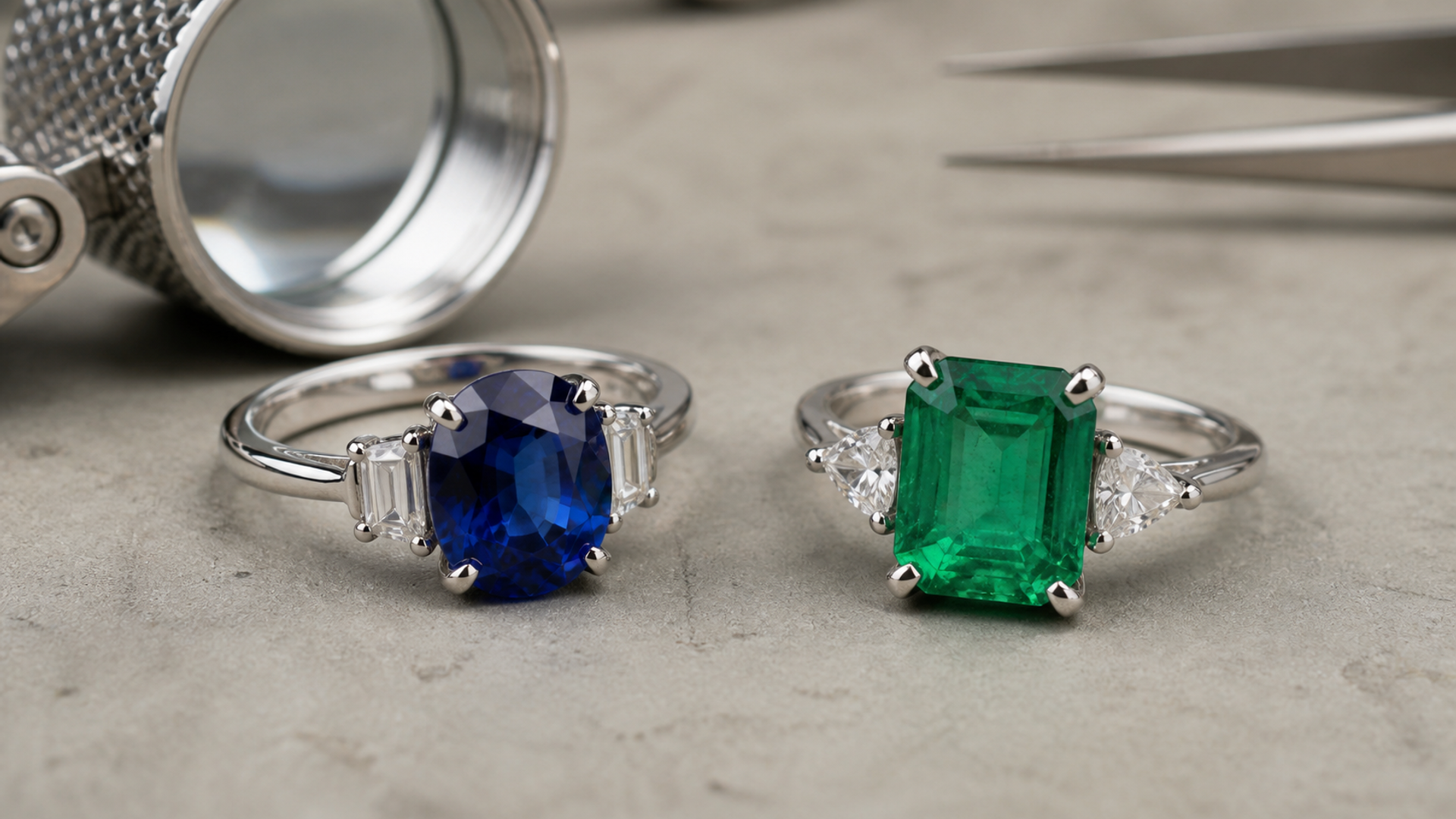
Sapphire versus emerald is not blue versus green alone. Sapphire is corundum, valued across many colours and recognised for durability. Emerald is green beryl, prized above all for colour and commonly carrying inclusion and treatment considerations. Cut, transparency, origin claims, laboratory evidence, setting and wear pattern decide whether either fits everyday jewellery.
Begin with colour and wear
Choose sapphire when durability, colour range and frequent wear lead, after treatment claims are verified. Choose emerald when distinctive green and inclusion character justify protective setting and care. Pause when a high-value gem lacks credible identification and disclosure.
| Decision factor | Sapphire | Emerald | Choose another gem or pause for a report |
|---|---|---|---|
| Colour | Hue, tone and saturation stay lively | Green remains vivid without going dark | Compare in several lights |
| Wear | Corundum suits exposure | Protective setting controls risk | Use a less exposed jewel |
| Clarity | Inclusions do not threaten durability | Jardin remains attractive and stable | Request examination |
| Treatment | Heat or diffusion is disclosed | Clarity enhancement is disclosed | Do not rely on speech |
| Cut | Light returns with controlled zoning | Cut balances colour and transparency | Reject severe windowing |
| Report | Identity and origin premium are supported | Treatment and origin are supported | Pause for independent report |
This sapphire vs emerald matrix is the article's working value object. Read the sapphire vs emerald rows together: the decisive failure mode depends on this topic's evidence, operating context and reader objective.
How the materials differ
Evidence 1. GIA identifies sapphire as durable corundum available in blue and other colours.
Evidence 2. GIA identifies emerald as green beryl and colour as its most important quality factor.
Evidence 3. GIA reports identify material and detectable treatments and may offer origin opinions; they do not set retail value.
Evidence 4. Treatments affect rarity, care and price and must be checked on the exact stone.
Reader-visible sources checked for this article:
gia.edu — reader-visible current or official evidence
gia.edu — reader-visible current or official evidence
For sapphire vs emerald, these sources establish only the claims inside their documented scope. Recheck every changeable specification, availability condition, price, policy or service term in the relevant market before acting.
Read treatment and report boundaries
Read colour as a stop/go test: hue, tone and saturation stay lively supports the first option; green remains vivid without going dark supports the second; and compare in several lights supports the third. Record which source proves the condition and when it was checked.
A buyer can resolve wear without starting from a brand preference. Ask whether corundum suits exposure; compare that with whether protective setting controls risk; then use use a less exposed jewel as the third route's safeguard. An unknown condition stays unknown.
On clarity, popularity is not enough. The evidence for option one is that inclusions do not threaten durability. Option two means jardin remains attractive and stable. Option three is rational where request examination. Recheck any changeable term immediately before commitment.
The decision changes at treatment. Choose the first path only if heat or diffusion is disclosed; move to the second when clarity enhancement is disclosed; use the third when do not rely on speech. Save the downside that would make this row fail.
For cut, the first route works when light returns with controlled zoning; the second requires cut balances colour and transparency. The control for the third is reject severe windowing. Verify this row against the exact product, property, account or environment before it can reverse the decision.
The report row exposes a practical boundary. Route one assumes identity and origin premium are supported, while route two is defensible only when treatment and origin are supported. Route three depends on pause for independent report. If that evidence is absent, keep the more reversible option.
Facts that would reverse the current choice
Reversal control 1 — Colour. Before choosing Sapphire, write down how the decision changes if “Hue, tone and saturation stay lively” proves false. Do the same for Emerald and “Green remains vivid without going dark”. Keep the Choose another gem or pause for a report route available until “Compare in several lights” is verified. This control belongs to sapphire vs emerald; update it from the cited source or exact supplier rather than copying a generic checklist.
Reversal control 2 — Wear. Before choosing Sapphire, write down how the decision changes if “Corundum suits exposure” proves false. Do the same for Emerald and “Protective setting controls risk”. Keep the Choose another gem or pause for a report route available until “Use a less exposed jewel” is verified. This control belongs to sapphire vs emerald; update it from the cited source or exact supplier rather than copying a generic checklist.
Reversal control 3 — Clarity. Before choosing Sapphire, write down how the decision changes if “Inclusions do not threaten durability” proves false. Do the same for Emerald and “Jardin remains attractive and stable”. Keep the Choose another gem or pause for a report route available until “Request examination” is verified. This control belongs to sapphire vs emerald; update it from the cited source or exact supplier rather than copying a generic checklist.
Reversal control 4 — Treatment. Before choosing Sapphire, write down how the decision changes if “Heat or diffusion is disclosed” proves false. Do the same for Emerald and “Clarity enhancement is disclosed”. Keep the Choose another gem or pause for a report route available until “Do not rely on speech” is verified. This control belongs to sapphire vs emerald; update it from the cited source or exact supplier rather than copying a generic checklist.
Reversal control 5 — Cut. Before choosing Sapphire, write down how the decision changes if “Light returns with controlled zoning” proves false. Do the same for Emerald and “Cut balances colour and transparency”. Keep the Choose another gem or pause for a report route available until “Reject severe windowing” is verified. This control belongs to sapphire vs emerald; update it from the cited source or exact supplier rather than copying a generic checklist.
Reversal control 6 — Report. Before choosing Sapphire, write down how the decision changes if “Identity and origin premium are supported” proves false. Do the same for Emerald and “Treatment and origin are supported”. Keep the Choose another gem or pause for a report route available until “Pause for independent report” is verified. This control belongs to sapphire vs emerald; update it from the cited source or exact supplier rather than copying a generic checklist.
Judge colour
View face-up and tilted under daylight-equivalent, warm and low light. Record hue, tone, saturation, zoning and brightness in the intended metal rather than relying on phone white balance. Record the exact model, material, room, recipe or operating condition and the time of the check. Keep the observation separate from a marketing promise, and repeat the test under the intended use rather than an ideal showroom condition. If colour dies in normal wear light, showroom intensity should not decide. Save the result and the evidence that would reverse it, because a change in fit, specification, service, price or environment must reopen this decision rather than inherit an old conclusion.
Inspect inclusions
Use qualified magnification to study fractures, cavities and surface-reaching features. Ask whether an inclusion threatens a prong or edge and distinguish character from stability risk. Record the exact model, material, room, recipe or operating condition and the time of the check. Keep the observation separate from a marketing promise, and repeat the test under the intended use rather than an ideal showroom condition. If filling or fracture state is unclear, pause for laboratory evidence. Save the result and the evidence that would reverse it, because a change in fit, specification, service, price or environment must reopen this decision rather than inherit an old conclusion.
Verify claims
Match report number, measurements, weight and features to the stone. Record natural or laboratory-grown origin, detectable treatment and any geographic opinion, separating origin from quality. Record the exact model, material, room, recipe or operating condition and the time of the check. Keep the observation separate from a marketing promise, and repeat the test under the intended use rather than an ideal showroom condition. If rarity drives price, verify the report directly. Save the result and the evidence that would reverse it, because a change in fit, specification, service, price or environment must reopen this decision rather than inherit an old conclusion.
Design for use
Map ring, bracelet, pendant or earring exposure to impact, cosmetics, heat and cleaning. Choose protective setting and ask how the stone can be removed, repaired and rechecked. Record the exact model, material, room, recipe or operating condition and the time of the check. Keep the observation separate from a marketing promise, and repeat the test under the intended use rather than an ideal showroom condition. If the care routine conflicts with daily wear, choose another format. Save the result and the evidence that would reverse it, because a change in fit, specification, service, price or environment must reopen this decision rather than inherit an old conclusion.
Three jewels, three answers
Daily ring
Documented sapphire can combine colour and durability. Define the fact that would reverse this recommendation before committing.
Occasional statement jewel
Emerald can centre colour when exposure is controlled. Define the fact that would reverse this recommendation before committing.
Vague expensive loose stone
Independent identification should precede claims. Define the fact that would reverse this recommendation before committing.
Action checklist
Define wear.
Compare light.
Inspect inclusions.
Check cut.
Verify report.
Record treatment.
Separate origin.
Choose setting.
Confirm cleaning.
Save documents.
Continue the decision
The linked VERTU articles expand adjacent parts of the sapphire vs emerald decision. They do not substitute for the external evidence above.
The gemstone verdict
Choose sapphire when durability, colour range and frequent wear lead, after treatment claims are verified. Choose emerald when distinctive green and inclusion character justify protective setting and care. Pause when a high-value gem lacks credible identification and disclosure.
Keep the sapphire vs emerald decision reversible until its material cost, safety, access, privacy and compatibility facts are verified. Unknown evidence stays unknown; it is never silently scored as favourable.