An OpenAI smart speaker has not been officially announced with a final design, price or shipping date. Reports describe a possible portable, screen-free AI device developed with Jony Ive’s team, but those details remain unconfirmed. The more useful question is what a voice-first device could do that a phone cannot, and which privacy and reliability tests would justify adding another always-available microphone to daily life.
Key Takeaways
- OpenAI has confirmed its hardware collaboration with Jony Ive; it has not published a complete consumer-device specification.
- Screen-free speaker descriptions and shipment dates come from reporting, not an official product launch.
- A voice-first device may simplify hands-free requests, but a screen remains useful for reviewing, correcting and approving consequential actions.
- Evaluate microphone controls, data handling, app permissions and failure recovery before judging an AI device by its form.
- VERTU ALPHAFOLD offers a different model: a display-based phone with Hermes Agent acting across supported services with user authorisation.
What has OpenAI confirmed about a smart speaker?
OpenAI’s statement with Jony Ive confirms a collaboration bringing design and hardware work into its product plans. It does not name a retail smart-speaker model or publish a feature sheet. Separately, reporting by the San Francisco Chronicle describes a portable screen-free speaker as a possibility attributed to people familiar with the project, while noting that OpenAI and Ive have not confirmed that form. The distinction is essential: a collaboration is fact; a specific device description is still reporting.
Claims that the first device will ship at the end of 2026 should be treated cautiously. The Chronicle reported that a court filing indicated no customer shipment before the end of February 2027, and an Ive spokesperson declined to comment on launch timing. A supply-chain claim about production preparation would not by itself establish a consumer release date. As of 19 November 2026, buyers cannot compare an official OpenAI device against a phone using verified dimensions, battery life, service terms or price.
Why is a screen-free smart speaker attracting attention?
The appeal is interaction with less visual effort. A person could ask for a reminder while cooking, request a summary while walking around a room, or control supported services without finding an app icon. A dedicated object could be positioned for speech rather than handheld viewing. These are plausible use cases, not claims that OpenAI’s unreleased product already delivers them. The quality of microphones, wake-word handling, response time and supported integrations would determine whether the concept works in practice.
There is also a design argument: reducing visual interruptions may make an assistant feel less like another feed demanding attention. Yet removing a screen does not remove complexity. A voice interaction still needs a way to show what the system heard, which account it will use, what data it will send and whether an action succeeded. If the answer requires reading a contract, map, image or comparison table, voice alone can become a cumbersome interface. The value proposition must be tested task by task.
Source and timing: OpenAI’s 2025 collaboration statement confirms work with Jony Ive, not a final speaker specification. A San Francisco Chronicle report published in November 2026 attributes the portable, screen-free form to reporting and cites a court filing suggesting customer shipments would not precede late February 2027. These statements were checked on 19 November 2026; a supplier production claim is not an official retail launch.
Where does a screen still matter?
A display provides a review surface. Before sending a message, changing a booking or sharing a file, the user can inspect names, dates, costs and permissions. A screen also helps when speech recognition misunderstands a proper noun or when several similar options exist. An audio-only device can request spoken confirmation, but that may be awkward in public or insufficient for a dense document. Whether a screen-free product uses a companion phone, projector or another confirmation method is not yet established for OpenAI’s device.
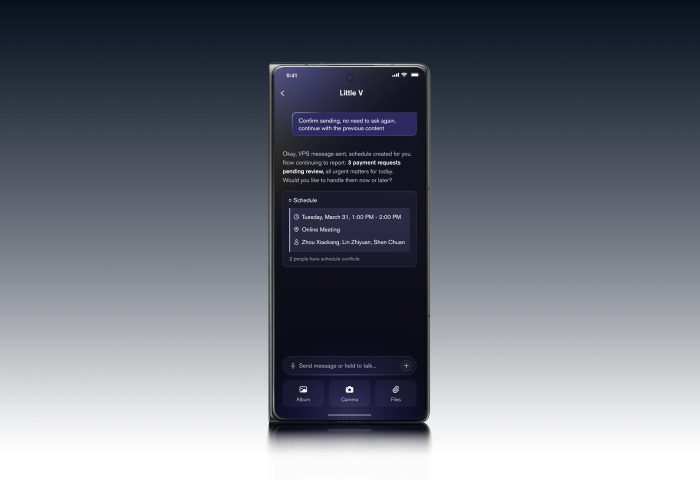
Consider an illustrative scenario: you ask an assistant to move a meeting and notify participants. A useful system should identify the intended event, present or read the proposed time, explain whom it will contact, and ask for approval before sending. The scenario is hypothetical, not a documented test of OpenAI or VERTU hardware. It illustrates that “agentic” usefulness depends less on the number of commands than on accurate context and clear control.
How should privacy be assessed for a voice-first device?
Start with concrete controls. Can the microphone be physically disabled? Is there a visible status indicator when it is listening or sending data? What is recorded, retained or shared with connected services? Can users review and delete history? Are household guests able to distinguish their own permissions from the owner’s? Published answers will matter more than assurances that a device is “private by design.” No unreleased product should be given a privacy grade from concept art or supplier speculation.
Context also changes the risk. A speaker on a shared kitchen counter may hear several people; a phone usually stays with one owner and can present a private screen. Voice can be convenient while driving or cooking, but it may be inappropriate for confidential work in an open room. Buyers should demand an explanation of what runs on the device, what requires cloud processing and what happens if the network fails. Until OpenAI publishes documentation, these remain questions rather than established shortcomings or strengths.
How does this compare with an AI agent phone?
The comparison is about interface and control, not a race against an unannounced specification. VERTU’s knowledge base describes ALPHAFOLD as a foldable phone with a 6.53-inch outer display, an 8.05-inch inner display and Hermes Agent. The agent is designed to turn spoken intent into actions across supported apps and services with user authorisation; availability varies by configuration and region. The displays provide space to review documents, dashboards and confirmations. That is a verified VERTU product position, not a claim that it outperforms an unreleased OpenAI device.
ALPHAFOLD also has a traditional phone’s communication and visual workflows. Its enterprise integrations require whitelist approval, data authorisation, private deployment and professional configuration; they are not enabled for every retail owner. A future screen-free assistant might complement a phone rather than replace it, especially if it handles quick ambient requests while the phone remains the review and transaction surface. That relationship is an editorial hypothesis pending actual hardware and interoperability details.
Which tasks could favour each form?
| Task | Screen-free voice device could suit | Phone with display could suit |
|---|---|---|
| Set a simple timer | Hands-free request | Visual check and edit |
| Review a long document | Brief spoken summary | Reading, annotation and verification |
| Arrange a meeting | Initial voice instruction | Participant, date and permission review |
| Share sensitive information | Only with clear controls | Private visual confirmation |
| Use while away from a desk | Depends on portability and connectivity | Established mobile form factor |
This is a decision framework, not performance testing. The OpenAI column describes what a screen-free category might support; the product has not been verified against those tasks. A useful review after launch would measure recognition in noise, correction time, permission clarity, response reliability, battery life and service availability rather than merely count demonstrations.
What would make the hardware genuinely useful?
First, it must solve repeated tasks faster than reaching for a phone. Second, it must know when to ask a clarifying question and when to stop. Third, users need a clear record of what was done and how to undo it. Fourth, the device must work with the services people actually use, under permissions they understand. Fifth, the physical product must be easy to charge, locate and mute. None of these can be established from a ring-shaped render or a claimed production timetable.
The strongest independent test would compare the same set of tasks across the device, a phone assistant and ordinary app use. Record success rate, correction steps, time to completion and unintended actions. Include quiet and noisy environments, multiple speakers, and a network interruption. Those measurements would give buyers evidence of practical benefit. No such first-hand OpenAI hardware test is available for this article.
What should buyers watch before any launch?
Look for an official product page, not an anonymous image. It should name supported markets, languages, subscriptions, connectivity requirements and repair or return terms. Privacy documentation should explain microphone operation, retention and third-party access. Demonstrations should show corrections and failed requests, not only a polished successful exchange. If a publication reports shipment timing, check whether it means component production, retail orders or delivery to consumers.
Also separate the company’s ambitions from the first device’s capabilities. A hardware team may work on several form factors. A smart speaker, wearable or companion accessory could each require a different routine. Do not buy a current product solely on the expectation that it will integrate with a future OpenAI device. Interoperability needs explicit confirmation from both sides.
Frequently asked questions
Has OpenAI officially launched a smart speaker?
No official consumer smart-speaker specification or retail launch has been published in the sources reviewed on 19 November 2026. OpenAI has confirmed its hardware collaboration with Jony Ive, while screen-free device descriptions come from reporting.
Will OpenAI hardware ship in 2026?
Do not treat that as confirmed. Reports conflict on timing, and a reported court filing indicated customer shipment would not occur before late February 2027. Wait for an official availability statement before planning a purchase.
Could a screen-free assistant replace a smartphone?
That is unproven. Voice may suit short hands-free tasks, while a screen remains useful for reading, correcting and approving complex actions. A future device might complement a phone rather than replace one.
How is VERTU ALPHAFOLD different?
ALPHAFOLD is an available foldable-phone product with inner and outer displays and Hermes Agent for supported, authorised workflows. It provides a visual review surface; it should not be compared on speed or privacy with untested OpenAI hardware.
What is the responsible conclusion?
The OpenAI smart speaker story is an emerging hardware question, not a confirmed year-end product release. The verified collaboration merits attention, while the alleged shape, specifications and shipment date require official confirmation. Buyers should judge any eventual device by successful tasks, transparent controls and its relationship to the phone they already use.