Introduction
Sleeping heart rate is the pace your heart settles into once you’re genuinely asleep (not just lying still). For many people, it’s the first health signal they notice from a smartwatch or ring.
You’ll learn what sleeping heart rate means, normal ranges, and why it drops at night.
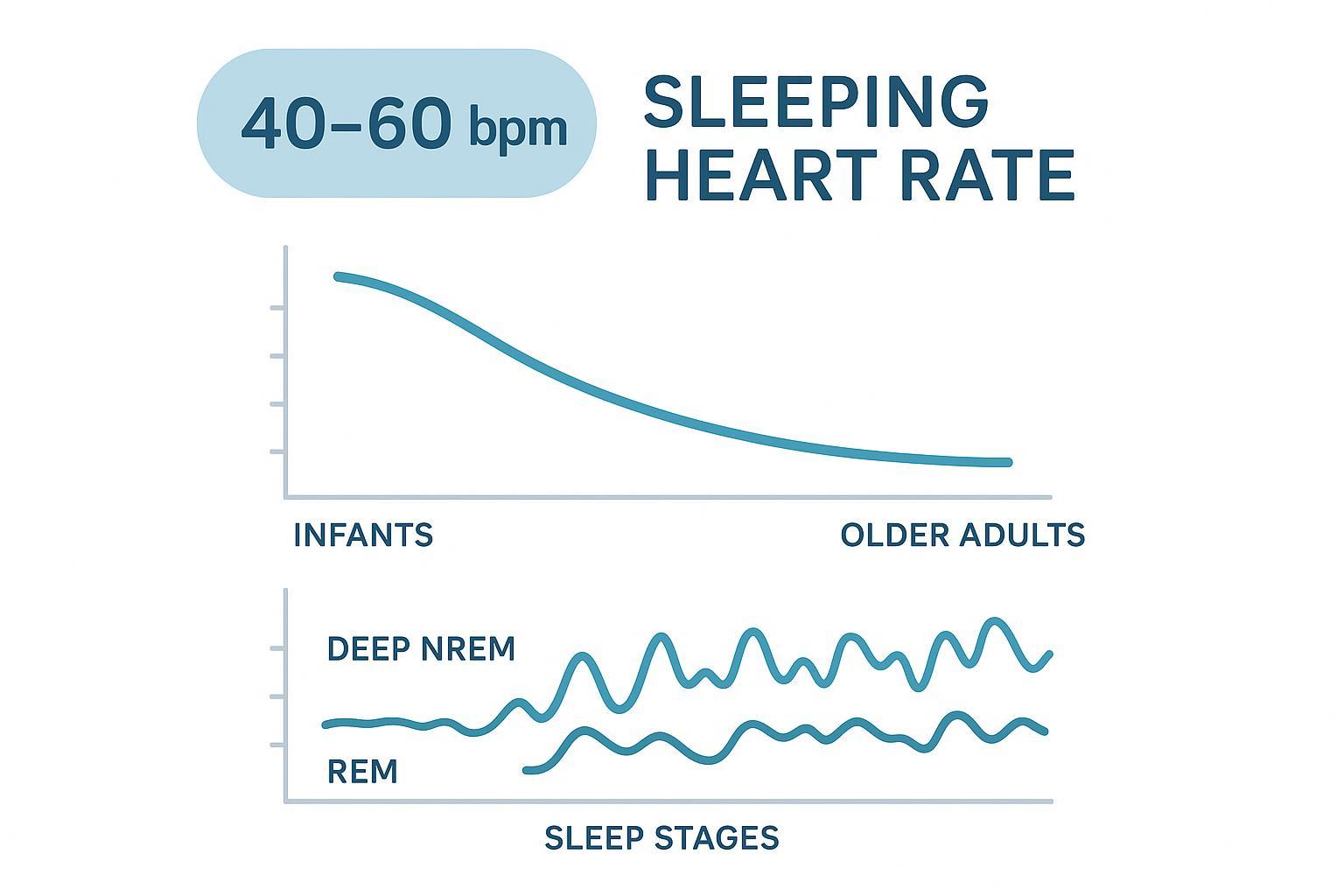
Quick answer: for most adults, a good sleeping heart rate is about 40–60 bpm.
Children run higher and decline with age; well‑trained athletes may dip into the 30s.
You’ll also see how to measure, improve, and when to seek care.
Key TakeawayA “good” normal sleeping heart rate is one that fits your age, fitness, and symptoms — and stays stable over time. A sudden change matters more than a single night.
Quick ranges and sleep stages
Adult quick answer (40–60 bpm)
For most healthy adults, sleeping heart rate often lands in the 40–60 bpm range. That’s because, as you drift into non-REM sleep, your body shifts into a more “rest-and-repair” state and your heart rate typically slows.
A clear reference point: the Sleep Foundation explains that heart rate is generally slower during sleep than wakefulness, with deep sleep being the lowest and REM potentially rising toward wake-like levels, in its overview of sleeping heart rate.
By-age overview (infants to older adults)
Your “normal” sleeping heart rate changes across life. Infants and children typically run higher; rates generally decline through adolescence and settle into adult patterns.
Rather than obsessing over a single table, treat age ranges as context, and watch your personal baseline.
Two practical notes:
Fitness matters. Endurance-trained athletes may have very low sleeping heart rates (sometimes in the 30s) without it being dangerous.
Aging and medications matter. Some people see slightly higher overnight averages with age or after medication changes.
Why deep vs REM changes HR
Deep non-REM sleep is typically where heart rate is at its lowest and most stable. Heart rate during REM sleep (dreaming sleep) tends to look “busier”: it can rise, fluctuate, and spike briefly.
Physiology helps explain why. A review of heart-rate-variability patterns across sleep stages in PubMed Central (PMC) describes a shift toward greater parasympathetic influence during non-REM sleep and greater sympathetic modulation during REM, which can contribute to higher variability.
In plain language, that means: some variability is expected in REM — especially toward the early morning hours when REM episodes become longer.
Measure and interpret your data
How to track accurately at night
If you’re using wearables, you’ll get better data when you treat sleep tracking like measurement — not entertainment.
Wear the device snugly (not painfully tight), and keep the sensor area clean and dry.
Compare averages, not momentary spikes. Short bursts can happen with turning over, waking briefly, or REM.
Track for at least 2–3 weeks before deciding something is “abnormal.”
Note context in the morning: alcohol, late meals, illness, stress, travel, and bedtime shifts often show up clearly overnight.
Wearables: accuracy, limits, and trends
Most wrist devices estimate heart rate using optical sensors (PPG). This can be very useful — but it’s not an ECG.
A review on wearable PPG measurement accuracy in PubMed Central (PMC) highlights a key reality: motion and non-resting conditions can degrade accuracy, and heart-rate-variability metrics are typically more fragile than basic heart rate.
And even when heart-rate measurement is decent, sleep staging has meaningful error. A validation study in Sleep Advances (2025) found that while some devices can estimate total sleep time with clinically acceptable bias, misclassification between wake/light/deep/REM still occurs.
So use your wearable the way clinicians use trend data:
Look for your baseline and its drift over weeks.
Treat one strange night as a clue — not a diagnosis.
Confirm major concerns with clinical tools.
Red flags and when to get care
The “decision-stage” question is simple: when should a number make you act?
Start with symptoms first. If you have chest pain, fainting, severe shortness of breath, or new neurological symptoms, seek urgent care regardless of what your wearable says.
Then consider patterns and thresholds:
Persistently very low (especially with symptoms): Low heart rate while sleeping can be normal in fit people, but the Mayo Clinic notes bradycardia can become serious when the heart can’t pump enough blood, particularly when accompanied by symptoms like fatigue, dizziness, or fainting in its overview of bradycardia symptoms and causes.
Persistently high at rest or during sleep: Tachycardia is generally defined as a resting heart rate over 100 bpm; the American Heart Association summarizes tachycardia and why it matters in its page on fast heart rate (tachycardia).
New irregularity alerts or repeated “AFib” warnings: Even if you feel fine, repeated alerts warrant clinical confirmation.
A sudden baseline change: If your typical sleeping average jumps (or drops) for many nights in a row without an obvious cause (illness, travel, medication, alcohol), it’s worth discussing with a clinician.
VERTU note (non-promotional): VERTU can securely aggregate wearable sleep metrics and its concierge can arrange specialist referrals; it doesn’t diagnose or replace medical care.
Factors and ways to improve
What commonly raises night HR
A higher-than-usual sleeping heart rate is often a signal, not a verdict. Common causes include stress, alcohol, illness, sleep loss, and sleep-disordered breathing.
Sleep medicine guidance commonly flags stress, stimulant timing, alcohol, schedule shifts, illness, and sleep-disordered breathing as frequent drivers of a higher overnight average — especially when the pattern persists for multiple nights.
What helps lower it
Think in two layers: lowering the number and improving the system underneath it.
Protect your sleep window: Keep bed and wake times stable; make the room cool and dark; wind down.
Move alcohol earlier — or skip it: Alcohol can elevate nighttime heart rate and fragment sleep.
Build fitness gradually: Over time, regular aerobic activity often lowers resting and sleeping heart rate.
Treat sleep like recovery: If you’re consistently waking unrefreshed, snoring loudly, or gasping, ask about sleep apnea evaluation.
How to verify: If your wearable shows a concerning pattern, confirm the basics (fit, sensor placement, battery, skin contact), then bring trend screenshots and symptom notes to a clinician.
Tonight vs long-term action plan
If you want something you can do immediately, and something you can build, separate them.
Tonight (low friction)
Avoid alcohol and heavy meals.
Set a consistent bedtime.
Use a 5–10 minute wind-down (slow breathing, warm shower, reading).
Keep the room cool and dark.
Long-term (what changes the baseline)
Build 150 minutes/week of moderate aerobic activity.
Address stress with a repeatable practice (walking, meditation, therapy — whichever you’ll actually maintain).
Review medications and supplements with a clinician if your baseline changed.
If symptoms or red flags persist, get evaluated (and bring your trend data).
Conclusion
Most adults: 40–60 bpm asleep; kids higher, athletes lower can be normal.
Track trends with care, adjust habits, and seek medical advice for persistent extremes or symptoms.
Disclosure: This article references VERTU pages. Editorial judgment remains the priority.
For privacy context, see the VERTU Privacy Policy.