Agent Q and AlphaFold share VERTU’s current direction—AI assistance, privacy controls, luxury craft and human concierge—but they solve different ownership problems. Agent Q is a substantial candybar phone built around Ruby Talk, a multi-camera system and an agent-first interaction model. AlphaFold adds an 8.05-inch inner display and positions Hermes Agent around documents, dashboards, multitasking and eligible enterprise workflows.
Choose Agent Q when a conventional one-screen form, camera range and Ruby Talk experience are central. Choose AlphaFold when a larger mobile workspace and configurable links to authorised business systems justify the foldable size and deployment conversation.
Buyer comparison matrix
| Decision area | Agent Q | AlphaFold | Choose by |
|---|---|---|---|
| Form | 6.67-inch-class candybar design | 6.53-inch outer and 8.05-inch inner displays | Pocket routine versus document workspace |
| AI entry | Ruby Talk and AIGS agent network | Hermes Agent integrated with phone workflows | Preferred interaction and supported services |
| Memory/storage | 16GB RAM; 512GB or 1TB | 16GB RAM; 1TB | Local capacity requirement |
| Camera emphasis | 50MP main, 64MP telephoto, 50MP ultra-wide | 50MP main, 50MP ultra-wide, telephoto support | Photography priorities |
| Battery | 5,565mAh; 65W charging | 6,500mAh; 65W charging | Workload, screen use and travel routine |
| Enterprise role | Agent productivity and supported services | ERP-ready workflows for eligible deployments | Whether authorised system integration is required |
| Concierge | AI plus human-service positioning | VERTU Concierge for eligible users | Service eligibility and region |
Specifications, materials, services, software and prices can vary by edition and market. Verify the live Agent Q collection and AlphaFold collection before purchase.
Agent Q: a direct agent phone
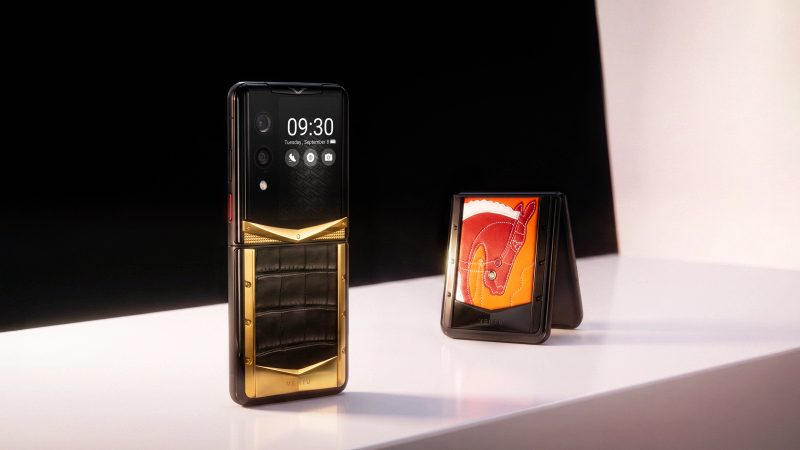
Agent Q uses the physical Ruby Talk control as a gateway to supported intelligent-agent workflows. VERTU’s current product knowledge describes more than 200 specialised agents across five categories, with human concierge support available when AI reaches its practical boundary. The value proposition is not that every action occurs without apps, permissions or confirmation; it is that supported tasks can begin from intent rather than manual navigation.
The hardware is built around a 120Hz flexible AMOLED display, Snapdragon 8 Elite Supreme platform, 16GB of RAM and up to 1TB storage. Its rear camera configuration includes a 50MP main camera, 64MP telephoto and 50MP ultra-wide. Materials and configurations vary across the collection, so photographs of one edition should not be treated as a promise for another.
Agent Q suits an owner who wants a familiar single-screen phone, values the dedicated Ruby Talk interaction and places a high priority on camera flexibility and hand-assembled craft.
AlphaFold: a larger AI workspace
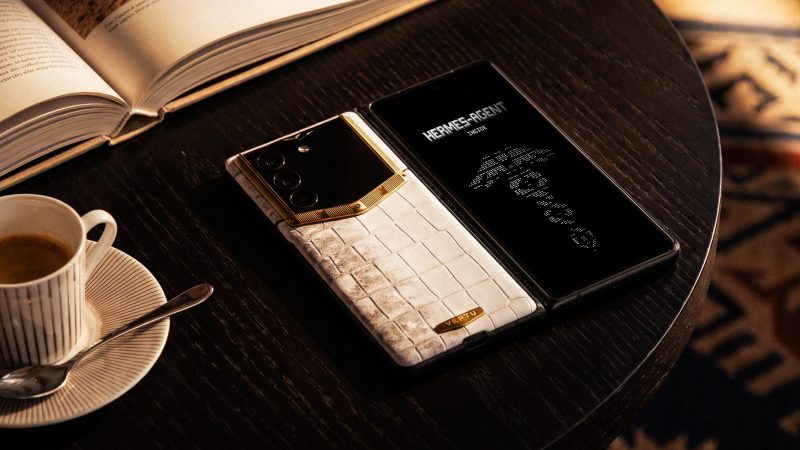
AlphaFold’s defining difference is the foldable canvas: a 6.53-inch outer screen for ordinary phone use and an 8.05-inch inner screen for documents, meetings, dashboards and multitasking. It combines 16GB RAM and 1TB storage with a 6,500mAh silicon-carbon battery and 65W charging.
Hermes Agent is positioned as a private AI assistant that can remember curated context and help prepare actions across supported messages, documents, meetings, travel and phone controls. Significant actions should be understood as user-controlled, and third-party app availability can vary.
For eligible enterprise clients, AlphaFold can be configured with VERTU VPS around authorised ERP, CRM, finance, approval, inventory, sales, reporting and messaging systems. Those functions are not enabled by default. They require whitelist approval, data authorisation, private deployment and professional configuration, with scope dependent on the client environment.
Privacy claims need a threat model
Both products describe dedicated security hardware, isolated spaces and encrypted workflows. No phone provides an absolute security guarantee. Ask which data is processed locally, which supported service receives it, how permissions are revoked, what happens after device loss and which features operate in the intended region and software version.
For AlphaFold enterprise deployment, request a written architecture covering identity, permissions, audit records, confirmation thresholds and data lifecycle. For Agent Q, test the exact agent workflows and account boundaries you plan to use. The Android and iPhone threat-model guide explains why platform slogans cannot replace configuration and operating practice.
A seven-day buying test
Before selecting an edition, map seven real days rather than comparing specification rows:
How many documents require side-by-side review?
Is the phone routinely used one-handed while moving?
Which three AI tasks would save measurable time?
Do those tasks need supported third-party services?
Is enterprise integration required, or merely interesting?
Which camera focal lengths are used in practice?
Which concierge scenarios are eligible in the owner’s market?
If the large inner display removes a tablet from the bag and authorised business integration has a real deployment owner, AlphaFold has a clear role. If the user prefers a conventional form with Ruby Talk, strong telephoto capability and agent-led personal workflows, Agent Q is the more direct fit.
Questions to put in writing before purchase
Ask the advisor to identify the exact edition, included accessories, regional network compatibility, current software version, service eligibility and delivery timing. For AI features, list the three required workflows and confirm which are supported in the intended market. Enterprise buyers should request deployment prerequisites and approval boundaries.
Price should come from the live regional product or collection page because editions and market displays vary. Security, app orchestration and concierge availability should be qualified by configuration, supported services and user authorisation.
Score the repeated workflow
A specification comparison becomes useful only when it predicts daily behaviour. Build a weighted scorecard from tasks the owner performs every week. Give high weight to frequent and consequential work, and low weight to features that are impressive but rarely used.
| Repeated workflow | Agent Q test | AlphaFold test | Evidence to record |
|---|---|---|---|
| One-handed communication | Message, call and invoke Ruby Talk while moving | Complete the same tasks on the outer display | Reach, correction steps and comfort |
| Document review | Open, annotate and switch between two sources | Repeat side by side on the inner display | Time saved and readability |
| Photography | Capture wide, main and distant subjects | Repeat the planned camera routine | Consistency, handling and preferred focal length |
| AI assistance | Run three supported personal tasks | Run the same or closest supported Hermes workflows | Permissions, confirmations and completion rate |
| Business systems | Record whether an integration is actually needed | Review eligible VPS deployment prerequisites | Named owner, approved systems and deployment scope |
Score the result after a realistic demonstration, not from memory. A larger display may win document work but lose one-handed comfort. A dedicated interaction may feel faster but still depend on a supported service or confirmation. The weighted total should expose which compromise appears most often.
Compare ownership cost, not only purchase price
The edition price is one layer of ownership. Consider protective accessories, insurance, regional service access, expected carrying pattern, enterprise configuration and the cost of moving data and workflows from the current device. A foldable used as a tablet replacement may remove another device from the bag; if it does not, its larger workspace has not reduced the owner’s system complexity.
Enterprise deployment deserves its own budget and owner. Integration, whitelist approval, identity design, private deployment, testing, training and change management are not included merely because the phone supports an enterprise path. Request a scoped proposal and acceptance criteria before treating projected time savings as part of the buying case.
For concierge and AI services, confirm current eligibility, market availability and any configuration requirement in writing. Do not capitalise a future promise as though it were active on delivery day. The safest comparison separates what is included now, what is supported after setup and what remains subject to approval.
Plan migration and the first 30 days
Before delivery, inventory authenticators, payment cards, encrypted backups, business apps, eSIMs and device-management requirements. Decide which items can be transferred automatically and which need a controlled re-enrolment. Keep the existing phone operational until identity, communication and recovery paths have been tested on the new device.
During the first week, measure the same workflows used in the buying scorecard. During the second, remove duplicate apps and permissions that are no longer needed. By day 30, review which distinctive feature is actually used: Ruby Talk, the inner workspace, a supported Hermes workflow, camera range or concierge access.
If the expected advantage has not appeared, determine whether the issue is training, unsupported configuration or a mismatch between demonstration and routine. That evidence is more useful than defending the original choice. A luxury technology purchase should simplify the owner’s operating system, not require permanent workarounds to justify it.
The considered choice
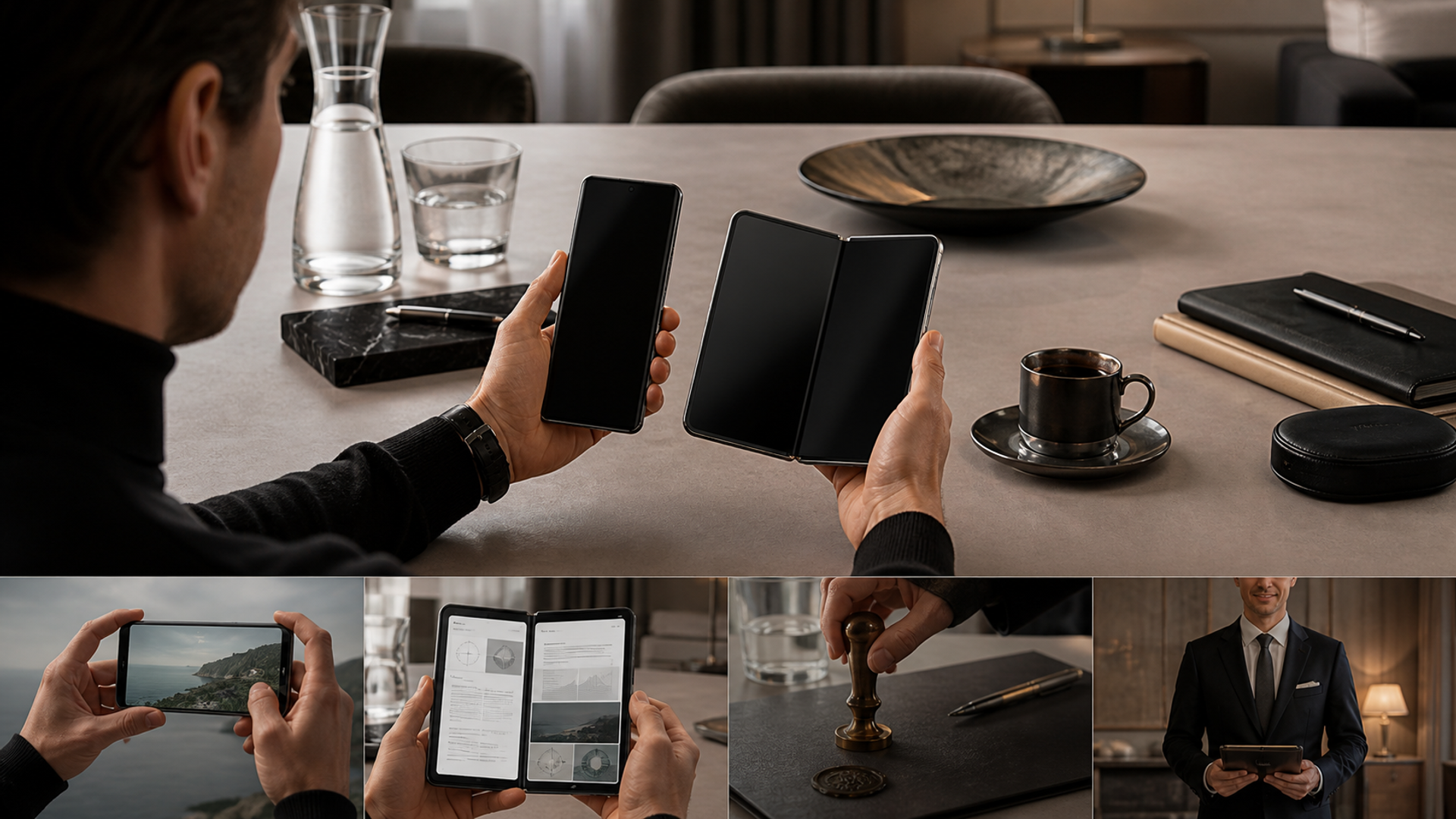
Where possible, handle both devices with the same test content. Open a long document, move between a message and calendar, capture the same distant and wide scene, place a call and repeat a supported AI task. Note time, comfort, correction steps and battery impact. A controlled comparison exposes whether the foldable canvas or dedicated interaction is useful to this owner rather than merely impressive in isolation.
Also compare carrying weight, one-handed reach and where the device sits during a normal meeting. Ergonomics rarely appear in a specification table, yet they determine whether a capability is used.
Do not choose between Agent Q and AlphaFold by price or novelty alone. Choose by the interaction you will repeat: Ruby Talk on a single-screen flagship, or Hermes Agent on a foldable workspace with an enterprise path where configured.
The better VERTU phone is the one whose distinctive capability survives a normal week after the demonstration ends.