

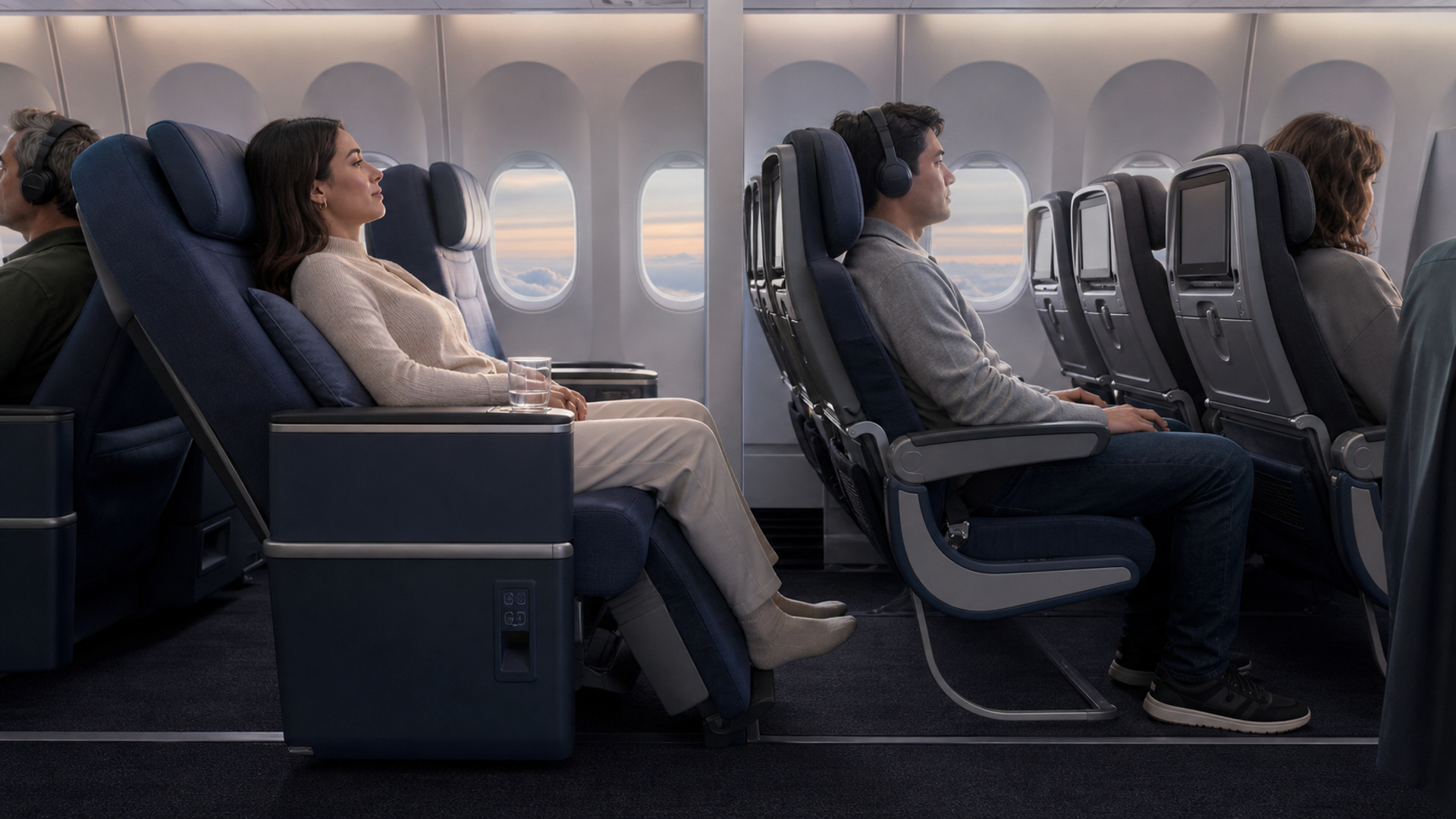
Premium-air-travel decisions often fail because a familiar brand name is treated as a complete product specification. In reality, the useful choice is narrower: United Premium Plus, Economy Plus or standard Economy on a particular itinerary, date and fare. The difference can affect sleep, connection risk, privacy, airport time and the condition in which a traveller arrives.
This guide is built for that decision. It uses current official material, a live inventory check and a concrete value matrix. It does not promise a particular aircraft, seat, lounge admission, hotel, tour, route or schedule. Operational details can change, so the final verification must happen against the exact booking.
The short answer
Choose United Premium Plus when its defining advantage is central to the journey and the live booking confirms it. Choose Economy Plus when it solves the main problem at a lower or more practical total cost. Choose standard Economy when schedule, simplicity or value matters more than the headline premium feature. The correct answer can change between an overnight flight, a daytime sector, a short connection and a leisure stop.
Decision matrix
| Decision | United Premium Plus | Economy Plus | standard Economy |
|---|---|---|---|
| Best use | When the defining premium feature will be used | When the middle option solves most of the need | When schedule or simplicity dominates |
| Main risk | Paying for a feature not confirmed on the exact itinerary | Assuming a similar name means an identical product | Saving money but creating an avoidable comfort or timing problem |
| Verification | Exact flight, date, operating carrier and live seat or service page | Fare bundle, location and current availability | Connection, restrictions and total journey cost |
| Value test | Would the trip outcome materially improve? | Is the incremental benefit sufficient? | Is the compromise acceptable for this duration? |
The matrix is deliberately conditional. It prevents a one-size-fits-all verdict and keeps schedule, fare rules and operational certainty in the same frame as comfort.
What the official material confirms
United Premium Plus is a separate premium-economy cabin on eligible long-haul aircraft, while Economy Plus is extra-legroom seating within the economy cabin. That category distinction matters more than the similar names: Premium Plus can change the seat type and service bundle, whereas Economy Plus mainly changes space and position within Economy. Exact inclusions depend on route, fare and aircraft. The source set is reader-visible here: united.com and united.com.
Official pages describe the intended product. They do not guarantee that a particular aircraft, lounge, benefit or service remains unchanged on the day of travel. That is why the decision workflow below separates a published specification from a live booking check.
Cabin versus seat option
Premium Plus is a cabin product; Economy Plus is an economy seating option. The first changes more of the journey, while the second solves a narrower legroom problem.
Confirm the cabin shown on the seat map. If Premium Plus is not sold on the flight, an Economy Plus label should not be read as premium economy. For a premium-cabin purchase, the practical unit of comparison is the exact flight and seat map, not the airline's best publicity image. Compare United Premium Plus, Economy Plus, standard Economy on the same itinerary conditions so the decision is not distorted by different dates, fare rules or connection risks. A strong result is one that still makes sense after a schedule change, an aircraft substitution or a busy travel day.
Seat and recline
Premium Plus typically uses a wider recliner with more separation and leg support. Economy Plus retains the economy seat architecture with additional pitch.
Check the aircraft-specific seat map and bulkhead design. Row position, fixed armrests and proximity to lavatories can outweigh a generic pitch advantage. For a premium-cabin purchase, the practical unit of comparison is the exact flight and seat map, not the airline's best publicity image. Compare United Premium Plus, Economy Plus, standard Economy on the same itinerary conditions so the decision is not distorted by different dates, fare rules or connection risks. A strong result is one that still makes sense after a schedule change, an aircraft substitution or a busy travel day.
Service bundle
Premium Plus may include upgraded meal presentation, priority elements and a different amenity bundle on eligible routes. Economy Plus generally follows the economy service model.
Read the fare display for the exact itinerary. Do not assume lounge access, baggage or upgrade priority merely from the cabin name. For a premium-cabin purchase, the practical unit of comparison is the exact flight and seat map, not the airline's best publicity image. Compare United Premium Plus, Economy Plus, standard Economy on the same itinerary conditions so the decision is not distorted by different dates, fare rules or connection risks. A strong result is one that still makes sense after a schedule change, an aircraft substitution or a busy travel day.
Sleep value
Neither product is a lie-flat business seat. Premium Plus is usually better for supported recline; Economy Plus is better understood as extra room rather than a sleep transformation.
If sleep is mission-critical, compare Premium Plus with Polaris as a separate decision. If the need is knee space on a daytime flight, Economy Plus may be sufficient. For a premium-cabin purchase, the practical unit of comparison is the exact flight and seat map, not the airline's best publicity image. Compare United Premium Plus, Economy Plus, standard Economy on the same itinerary conditions so the decision is not distorted by different dates, fare rules or connection risks. A strong result is one that still makes sense after a schedule change, an aircraft substitution or a busy travel day.
Companions and families
Premium Plus's smaller cabin can feel calmer, but fixed consoles or footrests may complicate some family arrangements. Economy Plus offers more rows and familiar economy layouts.
Check child seating, bassinet and adjacent-seat availability before paying. A cabin upgrade that separates the party is not automatically better. For a premium-cabin purchase, the practical unit of comparison is the exact flight and seat map, not the airline's best publicity image. Compare United Premium Plus, Economy Plus, standard Economy on the same itinerary conditions so the decision is not distorted by different dates, fare rules or connection risks. A strong result is one that still makes sense after a schedule change, an aircraft substitution or a busy travel day.
Price threshold
Premium Plus makes sense when the additional seat and service value matches flight duration and arrival stakes. Economy Plus is often the efficient answer when budget is tight and legroom is the only problem.
Compare the incremental price per flight hour, but include fare flexibility and seat-selection cost. Never compare a refundable Premium Plus fare with a restrictive Economy fare as if cabin were the only difference. For a premium-cabin purchase, the practical unit of comparison is the exact flight and seat map, not the airline's best publicity image. Compare United Premium Plus, Economy Plus, standard Economy on the same itinerary conditions so the decision is not distorted by different dates, fare rules or connection risks. A strong result is one that still makes sense after a schedule change, an aircraft substitution or a busy travel day.
Match the choice to the traveller
| Traveller scenario | Priority | Recommended approach |
|---|---|---|
| Solo overnight traveller | Sleep, privacy and certainty | Target United Premium Plus only when the exact product is confirmed and the schedule creates a real sleep window |
| Couple or colleagues | Adjacency and communication | Compare seat or space geometry before defaulting to United Premium Plus |
| Daytime leisure trip | Space and experience | Price Economy Plus against the actual hours of use |
| Time-critical executive | Arrival condition and disruption risk | Put schedule reliability and change flexibility ahead of novelty; standard Economy can be correct |
| Family or mobility-sensitive traveller | Access, assistance and reach | Verify assistance, seat restrictions and physical layout before payment |
A recommendation becomes useful only when it names the traveller and consequence. 'Best' without an itinerary is packaging, not a decision. A traveller arriving for a board meeting values rest and schedule protection differently from someone beginning a holiday. Similarly, a short daytime sector cannot monetise a bed or extended stop in the same way as an overnight journey.
Exact-itinerary verification checklist
Confirm the marketing and operating carrier; codeshares can change the product and benefit rules.
Record the aircraft, cabin, seat map, terminal or programme shown for the exact flight and date.
Read the fare conditions, including changes, refunds, baggage, seat selection and upgrade treatment.
Check whether the key feature is guaranteed, scheduled, capacity-controlled or merely described as available.
Recheck before the free-change or cancellation deadline and again at check-in.
Keep essential medicine, chargers, documents and overnight items in hand luggage.
Build a fallback that still works after a late aircraft swap, lounge closure, weather delay or missed connection.
Do not make a non-refundable purchase solely because an article, review or old seat map showed the preferred product.
This process does not eliminate operational change. It reduces the chance that a traveller pays for a promise the booking never made. It also makes a later service conversation easier because the original evidence and conditions are documented.
How to decide whether the premium is worth it
Start with the incremental cost, then divide it by the hours in which the benefit can actually be used. That is only the first pass. Add the value of sleep, reduced recovery time, a safer connection, baggage, flexibility and ground handling when those outcomes matter. Subtract the value of benefits that duplicate status, credit-card access or services already included elsewhere.
Use three thresholds. Below the first, take the better product because the downside is small. Between the first and second, require the exact preferred configuration and a meaningful travel consequence. Above the second, choose only when the trip is unusually important or the alternative creates a known problem. Set those thresholds before searching so scarcity and attractive cabin photography do not move the budget.
Points require the same discipline. A low mileage figure can hide surcharges, inflexibility or a poor schedule. Compare the complete itinerary and the opportunity cost of the points, not just the cabin label.
Final verdict
The best choice is not automatically the newest or most expensive. United Premium Plus wins when its defining feature is live, usable and consequential. Economy Plus wins when it captures most of the benefit without the full premium. standard Economy wins when timing, certainty or simplicity protects the journey better than a headline upgrade.
For adjacent planning, see our Air Canada premium cabin comparison. For adjacent planning, see our best premium-economy airlines guide. Recheck the official source and live booking before payment, because this guide is a decision framework rather than a promise of availability.
![How to Scan Receipts and Documents with Your Phone [Full Guide]](https://cdn.sanity.io/images/e0gp1l2g/production/0db13feec1d5e72b8a8a5f976d1f3e86619c9228-3840x1860.webp?w=180&h=180&q=78&auto=format&fit=crop)
![How to Scan Receipts and Documents with Your Phone [Full Guide]](https://cdn.sanity.io/images/e0gp1l2g/production/0db13feec1d5e72b8a8a5f976d1f3e86619c9228-3840x1860.webp?w=800&h=450&q=82&auto=format&fit=crop)
![Top 10 Two-Tone Carbon-Fibre Watches for Men [2026 List]](https://cdn.sanity.io/images/e0gp1l2g/production/18870799ba33fab0e038968359cd5772d7d7db30-1024x576.webp?w=800&h=450&q=82&auto=format&fit=crop)
![Top 10 Luxury Watches with Digital Complication Displays for Men [Latest]](https://cdn.sanity.io/images/e0gp1l2g/production/c4f6bf8c080f291c39f7cc85c7344ecff2fd3799-1024x553.webp?w=800&h=450&q=82&auto=format&fit=crop)