

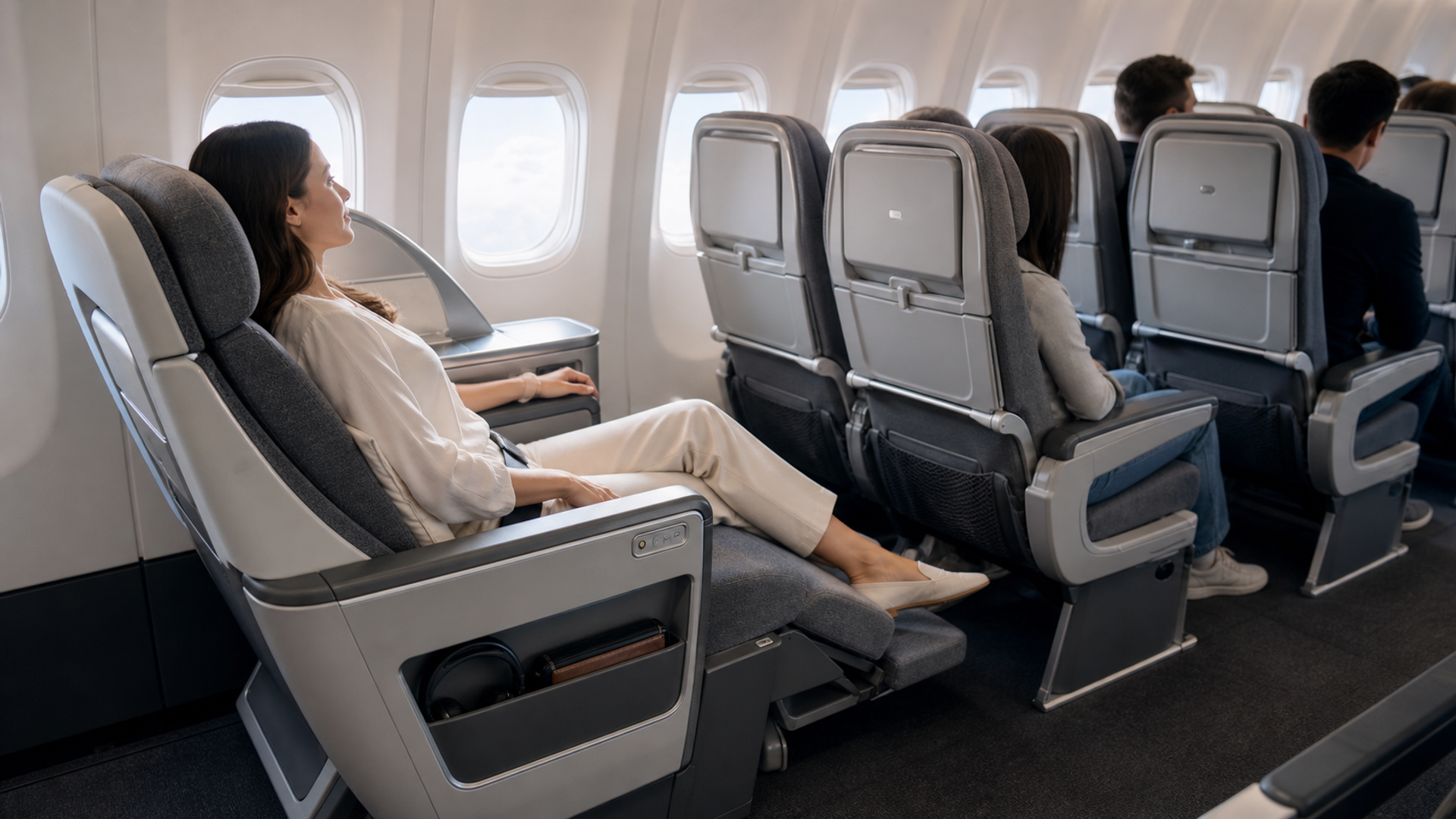
The best Premium Economy airline in 2026 is the one that actually operates a true separate cabin on your flight and sells the combination of space, recline, leg support, baggage and fare flexibility you will use. The cabin name alone is not enough. Some products approach a compact armchair; others are little more than extra-legroom Economy.
As of July 2026, the latest completed Skytrax Premium Economy ranking is the 2025 edition. Japan Airlines placed first, followed by Emirates, EVA Air, Virgin Atlantic and Singapore Airlines. That list is useful for discovery, but a route-by-route buyer must still verify aircraft, seat specification and fare conditions.
The fast answer
| If your priority is… | Start with… | The decisive check |
|---|---|---|
| Strong all-round Premium Economy | Japan Airlines on an equipped route | Aircraft, seat map and operating product |
| A refined cabin on selected long-haul routes | Emirates | Whether Premium Economy is installed on the scheduled aircraft |
| Reliable Asia-Pacific comfort | EVA Air | Aircraft and leg-rest/footrest design |
| A clear step up on transatlantic travel | Virgin Atlantic Premium | Route, aircraft and fare inclusions |
| Network and service through Singapore | Singapore Airlines | Seat generation and connection duration |
| Maximum value rather than maximum luxury | The best priced nonstop true Premium Economy | Fare gap per usable comfort hour |
Do not buy a connection merely to access a higher-ranked cabin unless the product gain exceeds the time, disruption and baggage risk introduced by the connection.
First, distinguish four products that are often confused
True Premium Economy is a separate cabin with wider seats, more pitch and recline, upgraded dining or service, and usually stronger baggage or priority benefits.
Extra-legroom Economy normally uses an Economy seat with additional pitch or a preferred location. It can be good value, but it is not the same product.
Economy Plus, Comfort or Main Cabin Extra may be a commercial label for extra space rather than a separate cabin. Read the specification.
Business-lite is an informal description sometimes applied to unusually strong Premium Economy, but the seat still does not become a flat bed. Avoid comparing it with Business Class on branding alone.
The practical test is simple: is there a physically distinct cabin, a materially wider seat, a meaningful leg support system and published service differences?
The route-verification matrix
Complete this table for every flight under consideration.
| Field | Option A | Option B |
|---|---|---|
| Flight number/date | ||
| Nonstop or connecting | ||
| Scheduled aircraft | ||
| Separate cabin confirmed | ||
| Seat width/pitch as published | ||
| Leg rest or footrest | ||
| Recline mechanism | ||
| Seat location available | ||
| Baggage allowance | ||
| Lounge access | ||
| Change/refund rule | ||
| Total journey duration | ||
| Fare gap over Economy |
The “lounge access” row prevents a common assumption. Premium Economy usually does not include Business Class lounge access. A traveller may have access through status, a credit card or a separately purchased programme, but that is a different entitlement and should not be attributed to the ticket.
Leading products and where they fit
Japan Airlines
Japan Airlines led the 2025 Skytrax Premium Economy ranking, making it the strongest neutral starting point for a 2026 comparison. Its appeal is most relevant when a JAL-operated long-haul flight fits the itinerary and the desired cabin is shown on the actual aircraft.
Best for: Japan-bound and connecting travellers who value a well-regarded seat and service package.
Verify: aircraft type, seat plan, baggage, lounge or priority entitlements, and whether the itinerary includes sectors without Premium Economy.
Emirates
Emirates placed second in the latest completed ranking. Its Premium Economy page describes a dedicated cabin with cream leather seats, leg rests and upgraded dining on equipped aircraft. The product is still being deployed across the network, so availability is route- and aircraft-specific.
Best for: travellers whose direct or Dubai-connecting flight is confirmed with the cabin and whose fare gap is materially below Business Class.
Verify: both sectors of a return or connection. An outbound equipped aircraft does not prove the inbound product. The VERTU guide to Emirates Premium Economy versus Business Class provides a detailed fare-gap framework.
EVA Air
EVA Air ranked third in the 2025 list and has longstanding credibility in the category. It is a useful candidate for trans-Pacific and Asian routes when the schedule and aircraft align.
Best for: travellers who want a mature Premium Economy proposition without paying for a flat bed.
Verify: product on the exact aircraft, seat dimensions and route-specific fare benefits.
Virgin Atlantic
Virgin Atlantic ranked fourth. Its current Premium pages describe a dedicated cabin with a larger seat, additional recline and priority services, with specifications varying by aircraft.
Best for: transatlantic travellers who want a clear comfort upgrade and a recognisable premium ground sequence.
Verify: aircraft-specific seat width and pitch, lounge assumptions, seat-selection charge and fare family.
Singapore Airlines
Singapore Airlines ranked fifth in the latest completed list. Its network and hub can make the overall journey attractive even when another carrier has a marginally better seat.
Best for: long-haul travellers to or through Singapore who value schedule and service.
Verify: aircraft, seat version, connection time and whether the feeder sector offers Premium Economy.
The fare-gap calculator
The fare gap should buy useful comfort, not just a better label.
Adjusted Premium Economy gap
= Premium Economy fare
seat-selection charges
connection-related hotel or transfer costs
expected change-cost difference
minus Economy extras you would otherwise purchase
minus baggage value you will genuinely use
Usable comfort hours
= seated flight hours
minus meal and service interruptions
minus time you expect to be awake and moving
plus ground time saved through priority benefits
Cost per usable comfort hour
= Adjusted fare gap ÷ usable comfort hours
Example: Premium Economy is £620 above Economy on a 12-hour nonstop. You would otherwise pay £120 for an extra-legroom seat and £70 for additional baggage. The adjusted gap is £430. If nine hours of the flight benefit from the wider seat, recline and leg rest, the premium is roughly £48 per usable comfort hour.
Now compare a connecting option that costs only £450 more but adds four hours and a missed-connection risk. The cheaper fare gap may produce a worse journey.
When Premium Economy beats Business Class
Premium Economy often wins when:
the flight is daytime and sleep is not the central objective;
the Business fare is three or four times higher;
the traveller needs more personal space but not a bed;
the schedule is nonstop while the affordable Business option connects;
a company policy allows Premium Economy but not Business;
the fare includes useful baggage and flexibility;
two Premium Economy tickets preserve more value than one Business redemption for a couple.
Business Class usually wins when the flight is overnight, the arrival has a high-stakes purpose, a lie-flat bed can protect a full working day, or the Business fare gap becomes unusually small through an offer or points redemption.
Seat selection matters inside the same cabin
Bulkhead seats may provide better knee clearance or a full leg rest, but fixed armrests can narrow the usable space and bassinet positions may increase disturbance. Last-row seats may have restricted recline. Window seats offer control of the shade but require negotiating around a neighbour on some layouts. Centre pairs can suit couples; solo travellers may prefer an aisle.
Before selection:
Read the airline’s own aircraft seat plan.
Check whether a bassinet, lavatory, galley or crew area is nearby.
Confirm whether the published recline applies to the last row.
Check under-seat obstructions and entertainment boxes.
Revisit the seat map after any aircraft change.
Third-party seat maps can be helpful, but the airline’s live booking map is the primary operational evidence.
Fare rules can outweigh the seat
Two Premium Economy fares on the same flight can have different change, refund, seat-selection and mileage rules. A flexible fare may protect a business trip whose date is uncertain. A deeply restricted fare may be poor value even with a comfortable seat.
Check:
change fee and fare difference;
refundability before and after departure;
no-show rules;
seat-selection inclusion;
checked baggage;
mileage and status credit;
upgrade eligibility;
through-ticket protection for connections.
If the itinerary is assembled from separate tickets, price the risk of missed connections and baggage rechecking. A through-ticket on a slightly weaker cabin may be the more luxurious decision because it reduces operational friction.
Mixed-cabin warnings
Search results can display “Premium Economy” when only one sector has the cabin. Expand the itinerary and inspect every leg. A short Economy feeder may be acceptable; a long overnight sector in Economy defeats the purpose.
Also check the return separately. Airlines deploy different aircraft by day and season. A route that is equipped in one direction on one date may not match another.
The 80/20 booking checklist
Most of the decision quality comes from eight checks:
Is it a true separate cabin?
Is it on the operating aircraft?
Is the itinerary nonstop?
Does the seat have meaningful leg support?
Is the fare gap sensible per comfort hour?
Are the baggage and priority benefits useful?
Are change and refund terms acceptable?
Does every long sector carry the promised cabin?
If any answer is unclear, pause before payment. The costliest Premium Economy failure is not choosing the fifth-best airline instead of the first. It is paying a premium for a product that does not operate on the important sector.
The verdict
Japan Airlines is the evidence-based starting point because it led the latest completed Skytrax ranking. Emirates, EVA Air, Virgin Atlantic and Singapore Airlines are strong alternatives for specific networks and traveller priorities. None should be selected without aircraft and fare verification.
The best Premium Economy in 2026 is the one whose real operating seat converts a reasonable fare gap into usable space, rest and flexibility. Choose at flight-number level, then calculate the value against the journey you would otherwise buy.
![How to Scan Receipts and Documents with Your Phone [Full Guide]](https://cdn.sanity.io/images/e0gp1l2g/production/0db13feec1d5e72b8a8a5f976d1f3e86619c9228-3840x1860.webp?w=180&h=180&q=78&auto=format&fit=crop)
![How to Scan Receipts and Documents with Your Phone [Full Guide]](https://cdn.sanity.io/images/e0gp1l2g/production/0db13feec1d5e72b8a8a5f976d1f3e86619c9228-3840x1860.webp?w=800&h=450&q=82&auto=format&fit=crop)
![Top 10 Two-Tone Carbon-Fibre Watches for Men [2026 List]](https://cdn.sanity.io/images/e0gp1l2g/production/18870799ba33fab0e038968359cd5772d7d7db30-1024x576.webp?w=800&h=450&q=82&auto=format&fit=crop)
![Top 10 Luxury Watches with Digital Complication Displays for Men [Latest]](https://cdn.sanity.io/images/e0gp1l2g/production/c4f6bf8c080f291c39f7cc85c7344ecff2fd3799-1024x553.webp?w=800&h=450&q=82&auto=format&fit=crop)