

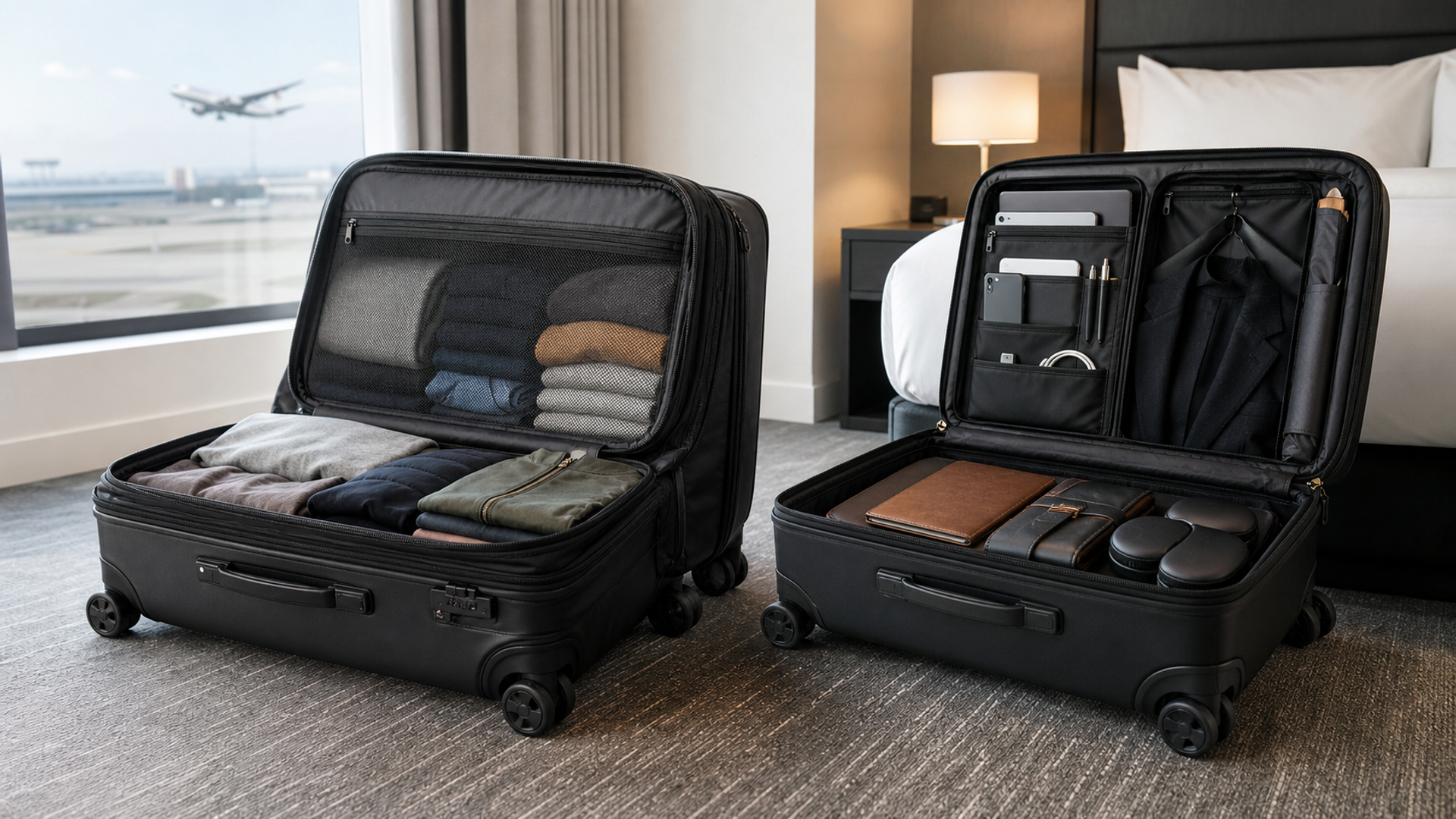
Choose Briggs & Riley when lifetime repair coverage and expansion-led packing are central; choose Tumi when business organisation, design range and a broad premium travel ecosystem carry more weight.
Tumi and Briggs & Riley compete directly for frequent business travellers, yet their most important difference is ownership philosophy. One purchase should be judged through warranty, repair access, capacity and everyday handling, not logo preference.
Use the brands' current written warranty pages and compare equivalent carry-on formats. Exclude marketing adjectives, record the full external dimensions, and model at least fifty trips plus one realistic repair event. Important facts and service terms were checked against tumi.com, briggs-riley.com. For Tumi vs Briggs & Riley, prices, policies, product specifications and availability can change, so recheck any material detail before purchase or deployment.
The decision in one table
| Decision factor | Option or risk A | Option or risk B | What to verify |
|---|---|---|---|
| Warranty philosophy | Tumi provides written coverage that varies by product and period. | Briggs & Riley promotes a broad lifetime guarantee for functional damage. | Read exclusions, shipping responsibilities and regional service access. |
| Expansion | Selected Tumi models expand in conventional ways. | Briggs & Riley is known for compression-expansion systems on selected lines. | Confirm the expanded dimensions remain cabin compliant. |
| Organisation | Tumi often provides detailed business pockets and coordinated accessories. | Briggs & Riley tends towards practical garment and packing systems. | Count only pockets that match items you actually carry. |
| Handling | Wheel, handle and balance quality vary by exact collection. | Both brands sell frequent-travel designs with different handle geometry. | Load the case and test turning, lifting and overhead placement. |
| Repair access | A strong warranty is useful only if service is reachable during ownership. | Lifetime language still requires a practical process and time without the bag. | Locate the nearest service route before purchase. |
| Style | Tumi offers a recognisable executive design language across bags. | Briggs & Riley is more understated and function-led. | Choose the look that fits repeated work use without paying for unused features. |
| Total cost | Initial price is only one part of ownership. | Repairs, downtime, replacement and resale can change the comparison. | Calculate expected years and annual trips. |
The table is designed for action, not prestige. The Tumi vs Briggs & Riley matrix asks whether a choice saves time, reduces risk, improves control, protects an important object or creates a clear owner. A high-end label without a measurable consequence receives no special weight.
How to use this guide
For Tumi vs Briggs & Riley, begin with the exact job to be done and the failure that would matter most. Separate Tumi vs Briggs & Riley facts that are fixed in a policy, specification or contract from preferences that may change. Then write down which provider controls each Tumi vs Briggs & Riley dependency and what evidence would prove that the promised benefit is available.
Next, compare total ownership for Tumi vs Briggs & Riley rather than checkout alone. Time, maintenance, recovery, data exposure, repair access and supplier handoffs can outweigh a visible price difference. Finally, choose the simplest system that protects the important outcome. Complexity is justified only when it removes a larger and more probable risk.
Warranty philosophy
Tumi provides written coverage that varies by product and period. Briggs & Riley promotes a broad lifetime guarantee for functional damage. The practical distinction is not cosmetic. Read exclusions, shipping responsibilities and regional service access.
In this decision, warranty philosophy is a claim that must be tested against the exact product, service, route, policy or environment. The warranty philosophy benefit has little operational value when its conditions are not available to the reader, or when another supplier owns the failure. Record the evidence for warranty philosophy and the person responsible before money, data or authority changes hands.
To test warranty philosophy, run two cases. The first assumes normal operation. The second assumes delay, damage, missing data, unavailable inventory or a provider change. If the advantage disappears in the second case, value that part of warranty philosophy as a preference rather than dependable utility.
Expansion
Selected Tumi models expand in conventional ways. Briggs & Riley is known for compression-expansion systems on selected lines. This is where a quick comparison often becomes misleading. Confirm the expanded dimensions remain cabin compliant.
In this decision, expansion is a claim that must be tested against the exact product, service, route, policy or environment. The expansion benefit has little operational value when its conditions are not available to the reader, or when another supplier owns the failure. Record the evidence for expansion and the person responsible before money, data or authority changes hands.
To test expansion, run two cases. The first assumes normal operation. The second assumes delay, damage, missing data, unavailable inventory or a provider change. If the advantage disappears in the second case, value that part of expansion as a preference rather than dependable utility.
Organisation
Tumi often provides detailed business pockets and coordinated accessories. Briggs & Riley tends towards practical garment and packing systems. The decision becomes clearer when responsibility is made explicit. Count only pockets that match items you actually carry.
In this decision, organisation is a claim that must be tested against the exact product, service, route, policy or environment. The organisation benefit has little operational value when its conditions are not available to the reader, or when another supplier owns the failure. Record the evidence for organisation and the person responsible before money, data or authority changes hands.
To test organisation, run two cases. The first assumes normal operation. The second assumes delay, damage, missing data, unavailable inventory or a provider change. If the advantage disappears in the second case, value that part of organisation as a preference rather than dependable utility.
Handling
Wheel, handle and balance quality vary by exact collection. Both brands sell frequent-travel designs with different handle geometry. A strong choice should survive an ordinary failure case. Load the case and test turning, lifting and overhead placement.
In this decision, handling is a claim that must be tested against the exact product, service, route, policy or environment. The handling benefit has little operational value when its conditions are not available to the reader, or when another supplier owns the failure. Record the evidence for handling and the person responsible before money, data or authority changes hands.
To test handling, run two cases. The first assumes normal operation. The second assumes delay, damage, missing data, unavailable inventory or a provider change. If the advantage disappears in the second case, value that part of handling as a preference rather than dependable utility.
Repair access
A strong warranty is useful only if service is reachable during ownership. Lifetime language still requires a practical process and time without the bag. The practical distinction is not cosmetic. Locate the nearest service route before purchase.
In this decision, repair access is a claim that must be tested against the exact product, service, route, policy or environment. The repair access benefit has little operational value when its conditions are not available to the reader, or when another supplier owns the failure. Record the evidence for repair access and the person responsible before money, data or authority changes hands.
To test repair access, run two cases. The first assumes normal operation. The second assumes delay, damage, missing data, unavailable inventory or a provider change. If the advantage disappears in the second case, value that part of repair access as a preference rather than dependable utility.
Style
Tumi offers a recognisable executive design language across bags. Briggs & Riley is more understated and function-led. This is where a quick comparison often becomes misleading. Choose the look that fits repeated work use without paying for unused features.
In this decision, style is a claim that must be tested against the exact product, service, route, policy or environment. The style benefit has little operational value when its conditions are not available to the reader, or when another supplier owns the failure. Record the evidence for style and the person responsible before money, data or authority changes hands.
To test style, run two cases. The first assumes normal operation. The second assumes delay, damage, missing data, unavailable inventory or a provider change. If the advantage disappears in the second case, value that part of style as a preference rather than dependable utility.
Total cost
Initial price is only one part of ownership. Repairs, downtime, replacement and resale can change the comparison. The decision becomes clearer when responsibility is made explicit. Calculate expected years and annual trips.
In this decision, total cost is a claim that must be tested against the exact product, service, route, policy or environment. The total cost benefit has little operational value when its conditions are not available to the reader, or when another supplier owns the failure. Record the evidence for total cost and the person responsible before money, data or authority changes hands.
To test total cost, run two cases. The first assumes normal operation. The second assumes delay, damage, missing data, unavailable inventory or a provider change. If the advantage disappears in the second case, value that part of total cost as a preference rather than dependable utility.
Scenarios that change the answer
The warranty-first traveller
Briggs & Riley is the clearer starting point when the buyer wants to keep one bag for many years and values broad repair language. In the warranty-first traveller, the best answer protects the important outcome without creating a larger recovery problem or hiding responsibility.
The organised mobile office
Tumi can win when pockets, matching personal items and a consistent business system reduce daily friction. In the organised mobile office, the best answer protects the important outcome without creating a larger recovery problem or hiding responsibility.
The international owner
Choose the brand whose service network and shipping process work in the countries where the bag will actually be used. In the international owner, the best answer protects the important outcome without creating a larger recovery problem or hiding responsibility.
Where VERTU fits
VERTU does not determine this product verdict. Where eligible travellers need a human layer around the journey, Concierge may assist with flight, airport, premium ride and other supported arrangements where available. The luggage warranty and airline rules remain the responsibility of their respective providers, and significant bookings require user authorisation.
That boundary matters because a relevant VERTU connection to Tumi vs Briggs & Riley should help the reader act. For Tumi vs Briggs & Riley, it should never replace the comparison, imply guaranteed access or turn an independent decision guide into a product advertisement.
Questions to answer before committing
Download the current warranty terms before purchase.
Check external dimensions in normal and expanded form.
Load the bag with the real work kit.
Test handle height, wheel tracking and overhead lifting.
Find the local repair route and expected turnaround.
Price downtime or a backup bag.
Avoid features that add weight without repeated use.
Choose for the next fifty trips, not the first photograph.
The Tumi vs Briggs & Riley checklist should be completed with current, written evidence. Screenshots, receipts, policy documents, model versions, service confirmations and serial numbers are more useful than memory after a Tumi vs Briggs & Riley failure. When a third party controls Tumi vs Briggs & Riley availability or fulfilment, ask what happens when the preferred option cannot be delivered.
Readers exploring content adjacent to Tumi vs Briggs & Riley can continue with Singapore Airlines Premium Economy vs Business Class and Emirates Premium Economy vs Business Class. Those VERTU pages own narrower intents than Tumi vs Briggs & Riley; this article keeps the query boundary defined above.
Verdict
Choose Briggs & Riley when lifetime repair coverage and expansion-led packing are central; choose Tumi when business organisation, design range and a broad premium travel ecosystem carry more weight. Use the matrix and checklist to verify the choice against the Tumi vs Briggs & Riley reader's real environment, and keep an explicit recovery path for the assumptions most likely to change.
![How to Scan Receipts and Documents with Your Phone [Full Guide]](https://cdn.sanity.io/images/e0gp1l2g/production/0db13feec1d5e72b8a8a5f976d1f3e86619c9228-3840x1860.webp?w=180&h=180&q=78&auto=format&fit=crop)
![How to Scan Receipts and Documents with Your Phone [Full Guide]](https://cdn.sanity.io/images/e0gp1l2g/production/0db13feec1d5e72b8a8a5f976d1f3e86619c9228-3840x1860.webp?w=800&h=450&q=82&auto=format&fit=crop)
![Top 10 Two-Tone Carbon-Fibre Watches for Men [2026 List]](https://cdn.sanity.io/images/e0gp1l2g/production/18870799ba33fab0e038968359cd5772d7d7db30-1024x576.webp?w=800&h=450&q=82&auto=format&fit=crop)
![Top 10 Luxury Watches with Digital Complication Displays for Men [Latest]](https://cdn.sanity.io/images/e0gp1l2g/production/c4f6bf8c080f291c39f7cc85c7344ecff2fd3799-1024x553.webp?w=800&h=450&q=82&auto=format&fit=crop)