

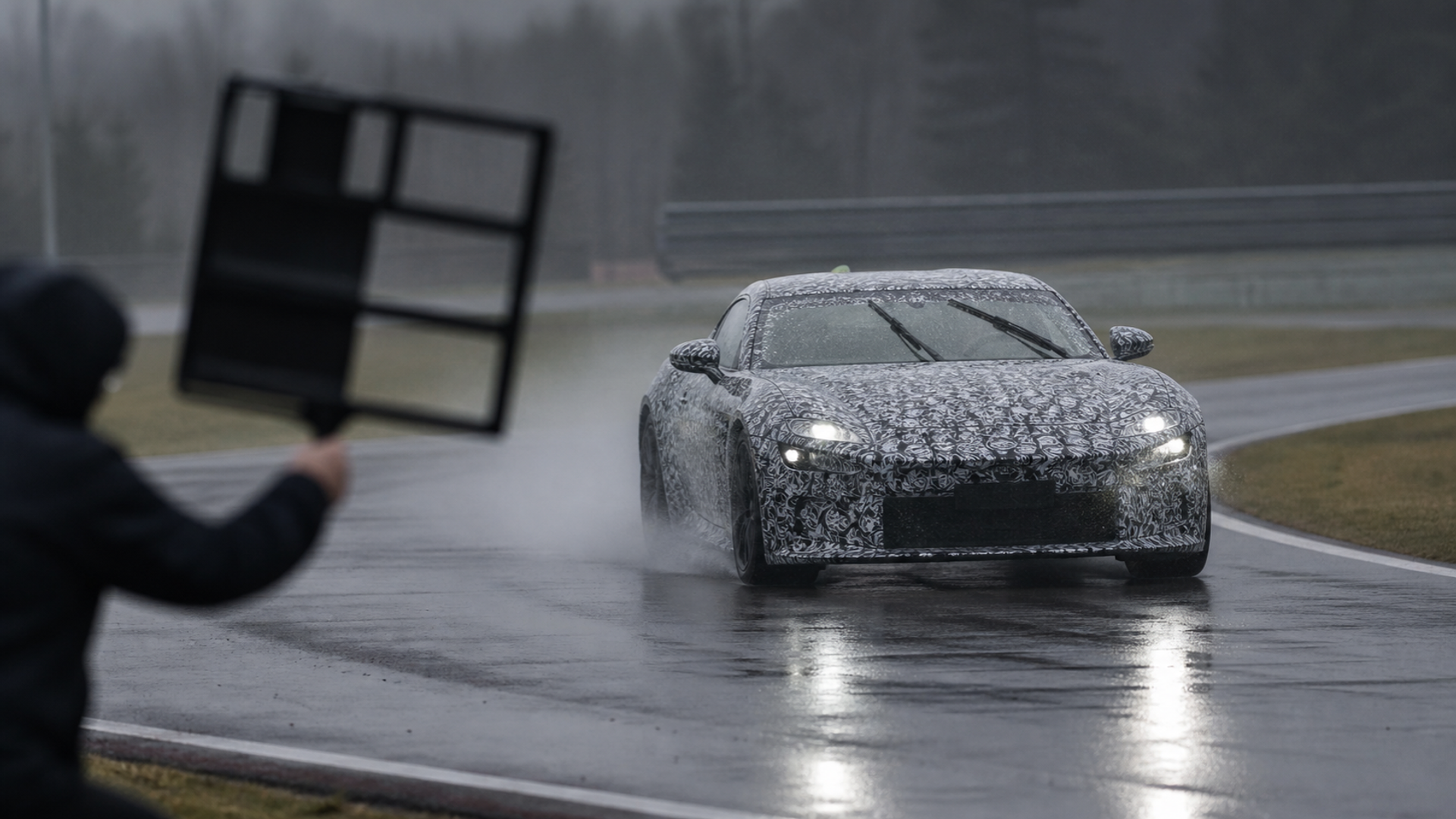
Toyota has shown the GR GT as an under-development prototype and published unusually detailed targets for it: a front-engine, rear-wheel-drive hybrid flagship built around a new 4.0-litre twin-turbo V8, a rear transaxle and an all-aluminium body frame. That is substantial evidence of engineering intent. It is not the same as a final, homologated production specification.
The practical buyer answer is therefore two-part. A collector can prepare a place, an ownership brief and a test plan for the GR GT now. A buyer should not treat its target power, weight, speed or “around 2027” launch aim as a binding market specification, and should not commit money on the assumption that price, allocation or local support has been confirmed.
What Toyota has actually released
Toyota’s 5 December 2025 global newsroom release calls the displayed GR GT a prototype and labels its specification table “prototype development targets, in-house measurements”. The company also states that the car remains under development and that details are subject to change without notice. The distinction applies to the whole table, including dimensions, output, torque, weight and top speed.
The same release says development is continuing “toward launching” the GR GT and GR GT3 around 2027, with further details to follow. That wording is a launch aim, not a confirmed on-sale date in every country and not a promise that every market will use the same model year.
Toyota’s dedicated GR GT world-premiere page repeats the development-target qualification beside the power and torque figures and says the photographs show a December 2025 prototype. Its small print warns that specifications and model names may change. That makes the official boundary clear enough for a buyer’s ledger.
Development-target ledger
| Item | Toyota’s published position | Status for a buyer | What still needs confirmation |
|---|---|---|---|
| Vehicle concept | Road-legal, driver-first GR flagship developed from a race-car brief | Confirmed programme intent | Final road-market specification and homologation |
| Powertrain | 3,998 cc V8, twin turbo, transaxle-integrated single-motor hybrid | Prototype architecture disclosed | Market tune, emissions certification, service intervals |
| Output and torque | 650 PS or greater; 850 Nm or greater | Development targets | Final certified production outputs |
| Transmission and drive | Newly developed eight-speed automatic; front engine, rear-wheel drive | Prototype target specification | Final gearing, calibration and market equipment |
| Structure | Toyota’s first all-aluminium body frame with selected aluminium/CFRP panels | Prototype construction disclosed | Repair method, parts pricing and insurer treatment |
| Size | 4,820 mm long, 2,000 mm wide, 1,195 mm high; 2,725 mm wheelbase | Prototype target dimensions | Final production dimensions and mirrors/market equipment |
| Weight and balance | 1,750 kg or lower; 45:55 front-to-rear | Development targets | Homologated kerb weight and option effects |
| Top speed | 320 km/h or greater | Development target | Final governed speed and market restrictions |
| Launch | Development continuing towards launch around 2027 | Direction only | Country, order date, deliveries and model-year naming |
| Commercial terms | No official price or allocation terms in the cited releases | Unknown | Price, deposit, refund, allocation and warranty |
Primary source: Toyota’s GR GT and GR GT3 world-premiere release, published 5 December 2025 and checked 6 August 2026.
The table is the article’s central discipline: a development target remains a development target even when it is precise to the millimetre. Repetition by dealers, media or social accounts does not promote it to a production specification.
Why the architecture deserves attention
The GR GT’s interest is not reducible to a single power figure. Toyota describes a low-centre-of-gravity package with the V8 mounted at the front, a transaxle at the rear, dry-sump lubrication and heavy components arranged to support the targeted 45:55 balance. The hybrid motor and newly developed eight-speed automatic are integrated with the rear transaxle. Toyota’s corporate world-premiere transcript likewise distinguishes the road car’s hybrid powertrain from the related GR GT3 race car. This is a different proposition from adding electrical assistance to an existing grand-tourer platform.
Toyota also says it began with an aerodynamic model before finalising the exterior form, reversing the more conventional sequence in which a styled body is subsequently refined in the wind tunnel. The all-aluminium frame and selective use of CFRP are meant to reconcile rigidity, weight and a very low profile.
For a potential owner, these choices create the real reasons to wait for a drive. They should shape steering response, visibility, heat management, sound, low-speed behaviour and the relationship between the engine, motor and transmission. None of those qualities can be settled by reading the target table. A car may meet every target and still overlap too closely with another front-engine GT in a collection—or prove too demanding for its intended roads.
“Around 2027” is not an order date
Toyota has not used the cited material to publish a market-by-market order book, production allocation, first-delivery month or official price. Nor does the global launch aim answer whether a particular country will receive the car in calendar 2027, call it a 2027 model, or open orders earlier or later.
That matters because collector planning often starts long before the car is formally orderable. There is nothing wrong with registering interest through an authorised Toyota or GR channel, provided the buyer records what that expression of interest means. Is it a non-binding contact request, a refundable deposit, a contractual order or an unofficial place on a dealer list? Only written terms can answer.
A sensible pre-launch file should contain the dated Toyota release, the prototype ledger above, dealer correspondence and a list of unresolved commercial questions. It should not contain a guessed price copied from an unsourced report and treated as an acquisition budget.
The ownership questions Toyota has not yet answered
The official release explains that development considered thermal management and serviceability, and it describes customer-support ambitions for the related GR GT3 racing programme. It does not set out a road-car warranty, global specialist-centre network, parts-availability commitment, track-use policy or vehicle-recovery programme.
Those omissions are normal at this stage, but they matter for a technically unusual flagship. Ask which facility will service the V8-hybrid system, rear transaxle, aluminium structure and carbon-ceramic brakes; which body shops can carry out approved structural repairs; and how the car would be transported if it could not be driven. A buyer who keeps cars across several countries should verify support where the GR GT will be registered and stored, not merely where the order is placed.
Insurance is another production-stage question. A prototype’s construction can indicate repair complexity without revealing actual premiums, agreed-value terms or parts lead times. Obtain a quotation only against the final vehicle identification and market specification.
Road usability must be demonstrated, not assumed
Toyota says the GR GT has been tested on public roads and developed for circuit and everyday use. The prototype target is two metres wide and 1,195 mm high. Those dimensions make a route-and-storage audit more useful than an abstract argument about whether the car is a “daily driver”.
Measure the garage opening, ramp breakover, turning space and any mechanical parking system. Check the width of regular urban routes and the clearances at frequently used hotels, clubs or office car parks. When a demonstrator becomes available, test entry, seating position, outward visibility, cabin heat, low-speed transmission response and luggage provision. The relevant standard is not whether the car can be driven on the road; it is whether it can perform the owner’s intended road role without constant logistical compromise.
A buyer plan for four different ownership goals
The established collector. Map the GR GT against existing front-engine GTs, hybrid flagships and track-focused cars. The new car earns a place only if its architecture, use or emotional character is distinct enough to justify another support and storage obligation.
The frequent track-day driver. Wait for final cooling, brake, tyre and warranty information. Ask how track use is recorded, which consumables are market-specific and whether recovery support extends to the circuits actually used.
The first-time supercar buyer. Keep an orderable alternative with proven service coverage in the comparison. A new flagship may be compelling, but an unclear delivery path and untested ownership network impose more risk on a buyer without another suitable car.
The globally mobile owner. Separate allocation from usability. A car obtained in one country may face different registration, warranty, import, emissions or service constraints in another. Confirm the country in which the car will live before optimising for the country in which it is easiest to reserve.
Define the test before the production car arrives
Desire becomes more useful when it can be disproved. Write the five conditions that would make the GR GT wrong for the planned role. They might include poor low-speed modulation, restricted visibility, difficult access, excessive overlap with an existing car or inadequate local support.
Then test in a fixed order:
Confirm the exact production specification and market homologation.
Sit in the car long enough to assess driving position and visibility.
Drive at urban speed before judging circuit capability.
Test brake modulation, transmission behaviour and hybrid transitions.
Check garage, route and transport clearances with the production dimensions.
Obtain written service, warranty, deposit and cancellation terms.
Compare the car with the existing collection by role, not only performance.
This approach protects the buyer from solving a specification-sheet puzzle while ignoring the ownership experience.
Prepare now, buy an alternative, or wait?
Prepare now if the V8-hybrid front-engine architecture genuinely fills a gap. Preparation means measuring, budgeting, registering non-binding interest and defining the test—not treating targets as final facts.
Buy an established alternative if delivery certainty, a known driving experience and proven service coverage matter more than the GR GT’s newness. That is particularly rational when the car is needed for a fixed season or event.
Wait for production confirmation before making a non-refundable commitment, disposing of another car or relying on a resale thesis. Final specification, local price, allocation, warranty and support are precisely the facts that convert an exciting programme into an investable ownership decision.
Related VERTU guides
Verdict
Toyota has confirmed the GR GT programme, the prototype architecture and a detailed set of development targets. It has not, in the cited material, confirmed a final production specification, a universal 2027 on-sale date, price, allocation or road-car support package.
That is enough information to take the car seriously and prepare intelligently. It is not enough to turn a prototype target into a purchase promise.
![How to Scan Receipts and Documents with Your Phone [Full Guide]](https://cdn.sanity.io/images/e0gp1l2g/production/0db13feec1d5e72b8a8a5f976d1f3e86619c9228-3840x1860.webp?w=180&h=180&q=78&auto=format&fit=crop)
![How to Scan Receipts and Documents with Your Phone [Full Guide]](https://cdn.sanity.io/images/e0gp1l2g/production/0db13feec1d5e72b8a8a5f976d1f3e86619c9228-3840x1860.webp?w=800&h=450&q=82&auto=format&fit=crop)
![Top 10 Two-Tone Carbon-Fibre Watches for Men [2026 List]](https://cdn.sanity.io/images/e0gp1l2g/production/18870799ba33fab0e038968359cd5772d7d7db30-1024x576.webp?w=800&h=450&q=82&auto=format&fit=crop)
![Top 10 Luxury Watches with Digital Complication Displays for Men [Latest]](https://cdn.sanity.io/images/e0gp1l2g/production/c4f6bf8c080f291c39f7cc85c7344ecff2fd3799-1024x553.webp?w=800&h=450&q=82&auto=format&fit=crop)