Introduction
Last updated: July 2026; researched from multiple 2024–2026 sources.
What you’ll learn: records, rankings, specs, buying steps, 2026 trends.
Who it’s for: US collectors, executives, and style-led buyers.
Ultra-thin watchmaking rewards a very specific kind of buyer. You’re not paying for “more watch.” You’re paying for watchmaking that can survive a life with almost no vertical space.
This guide separates three things that often get blurred together online: record-holding engineering, wearable thinness you can actually live with, and “thinness” marketing that disappears the moment you look at caseback bulges and bracelets.
Key TakeawayIn 2026, the smartest ultra-thin purchase isn’t always the thinnest watch. It’s the thinnest watch that still fits your life.
Record holders 2026
Thinnest mechanical (serial)
Record (production/serial): Bulgari Octo Finissimo Ultra COSC — 1.70mm.
The cleanest way to think about this record is not as a number, but as an architectural trick: the movement and case become one system. That’s how you get to 1.70mm without the watch turning into a fragile desk object.
Credible coverage is consistent on the headline measurement. See Forbes’ 2024 report on the 1.70mm Octo Finissimo Ultra COSC and Monochrome’s hands-on with the 1.70mm Octo Finissimo Ultra COSC.
Thinnest tourbillon (serial)
Record (production/serial): Bulgari Octo Finissimo Ultra Tourbillon — 1.85mm.
This one matters because tourbillons are typically “vertical” complications: they want height. Bulgari’s Ultra Tourbillon compresses the architecture to the plane of the watch, with technical coverage consistently listing a 42-hour reserve in the ultra-thin calibre.
For authoritative specs, see Hodinkee’s 2026 look at the 1.85mm Octo Finissimo Ultra Tourbillon and the more technical breakdown in Monochrome’s 2026 technical specs for the Ultra Tourbillon Platinum. (For additional architecture detail, SJX’s hands-on breakdown of Bulgari’s 1.85mm Ultra Tourbillon (2025) is worth your time.)
Prototypes vs. production status
If you’re reading ultra-thin headlines, make this your default filter:
Production/serial means the watch is released as an actual product (even if it’s a tiny limited run).
Prototype/concept means the engineering exists, but the buying pathway may not.
A useful example is Konstantin Chaykin’s ThinKing, often cited around 1.65mm as a prototype-level achievement — impressive, but not the same thing as a serially deliverable watch with a service pathway.
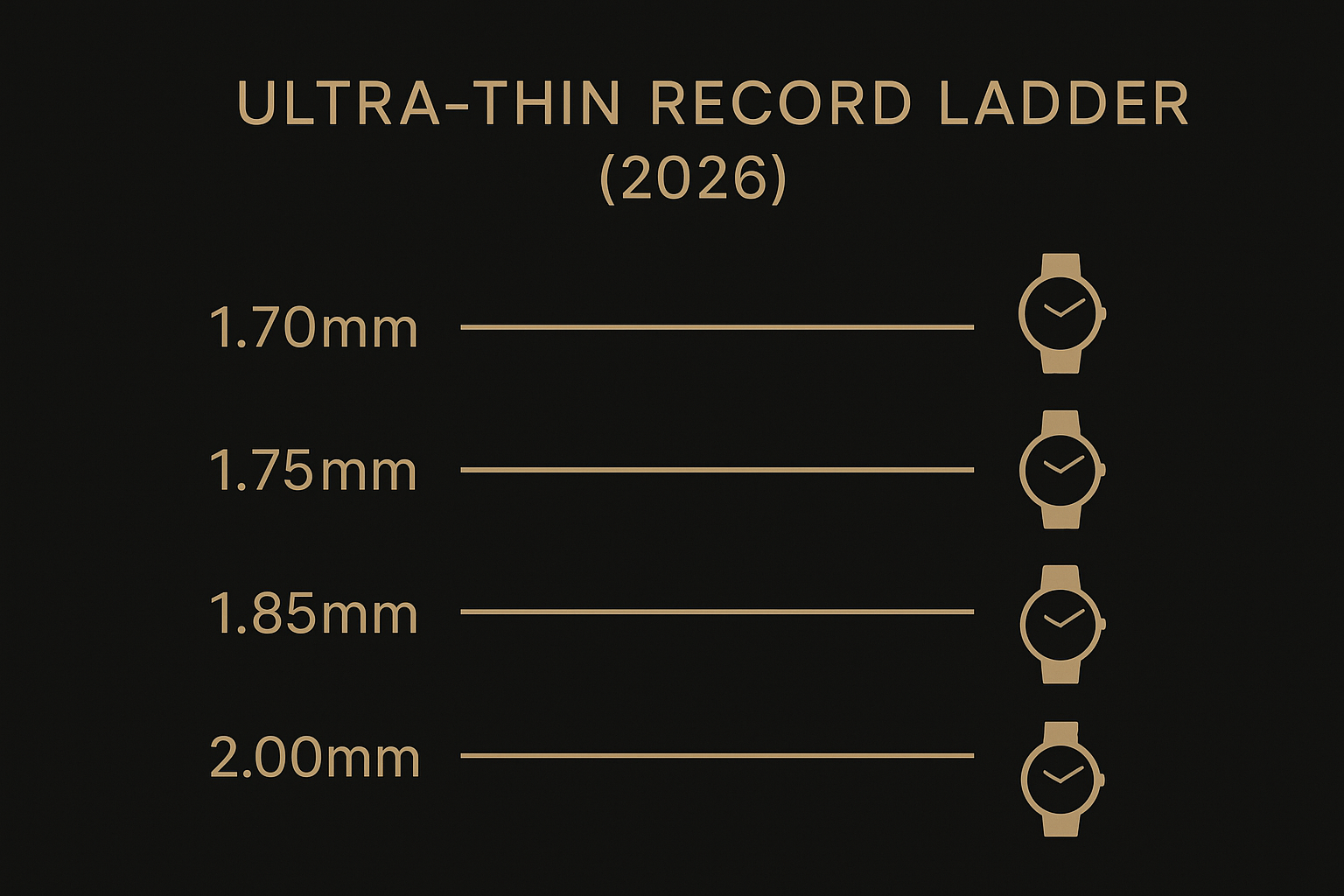
Collector’s note: When the watch is under ~2mm, the real “spec” you should care about is not just thickness. It’s whether the brand has built a credible ownership story: allocation, warranty, service, and parts support.
Best ultra-thin to buy now
This section is intentionally different from the record section. The “best” watch is the one you can actually acquire, insure, service, and wear without building your week around it.
Under $10k–$20k: design-led thinness
At this tier, thinness is usually achieved through quartz or high-efficiency, simplified constructions. The win is simple: under-cuff comfort and a dial that looks expensive without asking for special handling.
Shortlist archetypes to look for
Thin quartz dress pieces with clean case profiles and well-finished bracelets.
Discreet rectangular/square cases that wear thinner than the measurement suggests.
Solar or high-efficiency quartz if you want low-maintenance ownership.
One widely cited ultra-thin reference in this broader accessibility band is the Citizen Eco-Drive One (often noted for sub-3mm thinness in roundups such as Teddy Baldassarre’s “19 thinnest watches” list), though availability and exact references vary by market and year.
$20k–$60k: haute micro-rotor dress
This is the sweet spot if you want mechanical thinness without entering the “engineering trophy” tier.
What you’re paying for here:
Movement architecture that stays slim without feeling delicate.
Better case finishing (which matters more than people admit in thin watches because there’s nowhere to hide).
A service pathway that doesn’t feel like a negotiation.
A practical way to shop this tier is to anchor around proven “thin families” rather than chasing a single model. As a starting point for modern options, Monochrome’s Watches & Wonders 2026 ultra-thin highlights is a solid map of what brands were emphasizing as wearable thinness (not just records).
$60k+ and boutique-only allocations
Above $60k, two realities matter more than taste:
- Allocationmany of the most interesting ultra-thin pieces are boutique-led, relationship-driven, or limited.
- Risk managementinsurance, provenance, and service should be decided before you swipe a card.
If you’re buying at this level, treat “thinness” as a system:
- Dial and crystalextremely thin crystals can change how reflections behave (and how legible the watch feels).
- Bracelet rigiditya thin case on a stiff bracelet can feel like a plate.
- Wear rulessome record-class pieces are effectively “dry only.”
Specs & comparisons
Thickness, calibers, materials
Thickness is the headline, but it isn’t the whole comfort story.
Case height vs. perceived height: A slightly thicker watch with a well-curved mid-case can wear slimmer than a flatter “ultra-thin” slab.
Manual vs. automatic: Many extreme-thin watches lean manual because rotors add height. When you do see thin automatics, look for architecture that’s designed to stay slim.
Material choices: Titanium tends to make thin watches feel less “present” on wrist; dense metals can make a thin case feel surprisingly substantial.
Editions, availability, US pricing
Ultra-thin records are often limited in a way that makes pricing volatile. Unless you have primary documentation in front of you, treat any hard numbers online as indicative at best.
A more dependable approach:
Ask the boutique to confirm MSRP, allocation process, and timeline in writing.
Confirm whether the watch is sold as a set (some record watches ship with dedicated setting tools or companion pieces).
Decide whether you’re comfortable with pre-owned given the risk profile and service complexity.
Wearability cues (size, WR, bracelet)
For ultra-thin watches, “spec sheet realism” matters.
Diameter is secondary to lug-to-lug. A 40mm watch can wear small if the lug-to-lug is compact.
Water resistance (WR): many extreme-thin watches prioritize architecture over gaskets. If you travel often or wash hands aggressively, avoid “precious” WR.
Bracelet articulation: thin watches can feel sharp if the bracelet doesn’t drape.
How to choose & buy (US)
Fit and ergonomics checklist
Use this checklist before you care about brand, movement, or scarcity.
Case height: will it clear your cuff without snagging?
Lug-to-lug: does it stop before the edge of your wrist, or overhang?
Bracelet drape: does it articulate immediately, or fight your wrist?
Caseback feel: does it sit flat, or create pressure points?
Dial legibility in motion: thin watches sometimes trade legibility for minimalism.
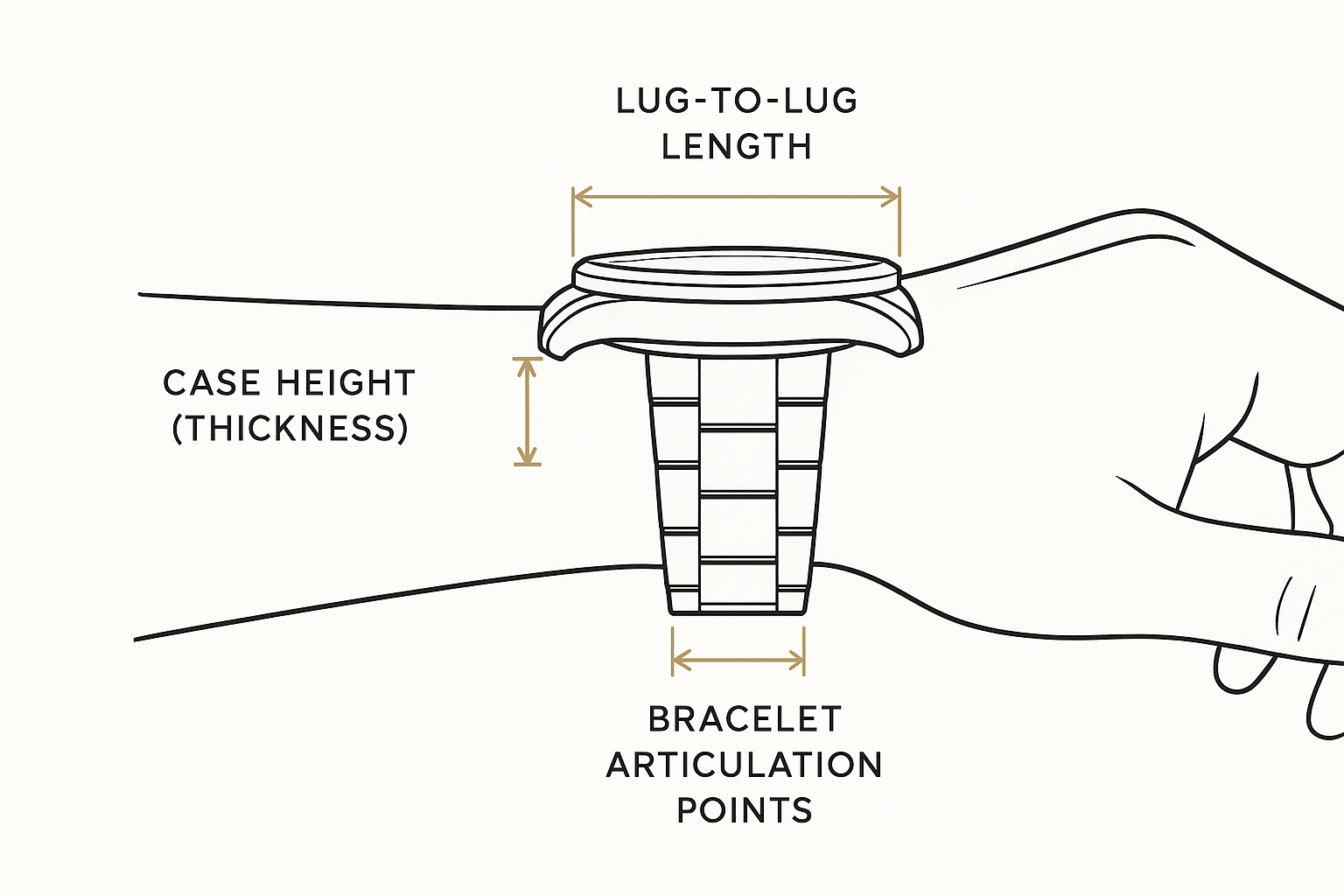
How to verify: When you try the watch on, slide a shirt cuff over it and flex your wrist. If the bracelet doesn’t drape, the cuff test will expose it instantly.
Movement, service, and warranties
Ultra-thin watches make two types of promises: precision and permanence. Do not accept the first without interrogating the second.
Ask these three questions at the boutique (or from the seller, in writing):
Where is the watch serviced in the US? (Or if shipped abroad, what is the typical cycle time?)
What is the warranty coverage for thinness-related issues? (Case integrity, crown interfaces, bracelet/clasp tolerances.)
Are parts restricted or allocation-based? Some movements are effectively “manufacturer-only” for the long run.
Concierge-grade ownership add-ons
For buyers who travel constantly, the most valuable “add-on” isn’t a complication. It’s the system around the object: discreet support, secure coordination, and a private channel for time-sensitive logistics.
That’s where luxury technology ecosystems can complement watch ownership. For example, VERTU frames its security posture around a blend of cryptographic protection and access controls in VERTU’s overview of protection against cyber threats, and backs the necessary caveats in the VERTU Privacy Policy. In practice, the value is simple: one discreet channel that supports the logistics of a life in motion.
2026 trends & outlook
From record-chasing to breadth
The past few years were dominated by record headlines: who could shave another fraction of a millimeter.
In 2026, the more interesting story is the second-order effect: brands are taking what they learned at the extremes and pushing it into wearable proportions, better bracelets, and cases that feel thin without being fragile. The mood is “refinement,” not just spectacle.
Materials and integrated design
Integrated architecture is no longer just an aesthetic trend. In ultra-thin watches, it becomes functional:
It can reduce height by distributing structure across the case and bracelet.
It can improve comfort when the bracelet actually drapes.
Material experimentation (titanium, dense noble metals, composite-like blends) is less about novelty and more about controlling how thinness feels on wrist.
Independents and boutique exclusivity
Independents remain the place where the most daring thinness experiments happen — but that often means prototype language, micro-runs, and service that depends on the maker.
If you want thinness with low ownership friction, buy from brands with visible after-sales infrastructure. If you want thinness as collecting philosophy, accept the tradeoffs and buy accordingly.
Conclusion
Key takeaways: records, realistic picks, and how to buy with confidence.
Next steps: shortlist models, try-on at boutiques, confirm service and allocation.
Start by deciding what “thin” means in your life: under-cuff comfort, travel durability, or pure engineering.
Then do it in this order:
Build a shortlist.
Try the watches on (cuff test + bracelet drape).
Confirm service, warranty, and allocation in writing.
Only then decide whether you want a record-holder — or a watch you’ll actually wear.
Disclosure: This article references VERTU pages. Editorial judgment remains the priority.