

Introduction
Luxury rose gold watches sit in a very specific place in the market. You are not only buying a dial and a movement; you are buying a color that changes the entire presence of a watch on the wrist. Done well, rose gold reads as warm, restrained, and quietly expensive. Done poorly, it can feel fragile, flashy, or hard to live with.
This guide is built to help you make the decision with fewer regrets. We’ll cover what actually makes luxury rose gold watches different, how to shortlist models by alloy and design (not marketing), what the U.S. market tends to look like across price bands, and the care habits that protect both finish and long-term value.
Alloy fundamentals
This is where most buying guides get vague. Don’t.
If you want a practical shorthand: a classic 18k rose gold watch gives you warmth and prestige, but engineered rose-gold alloys are often the smarter choice when you care about long-term color stability.
18k rose gold composition and color behavior
“Rose gold” is not a single metal. It’s an alloy: gold mixed with other metals to create both color and strength. In typical 18k rose gold, gold is 75% of the alloy, and the remaining portion is largely copper with a small amount of silver. Copper is what pulls the color toward pink and increases hardness modestly, but it can also oxidize over time and develop a subtle patina depending on environment and wear habits.
For buying decisions, the practical point is simple: rose gold’s warmth is real, but so is its relationship with wear. The finish you love on day one is the finish you have to protect through day 1,000.
If you’re comparing materials directly, rose gold is also modestly harder than yellow gold of the same karat, largely due to copper content; Deeve summarizes typical hardness ranges and patina behavior in Deeve’s “White vs Yellow vs Rose Gold Alloys” (2026).
Proprietary stabilized alloys: Everose, Sedna, King Gold, Goldtech
Top maisons know the downside of copper-rich rose gold: over years, untreated rose gold can drift in tone as copper reacts with the environment. Their solution is to engineer rose-gold alloys that hold color better.
Rolex’s Everose is designed to resist fading, with Rolex describing its proprietary blend as “at least 75% gold” plus copper and stabilizing elements (including palladium and indium). The aim is a consistent rose tone across decades, not “vintage drift.” See The 1916 Company’s “A Guide to Loving Gold” (2023).
Omega’s Sedna uses palladium as a stabilizer for long-term color stability; it’s often explained as a way to keep the hue from softening toward yellow with age. If you’re searching specifically for Everose gold vs Sedna gold, this is the practical difference: both target color stability, but they use different stabilizing metals and often land at slightly different “warmth” on the wrist. See the consumer-level overview in Luxury Bazaar’s guide to proprietary gold alloys (Everose, Sedna, King Gold, Goldtech).
Hublot’s King Gold and Panerai’s Goldtech push a richer rose tone with higher copper content, then use platinum as a stabilizer to reduce oxidation and keep the look consistent. A buyer-friendly overview is in Luxury Bazaar’s guide to proprietary gold alloys (Everose, Sedna, King Gold, Goldtech).
If you are sensitive to finish changes, or you want the watch to look “factory fresh” for longer, proprietary stabilized alloys are worth prioritizing.
Durability vs. steel and ceramic in daily wear
Rose gold is softer than steel and ceramic, but that does not mean it is “delicate.” It means it records life faster.
Steel tends to show scratches, but it tolerates daily knocks well and is easier to refinish without anxiety.
Ceramic resists scratches exceptionally well, but chips can be unforgiving.
Rose gold sits between: it is wearable, but you will see hairlines and contact marks sooner, especially on polished surfaces.
If you plan to wear the watch daily, look for designs that hide wear gracefully: brushed surfaces, softer bezel profiles, or straps that keep the case from rubbing against bracelets and desk edges.
U.S. market landscape
This section matters because the luxury rose gold watches buying guide decision is rarely just about aesthetics. Market liquidity, configuration demand, and service costs are part of the ownership equation in the U.S.
2024–2026 style and sizing trends
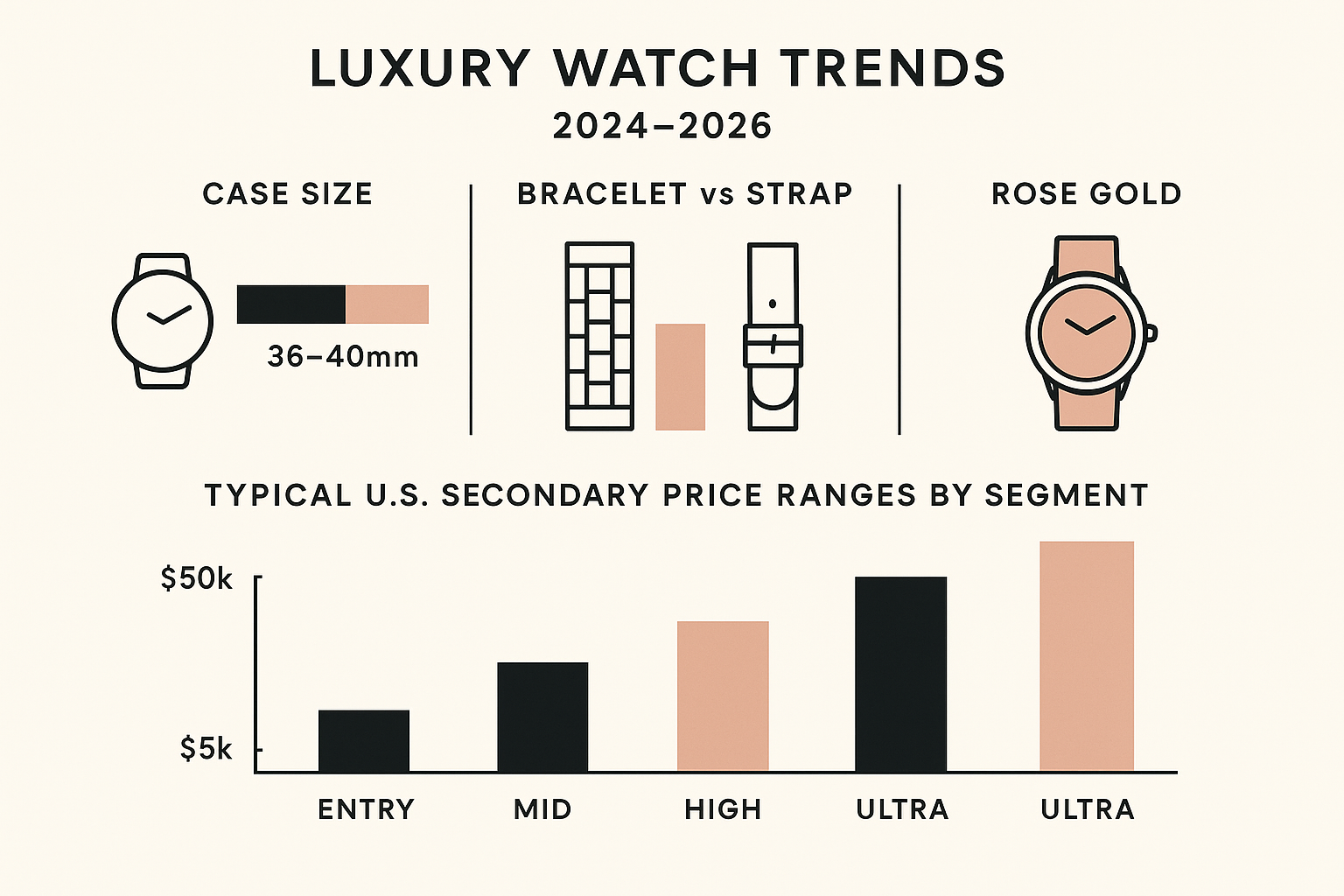
The U.S. market has moved toward more wearable proportions again. The practical “do everything” sizes live in the 36–40mm range for many wrists, and rose gold benefits from this shift: a slightly smaller case often keeps the metal elegant rather than loud.
Bracelets remain the default in luxury, especially in precious metal, while straps continue to be chosen for comfort, formality, and travel practicality. Market-level summaries often note bracelet dominance in the category; see Fortune Business Insights luxury watch market report.
In short: what was “statement sizing” a few years ago now reads a little dated. A tighter, better-proportioned case tends to age better, and it wears better.
Indicative price bands and configuration effects
In the U.S., rose gold pricing is heavily configuration-driven. The same reference can move meaningfully based on:
full rose-gold bracelet vs leather strap or rubber
factory gem-setting vs plain bezel
complications (chronograph, annual calendar, tourbillon)
dial variants that are hard to source
Rather than fixating on a single number, treat pricing as a set of bands:
Entry luxury (rose gold presence, often strap-based): usually the most accessible way to get the look.
Mid-luxury: where gold bracelets, stronger movements, and better finishing become the differentiators.
High luxury: where the brand’s design language and the specific reference matter as much as the material.
Ultra luxury: where rarity, complications, and factory-set stones dominate pricing and liquidity.
Resale value drivers and holding expectations
If you’re thinking about rose gold watch resale value, the most reliable drivers are unglamorous. They’re the same levers dealers and collectors use to price risk.
Resale in rose gold tends to be less about hype and more about fundamentals:
Brand strength and reference demand (a famous name is not the same as a liquid reference)
Condition (polish history matters; sharp edges and crisp hallmarks matter)
Completeness (box, papers, documented service)
Configuration desirability (bracelet vs strap, dial, gemstones)
Material floor (precious metal gives a baseline, but it is not a promise)
A useful mindset is to treat rose gold as a long-term ownership decision first, with resale as a risk-control factor rather than the primary reason to buy.
How to choose the right piece
Fit, use case, and size selection
Start with how you will actually use the watch.
Daily office + travel: prioritize comfort, lower visual friction, and durability of clasp/bracelet; a strap can be more forgiving and discreet.
Formal-heavy calendar: lean dress references, slimmer cases, and simpler bezels.
Weekend wear: luxury-sport works if the water resistance and strap/bracelet are aligned with your habits.
Size is not a status number. In rose gold, the “right” size is the one that keeps the metal looking intentional.
Dial, bezel, bracelet or strap choices
Rose gold changes how every other design element reads.
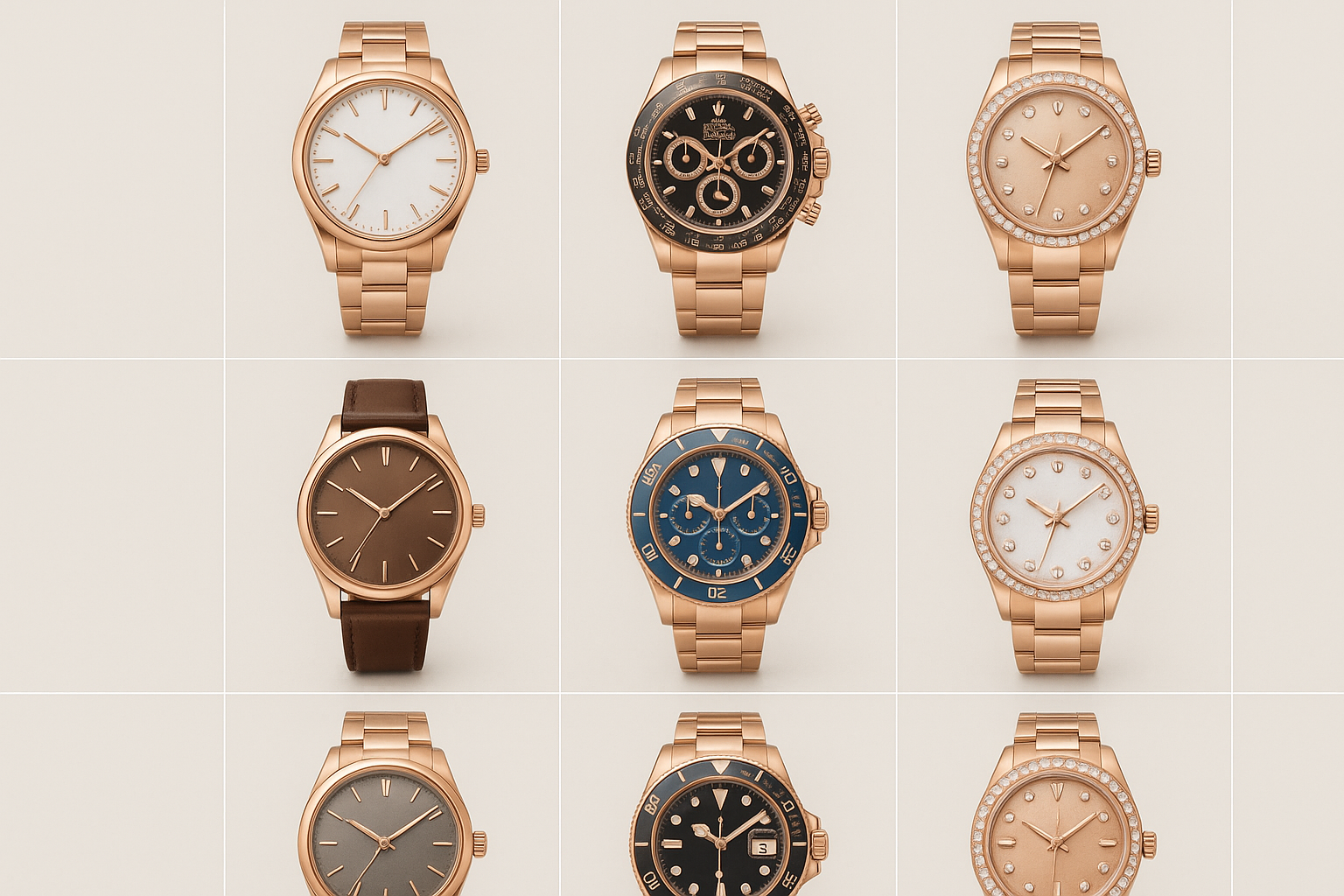
Dial: darker dials (black, slate, deep brown) often sharpen contrast; lighter dials can feel softer and more jewelry-forward.
Bezel: polished bezels show wear; fluted or textured bezels can hide it.
Bracelet vs strap: a full rose-gold bracelet amplifies presence and weight. A leather strap can keep the look refined and reduce the “all gold” effect.
If you are unsure, try the watch on with your real wardrobe. Rose gold is surprisingly honest about what you actually wear.
Authenticity, service history, and buying channels
The channel you buy through is part of the watch.
Authorized dealer or brand boutique: the cleanest provenance, but often not the fastest path to a specific allocation.
Established secondary dealers: speed and selection, but you must demand documentation and verification.
Private sale: sometimes the best value, also the highest execution risk.
How to verifyAsk for movement photos (when appropriate), serial verification, a documented service history, and confirmation of replaced parts. If a seller can’t explain the service story clearly, assume you will pay for it later.
This is also where concierge-enabled coordination can be genuinely useful, without turning the purchase into a publicity event. A discreet concierge can manage sourcing, appointment logistics, and documentation handoff across cities and time zones, while you stay focused on one thing: whether the piece is right.
If you already live in a world where time and privacy are the constraints, ownership tools like VERTU Concierge are designed around discreet coordination. And if you care about provenance as a mindset, it can be helpful to think in “ownership and verification” terms similar to VERTU’s framing in Vertu MetaVertu Explained: luxury, Web3 & ownership: not as a promise about watches, but as a reminder that secure ownership starts with verifiable history.
Top picks to shortlist
Dress references worth a look
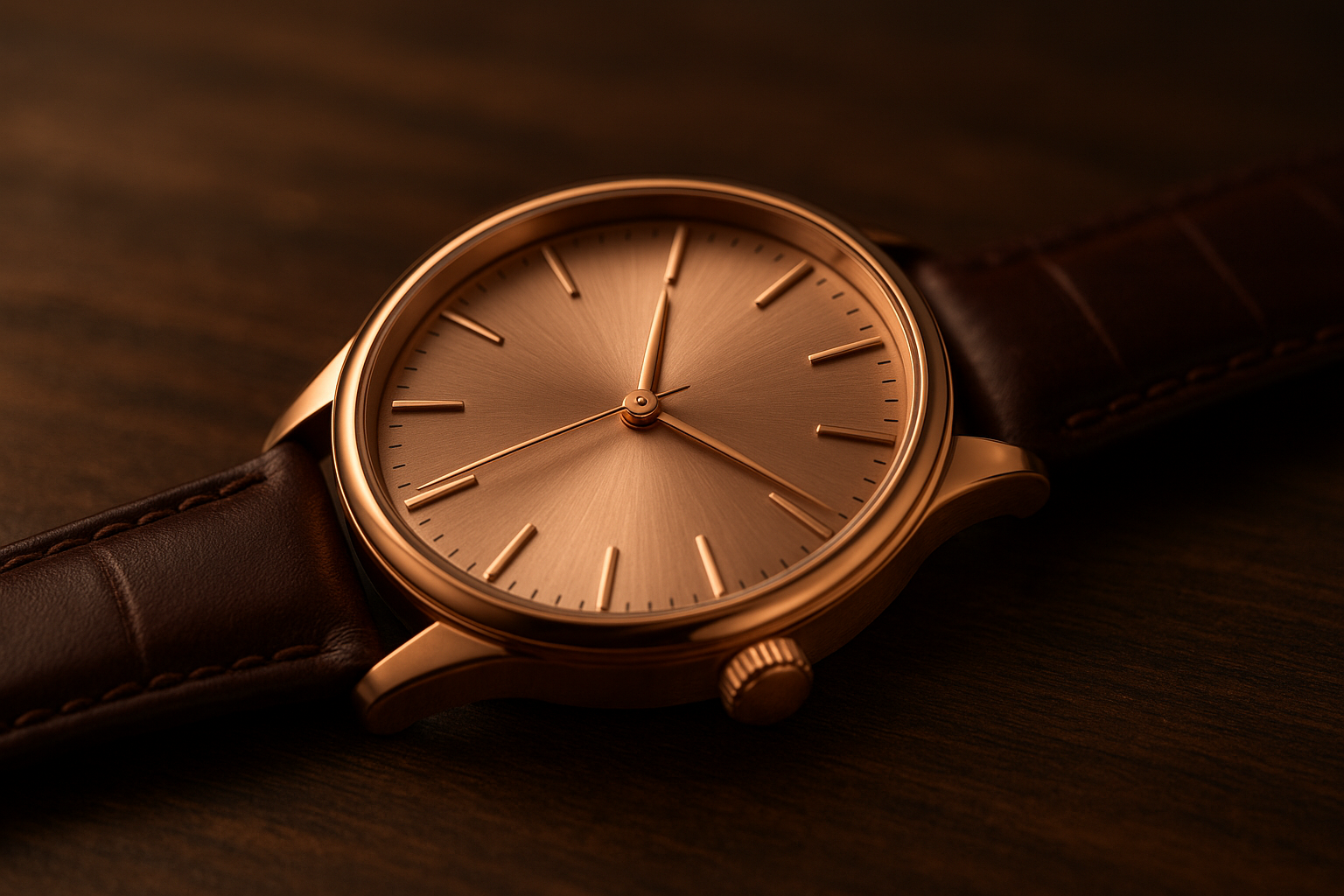
Dress rose gold is about proportion and restraint.
Look for:
slim cases and clean bezels that do not overstate the metal
dials with quiet depth (sunburst, lacquer, fine texture)
straps that feel intentional (not an afterthought)
A dress piece is usually your best “first rose gold,” because it lets the metal read as warmth rather than weight.
Sport and luxury-sport standouts
Luxury-sport in rose gold can be spectacular, and also the easiest to misbuy.
Prioritize:
water resistance you will actually respect (see care section)
straps/bracelets that suit daily friction (desk edges, travel, heat)
bezel materials and finishes that won’t look tired after one season
If your lifestyle is casual-luxury rather than formal, this is often where you will get the most wear.
Jewelry-forward options and factory-set pieces
Factory-set rose gold pieces can be astonishing when done with taste. They are also the most sensitive to configuration and liquidity.
Before you buy:
confirm whether the brand will service the exact gem-setting configuration long-term
evaluate whether you want “signature look” stones (high presence) or subtle setting (quiet sparkle)
ask how easily you could exit the piece later if tastes shift
Care and maintenance essentials
Daily cleaning and finish preservation
Your rose gold watch care tips should be gentle and boring. That is the point.
Wipe the case and clasp with a clean microfiber cloth after wear.
For deeper cleaning, use mild soap and warm water where appropriate, then dry fully.
Avoid harsh chemicals and unnecessary polishing; polishing is the fastest way to soften edges over time.
A solid consumer-friendly overview of how rose gold behaves and how patina can appear is in Deeve’s “White vs Yellow vs Rose Gold Alloys” (2026).
Water resistance checks and service cadence
Water resistance is not a lifetime trait. It is a maintained condition.
Treat “water resistant” as “tested water resistant.” Gaskets age, crowns get knocked, and seals dry out.
Pressure test periodically, especially if the watch sees pools, ocean, or even frequent hot showers.
Service intervals vary by brand and movement, but the principle is consistent: service before you have a failure, not after.
Storage, travel, and polishing discipline
Store the watch in a soft-lined box or pouch to prevent abrasion against other jewelry.
When traveling, avoid letting the watch knock against chargers, keys, or metal accessories.
If you polish, do it deliberately and infrequently, and prefer brand service or a watchmaker who respects case geometry.
Pro TipIf you rotate watches, keep one “daily” piece and one “formal” piece. Rose gold stays sharper longer when it is not forced to do everything.
Conclusion
Decide your shortlist by alloy stability, wear scenario, and budget range. Align expectations early on value retention and service cadence, and you will buy with a calmer mind. Then protect the finish with consistent, gentle care habits and disciplined water-resistance testing.
If you want a low-friction next step, start by writing down three things: your ideal size range, your preferred strap/bracelet, and the one occasion you want this watch to own. From there, sourcing becomes a process rather than a hunt.
Disclosure: This article references VERTU pages. Editorial judgment remains the priority.
![Top 10 Tourbillon Watches for Men [2026 Latest]](https://cdn.sanity.io/images/e0gp1l2g/production/8cb6bc45133cf9453382fc7d074465af588bb610-1800x1080.webp?w=800&h=450&q=82&auto=format&fit=crop)