

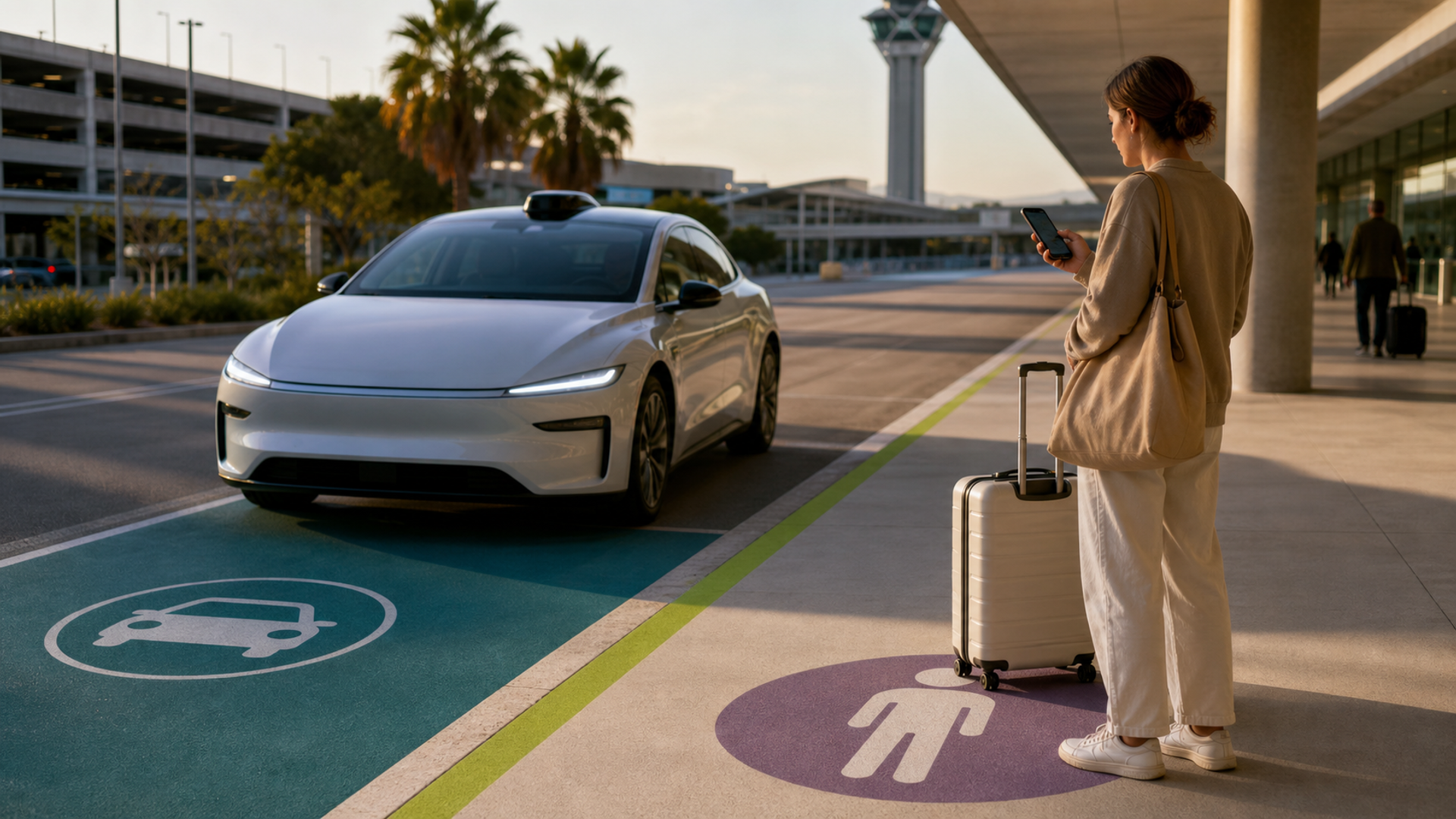
Tesla says its Robotaxi service is live in seven major US metropolitan areas, with unsupervised rides operating in Austin and launched in Miami, Orlando and Tampa in July 2026. The San Francisco Bay Area is listed with a safety driver. Existing Tesla vehicles remain the main fleet while production Cybercabs begin public-road testing.
That sounds simple until a rider asks the questions that matter: Is the service open to everyone? Does a safety driver sit in the car? What area and hours are covered? Which vehicle arrives? How does a passenger get help?
“Robotaxi” is a service category, not one uniform experience. Availability and supervision can vary by city and change as permits, testing and fleet capacity evolve. Use this guide as a current decision framework, then confirm the operating screen inside Tesla’s app before requesting a ride.
Current Tesla Robotaxi service picture
| Metro or operating area named by Tesla | Q2 2026 status in Tesla’s update | Supervision context stated by Tesla | What a rider must confirm |
|---|---|---|---|
| Austin | Service area expanding | Ramping unsupervised operation | Exact zone, hours, eligibility and remote-assistance process |
| Miami | Launched in July | Unsupervised rides | Public access and current geofence |
| Orlando | Launched in July | Unsupervised rides | Airport coverage and pickup restrictions |
| Tampa | Launched in July | Unsupervised rides | Service hours and weather limitations |
| San Francisco Bay Area | Announced coverage | Safety driver | Which journeys retain an onboard driver |
| Two additional major metros | Included in Tesla’s seven-metro total | Check current service notice | Name, launch stage and access |
Tesla’s Q2 shareholder deck is the source for the seven-metro claim and the named operating details. A company update can become stale quickly; a rider should treat the app’s live availability and local terms as authoritative for a specific journey.
“Unsupervised” does not mean unconstrained
An unsupervised ride generally means no human safety driver is continuously controlling the vehicle from the driver’s seat. It does not mean the vehicle can operate on every road, in every weather condition or without human support elsewhere.
Autonomous services operate within an operational design domain. That domain can include mapped geography, road types, weather, speed, construction conditions and time. A system may also have remote assistance for unusual situations. Remote assistance is not necessarily remote driving; the role and authority should be explained by the service.
Before booking, check whether the route stays inside the active zone and whether the service warns about weather, events or airport restrictions. If a trip is time-critical—an international flight, medical appointment or formal meeting—keep an ordinary ride option available until the service has demonstrated reliable availability in that area.
How access is likely to work
Tesla’s current materials describe rollout and coverage more clearly than a universal public onboarding process. Access can be staged. A city may begin with employees, invited users or a limited fleet before opening more broadly.
Use this sequence:
Install or update the official Tesla app through the device’s app store.
Sign in with the account you intend to use for payment and support.
Check whether Robotaxi appears for the current city and pickup point.
Review the fare, vehicle, pickup zone and supervision notice.
Confirm the number of passengers and luggage fit the offered vehicle.
Save an alternative transport route before accepting a time-critical ride.
Avoid unofficial invitations, payment links or account-verification messages. A popular launch creates opportunities for phishing. Do not provide credentials or payment details through a social-media message claiming to unlock early access.
Existing Tesla vehicles versus Cybercab
Tesla says current vehicles remain the workhorse of the Robotaxi fleet. Cybercab production has started at Gigafactory Texas, and engineering vehicles are being tested on public roads.
For riders, the distinction affects space, controls and expectations. A conventional Tesla model was designed for private ownership and retains familiar seating and doors. A purpose-built Cybercab may optimise for fleet utilisation and autonomous service. Early production does not guarantee that a Cybercab will arrive for an ordinary booking.
Check the vehicle displayed in the app. If travelling with several suitcases, a child seat, mobility equipment or more than two passengers, do not assume a “taxi” label guarantees fit. Accessibility and capacity should be explicit before the car is dispatched.
The pre-ride decision checklist
| Check | Why it matters | Do not proceed if |
|---|---|---|
| Exact pickup pin | Autonomous vehicles may use designated kerbs | The pin is unsafe or inaccessible |
| Supervision notice | Tells you whether an onboard safety driver is present | The mode is unclear and you are uncomfortable |
| Vehicle and seats | Determines passenger and luggage capacity | The offered vehicle does not fit the group |
| Destination and zone | Confirms the entire journey is supported | The route requires an uncertain handoff |
| Fare and cancellation | Prevents a launch-period pricing surprise | Terms are not visible |
| Help method | Essential if the car stops or the door will not open | No support channel is shown |
| Backup transport | Protects time-critical travel | Missing the journey would have serious consequences |
This is the value test: Robotaxi should reduce friction without asking the passenger to ignore uncertainty.
What to do at pickup
Stand at the designated pickup point rather than walking into traffic to meet the vehicle. Match the registration, vehicle image or app identifier before unlocking. Do not enter a car because it resembles the picture.
Inspect the passenger area and seat belts. Secure loose luggage. If a child seat is required, the passenger remains responsible for using an appropriate seat unless the service explicitly provides one. Do not place items where they can interfere with doors or controls.
Review the emergency and support interface before the vehicle moves. Know how to request a safe stop and contact support. If an onboard safety driver is present, understand whether the person is actively supervising and follow their instructions.
During the ride
Wear a seat belt and remain seated. An autonomous service does not remove ordinary passenger safety duties. Avoid obstructing cameras or sensors inside the cabin. Do not attempt to test the vehicle by creating hazards.
Watch the route at a high level. A small difference from a familiar route is not automatically a failure; services may choose roads within their operating domain. If the vehicle appears trapped, enters an unsafe location or does not respond to a passenger request, use the support control rather than trying to manipulate driving equipment.
For confidential calls, remember that a fleet vehicle may contain cameras and audio systems for safety or support. Read the privacy notice. Do not assume a car is a private meeting room simply because no driver is present.
Airports need special caution
Airport access is governed by local rules and designated pickup areas. Orlando, Miami and other metro launches do not necessarily mean every terminal or airport lane is supported.
Confirm the airport by its exact name and terminal. Check luggage capacity, pickup level and service hours. Build a larger time buffer than you would for a familiar transport option. If the service cannot enter the terminal area, the walk or shuttle transfer may erase any convenience.
International travellers should keep essential documents and medication with them rather than in a hard-to-reach boot. Save the trip receipt and support contact. If a vehicle stops and the connection is poor, a screenshot of the booking details can help.
How to interpret safety claims
Autonomous-vehicle safety comparisons require denominators. A low number of incidents is not meaningful without miles, operating conditions and definitions. A service restricted to good weather and simpler roads cannot be compared directly with all human driving.
Look for:
paid and autonomous miles by operating domain;
collisions and injuries with consistent definitions;
interventions or disengagements;
remote-assistance frequency;
service suspensions and recalls;
independent regulator reports;
exposure by city, road type and weather.
Tesla reports cumulative paid Robotaxi miles, but riders benefit from city-level and mode-level data. A national total can hide differences between an Austin unsupervised ride and a Bay Area journey with a safety driver.
Weather, construction and unusual events
Heavy rain, flooding, road works, emergency closures and major events can change the operating domain. A human driver also faces these problems, but an autonomous service may pause or alter coverage more abruptly.
Check the app shortly before departure. Do not rely on a booking option viewed hours earlier. If the vehicle asks you to leave at a safe alternative point, confirm that the location is genuinely safe before opening the door.
For extreme heat, keep your phone charged and avoid leaving a power bank in direct sun while waiting. Our Japan extreme-heat device guide explains the same battery principles for any hot-weather journey.
Privacy and account security
Robotaxi combines location, identity, payment and vehicle telemetry. Use a strong account credential and multi-factor authentication where available. Review who can see trip history and whether family or business accounts share data.
For business travel, decide whether the account should hold corporate journeys. Receipts may reveal client locations or meeting patterns. A personal account is not automatically an appropriate corporate travel record.
In the vehicle, minimise sensitive conversations. Cameras and microphones may be present for safety. The service should explain collection, retention and access. If that information is not clear enough for the conversation, wait until you reach a controlled environment.
When Robotaxi is the wrong choice
Choose a conventional service when:
the trip is time-critical and Robotaxi availability is unproven;
the passenger needs accessibility support not explicitly offered;
a child seat or luggage configuration cannot be confirmed;
the route goes beyond the operating zone;
severe weather or major disruption is present;
the passenger is uncomfortable with the current supervision mode;
support procedures are unclear.
Trying a new service should be optional, not a test of tolerance under pressure.
What the Q2 expansion changes
Moving to seven metros gives Tesla more varied roads and operating conditions. July’s Florida launches also test heat, rain and tourism patterns different from Austin. Cybercab production creates a path towards a purpose-built fleet.
It does not settle the commercial model. Tesla still needs to demonstrate reliable access, high vehicle utilisation, manageable support costs, safe expansion and rider trust. The sibling Tesla Q2 analysis tracks those operating and financial milestones.
The verdict
Tesla Robotaxi is no longer only a one-city demonstration. The company reports service across seven major US metros, an expanding unsupervised area in Austin and July launches in Miami, Orlando and Tampa. The Bay Area retains a safety-driver context in Tesla’s current deck, and existing Tesla vehicles remain central while Cybercab ramps.
For a rider, the city count is less important than the exact journey. Confirm access, operating zone, supervision, vehicle, support and backup transport every time. Use the service first for a flexible trip in good conditions, not for an airport departure you cannot miss.
Autonomy should make transport simpler. The best way to judge Tesla Robotaxi in 2026 is whether it delivers that simplicity while making its limits visible.
![How to Scan Receipts and Documents with Your Phone [Full Guide]](https://cdn.sanity.io/images/e0gp1l2g/production/0db13feec1d5e72b8a8a5f976d1f3e86619c9228-3840x1860.webp?w=180&h=180&q=78&auto=format&fit=crop)
![How to Scan Receipts and Documents with Your Phone [Full Guide]](https://cdn.sanity.io/images/e0gp1l2g/production/0db13feec1d5e72b8a8a5f976d1f3e86619c9228-3840x1860.webp?w=800&h=450&q=82&auto=format&fit=crop)
![Top 10 Two-Tone Carbon-Fibre Watches for Men [2026 List]](https://cdn.sanity.io/images/e0gp1l2g/production/18870799ba33fab0e038968359cd5772d7d7db30-1024x576.webp?w=800&h=450&q=82&auto=format&fit=crop)
![Top 10 Luxury Watches with Digital Complication Displays for Men [Latest]](https://cdn.sanity.io/images/e0gp1l2g/production/c4f6bf8c080f291c39f7cc85c7344ecff2fd3799-1024x553.webp?w=800&h=450&q=82&auto=format&fit=crop)