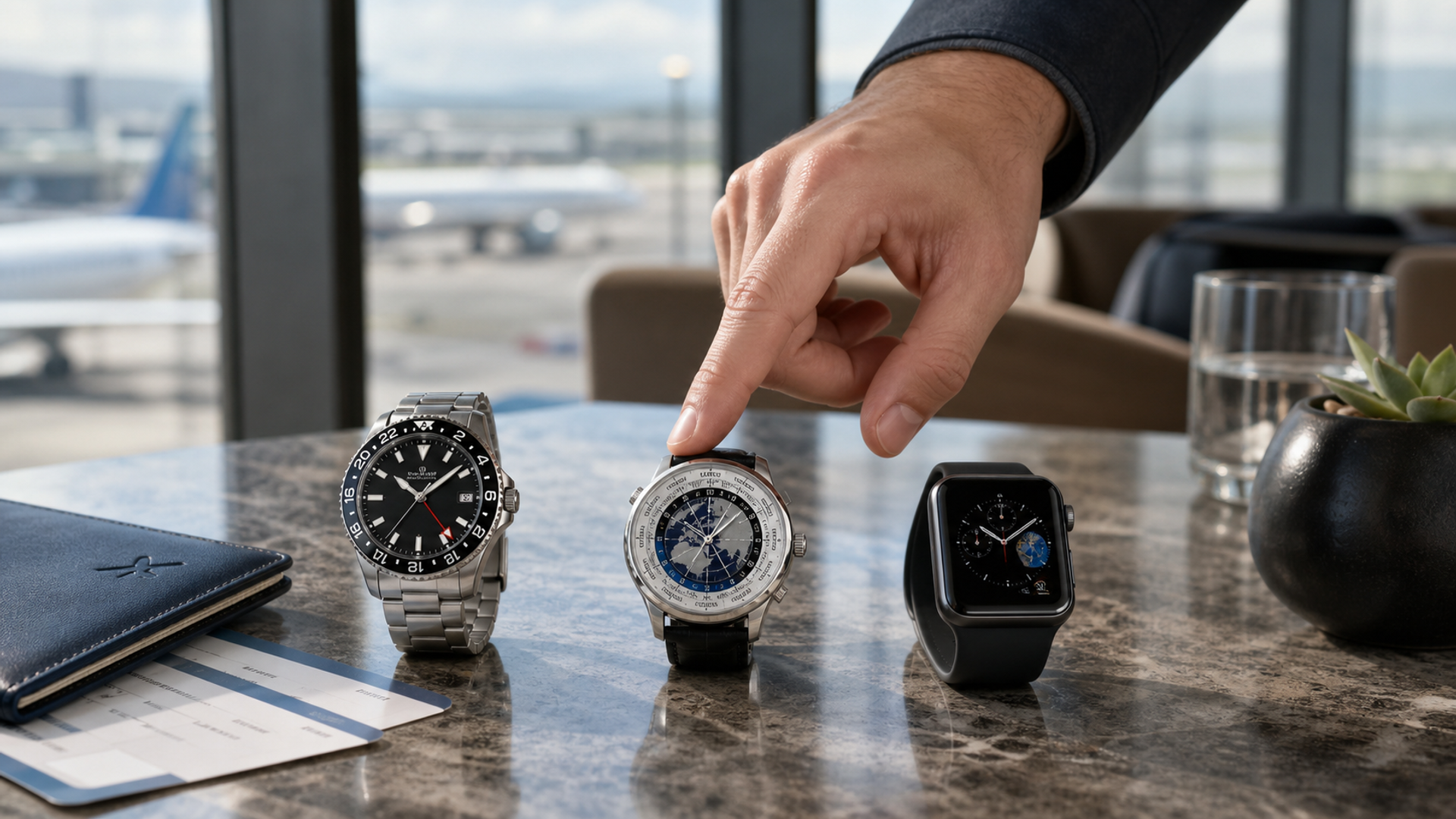
A GMT watch is the best default for most frequent flyers because it keeps home time visible while allowing the local hour to change without disturbing the minutes. A world timer is better for someone who routinely coordinates several cities from one dial. A smartwatch wins when automatic time-zone changes, calendar alerts, navigation and travel notifications matter more than mechanical independence. For the adjacent decision, see our luxury-watch travel documentation checklist.
The choice is not really analogue versus digital. It is a decision about how many places you need to track, how much interaction you want, and whether your travel watch should remain useful when the phone is offline or out of power.
The quick decision
| Traveller | Best format | Why | Main compromise |
|---|---|---|---|
| Flies between home and one destination | Traveller GMT | Home and local time stay legible; local hour changes independently | Usually shows only two zones at once |
| Coordinates offices across continents | World timer | Reads many named cities from one dial | Denser dial and more involved setup |
| Wants automatic changes and live travel information | Smartwatch | Updates time automatically and adds gates, maps and messages | Charging and phone ecosystem dependence |
| Travels off-grid or keeps devices out of meetings | Mechanical GMT | Works without network access or account sign-in | No live itinerary or navigation layer |
| Collects watchmaking complications | Mechanical world timer | Combines practical geography with visible mechanical theatre | Higher cost and servicing complexity |
What a GMT watch actually does
GMT watches use an additional hand that completes one rotation every 24 hours. On the Rolex GMT-Master II, the conventional hour hand shows local time and can be adjusted independently, while the arrow-tipped 24-hour hand remains tied to a reference time. A rotating 24-hour bezel can provide another reference when used deliberately.
The important distinction is between a traveller GMT and a caller GMT. A traveller GMT lets the wearer jump the local 12-hour hand in one-hour increments. This is the useful arrangement after landing because minutes, seconds and home time do not need to be reset. A caller GMT usually adjusts the 24-hour hand instead. That can work well from a fixed office when checking another city, but it is less convenient during repeated border crossings.
For a London-based executive landing in Hong Kong, the practical sequence is simple: leave the 24-hour hand on London, move the local hour hand forward, and read both places without opening a phone. The date should move correctly with the local hour; buyers should test this at a boutique because the direction and feel of adjustment differ by movement.
What a world timer adds
A world timer displays a reference ring of cities and a 24-hour scale so the approximate time across the major zones can be read together. The complication is useful when the problem is not “What time is it at home?” but “Which of our offices are in working hours?”
That overview is its advantage and its limitation. A well-designed world timer turns global time into a glanceable map, but city rings are compact, daylight-saving rules change, and politically altered time zones can outlive the dial. Some regions use half-hour or quarter-hour offsets that a conventional 24-city layout cannot represent perfectly.
A world timer therefore rewards a buyer who enjoys learning the display. It is not automatically more practical than a GMT. Before buying, ask the salesperson to demonstrate three tasks: setting the reference city, crossing midnight, and reading a location that observes daylight saving. If the explanation still feels slow after ten minutes, the complication may become decoration rather than a daily tool.
Where a smartwatch is decisively better
A smartwatch can change time zones automatically, display several cities, surface calendar changes and place an airline notification on the wrist. It can also provide turn-by-turn directions, boarding passes where supported, translation features and contactless payments. Those functions solve parts of the journey that a mechanical watch does not attempt.
The price is dependency. Automatic time can depend on the paired phone, location settings and network state. Travel features vary by country, app and airline. A bright always-on display consumes power, and an overnight charge may be awkward on a short connection. Notifications can also turn a watch into another source of interruption during a trip already crowded with messages.
The right comparison is therefore not feature count. It is failure behaviour. A mechanical watch loses or gains seconds gradually and continues showing time. A smartwatch can be perfectly accurate until battery, account, roaming or app access interrupts the broader experience. Frequent travellers should decide which failure mode is easier to manage.
A five-question buying test
1. How many time zones matter at once?
Two locations point towards a traveller GMT. Three or more regularly monitored offices make a world timer or smartwatch more useful. Do not buy a crowded city dial for an itinerary that only alternates between two places.
2. Do you cross time zones or call across them?
People who fly need easy local-hour adjustment. People who remain in one city but work with another may prefer an independently adjustable 24-hour hand. Confirm the movement architecture rather than assuming every “GMT” label means the same thing.
3. Must the watch work independently?
For cabins, secure meetings and places where a phone stays packed away, mechanical independence has real value. If the watch is primarily an extension of maps, messages and a calendar, a smartwatch is the more coherent purchase.
4. What is your charging routine?
Map the longest realistic journey: door to airport, lounge, flight, transfer and destination. A smartwatch that fits an ordinary day may not fit that sequence with an always-on screen and active radios. Use the manufacturer's current battery guidance as a starting point, then leave margin for battery ageing and cold weather.
5. Is this a tool, a collection piece or both?
A steel GMT can be a durable daily watch. A world timer can become the intellectual centre of a collection. A smartwatch is usually replaced on a technology cycle. None is inherently the more luxurious choice; the better object is the one whose ownership pattern matches the buyer.
Airport test: what to do before paying
Use this checklist in the shop:
Set home time and move local time across midnight.
Confirm whether the date moves backwards as well as forwards.
Read both zones in low light without explanation.
Check whether the crown or touchscreen can be operated with tired hands.
Wear the watch under the cuff used for travel.
Ask what happens during servicing: expected process, water-resistance testing and data reset for connected models.
For a smartwatch, verify roaming, payment and airline-app support in the countries actually visited.
The best answer for most travellers
Choose a traveller GMT when you want a watch first and a travel instrument second. It provides the most useful mechanical function for repeated flights without making the dial difficult to read. Choose a world timer when coordinating many cities is genuinely part of the day and the complexity itself is appealing. Choose a smartwatch when the journey depends on live information and you are willing to manage charging, permissions and ecosystem lock-in.
The decisive question is not which format can display the most. It is which one still helps at the most inconvenient point in the trip. For many frequent flyers, a clear local hour, a fixed home reference and independence from the phone remain the strongest combination.