

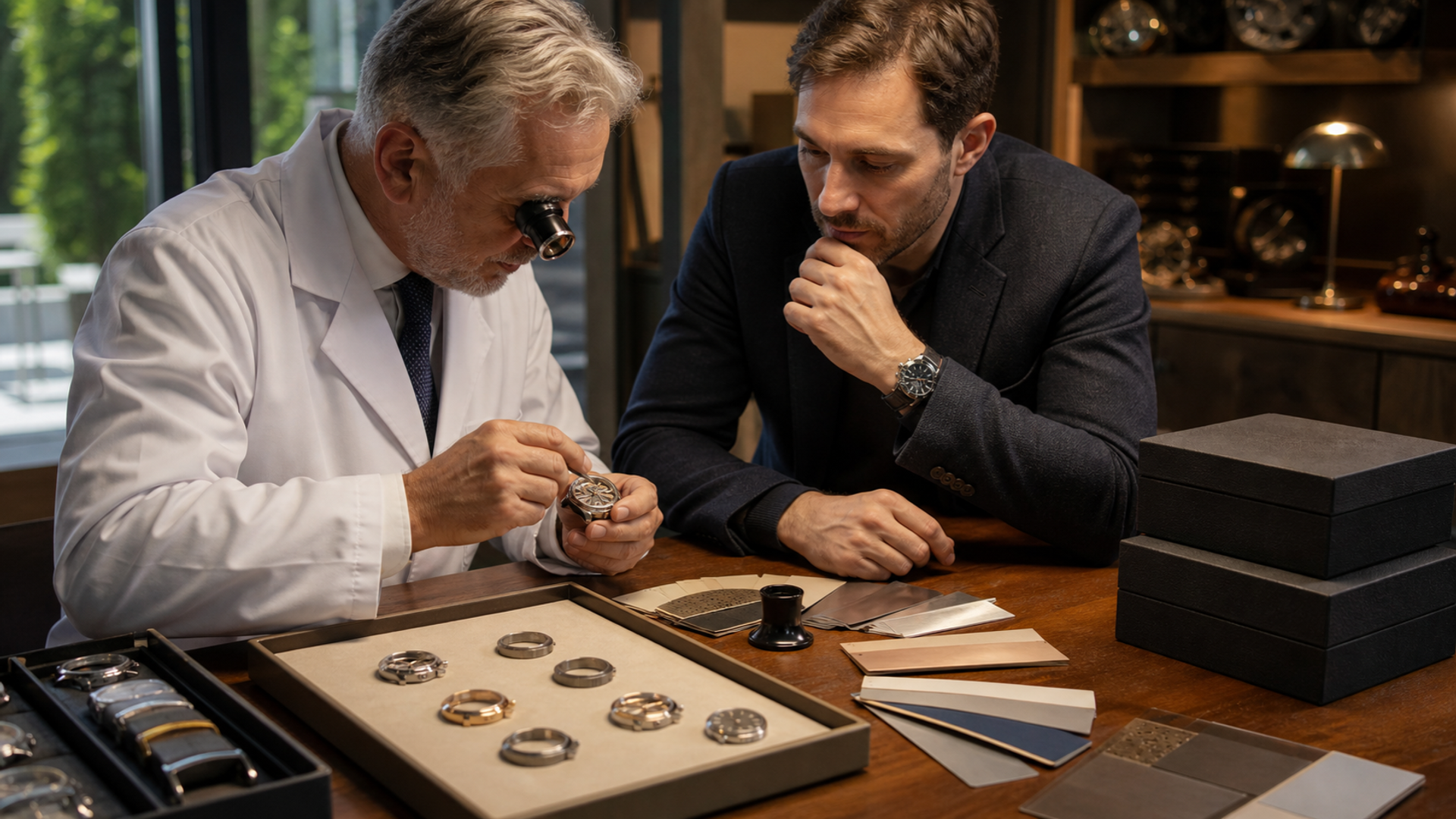
Rolex's 2026 launches are easier to understand as six distinct collecting propositions than as one long list of “new Rolexes”. The official programme comprises the Oyster Perpetual 41, Oyster Perpetual 36, Oyster Perpetual 28 and 34, Datejust 41, the new-generation Yacht-Master II, and an “Exceptional watches” chapter built around a Day-Date 40 and Cosmograph Daytona. Each answers a different ownership question: centenary symbolism, graphic dial craft, precious-metal simplicity, formal everyday use, a specialist regatta complication, or high horology expressed through unusual materials.
This is a buyer-routing guide to those six launch families, not an exhaustive catalogue of every 2026 reference, dial or regional price. It deliberately leaves the Yacht-Master II's mechanism and generation changes to a separate deep analysis. The aim here is to decide which branch deserves a wrist appointment—and which should be admired without becoming a purchase.
The 2026 range on one page
Rolex published all six launch chapters on 14 April 2026 in its official new-watches overview. The matrix below records the principal proposition confirmed by Rolex and the collection role it may fill. “Buyer fit” is editorial analysis, not a claim about availability or investment performance.
| 2026 launch family | Officially confirmed distinction | Natural collection role | Think twice when |
|---|---|---|---|
| Oyster Perpetual 41 | Centenary yellow Rolesor execution with slate dial and “100 years” details | Symbolic but mechanically simple daily watch | A commemorative detail would dominate the reason to buy |
| Oyster Perpetual 36 | Multicoloured lacquer Jubilee-motif dial in Oystersteel | Expressive everyday watch in a versatile size | The dial is less compelling away from launch imagery |
| Oyster Perpetual 28 and 34 | New 18 ct gold expressions in compact sizes | Precious-metal, time-only watch with restrained proportions | A larger wrist presence or date is essential |
| Datejust 41 | White Rolesor with green lacquer ombré dial | Formal daily watch with date | The buyer wants pure time-only simplicity |
| Yacht-Master II | New-generation regatta chronograph with redesigned operation and display | Specialist technical sports watch | The countdown will rarely be used or 44 mm is uncomfortable |
| Exceptional watches | Day-Date 40 in Jubilee Gold; Daytona combining Oystersteel, platinum and new ceramic/enamel work | Material-led flagship or advanced collector piece | Novel materials are being mistaken for a universal daily fit |
The matrix prevents a common error: comparing every launch by novelty. A colourful dial, a new alloy and a redesigned complication may all be new, but they do not compete for the same place in a collection.
Oyster Perpetual 41: a centenary object with a simple function
The official Oyster Perpetual 41 release frames the watch around 100 years of the Oyster. Rolex pairs a yellow-gold bezel and winding crown with an Oystersteel case and a bracelet whose centre links remain Oystersteel rather than yellow gold. The slate dial carries “100 years” at six o'clock, green five-minute markers and a green Rolex signature; the winding crown also bears the number 100 in relief.
Underneath those commemorative cues, this remains a 41 mm, time-only Oyster Perpetual. Rolex specifies calibre 3230, approximately 70 hours of power reserve, 100 metres of water resistance and an Easylink extension of about 5 mm. That combination suits a buyer who values the historical moment but still wants an uncomplicated automatic watch.
The centenary execution should be tested as a design, not purchased as a certificate. View the yellow-gold bezel and crown in daylight, compare the steel bracelet with a conventional Rolesor bracelet, and decide whether the “100 years” details will still feel coherent after the anniversary has passed. Collectability and future value are not established by the official launch material and should not be presented as guaranteed outcomes.
Oyster Perpetual 36: the dial is the decision
The 2026 Oyster Perpetual 36 is an Oystersteel watch whose lacquer dial revisits the Jubilee motif. Rolex says the letters of its name appear in no fewer than ten colours, applied sequentially rather than all at once. The technical base remains deliberately straightforward: 36 mm Oyster case, 100-metre water resistance, calibre 3230, about 70 hours of reserve and Easylink adjustment.
Its buyer is not simply someone with a smaller wrist. It is someone who wants a visually assertive dial on an otherwise restrained three-hand watch. The right test is to see the dial at normal conversation distance, under office lighting and beneath a cuff. Macro photography rewards complexity; daily wear tests whether the composition remains legible and personally convincing.
For a first Rolex, the 36 mm size and simple function are broadly versatile, but the dial is less neutral than the case. A buyer seeking one watch for formal and casual use should compare it directly with a quieter Oyster Perpetual dial rather than treating the 2026 motif as the default choice.
Oyster Perpetual 28 and 34: precious metal without a complication
Rolex's official 2026 overview confirms new Oyster Perpetual 28 and 34 expressions in 18 ct gold with satin-finished bracelets. This is the most focused branch of the launch: compact proportions, precious metal and time-only display. It is not simply a smaller version of the centenary 41, nor a Datejust without the date.
These watches suit a buyer who wants the weight, colour and permanence of gold but prefers the visual calm of an Oyster Perpetual. The choice between 28 and 34 mm should be made on the wrist with attention to bracelet presence, dial opening and how the case sits rather than by gender labels. A 28 mm watch can act as discreet jewellery; a 34 mm watch can provide more dial presence while remaining compact.
Do not infer the exact reference, alloy colour, price or local allocation from the range headline. Confirm the configuration on Rolex's live model page or through an official retailer. A precious-metal purchase also deserves a clear collection role: daily dress watch, compact evening watch or a deliberate alternative to a larger sports model.
Datejust 41: the most conventional daily proposition, with an unusual dial
The new Datejust 41 is presented in white Rolesor, combining Oystersteel and white gold, with a green lacquer ombré dial. Rolex says the gradient is created by applying green lacquer to the base plate and then spraying black lacquer in concentric movements. The shown configuration pairs the dial with a fluted bezel and Oyster bracelet.
This is the clearest option for a buyer who wants a date and recognisable formal Rolex design rather than a time-only Oyster Perpetual or specialist sports complication. Rolex confirms a 41 mm case, calibre 3235 and 100 metres of water resistance for the presented watch. The deciding factors are therefore proportion and dial treatment, not missing functionality.
Compare the green ombré dial in bright and subdued light, and compare the 41 mm case with a Datejust 36 before choosing. The larger case creates a different balance between bezel, dial and bracelet. The launch colour may attract attention, but the Datejust's long-term role is usually that of a repeated daily watch; the dial must work with the buyer's actual wardrobe and settings.
Yacht-Master II: a specialist branch, not the default sports choice
Rolex's official Yacht-Master II release describes the 2026 model as a new generation with a redesigned countdown function, improved legibility and easier manipulation. The launch confirms Oystersteel and 18 ct yellow-gold versions, a 44 mm case and calibre 4162. Its programmable regatta countdown remains the reason the model exists.
That makes it the least sensible watch in this list to buy by appearance alone. The relevant appointment is an operational one: programme the countdown, start it, synchronise it and reset it without coaching. Then wear the 44 mm case long enough to judge mass, clasp position and cuff interference. Buyers seeking a versatile first sports Rolex are likely to find a simpler model more useful. Sailors and complication-focused collectors may find precisely the opposite.
The mechanics, display redesign and old-versus-new operation are intentionally outside this article's scope. Keeping that boundary prevents this portfolio guide from competing with the dedicated Yacht-Master II buyer guide.
Exceptional watches: materials are the story
Rolex's Exceptional watches release covers two very different flagships. The Day-Date 40 introduces Jubilee Gold, a new 18 ct alloy developed and produced by Rolex, paired with a light-green aventurine dial and baguette-cut diamond hour markers. Rolex lists calibre 3255 and a President bracelet for that version.
The Cosmograph Daytona introduces an Oystersteel-and-platinum Rolesium configuration, an anthracite Cerachrom bezel made from ceramic enriched with tungsten carbide, and a white enamelled dial produced using a grand feu process. Rolex confirms calibre 4131, a transparent case back and a combination of steel and platinum around the case and bezel.
These are advanced collector propositions because their material and manufacturing choices are central to the identity and likely to make the in-person experience materially different from standard configurations. They should not be treated as automatically “better” versions of the Day-Date or Daytona. A buyer needs to decide whether the new alloy, natural-stone dial, enamel, ceramic and platinum combination advances an existing collection or merely duplicates a function already owned at much higher complexity and cost.
Three ways to build a shortlist
A first Rolex with broad daily use
Begin with the Oyster Perpetual 36, Oyster Perpetual 41 and Datejust 41. Choose time-only or date first, then size, then dial. The 2026 OP 36 is the expressive choice; the centenary OP 41 is the symbolic choice; the Datejust 41 is the more formal and functionally complete choice. Do not let allocation pressure reverse that order.
A collector seeking genuine incremental value
Identify what the collection lacks. The Yacht-Master II adds a programmable regatta countdown. The Jubilee Gold Day-Date adds a new proprietary alloy and natural-stone dial. The Daytona adds an unusual steel-platinum architecture, enamel and ceramic work. The compact gold Oyster Perpetuals add precious metal without another complication. The best addition is the one that creates a new wearing experience, not the one with the longest release description.
A size-led buyer
Start with the 28, 34, 36 and 41 mm Oyster Perpetual branches before considering model prestige. Photograph each from a normal distance, inspect bracelet articulation and wear it for at least 15 minutes. The Yacht-Master II's 44 mm case belongs in a separate fit category. Case diameter is only a starting number; bracelet width, case profile and total mass determine comfort.
A disciplined boutique appointment
Bring a written three-watch shortlist and ask to compare functions before dial colours. Confirm the exact reference, case material, bracelet and movement from the official listing. Test winding, setting, clasp adjustment and date or countdown operation where relevant. Ask which elements belong specifically to the 2026 reference and which are shared with existing models.
Availability, price, tax and delivery timing vary by market and can change. This guide does not infer them from search snippets or secondary-market listings. Record the official-retailer quotation, currency, included warranty documentation and return or deposit terms before making a decision. Do not treat scarcity claims, resale forecasts or unverified production estimates as official facts.
For deeper comparison of established collection roles, see Rolex Explorer vs Oyster Perpetual and Cartier Santos vs Rolex Datejust.
Verdict
The 2026 Rolex programme is broad, but it is not confusing once each launch is assigned a role. The Oyster Perpetual 41 is the centenary proposition; the OP 36 is dial-led; the OP 28 and 34 bring precious metal to compact time-only watches; the Datejust 41 is the formal daily choice; the Yacht-Master II is a specialist instrument; and the exceptional Day-Date and Daytona are material-led collector pieces. Choose the family that fills a real functional, proportional or material gap, then verify the exact reference on the wrist. “New for 2026” should narrow a good decision, not become the reason for one.
![How to Scan Receipts and Documents with Your Phone [Full Guide]](https://cdn.sanity.io/images/e0gp1l2g/production/0db13feec1d5e72b8a8a5f976d1f3e86619c9228-3840x1860.webp?w=180&h=180&q=78&auto=format&fit=crop)
![How to Scan Receipts and Documents with Your Phone [Full Guide]](https://cdn.sanity.io/images/e0gp1l2g/production/0db13feec1d5e72b8a8a5f976d1f3e86619c9228-3840x1860.webp?w=800&h=450&q=82&auto=format&fit=crop)
![Top 10 Two-Tone Carbon-Fibre Watches for Men [2026 List]](https://cdn.sanity.io/images/e0gp1l2g/production/18870799ba33fab0e038968359cd5772d7d7db30-1024x576.webp?w=800&h=450&q=82&auto=format&fit=crop)
![Top 10 Luxury Watches with Digital Complication Displays for Men [Latest]](https://cdn.sanity.io/images/e0gp1l2g/production/c4f6bf8c080f291c39f7cc85c7344ecff2fd3799-1024x553.webp?w=800&h=450&q=82&auto=format&fit=crop)