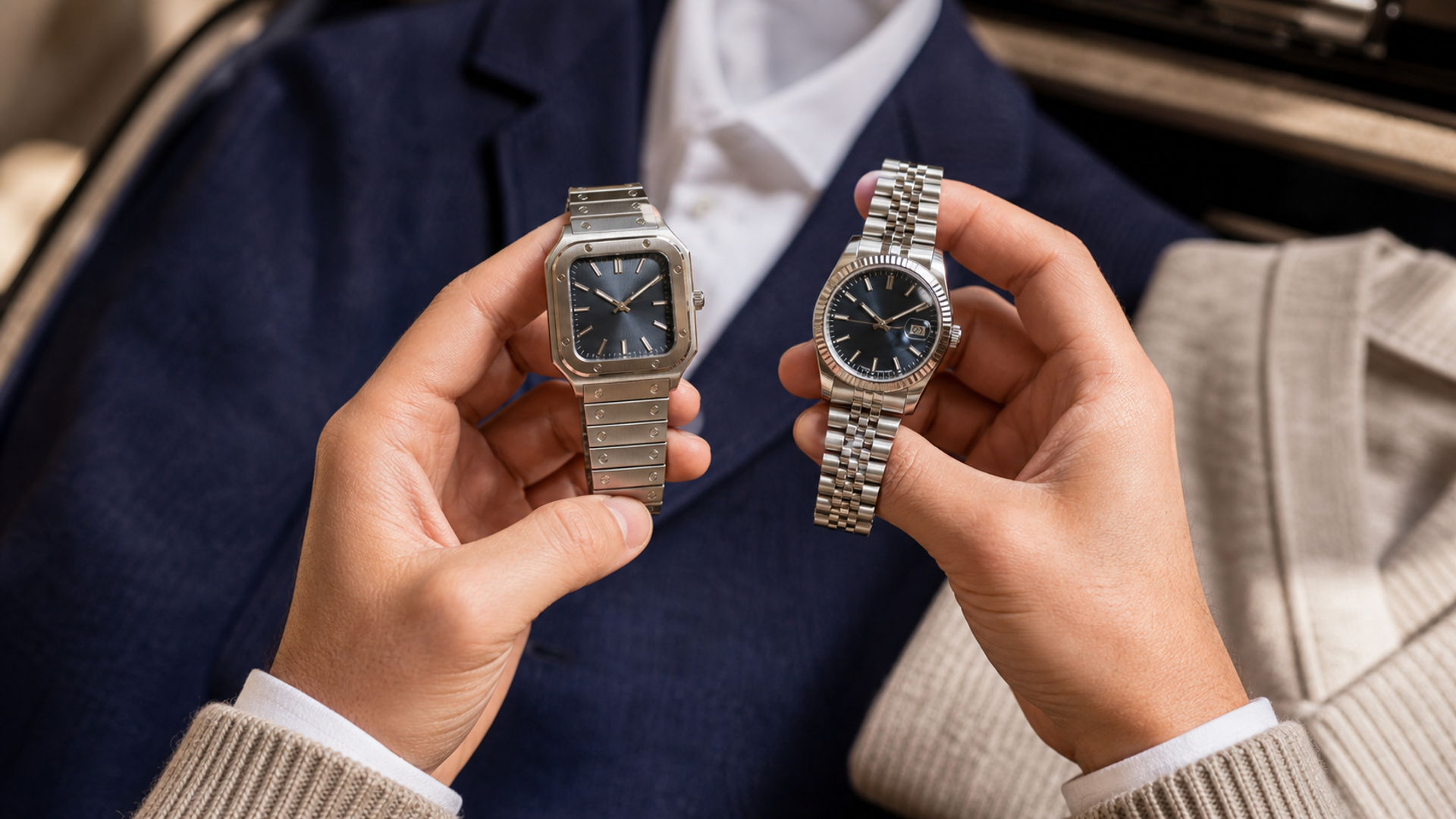
The Cartier Santos and Rolex Datejust solve the same broad problem in radically different ways. Both are recognisable, mechanically serious watches that can move from a weekday meeting to a weekend lunch. Yet the Santos makes its identity through a square case, exposed screws and an integrated-looking bracelet, while the Datejust refines the familiar round watch with a date window, many sizes and an unusually broad choice of bezels, dials and bracelets.
That makes this less a contest of prestige than a decision about daily rhythm. The Santos tends to suit someone who wants design to lead the conversation. The Datejust tends to suit someone who wants a highly adaptable, traditional watch whose personality can be tuned from discreet to conspicuous. Reference-level specifications change, so this guide compares the current collections and the ownership questions that remain useful even when a dial or size is updated.
The short answer
Choose a Cartier Santos if you want a watch whose architecture feels distinctive from across a room, prefer a slim-looking square profile, or value the option to change between bracelet and strap on supported references. Choose a Rolex Datejust if you prioritise a conventional round case, a useful date display, a large configuration range and an aesthetic that can be made sporty, formal or somewhere between.
Neither is automatically “better” for small wrists, business dress or travel. The correct answer depends on the exact case size, bracelet, dial contrast and how the lugs or case corners sit on your wrist. Try the actual reference, not merely another watch from the same collection.
Everyday decision matrix
| Decision factor | Cartier Santos | Rolex Datejust | Better fit when… |
|---|---|---|---|
| Visual identity | Square, geometric, visible screws | Round, classic, date-and-Cyclops signature | You know whether design or convention should lead |
| Wrist impression | Broad face with rounded corners; can appear larger than its dimensions suggest | Size depends heavily on reference, bezel and bracelet | You compare mirror photos and top-down wrist shots |
| Bracelet character | Integrated-looking, architectural links | Oyster or Jubilee choices on many references | You prefer modern geometry or traditional flexibility |
| Strap flexibility | Quick-change systems on relevant current models | Bracelet-focused; options depend on reference | You expect to change the mood regularly |
| Information | Time; date on selected models | Date is central to the collection | You either value or dislike a magnified date |
| Formality | Graphic and design-led | Ranges from understated smooth-bezel to jewellery-like configurations | Your work wardrobe is minimalist or traditional |
| Travel use | Distinctive but easy to dress down on strap | Familiar, robust daily-wear proposition | You consider discretion and local context, not only durability |
| Buying complexity | Fewer core visual branches | Many combinations of size, metal, bezel, dial and bracelet | You prefer a concise choice or extensive customisation |
Case shape changes more than the measurements suggest
A round watch is usually assessed by diameter, lug-to-lug length and thickness. A square watch adds another visual variable: how much of the dial and bezel occupies the wrist from corner to corner. The Santos has softened corners, but its broad geometric face can look more assertive than a round watch with a similar stated width. The polished and brushed planes also catch light differently as the wrist moves.
The Datejust is easier to understand from a conventional diameter figure, yet even here the number is not the whole answer. A fluted bezel creates a brighter, more formal perimeter than a smooth bezel. A Jubilee bracelet breaks the surface into smaller links and can read as more decorative, while an Oyster bracelet usually looks calmer and more continuous. Dial colour and markers can make the same case appear larger or smaller.
Use three fitting tests. First, look straight down and check whether the case or lugs overhang the wrist. Second, view the watch in a full-length mirror; close-up phone photos exaggerate size. Third, spend ten minutes moving the wrist, typing and putting on a jacket. A watch that looks perfect while static may irritate a wrist bone or fight a cuff.
Bracelet and strap: architecture versus configuration
The bracelet is part of each watch's identity. On the Santos, exposed screws continue the industrial language of the bezel and case. On current supported models, Cartier's tool-free systems can make bracelet resizing or changing to a supplied strap more approachable, but buyers should confirm exactly what is included with the reference. Never assume every Santos package has the same strap, clasp or interchange system.
The Datejust offers a different kind of flexibility. Depending on the reference, an Oyster bracelet gives a cleaner and somewhat sportier line, while a Jubilee bracelet introduces more articulation and visual texture. The choice is not only cosmetic. Link shape, clasp position and how the bracelet drapes can determine whether the watch remains comfortable through temperature changes and a full workday.
If you routinely change from tailoring to knitwear or travel clothes, ask a practical question: do you want one watch that changes character through straps, or one fixed configuration chosen perfectly at purchase? The Santos often makes the first route attractive. The Datejust rewards taking time over the second.
Dial, date and legibility
The Santos' Roman numerals, railway-style minute track and square dial create a strong graphic order. Some variations are more restrained than others, but the basic design is deliberate rather than neutral. That clarity can work beautifully with monochrome clothing; it can also compete with heavily patterned tailoring.
The Datejust's defining functional difference is the date at three o'clock, commonly paired with Rolex's magnifying lens. For a wearer who checks the date many times a day, this is genuine utility. For someone who values symmetry, it is a permanent visual interruption. There is no correct aesthetic answer.
Check low-light legibility on the exact dial. Polished hands against a reflective dial may behave differently under office lighting from how they appear in a product photograph. Likewise, diamond markers, unusual colours and low-contrast combinations may be emotionally compelling but less immediately readable. Everyday luxury should still work at a glance.
How each watch handles a wardrobe
The Santos is particularly effective when the rest of the wardrobe is quiet: navy tailoring, a white shirt, fine knitwear, clean leather footwear. Its square geometry supplies the visual punctuation. On a strap, it can move toward a more traditional dress-watch mood; on the bracelet, it is unmistakably modern and architectural.
The Datejust can be specified to match almost any wardrobe. A steel model with smooth bezel and restrained dial can function as an unobtrusive daily watch. A fluted bezel, bright dial or gem-set configuration can become the centre of an outfit. This range is an advantage only if the buyer decides what role the watch should play. Choosing solely from a tray of attractive combinations can produce a watch that is admired in the boutique but rarely worn.
The existing Rolex Datejust vs Oyster Perpetual guide is a useful control comparison if the square Santos is attractive but the date, bezel or bracelet configuration remains the real point of uncertainty.
For a more systematic approach, the guide to how to build a three-watch collection is useful: decide whether this purchase is the everyday anchor, the formal watch or the design statement. If it must be all three, prefer the configuration you would wear on an ordinary Tuesday, not the one that looks most dramatic under boutique lights.
Travel, discretion and real-world use
Both watches are capable daily companions, but travel suitability is not reducible to water resistance. Consider recognition, replacement difficulty, insurance, service access and the environments through which you will move. A highly recognisable configuration can be inappropriate for some itineraries even if it is mechanically robust.
Before departure, record the serial and reference privately, keep current photographs, confirm insurance terms and avoid storing proof of ownership only on the device travelling with you. Do not place a valuable watch in checked luggage. At security, retain physical control where procedures allow and do not leave it loose in a tray.
The Santos can become visually quieter on a dark strap. A restrained Datejust configuration can also travel discreetly, although the model remains widely recognisable. If the journey includes beach, pool or high-impact activity, verify the current reference's water-resistance guidance and the condition of seals; a rating when new is not a lifetime guarantee.
Movement and servicing: compare the ownership system
The most meaningful movement question for an everyday owner is not which calibre wins on a spec sheet. It is whether the watch keeps suitable time, has enough power reserve for the wear pattern and can be serviced through an authorised network on acceptable terms. Exact calibres and specifications vary by reference and year.
Ask the seller for the reference number, movement identification, warranty position and recommended maintenance guidance. For a pre-owned watch, request service history, timekeeping results, water-resistance test information and details of replacement or polished components. “Recently serviced” is not useful without documentary evidence.
The official Cartier Santos collection and Rolex's Datejust collection should be the starting points for current configurations. Rolex also explains collection features on its Datejust features page. Boutique stock, regional availability and included accessories can differ, so live verification matters more than a third-party listing.
New, authorised pre-owned or independent-market purchase
Buying new prioritises current documentation, warranty and a direct relationship with the selling boutique. It does not guarantee that every desired configuration is immediately available. Authorised pre-owned programmes may provide a structured route to discontinued combinations, but terms and selection vary. Independent sellers can widen access, yet the buyer assumes more authentication and condition risk.
For either model, inspect case geometry, bracelet stretch or damage, clasp operation, crown action, dial condition and consistency between the watch, paperwork and seller description. Aggressive refinishing can soften the Santos' planes or the Datejust's case definition. Condition should be assessed in person or through sharp, neutral-light images from multiple angles.
Do not use online asking prices as evidence of completed transaction value, and do not buy either watch on an assumption of appreciation. The return is the use you receive. Availability, taxes, servicing and resale conditions can all change.
A five-minute fitting protocol
Set the bracelet comfortably, because a loose display fit distorts the result.
Check the watch under daylight, office light and shadow.
Photograph the wrist from one metre away as well as close up.
Put on the jacket or cuff you wear most often.
Operate the crown, date and clasp without sales assistance.
Compare the quietest and boldest configuration you would genuinely consider.
Leave the boutique and review the photographs the following morning.
This protocol often reveals that the decision is not Santos versus Datejust in the abstract. It is one exact Santos reference against one exact Datejust configuration.
Final verdict
The Cartier Santos is the stronger choice for a wearer who treats industrial design and shape as the main pleasure of a watch. It feels intentional with minimal clothing, and supported quick-change options can extend its range. The Rolex Datejust is the stronger choice for someone who values a conventional round architecture, an always-visible date and the ability to choose a very precise point on the spectrum from quiet steel daily watch to formal statement.
If you are still undecided, do not compare brand status. Compare the two watches on your wrist with the same outfit, then ask which one you would choose for the least ceremonial day of your week. For broader context on how these models sit within the market, see the men's luxury watch brands guide. The everyday winner is the one whose shape, information and bracelet remain satisfying after the novelty has faded.