

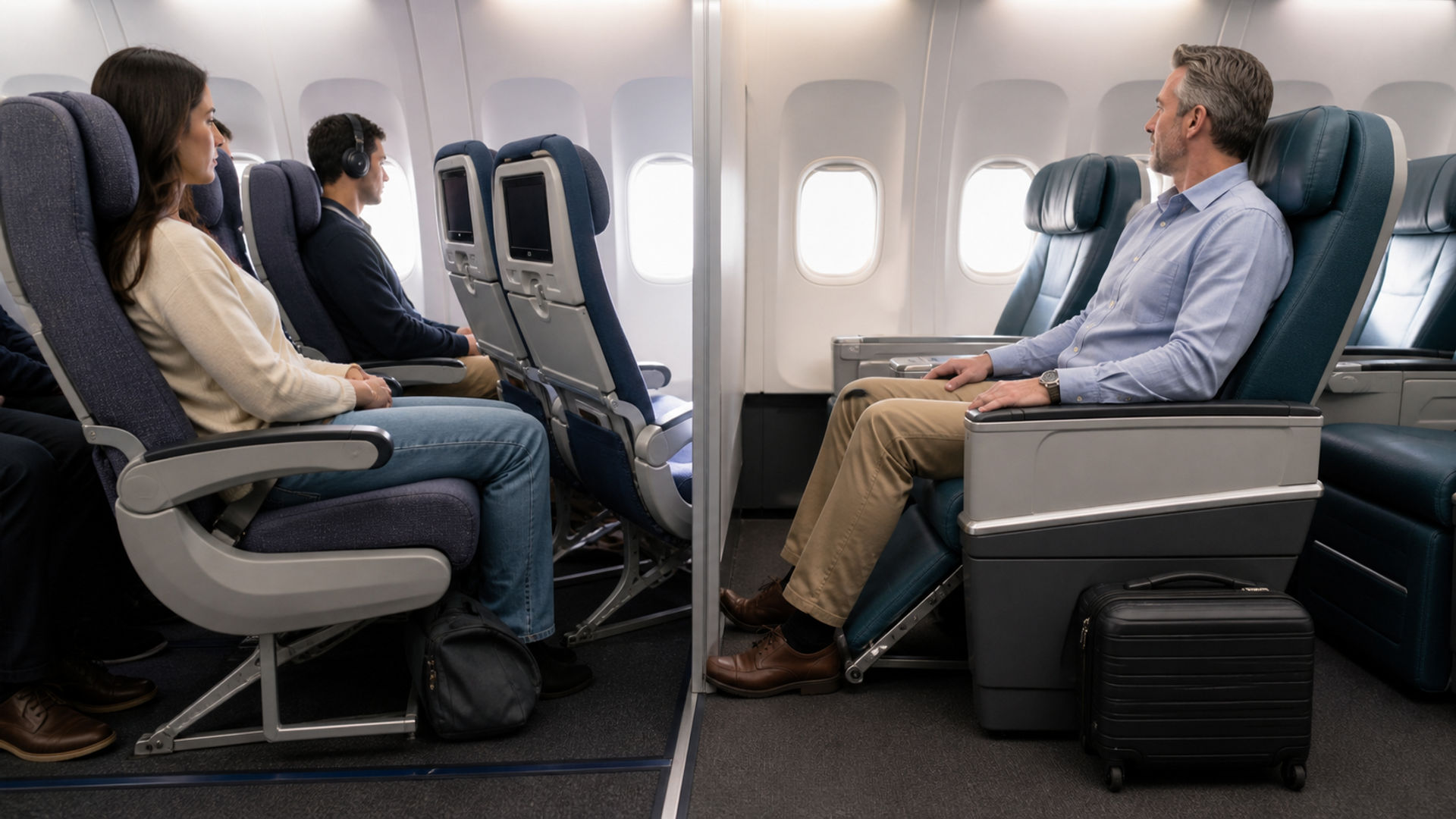
Premium economy is a separate cabin on some long-haul aircraft, but the improvement over economy varies by airline, route and seat map. Extra pitch, width, recline, baggage, boarding and meal details can help; none guarantees sleep or a business-class experience. The fare gap should be divided by the hours and constraints that actually matter on the booked flight.
Price the specific flight
Choose premium economy when the exact seat, flight duration, baggage and next-day consequence justify the incremental fare. Choose economy when the price gap is high, the flight is short enough or the traveller already has a suitable seat and benefits. Use miles, a bid or a flexible wait only when the rules, refundability and fallback seat remain acceptable.
| Decision factor | Premium economy | Economy | Bid, miles or keep flexibility |
|---|---|---|---|
| Flight duration | A long overnight sector creates repeated comfort value | A shorter daytime sector limits the benefit | An upgrade bid preserves a price ceiling |
| Seat geometry | The exact pitch, width and recline solve a real constraint | A selected economy seat is sufficient | Check aircraft and seat map before committing |
| Sleep and arrival | Next-day work makes rest margin valuable | Arrival has recovery time | Miles can cap cash cost without assuming sleep |
| Baggage | Included allowance avoids a charge or repack | Economy allowance covers the trip | Compare total fare after every add-on |
| Change terms | The premium fare retains acceptable flexibility | The cheaper fare preserves the needed terms | A non-refundable upgrade must not weaken the itinerary |
| Fare gap | Incremental cost per flight hour fits the value ceiling | The gap funds a better hotel or onward plan | Set a bid or miles ceiling before checkout |
This premium economy vs economy matrix is the article's working value object. Read the premium economy vs economy rows together: the decisive failure mode depends on this topic's evidence, operating context and reader objective.
What premium economy changes
Evidence 1. British Airways describes World Traveller Plus as a separate premium-economy cabin with a wider seat, more legroom and a smaller cabin on eligible aircraft, but the exact product varies by route and aircraft.
Evidence 2. Economy and premium-economy baggage, seat selection, lounge access and change terms are fare- and market-specific, so the displayed booking conditions are authoritative.
Evidence 3. Cabin labels do not guarantee uninterrupted sleep; seat location, timetable, noise, traveller physiology and service timing still matter.
Evidence 4. Aircraft substitutions can change seat layout, which makes the airline's current booking record and day-of-travel information more reliable than a static comparison.
Reader-visible sources checked for this article:
britishairways.com — reader-visible current or official evidence
hotline.britishairways.com — reader-visible current or official evidence
For premium economy vs economy, these sources establish only the claims inside their documented scope. Recheck every changeable specification, availability condition, price, policy or service term in the relevant market before acting.
Calculate value per useful hour
For flight duration, the first route works when a long overnight sector creates repeated comfort value; the second requires a shorter daytime sector limits the benefit. The control for the third is an upgrade bid preserves a price ceiling. Verify this row against the exact product, property, account or environment before it can reverse the decision.
The seat geometry row exposes a practical boundary. Route one assumes the exact pitch, width and recline solve a real constraint, while route two is defensible only when a selected economy seat is sufficient. Route three depends on check aircraft and seat map before committing. If that evidence is absent, keep the more reversible option.
Read sleep and arrival as a stop/go test: next-day work makes rest margin valuable supports the first option; arrival has recovery time supports the second; and miles can cap cash cost without assuming sleep supports the third. Record which source proves the condition and when it was checked.
A buyer can resolve baggage without starting from a brand preference. Ask whether included allowance avoids a charge or repack; compare that with whether economy allowance covers the trip; then use compare total fare after every add-on as the third route's safeguard. An unknown condition stays unknown.
On change terms, popularity is not enough. The evidence for option one is that the premium fare retains acceptable flexibility. Option two means the cheaper fare preserves the needed terms. Option three is rational where a non-refundable upgrade must not weaken the itinerary. Recheck any changeable term immediately before commitment.
The decision changes at fare gap. Choose the first path only if incremental cost per flight hour fits the value ceiling; move to the second when the gap funds a better hotel or onward plan; use the third when set a bid or miles ceiling before checkout. Save the downside that would make this row fail.
Facts that would reverse the current choice
Reversal control 1 — Flight duration. Before choosing Premium economy, write down how the decision changes if “A long overnight sector creates repeated comfort value” proves false. Do the same for Economy and “A shorter daytime sector limits the benefit”. Keep the Bid, miles or keep flexibility route available until “An upgrade bid preserves a price ceiling” is verified. This control belongs to premium economy vs economy; update it from the cited source or exact supplier rather than copying a generic checklist.
Reversal control 2 — Seat geometry. Before choosing Premium economy, write down how the decision changes if “The exact pitch, width and recline solve a real constraint” proves false. Do the same for Economy and “A selected economy seat is sufficient”. Keep the Bid, miles or keep flexibility route available until “Check aircraft and seat map before committing” is verified. This control belongs to premium economy vs economy; update it from the cited source or exact supplier rather than copying a generic checklist.
Reversal control 3 — Sleep and arrival. Before choosing Premium economy, write down how the decision changes if “Next-day work makes rest margin valuable” proves false. Do the same for Economy and “Arrival has recovery time”. Keep the Bid, miles or keep flexibility route available until “Miles can cap cash cost without assuming sleep” is verified. This control belongs to premium economy vs economy; update it from the cited source or exact supplier rather than copying a generic checklist.
Reversal control 4 — Baggage. Before choosing Premium economy, write down how the decision changes if “Included allowance avoids a charge or repack” proves false. Do the same for Economy and “Economy allowance covers the trip”. Keep the Bid, miles or keep flexibility route available until “Compare total fare after every add-on” is verified. This control belongs to premium economy vs economy; update it from the cited source or exact supplier rather than copying a generic checklist.
Reversal control 5 — Change terms. Before choosing Premium economy, write down how the decision changes if “The premium fare retains acceptable flexibility” proves false. Do the same for Economy and “The cheaper fare preserves the needed terms”. Keep the Bid, miles or keep flexibility route available until “A non-refundable upgrade must not weaken the itinerary” is verified. This control belongs to premium economy vs economy; update it from the cited source or exact supplier rather than copying a generic checklist.
Reversal control 6 — Fare gap. Before choosing Premium economy, write down how the decision changes if “Incremental cost per flight hour fits the value ceiling” proves false. Do the same for Economy and “The gap funds a better hotel or onward plan”. Keep the Bid, miles or keep flexibility route available until “Set a bid or miles ceiling before checkout” is verified. This control belongs to premium economy vs economy; update it from the cited source or exact supplier rather than copying a generic checklist.
Calculate the all-in fare gap
Compare the same flight, refund terms, baggage, seat selection, loyalty credit and payment conditions. Divide only the true incremental cost by scheduled flight hours and avoid mixing unrelated itineraries.
Audit the exact seat
Record aircraft, row, pitch, width, recline, bulkhead, bassinet, lavatory and aisle access. Recheck after schedule changes because the cabin name alone does not identify the seat.
Value the arrival consequence
Name the meeting, connection, driving task or recovery window after landing. Comfort has more economic value when fatigue carries a specific next-day cost.
Set a reversible upgrade rule
Choose a cash, points or bid ceiling before checkout and retain the acceptable economy fallback. Do not let an expiring offer erase change or cancellation requirements.
Three long-haul travellers
Overnight flight before a meeting
Premium economy can be rational when the exact seat and arrival consequence support a clear hourly value. Define the fact that would reverse this recommendation before committing.
Day flight with flexible arrival
Economy can protect budget when a selected aisle seat and recovery time solve the main needs. Define the fact that would reverse this recommendation before committing.
Price-sensitive traveller with miles
A capped points or bid route can work only when the fallback seat and change terms remain acceptable. Define the fact that would reverse this recommendation before committing.
Action checklist
Match the same flight.
Verify aircraft type.
Check seat dimensions.
Price baggage.
Read change terms.
Calculate fare gap per hour.
Value arrival commitments.
Set a bid ceiling.
Recheck after schedule changes.
Save the final fare rules.
A bounded Concierge role after the cabin decision
Where available and subject to service terms, eligible VERTU clients may ask human Concierge support to organise authorised research around flight options, airport transfers and itinerary contingencies after the traveller has set a cabin and fare-rule strategy. The airline, airport and booking provider remain the authoritative sources for aircraft, seat, baggage, fare, entry and day-of-travel conditions.
Availability and service terms apply. This support is not a guarantee of an upgrade, a specific aircraft, sleep, lounge access, reimbursement or protection from disruption, and it is not an emergency service. Any booking or itinerary change requires user authorisation. Travellers retain control over payment and account credentials and retain responsibility for identity documents, airline terms, cancellation rules and direct confirmation of every trip-critical detail.
Continue the decision
The linked VERTU articles expand adjacent parts of the premium economy vs economy decision. They do not substitute for the external evidence above.
The cabin-upgrade verdict
Choose premium economy when the exact seat, flight duration, baggage and next-day consequence justify the incremental fare. Choose economy when the price gap is high, the flight is short enough or the traveller already has a suitable seat and benefits. Use miles, a bid or a flexible wait only when the rules, refundability and fallback seat remain acceptable.
Keep the premium economy vs economy decision reversible until its material cost, safety, access, privacy and compatibility facts are verified. Unknown evidence stays unknown; it is never silently scored as favourable.
![How to Scan Receipts and Documents with Your Phone [Full Guide]](https://cdn.sanity.io/images/e0gp1l2g/production/0db13feec1d5e72b8a8a5f976d1f3e86619c9228-3840x1860.webp?w=180&h=180&q=78&auto=format&fit=crop)
![How to Scan Receipts and Documents with Your Phone [Full Guide]](https://cdn.sanity.io/images/e0gp1l2g/production/0db13feec1d5e72b8a8a5f976d1f3e86619c9228-3840x1860.webp?w=800&h=450&q=82&auto=format&fit=crop)
![Top 10 Two-Tone Carbon-Fibre Watches for Men [2026 List]](https://cdn.sanity.io/images/e0gp1l2g/production/18870799ba33fab0e038968359cd5772d7d7db30-1024x576.webp?w=800&h=450&q=82&auto=format&fit=crop)
![Top 10 Luxury Watches with Digital Complication Displays for Men [Latest]](https://cdn.sanity.io/images/e0gp1l2g/production/c4f6bf8c080f291c39f7cc85c7344ecff2fd3799-1024x553.webp?w=800&h=450&q=82&auto=format&fit=crop)