

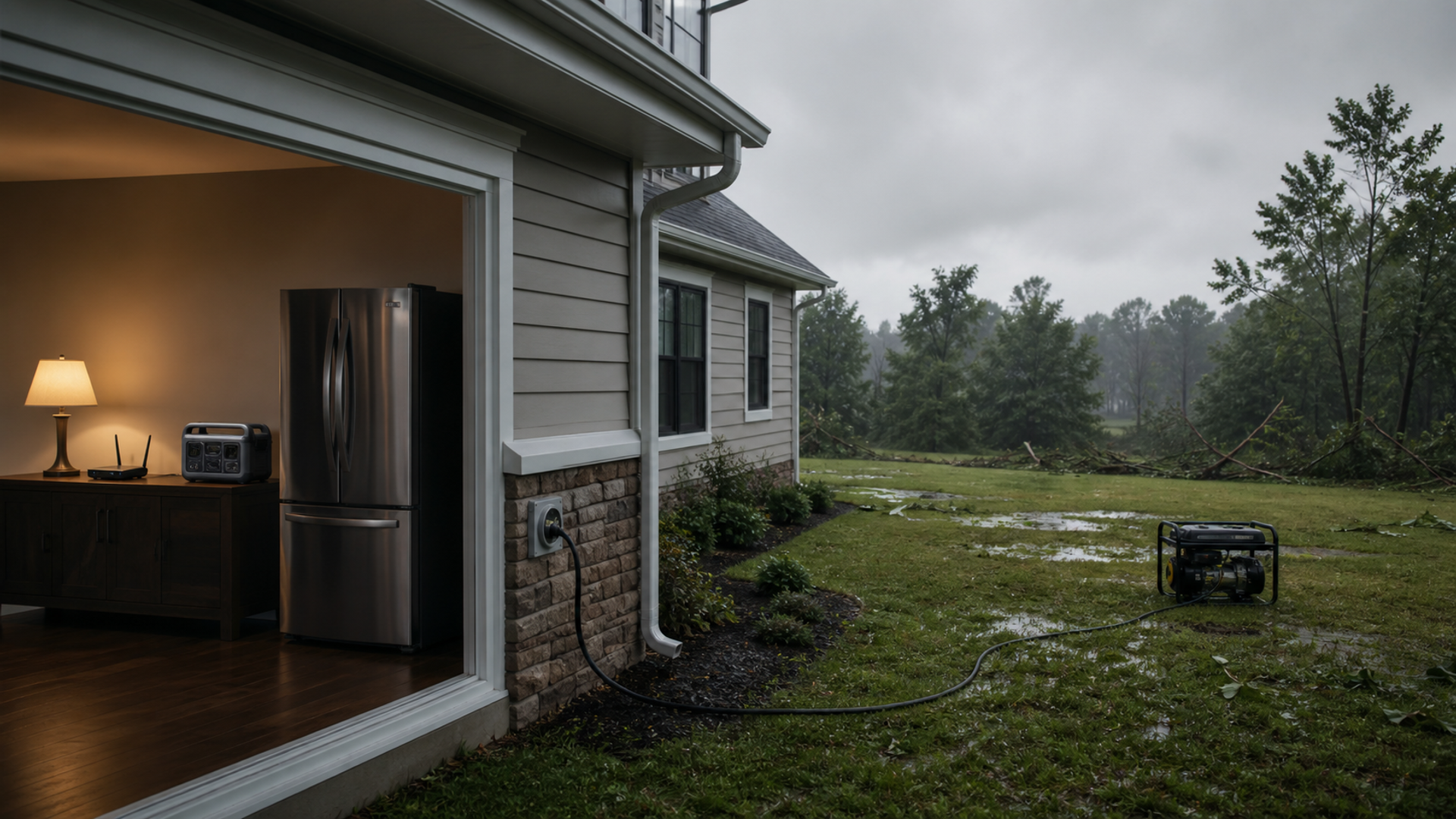
A portable power station stores finite electrical energy in a battery; a portable generator produces electricity while fuel and safe operating conditions continue. One is quiet at the point of use and can power modest indoor loads; the other may sustain larger loads but creates lethal carbon-monoxide and fuel risks. The decision begins with essential watts, surge, runtime, recharge and location.
Start with watts, hours and safety
Choose a battery power station when the essential load fits verified capacity and inverter limits, quiet indoor use matters and a dependable recharge route exists. Choose a portable generator when larger or longer loads require fuel-based generation and the unit can remain safely outdoors far from openings. Reduce loads first when neither system safely covers the wish list.
| Decision factor | Battery portable power station | Fuel portable generator | Reduce and prioritise essential loads |
|---|---|---|---|
| Essential load | Measured watt-hours fit usable battery energy | Running and surge watts fit generator output | Remove non-essential loads |
| Location | Battery unit follows indoor ventilation and maker rules | Generator remains outdoors far from doors and windows | Do not operate unsafe equipment |
| Runtime | Finite stored energy covers the required hours | Fuel plan and maintenance cover the outage | Cycle critical loads on a written schedule |
| Recharge | Grid, vehicle or solar route restores energy | Safe fuel supply is stored and rotated | Use community charging or relocation plan |
| Connection | Loads plug directly within outlet limits | Transfer equipment prevents backfeeding where required | Use only approved extension and transfer routes |
| Maintenance | Battery storage state and firmware are checked | Fuel, oil and exercise schedule are maintained | Run quarterly readiness drills |
This portable power station vs generator matrix is the article's working value object. Read the portable power station vs generator rows together: the decisive failure mode depends on this topic's evidence, operating context and reader objective.
What stored energy and generated power change
Evidence 1. The US Consumer Product Safety Commission warns that portable generators can produce deadly carbon monoxide and must never be operated inside a home, garage, basement, shed or near openings.
Evidence 2. CPSC also warns against connecting a generator directly to household wiring without appropriate transfer equipment because backfeeding can endanger utility workers and occupants.
Evidence 3. DOE backup-power guidance frames batteries and generators around critical loads, duration, charging or fuel, and safe connection rather than headline capacity alone.
Evidence 4. Battery watt-hours, inverter continuous watts and surge limits answer different questions; all must cover the measured appliance profile.
Reader-visible sources checked for this article:
cpsc.gov — reader-visible current or official evidence
ready.gov — reader-visible current or official evidence
For portable power station vs generator, these sources establish only the claims inside their documented scope. Recheck every changeable specification, availability condition, price, policy or service term in the relevant market before acting.
Build an outage load sheet
The essential load row exposes a practical boundary. Route one assumes measured watt-hours fit usable battery energy, while route two is defensible only when running and surge watts fit generator output. Route three depends on remove non-essential loads. If that evidence is absent, keep the more reversible option.
Read location as a stop/go test: battery unit follows indoor ventilation and maker rules supports the first option; generator remains outdoors far from doors and windows supports the second; and do not operate unsafe equipment supports the third. Record which source proves the condition and when it was checked.
A buyer can resolve runtime without starting from a brand preference. Ask whether finite stored energy covers the required hours; compare that with whether fuel plan and maintenance cover the outage; then use cycle critical loads on a written schedule as the third route's safeguard. An unknown condition stays unknown.
On recharge, popularity is not enough. The evidence for option one is that grid, vehicle or solar route restores energy. Option two means safe fuel supply is stored and rotated. Option three is rational where use community charging or relocation plan. Recheck any changeable term immediately before commitment.
The decision changes at connection. Choose the first path only if loads plug directly within outlet limits; move to the second when transfer equipment prevents backfeeding where required; use the third when use only approved extension and transfer routes. Save the downside that would make this row fail.
For maintenance, the first route works when battery storage state and firmware are checked; the second requires fuel, oil and exercise schedule are maintained. The control for the third is run quarterly readiness drills. Verify this row against the exact product, property, account or environment before it can reverse the decision.
Facts that would reverse the current choice
Reversal control 1 — Essential load. Before choosing Battery portable power station, write down how the decision changes if “Measured watt-hours fit usable battery energy” proves false. Do the same for Fuel portable generator and “Running and surge watts fit generator output”. Keep the Reduce and prioritise essential loads route available until “Remove non-essential loads” is verified. This control belongs to portable power station vs generator; update it from the cited source or exact supplier rather than copying a generic checklist.
Reversal control 2 — Location. Before choosing Battery portable power station, write down how the decision changes if “Battery unit follows indoor ventilation and maker rules” proves false. Do the same for Fuel portable generator and “Generator remains outdoors far from doors and windows”. Keep the Reduce and prioritise essential loads route available until “Do not operate unsafe equipment” is verified. This control belongs to portable power station vs generator; update it from the cited source or exact supplier rather than copying a generic checklist.
Reversal control 3 — Runtime. Before choosing Battery portable power station, write down how the decision changes if “Finite stored energy covers the required hours” proves false. Do the same for Fuel portable generator and “Fuel plan and maintenance cover the outage”. Keep the Reduce and prioritise essential loads route available until “Cycle critical loads on a written schedule” is verified. This control belongs to portable power station vs generator; update it from the cited source or exact supplier rather than copying a generic checklist.
Reversal control 4 — Recharge. Before choosing Battery portable power station, write down how the decision changes if “Grid, vehicle or solar route restores energy” proves false. Do the same for Fuel portable generator and “Safe fuel supply is stored and rotated”. Keep the Reduce and prioritise essential loads route available until “Use community charging or relocation plan” is verified. This control belongs to portable power station vs generator; update it from the cited source or exact supplier rather than copying a generic checklist.
Reversal control 5 — Connection. Before choosing Battery portable power station, write down how the decision changes if “Loads plug directly within outlet limits” proves false. Do the same for Fuel portable generator and “Transfer equipment prevents backfeeding where required”. Keep the Reduce and prioritise essential loads route available until “Use only approved extension and transfer routes” is verified. This control belongs to portable power station vs generator; update it from the cited source or exact supplier rather than copying a generic checklist.
Reversal control 6 — Maintenance. Before choosing Battery portable power station, write down how the decision changes if “Battery storage state and firmware are checked” proves false. Do the same for Fuel portable generator and “Fuel, oil and exercise schedule are maintained”. Keep the Reduce and prioritise essential loads route available until “Run quarterly readiness drills” is verified. This control belongs to portable power station vs generator; update it from the cited source or exact supplier rather than copying a generic checklist.
Measure the essential panel
List refrigerator, communications, medical devices, lighting, heating controls, pumps and any legally critical equipment. Measure running watts and starting surge where practical, then assign duty cycles. Exclude comfort loads until essential runtime is proven. A nameplate sum can overstate or understate real simultaneous demand.
Calculate usable energy
For a battery unit, derate advertised capacity for conversion losses, reserve and temperature, then divide by the timed load profile. For a generator, calculate safe continuous loading and fuel consumption at realistic load. Keep both models as ranges because outages rarely follow laboratory conditions.
Design safety before shopping
Choose outdoor generator placement far from openings and neighbour air paths, install working carbon-monoxide alarms, plan weather protection that preserves exhaust clearance and use qualified transfer equipment. For batteries, follow charging, temperature, ventilation and damage-inspection instructions. Never improvise a backfeed connection.
Run a quarterly drill
Start from a simulated outage, connect only approved loads, time setup and record remaining energy or fuel. Test alarms, cables, transfer operation, recharge and communications. Update the sheet when appliances, occupants or medical needs change. A system that has never been rehearsed is not a dependable backup plan.
Three backup plans
Apartment needing communications and refrigeration
A suitably sized battery station can avoid combustion risk when recharge and building rules are clear. Define the fact that would reverse this recommendation before committing.
Detached home with well pump and long outages
A professionally connected generator may be required when surge and duration exceed realistic battery capacity. Define the fact that would reverse this recommendation before committing.
Household trying to power every appliance
Load reduction and prioritisation should precede equipment because unsafe oversizing does not create resilience. Define the fact that would reverse this recommendation before committing.
Action checklist
List essential loads.
Measure running watts.
Record starting surge.
Calculate duty cycles.
Choose safe location.
Install CO alarms.
Verify transfer method.
Plan fuel or recharge.
Label cables and circuits.
Run quarterly drills.
Continue the decision
The linked VERTU articles expand adjacent parts of the portable power station vs generator decision. They do not substitute for the external evidence above.
The power-station-generator verdict
Choose a battery power station when the essential load fits verified capacity and inverter limits, quiet indoor use matters and a dependable recharge route exists. Choose a portable generator when larger or longer loads require fuel-based generation and the unit can remain safely outdoors far from openings. Reduce loads first when neither system safely covers the wish list.
Keep the portable power station vs generator decision reversible until its material cost, safety, access, privacy and compatibility facts are verified. Unknown evidence stays unknown; it is never silently scored as favourable.
![How to Scan Receipts and Documents with Your Phone [Full Guide]](https://cdn.sanity.io/images/e0gp1l2g/production/0db13feec1d5e72b8a8a5f976d1f3e86619c9228-3840x1860.webp?w=180&h=180&q=78&auto=format&fit=crop)
![How to Scan Receipts and Documents with Your Phone [Full Guide]](https://cdn.sanity.io/images/e0gp1l2g/production/0db13feec1d5e72b8a8a5f976d1f3e86619c9228-3840x1860.webp?w=800&h=450&q=82&auto=format&fit=crop)
![Top 10 Two-Tone Carbon-Fibre Watches for Men [2026 List]](https://cdn.sanity.io/images/e0gp1l2g/production/18870799ba33fab0e038968359cd5772d7d7db30-1024x576.webp?w=800&h=450&q=82&auto=format&fit=crop)
![Top 10 Luxury Watches with Digital Complication Displays for Men [Latest]](https://cdn.sanity.io/images/e0gp1l2g/production/c4f6bf8c080f291c39f7cc85c7344ecff2fd3799-1024x553.webp?w=800&h=450&q=82&auto=format&fit=crop)