Introduction
Flip phones are back, but the case shopping is less forgiving. A clamshell fold adds a hinge, a cover screen, and tighter tolerances. That means the wrong “fits your model” case can rub the hinge, block a cover display, or quietly ruin wireless charging.
In this guide, you’ll learn how flip phone covers behave in 2026, how to check compatibility before you buy, and how to balance protection with carry comfort.
This is for you if you own (or are about to buy) a modern flip like Samsung’s Galaxy Z Flip line or Motorola’s Razr line and want a case that feels right day one, and still feels right after months of pocket lint, desk slides, and daily folds.
Key TakeawayIn 2026, the three buying signals that matter most are hinge clearance, wireless charging alignment (especially as Qi2 spreads), and verifiable drop protection.
Case types
Slim snap-on
A slim snap on case is the “bare minimum” category: two light shells (top and bottom) that clip on and mostly stay out of your way.
What it’s good for:
Keeping the phone’s silhouette clean
Scratch resistance and grip
Avoiding hinge interference, since many slim cases leave the hinge exposed
What to watch:
Adhesive strips. Many slim designs rely on tape to stop the halves from shifting.
Cover screen lip height. Too low means scratches; too high can make edge swipes annoying.
Camera bump wobble on a desk. A slim case can still rock if the camera ring is uneven.
If you care about pocket feel and you don’t drop your phone often, this is usually the most comfortable daily choice.
Hybrid rugged
Hybrid rugged cases mix materials, typically a hard outer shell with a softer inner layer. Some add a hinge guard, corner bumpers, or a built-in stand.
What it’s good for:
Real drop protection (especially corner impacts)
Better grip for one-handed use
Raised lips around both the main screen and cover screen
What to watch:
Bulk at the hinge. Extra thickness where your fingers naturally rest can make the phone feel clumsy.
Wireless charging reliability. Thick backs and metal parts can slow charging or stop it.
Accessory interference. Some hinge covers can get in the way of magnetic mounts or wallets.
If you travel, commute, or tend to handle your phone while moving, rugged hybrids are often worth the extra size.
Leather folio & wallet
Folio and wallet covers add a leather (or leather-like) exterior, often with a front flap and sometimes card storage.
What it’s good for:
A refined look and softer hand feel
Scratch protection for the exterior when the phone is tossed into a bag
Extra privacy (a closed flap is an instant “screen off” signal)
What to watch:
Wireless charging friction. Thickness and cards in the wallet area can interfere.
Hinge stress. A stiff folio can pull against the hinge when you flip open quickly.
Edge lift over time. If the leather stretches, the fit can loosen.
If you like leather, treat it like any “daily carry” leather item. The best ones wear in beautifully. The cheap ones crack, warp, and start to feel messy.
Compatibility essentials

Hinge clearance
Flip phone case hinge protection and clearance is the first deal-breaker for flip phone covers.
A quick hinge check you can do the moment the case arrives:
Open and close the phone slowly. It should feel smooth, not spring-loaded.
Listen for plastic rubbing or clicking that wasn’t there before.
Look at the hinge area from the side. Nothing should bow or pinch as the phone closes.
Hinge guards can be excellent, but only when they’re engineered to move cleanly with the phone. A hinge cover that binds will make you hate the phone, even if it technically “fits.”
Wireless & Qi2 charging
Wireless charging is picky about alignment and distance. In 2026, Qi2 matters because it adds magnetic alignment to the wireless charging experience, which makes charging more consistent and reduces the “did it actually start charging?” guesswork.
Belkin’s explainer on Qi2 compatibility and what it adds is a good baseline: Qi2 is still Qi, but with magnets and clearer certification around magnetic alignment and power tiers.
What to check on a case listing:
“Qi2” or “MagSafe compatible” is not enough on its own. Look for wording that suggests the magnets are aligned for charging, not just for sticking.
Avoid cases with metal kickstands, metal plates for car mounts, or metal card holders if you rely on wireless charging.
A practical reality check: MagBak’s guide on testing whether your case is killing wireless charging speed points out common failure modes like thick backs (often noticeable above roughly 3 mm, and sometimes a deal-breaker above roughly 5 mm), metal inserts, and poorly placed magnets.
If your flip phone supports wireless charging but does not have built-in magnets, a magnetic case can still help with alignment. That’s where Qi2 magnetic case compatibility becomes practical: you’re looking for consistent coil placement, a stable snap, and fewer charging restarts. Just make sure the magnet module does not create a bump that makes the phone rock on a flat charger.
Drop ratings & screens
Flip phones have two screens to think about: the main folding display and the cover screen. The case has to protect both without creating awkward edges.
When you see “military-grade” drop protection, read it as a prompt to verify, not as proof.
Look for:
A named test standard (often some form of MIL-STD testing)
A stated drop height
Clear photos showing corner reinforcement and raised screen lips
Also check the cover screen area. Some cases protect the cover screen well, but make swiping from the edge frustrating. Others look sleek, but leave the cover screen glass too exposed.
Tom’s Guide notes that Z Flip models are not always case-interchangeable and emphasizes verifying fit for the exact model you own in its Galaxy Z Flip 7 case roundup. Treat that as a general rule for every flip family.
Buying guide
Fit and ergonomics
A flip phone case can “fit” and still feel wrong.
Fit is about precision. Ergonomics is about what your fingers do 200 times a day.
Check these three touchpoints:
- Hinge touchWhen closed, does the hinge area feel sharp, bulky, or uneven in the hand?
- Pocket slideDoes it catch on fabric when you pull it out?
- One-hand confidenceDoes the texture actually help grip, or is it slick once your hands are dry?
If you use your cover screen a lot, make sure the case lip is protective but not intrusive. The best cases fade into the background.
Protection vs. bulk
The clean way to decide is to match the case to your risk profile.
Choose slim if:
Your phone mostly goes pocket to desk to charger
You rarely drop phones
You value comfort and a clean silhouette
Choose rugged if:
You travel often
You use your phone while walking, commuting, or juggling bags
You want true corner protection
A useful compromise is a hybrid case that focuses protection on corners and screen lips while keeping the back thin enough for reliable wireless charging.
Where to buy & verify
Buy channels matter more for flip cases than for slab phones because fit tolerances are tighter.
What to do before you click “buy”:
Confirm the exact model name and year (for example, “Z Flip 6” is not “Z Flip 7,” and Razr generations can look similar but fit differently).
Read the return policy, then screenshot it.
Look for real customer photos, especially hinge and cover screen angles.
What to do when the case arrives:
Keep the packaging until you’ve tested hinge movement, wireless charging, and button feel.
Photograph any hinge rubbing or misalignment immediately.
A brief contextual lens from the luxury end of the market: brands like VERTU tend to treat accessories as hinge-aware, tolerance-driven parts of ownership, not as generic shells. You can apply the same mindset no matter what you buy: prioritize fit precision, clean finishing, and engineering that respects the hinge.
If you want a deeper look at craftsmanship cues (stitching, materials, and what “quality” actually looks like up close), VERTU’s guide on artisan-crafted phone accessories (2025) is a useful reference.
Model notes
Galaxy Z Flip 6/7 covers
The Z Flip family has a simple rule: treat each generation as its own fit.
Before you buy, verify:
Button cutouts (volume and power) line up without forcing
Cover screen clearance (especially if the case adds a frame around the outer display)
Hinge cover behavior when the phone is half-open
If you’re shopping specifically for a Galaxy Z Flip 6 case or a Z Flip 7 case, don’t assume a “close enough” fit across years. Confirm the exact SKU and return policy before you commit.
If you rely on wireless charging, be cautious with thick cases and cases that add metal components.
Razr 2024/2025 covers
Razr case listings are full of “fits multiple years” claims. Sometimes that’s true. Often it is not.
Before you buy, verify:
Camera bump clearance (Razr modules can differ subtly)
Hinge and spine thickness, especially on rugged hinge-protection designs
Whether the case shifts over time. Two-piece cases that drift will eventually annoy you.
If you’re shopping for a Motorola Razr 2024 case or a Razr 2025 case, confirm the exact generation naming on the listing and match it against your phone’s model number in Settings.
If you see “MagSafe compatible” on a Razr case, look closely at user photos. A poorly positioned magnetic ring can align well enough to stick, but still charge poorly.
Accessory pairing tips
Flip phones tend to reward a clean accessory stack.
A few pairing rules that avoid common pain:
If you use a magnetic wallet, pick one that detaches easily before charging.
If you use a car mount, test hinge clearance while mounting and unmounting. Some hinge covers catch.
If you use a wireless charger pad, confirm the phone sits flat and stays centered. A raised ring module can make it wobble.
2026 trends
Anti-yellowing clears
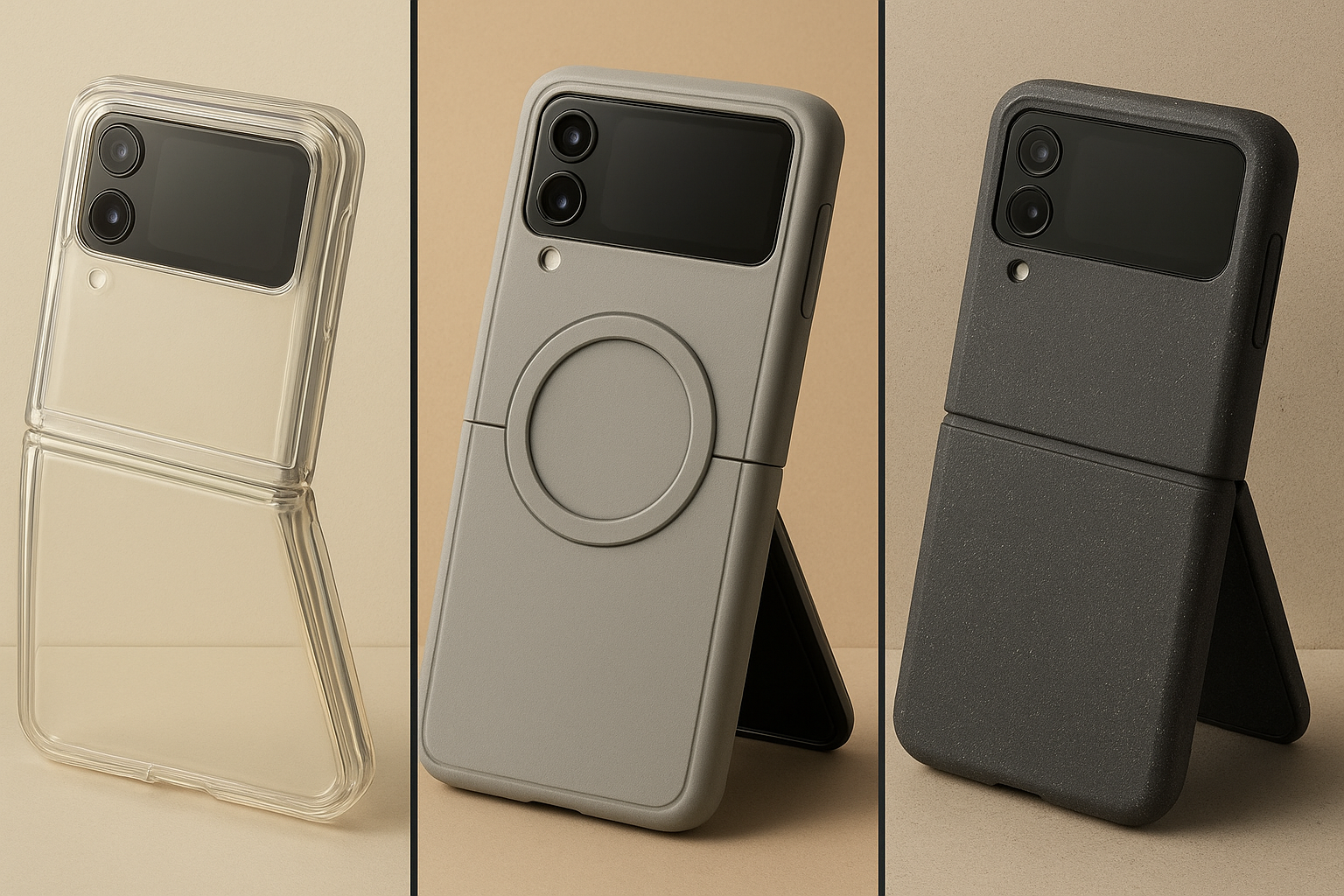
Clear cases are still popular because they show the hardware. The 2026 shift is that buyers are less tolerant of yellowing.
Two practical indicators when shopping:
Listings that specify anti-yellowing materials or treatments, rather than vague “clear TPU.”
Reviews that show the case after real use, not just day-one photos.
If you want the clear look long-term, consider cases that use more stable plastics (often polycarbonate blends) or explicit anti-yellowing formulas.
Slim magnetic modules
Magnetic ecosystems are maturing. A “good” magnetic case in 2026 is one where the magnets improve alignment without turning the phone into a brick.
Check for:
A module that sits flush enough to keep the phone stable on a charger
No metal parts near the coil area
Verified user reports that wireless charging still works reliably
If you’ve had inconsistent wireless charging in the past, moving to a Qi2-certified charger and a well-aligned magnetic case is one of the simplest upgrades.
Textured grips & sustainability
Texture is quietly becoming a buying feature, not a design flourish. Matte and lightly grippy finishes reduce drops because the phone feels secure in the hand.
On the sustainability side, more brands are using recycled plastics or bio-based blends. The practical way to treat these claims is the same as drop ratings: look for specificity. “Eco-friendly” is marketing. Material details and certifications are evidence.
Conclusion
The fastest path to the right flip cover in 2026 is simple: pick a case type that matches your daily risk, then verify compatibility with hinge movement and charging before you commit.
Final checks before you keep a case:
Hinge feels smooth and unforced
Wireless charging works reliably (especially if you’re moving toward Qi2 chargers and magnetic alignment)
Drop protection is supported by clear design features and verifiable claims
Retailer terms make returns painless if fit is wrong
If you get those right, you’ll end up with a flip phone that’s comfortable to carry, protected in the moments that matter, and compatible with the way you actually use it.
Disclosure: This article references VERTU pages. Editorial judgment remains the priority.