Introduction
A luxury watch is easy to admire and surprisingly easy to buy the wrong way.
This 2026 guide is built for one outcome: helping you choose a gift of time luxury watch store path that fits your life, your risk tolerance, and your after-sales expectations—whether you buy online or walk into a boutique.
Here’s how to use it:
Start with fit (because the “right” watch that wears wrong becomes a regret).
Then evaluate movement + service reality (accuracy is not just a spec; it’s a maintenance relationship).
Only then decide where to buy (AD, gray market, or certified pre-owned).
Finish with verification and gifting logistics so your purchase is both meaningful and safe.
The balance you’re aiming for is simple: selection, authenticity, warranty coverage, and after-sales support—without paying for uncertainty.
Fit first: lifestyle & sizing
Match the wearer’s routine
Before you talk about brands, talk about days.
A watch for a boardroom schedule wants different traits than a watch that lives in airports or on weekends.
Ask three questions:
Is this watch for daily wear, or for occasions?
Does the wearer dress mostly formal, smart casual, or active?
Will it face water, sweat, shocks, or frequent travel?
A practical rule: the more unpredictable the routine, the more you should prioritize comfort, durability, and service access over “rare” details you’ll be afraid to use.
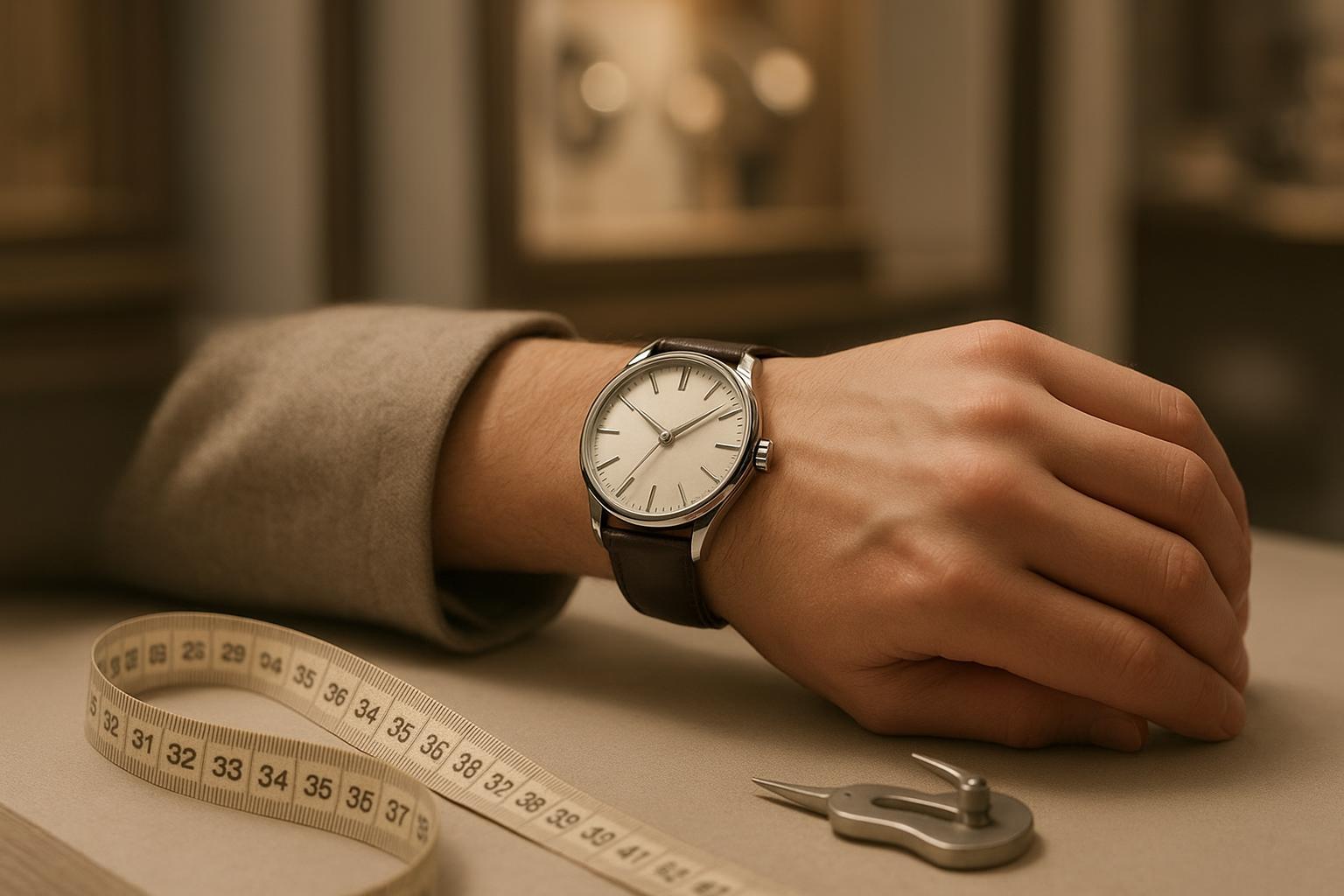
Comfort: case, L2L, thickness
Fit isn’t only case diameter.
The dimensions that quietly decide comfort are:
Case diameter (how wide it looks)
Lug-to-lug (L2L) (how much wrist real estate it occupies)
Thickness (whether it slips under a cuff and whether it topples on smaller wrists)
If you can, try the watch on and check two moments:
Wrist relaxed at your side (does it slide and rotate?)
Wrist on a desk (does the crown bite, does the clasp pinch?)
Materials and crystal choices
Materials change how a watch lives with you.
- Steeloften the lowest-fuss option for daily wear.
- Gold and platinumunmistakable presence; also more susceptible to visible marks.
- Titaniumlighter on-wrist, often more comfortable for long days.
For the crystal, the decision is usually between scratch resistance and the “I can live with it” factor. Many luxury watches use sapphire; if you’re comparing two pieces, ask what the crystal is and how the brand handles replacement during service.
Movements, accuracy, and service
In-house, third-party, quartz
Movement choice is less about bragging rights and more about ownership style.
- In-house mechanicalcan signal brand identity and long-term commitment. Service is typically brand-network driven.
- Third-party mechanicalcan offer excellent reliability and easier service access, depending on parts availability.
- Quartzlower maintenance burden in many cases; high practical accuracy; often an underrated gift when the wearer values “grab and go.”
A simple framing: if the watch is meant to be worn as a tool, quartz can be a very rational luxury decision. If it’s meant to be worn as a small machine, mechanical becomes part of the enjoyment.
Accuracy standards (COSC, METAS)
Accuracy claims vary. Independent standards help you compare without marketing fog.
- COSCA Swiss chronometer certification widely used as a baseline signal for precision; see the official overview of the COSC certified chronometer.
- METASA more expansive “Master Chronometer” certification framework associated with the Swiss Federal Institute of Metrology; see METAS Master Chronometer certification. For a brand-side explainer that’s readable, TUDOR’s METAS certification explainer is a good reference.
Treat these as signals, not guarantees. A non-certified watch can still be excellent; certification just reduces uncertainty.
Service intervals and U.S. costs
In 2026, the smartest service mindset is: condition-led, documentation-backed.
Intervals vary by brand, usage, and the complexity of the watch. What changes cost in the U.S. is usually not one magic number—it’s the combination of:
complication complexity (chronograph, calendar, etc.)
parts availability and brand policies
water damage risk (often a documentation problem as much as a mechanical one)
whether you service through an official network or a local specialist
A useful baseline explanation of why servicing matters—and why costs can jump with complexity and condition—is in Bob’s Watches’ guide on why luxury watches require service.
Collector’s note: The best time to learn the service reality is before you buy, while you still have leverage. Ask the store how warranty claims work, what paperwork you’ll need, and what turnaround typically looks like in the U.S.
New, pre-owned, and CPO in 2026
AD and boutique realities
Buying new from an authorized dealer (AD) or boutique is still the cleanest chain of custody.
You’re paying for:
a straightforward warranty situation
clear documentation
a relationship for sizing, adjustments, and service handoff
You’re also accepting realities that didn’t used to be called “realities”: allocation, waitlists, and limited selection on high-demand references.
Gray market and platforms
Gray market is where many buyers go when they want availability—or a specific reference—without waiting.
The tradeoff is not inherently authenticity (authentic watches can circulate there), but certainty:
warranty can be different from manufacturer coverage
returns can be narrower
provenance quality depends on the seller’s discipline
If you use this path, your evaluation must become more process-driven: who is the seller, what documentation is included, what happens if something is off, and how quickly you can unwind the purchase.
Rolex CPO: how it works now
Rolex’s official Certified Pre-Owned program is designed to reduce pre-owned uncertainty.
Rolex describes the Rolex Certified Pre-Owned programme as offering previously worn watches that are certified authentic, fully serviced, and guaranteed by the brand, sold only through Official Rolex Jewelers participating in the program, with a two-year international guarantee starting from the date of purchase.
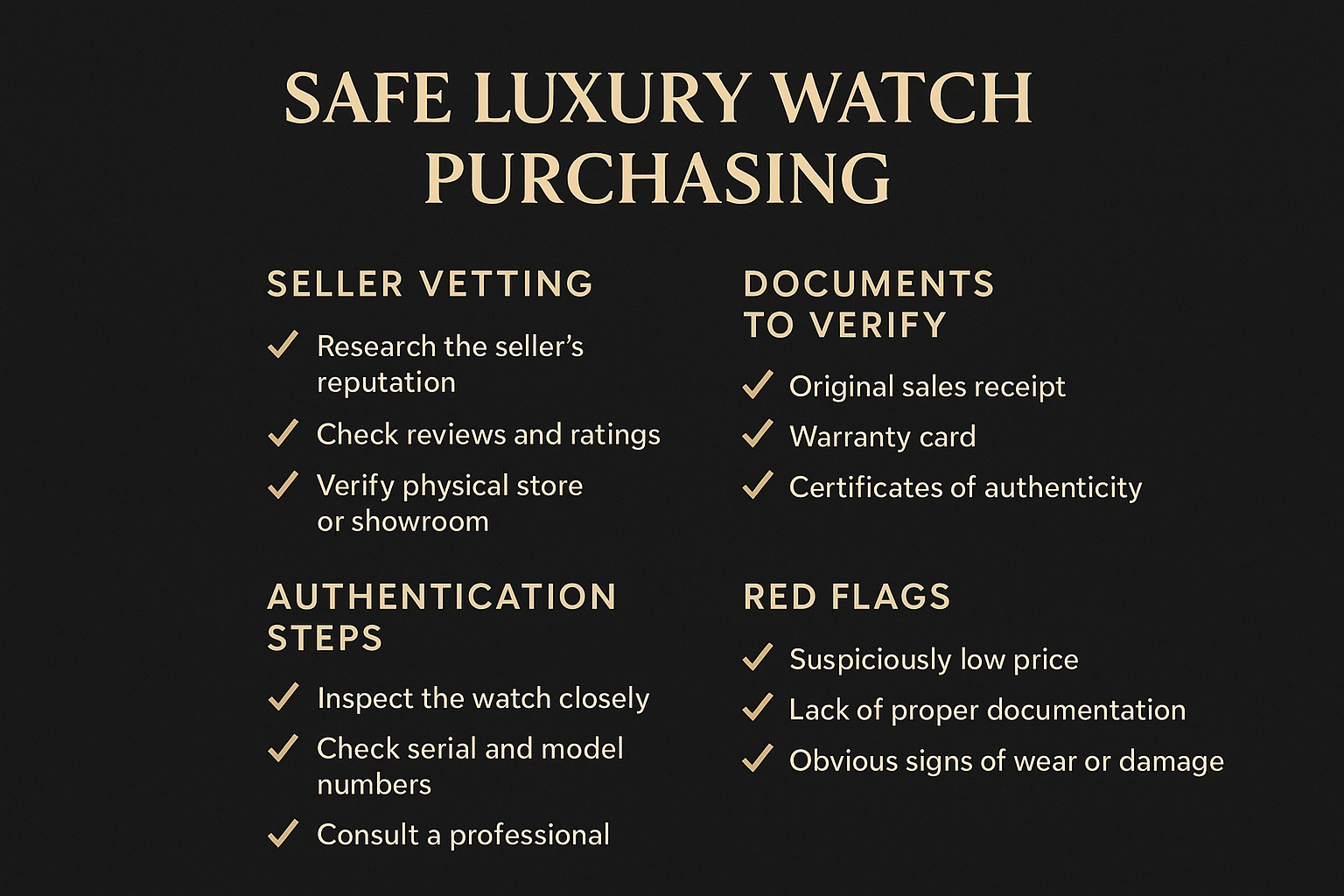
Verify the seller you choose
Reputation signals that matter
When the price is high, you’re not just buying an object—you’re buying the seller’s process.
Strong signals:
a long operating history under the same name
transparent ownership and physical address
clear written policies (returns, warranty handling, authentication)
responsive, specific answers (not “don’t worry, it’s real”)
Weak signals:
evasive language around documentation
pressure to move off-platform
“too good to be true” urgency
Documentation and authentication
Your baseline is a simple “chain of proof.”
Ask for:
an itemized invoice
serial/reference information where appropriate
service records (if pre-owned)
what is included: box, papers, cards, booklets, extra links
Then make sure the store will put in writing:
the return window and any restocking policies
what happens if authenticity is disputed
how warranty service is handled (brand network vs store warranty)
A helpful mindset is to treat verification like a checklist, not a vibe. Even outside watches, luxury brands emphasize workflow-based verification—see VERTU’s authenticity checklist for how a “verify first, pay second” process is structured.
Red flags to avoid
There are a few deal-breakers that should end the conversation immediately:
refusal to provide clear photos, identifiers, or documentation before payment
insistence on irreversible payment methods or off-platform payment
inconsistent story about ownership, service history, or included accessories
no meaningful return policy
heavy pressure to “decide right now”
Gifting, warranty, and after-sales
Discreet sizing and presentation
If this is a gift, you’re managing two risks at once: the emotional moment and the practical fit.
Discreet options that preserve the surprise:
buy from a store with a strong exchange policy and confirm it in writing
choose a bracelet/strap option that’s easy to resize locally
consider including a private note: “We’ll size it together,” which turns resizing into part of the experience
Warranty and returns explained
A luxury watch warranty is only as useful as the path to use it.
Before you commit, make sure you can answer:
What exactly does the warranty cover?
Who performs warranty work (brand network, in-house, third party)?
What paperwork is required for a claim?
What is the return window, and what voids it (stickers removed, bracelet resized, etc.)?
This is where “concierge-style” support matters—quietly.
Good luxury ownership feels like: clear guidance, secure purchasing, and a human who can help you resolve edge cases without drama.
As a reference point for that kind of service expectation, VERTU frames ownership as including a service layer—see VERTU Concierge for how 24/7 support is positioned, and its practical guidance on buying through official channels as a model for reducing risk through verified pathways.
Insurance and local service access
If the watch is valuable enough to worry about, it’s valuable enough to insure.
Two practical moves:
Confirm you have an insurer who understands high-value items and travel risk.
Identify your nearest credible service access before the watch needs help (brand service center, authorized service partner, or an independent specialist if appropriate).
Buyer’s worksheet: next steps
Selection summary you can use
Write this down before you shop:
Wearer’s routine: daily / travel / occasion
Wrist preferences: smaller / balanced / bold presence
Must-haves: comfort, service access, warranty clarity, authenticity confidence
Nice-to-haves: material preference, complication preference, rarity
Store-vetting summary at a glance
Use this quick filter:
Can they explain documentation, warranty, and returns without hesitation?
Do they provide a written invoice and clear policy terms?
Do they support verification before final payment?
Do they handle after-sales like a process, not an attitude?
Purchase readiness checks
Right before you pay:
You have the full itemization in writing.
You understand the return window and what voids it.
You’ve confirmed service access in your region.
You’ve sanity-checked the deal against the risk profile of the channel.
Key Takeaway: A great purchase is not only “the right watch.” It’s the right watch plus a clean chain of proof and a clear after-sales path.
Conclusion
Answer 2026 luxury watch purchase rewards discipline.
Start with fit. Understand movement and service reality. Choose the channel that matches your tolerance for ambiguity. Then verify the seller like you’re protecting a future heirloom—because you are.
If you want the shortest possible recap: build a simple framework, ask for documents early, and buy through a path that keeps your ownership clean.
And if you’re optimizing for relevance as you publish and update: gift of time luxury watch store.
Disclosure: This article references VERTU pages. Editorial judgment remains the priority.
![Top 10 Smartwatches for On-Wrist Voice Notes for Men [New]](https://cdn.sanity.io/images/e0gp1l2g/production/e7630bbd3f3a13378c868abfa960bb193c73b8f1-3840x1860.webp?w=180&h=180&q=78&auto=format&fit=crop)
![Top 10 Smartwatches for On-Wrist Voice Notes for Men [New]](https://cdn.sanity.io/images/e0gp1l2g/production/e7630bbd3f3a13378c868abfa960bb193c73b8f1-3840x1860.webp?w=800&h=450&q=82&auto=format&fit=crop)