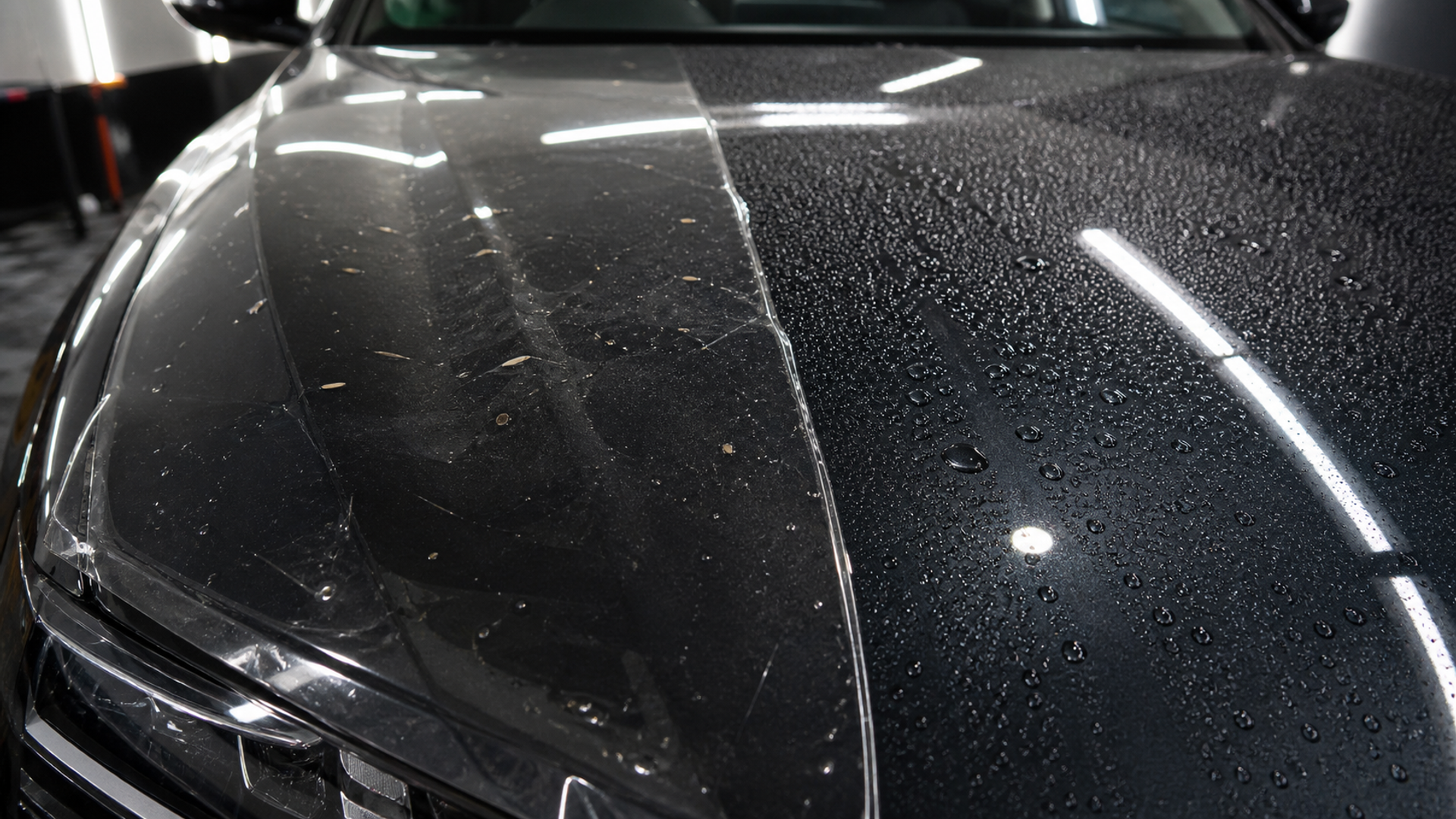
Paint protection film and ceramic coating solve different problems. Paint protection film, usually shortened to PPF, is the stronger answer for stone chips, light road-debris impacts and abrasion on vulnerable panels. A ceramic coating is primarily a surface-management layer: it can make paint easier to wash, improve water behaviour and provide resistance to some chemical and environmental contamination. It does not turn the clear coat into armour.
For a luxury car, the practical choice is therefore rarely a simple contest between two products. It is a risk-allocation decision. Owners should first identify where the car is exposed to physical impact, then decide how much easier maintenance and finish enhancement matter. On a frequently driven grand tourer, a well-installed full-front PPF package with an appropriate coating over the protected and unprotected surfaces can be coherent. On a lightly used, carefully stored car, a coating alone may meet the actual risk. The installer, preparation and coverage design often matter more than the brand name on the bottle or film box.
Two protection jobs that should not be confused
Automotive paint is a layered finish, and the visible clear coat can be damaged in more than one way. A sharp chip from road debris is a concentrated physical event. Mineral deposits, bird contamination, road film and repeated washing are slower surface-management problems. One treatment cannot be assumed to perform both jobs equally well.
3M's Series 150 product information describes a flexible, professionally installed film intended to protect vulnerable automotive paint from hazards including stone chips, scratches, bugs, road tar and weathering. The company also describes self-healing behaviour for minor scratches in the film and a low-maintenance finish. Those are properties of the film system; they do not mean every impact will disappear or that the underlying panel can never be damaged.
Gtechniq's ceramic-coating guide draws the central distinction plainly: PPF is a physical layer for rock chips and road debris, while a ceramic coating focuses on chemical and environmental exposure, water behaviour and easier cleaning. It also states that a ceramic coating is not scratch-proof and will not stop a stone from chipping paint. That is the most useful starting point for a buying decision.
Protection decision matrix
The table separates the jobs rather than treating “protection” as one score. Outcomes remain dependent on the product, paint condition, preparation, installation and maintenance.
| Ownership concern | PPF contribution | Ceramic-coating contribution | Better primary response | Important limitation |
|---|---|---|---|---|
| Motorway stone chips | Sacrificial physical film over paint | Little meaningful impact absorption | PPF on exposed panels | A severe or sharp impact can still mark film or paint |
| Front-bumper road debris | Helps isolate paint from light abrasion and impacts | Can make residue easier to remove | PPF | Edges, apertures and complex shapes depend on installation quality |
| Bird droppings and tree sap | Adds a removable barrier but still needs prompt cleaning | Improves chemical resistance and cleanability | Ceramic coating, or coating over PPF | Neither makes neglect harmless |
| Wash-induced light marring | Film takes wear on covered panels; some films self-heal minor marks | May resist light swirls but is not scratch-proof | Technique first, then either system | Poor washing can damage both surfaces |
| Water behaviour and drying | Varies by film and topcoat | Hydrophobic behaviour can reduce adhesion of dirt and speed washing | Ceramic coating | Water beading does not prove impact protection |
| Gloss and finish consistency | High-quality clear film can preserve the underlying finish | Can enhance gloss and surface slickness | Depends on desired finish | Bad correction or installation remains visible beneath the layer |
| Door cups, sills and loading edges | Targeted film protects high-contact zones | Limited help against repeated physical contact | Targeted PPF | Partial coverage creates seams that must be placed carefully |
| Long-term removability | Film is designed as a replaceable sacrificial layer | Coating normally requires abrasion or polishing to remove fully | PPF for sacrificial protection | Removal should be assessed and performed professionally |
The matrix points to a simple rule: choose PPF according to impact geography and choose ceramic coating according to maintenance behaviour. A bonnet, front bumper and mirror caps face a different risk profile from the roof or rear quarter panels. Paying for equal treatment everywhere may not be the most rational allocation.
Where impact protection earns its cost
PPF makes the clearest case on surfaces that sit directly in the path of debris or repeated contact. The 3M overview of post-factory surface-protection films describes graduated coverage choices, from small wear areas and a partial front to a full front or full vehicle. That hierarchy is useful because it frames coverage as a response to exposure, not status.
For many fast road cars, a full-front package is the rational centre: complete bonnet, front wings, bumper and mirror caps. It avoids the visible line that can appear when film stops part-way across a bonnet, while concentrating spend where impacts are most frequent. Track use, broad rear arches, low side skirts or carbon-fibre aero parts may justify additional coverage. Luggage loading edges, door cups and sills can be protected individually on cars used in cities or for family travel.
Full-body PPF is a different proposition. It may make sense for a difficult-to-match paint finish, a car driven over abrasive roads, or an owner who values a replaceable outer layer across every painted panel. It is not automatically superior. More coverage creates more edges, more installation work and more surface area that may eventually require replacement. A rarely driven collector car stored correctly may derive less value from full-body film than from careful paint correction, appropriate storage and disciplined washing.
PPF should also be understood as sacrificial, not invulnerable. Its purpose is to take damage that might otherwise reach paint. A marked section can sometimes be replaced without refinishing the panel, but an impact can still penetrate, stretch or tear film. Owners should ask what happens when one panel needs replacement, whether patterns wrap edges, and how the installer handles badges, sensors and trim.
Why easier maintenance is a separate objective
A ceramic coating changes the interaction between the surface and contamination. Gtechniq describes hydrophobic behaviour that helps water roll from the surface and makes dirt less willing to bond. This can reduce washing effort and improve the consistency of a properly maintained finish. It is particularly useful on complicated bodywork, wheels and cars exposed to road salts, insects or frequent rain.
However, “easier to clean” should not be translated into “maintenance-free”. Water can still leave mineral deposits. Bird contamination should still be removed promptly. A coated vehicle can still acquire swirls from dirty wash media or automatic brushes. The coating itself becomes a maintained layer whose behaviour will vary with preparation, chemistry, climate, mileage and aftercare.
The scratch language deserves similar discipline. A ceramic layer may provide resistance to very light abrasion, but that is not equivalent to absorbing a stone impact. Marketing demonstrations that emphasise hardness can obscure this difference. The relevant ownership question is not which surface sounds harder; it is whether the threat is physical energy, chemical exposure, or routine cleaning friction.
Applied over suitable PPF, a compatible coating can add slickness, water behaviour and easier maintenance to the film. That combination is credible only when the film manufacturer, coating maker and installer support it. The owner should confirm cure times, maintenance products and warranty interaction rather than assuming any coating can be layered over any film.
Installation quality is the hidden variable
The quality of a protection package cannot be judged from product specifications alone. XPEL's owner FAQs are a useful reminder that questions about care, installation, product-specific warranties and compatibility belong in the purchasing process. The installer is responsible for turning a material into a finished system on a particular vehicle.
Film work is edge work
Good PPF installation starts with decontamination and close inspection. Pattern choice, stretch, tension and edge placement affect clarity and durability. Wrapped edges can reduce visible terminations where panel geometry allows, but unnecessary disassembly also introduces risk. Pre-cut patterns may limit blade contact with paint, yet the skill used to align and finish them still matters. Dust, trapped moisture, lift lines, silvering and poor edge adhesion can turn a premium material into an unsatisfactory result.
Ask to inspect cars completed by the same technician, ideally in similar paint colours and with comparable panel complexity. View them indoors and in strong oblique light. Confirm who is responsible if film lifts, contaminates or discolours, and whether a local repair can be performed without compromising adjacent panels.
Coating work is preparation work
A coating preserves the surface beneath it; it does not correct that surface. Washing, chemical and mechanical decontamination, paint measurement and correction determine what becomes sealed in. Dark paint can reveal rushed polishing, residue or high spots. Freshly delivered cars are not automatically defect-free, so preparation should be based on inspection rather than age.
The quotation should distinguish correction from coating application. It should also state which surfaces are included, the required cure environment, the first-wash interval and the maintenance process. A headline durability claim is less useful than a written plan for the climate and mileage the car will actually encounter.
Three coherent coverage architectures
The first architecture is targeted PPF without a full ceramic package. It suits an owner whose principal concern is impact damage on the front and contact points, and who is comfortable with conventional washing and protection elsewhere. Film choice should still consider gloss, texture and how uncovered paint will age beside it.
The second is ceramic coating over corrected paint with no PPF. It fits a car that sees controlled mileage, low debris exposure and careful storage, where easier maintenance and finish presentation matter more than chip resistance. This is a maintenance decision, not a substitute for film.
The third combines full-front or selected PPF with compatible coatings across the vehicle. It is often the balanced choice for a regularly driven luxury saloon or grand tourer: physical protection on high-impact panels, with more consistent water behaviour and cleaning across film and paint. Owners comparing such cars may also find the different use cases in this guide to the best luxury saloons helpful, while the Rolls-Royce Ghost and Bentley Flying Spur comparison illustrates why duty cycle should shape an ownership decision.
Questions that expose a weak quotation
Before authorising work, ask the installer to mark the exact coverage on a vehicle diagram. Request the specific film and coating names, not just brand families. Confirm whether paint correction, trim removal, badge removal, edge wrapping, curing and post-install inspection are included. Ask how sensors, cameras, satin paint and carbon-fibre parts will be handled.
Then ask about failure. Who inspects a lifting edge? What is covered by the installer and what is covered by the manufacturer? Can one damaged section be replaced? Which wash chemicals are approved? Does applying a coating over film alter either warranty? What records will you receive for future claims or resale?
The best quotation is not necessarily the most expensive or the one with the longest headline warranty. It is the one that defines the risk, surface preparation, coverage, materials, workmanship, aftercare and remedy clearly enough that two installers can be compared on the same basis.
The protection verdict
PPF is the primary tool for light impact and abrasion protection; ceramic coating is the primary tool for chemical resistance, water behaviour, gloss and easier cleaning. Neither replaces careful washing, prompt contamination removal or appropriate storage. Neither can promise an undamaged car.
For a luxury car used regularly, start with the physical risk map. Protect the front and other exposed zones with professionally installed film where the expected damage justifies it. Add a compatible coating when lower-friction maintenance and a consistent finish are valuable. For a low-mileage car with controlled exposure, coating alone may be enough. In every case, select the installer with the same care as the material, because preparation and workmanship determine whether the theoretical protection becomes a convincing result.