The costly mistake in this category is not simply choosing the less famous option. It is paying for a story that does not survive contact with the exact product, the owner's habits and the local service or buying conditions. This guide compares Rolls-Royce Ghost, Bentley Flying Spur and the disciplined alternative—Test exact local specifications—using current official material, a live VERTU content-inventory check and a decision framework designed for real ownership.
The aim is not to manufacture one universal winner. It is to identify which facts should change the choice, which claims need reference-level confirmation and when waiting is more intelligent than buying. Prices, availability, specifications, policies and service conditions can change by market and date, so verify the exact item and terms before committing.
The short answer
Choose the Ghost when rear-cabin calm, ceremonial arrival and the Rolls-Royce commissioning experience are the main purchase. Choose the Flying Spur when the owner will drive regularly and wants a stronger blend of performance, luxury and rear-seat usefulness. The correct answer depends on wheelbase, seat specification and local powertrain, so compare configured cars rather than brand stereotypes.
That answer is deliberately conditional. A high-value decision should remain sensible after the novelty wears off, after the first repair or service question, and after the product has to perform in an ordinary week. If the recommendation collapses when one marketing assumption is removed, the evidence is not yet strong enough.
Comparison at a glance
| Decision factor | Rolls-Royce Ghost | Bentley Flying Spur | Test exact local specifications |
|---|---|---|---|
| Primary character | Rear-cabin serenity and occasion | Driver engagement with luxury | Test the exact configured cars |
| Rear seat | Strong chauffeur-first identity | Highly capable but specification-sensitive | Measure entry, recline and device use |
| Driving | Effortless, isolated response | More overt chassis and powertrain character | Drive urban and motorway routes |
| Powertrain | Verify current market specification | V8 or hybrid availability varies | Compare real delivery dates |
| Customisation | Bespoke commissioning is central | Mulliner and option depth | Price the complete build |
| Ownership | Network, insurance and downtime matter | Network, tyres and options matter | Model local five-year cost |
Read the table as a sequence of verification prompts, not a scorecard. Some factors are non-negotiable and others are preferences. Weight each row according to actual use, then compare the exact references and local terms on the same day.
What current official material confirms
Rolls-Royce and Bentley publish model and market-specific configurations, dimensions and powertrains. The Ghost is positioned around effortless, quiet travel and commissioning; the Flying Spur combines four-door luxury with a stronger driver-led proposition. Exact outputs, hybrid availability, rear-seat equipment and pricing change by market and model year.
The primary sources used here are visible to readers:
Official pages are the best starting point for specifications, benefit wording and care guidance, but their scope matters. A family page may cover several references; a network benefit can depend on the issuer; and a material standard cannot prove personal fit. Save the exact page and date behind any fact that changes the purchase.
How to interpret the decision matrix
Primary character. For Rolls-Royce Ghost, the practical case is: Rear-cabin serenity and occasion. For Bentley Flying Spur, it is: Driver engagement with luxury. The control is to test the exact configured cars. That last step matters because a headline specification or familiar name does not prove the result for the exact reference, market, owner or pattern of use. Record the evidence before letting price, scarcity or presentation decide the comparison.
Rear seat. For Rolls-Royce Ghost, the practical case is: Strong chauffeur-first identity. For Bentley Flying Spur, it is: Highly capable but specification-sensitive. The control is to measure entry, recline and device use. That last step matters because a headline specification or familiar name does not prove the result for the exact reference, market, owner or pattern of use. Record the evidence before letting price, scarcity or presentation decide the comparison.
Driving. For Rolls-Royce Ghost, the practical case is: Effortless, isolated response. For Bentley Flying Spur, it is: More overt chassis and powertrain character. The control is to drive urban and motorway routes. That last step matters because a headline specification or familiar name does not prove the result for the exact reference, market, owner or pattern of use. Record the evidence before letting price, scarcity or presentation decide the comparison.
Powertrain. For Rolls-Royce Ghost, the practical case is: Verify current market specification. For Bentley Flying Spur, it is: V8 or hybrid availability varies. The control is to compare real delivery dates. That last step matters because a headline specification or familiar name does not prove the result for the exact reference, market, owner or pattern of use. Record the evidence before letting price, scarcity or presentation decide the comparison.
Customisation. For Rolls-Royce Ghost, the practical case is: Bespoke commissioning is central. For Bentley Flying Spur, it is: Mulliner and option depth. The control is to price the complete build. That last step matters because a headline specification or familiar name does not prove the result for the exact reference, market, owner or pattern of use. Record the evidence before letting price, scarcity or presentation decide the comparison.
Ownership. For Rolls-Royce Ghost, the practical case is: Network, insurance and downtime matter. For Bentley Flying Spur, it is: Network, tyres and options matter. The control is to model local five-year cost. That last step matters because a headline specification or familiar name does not prove the result for the exact reference, market, owner or pattern of use. Record the evidence before letting price, scarcity or presentation decide the comparison.
The matrix also exposes false precision. A single numerical advantage rarely determines long-term satisfaction. The strongest choice combines minimum acceptable performance, low ownership friction and a design or service proposition the owner continues to value after the launch story disappears.
Decide who occupies the best seat
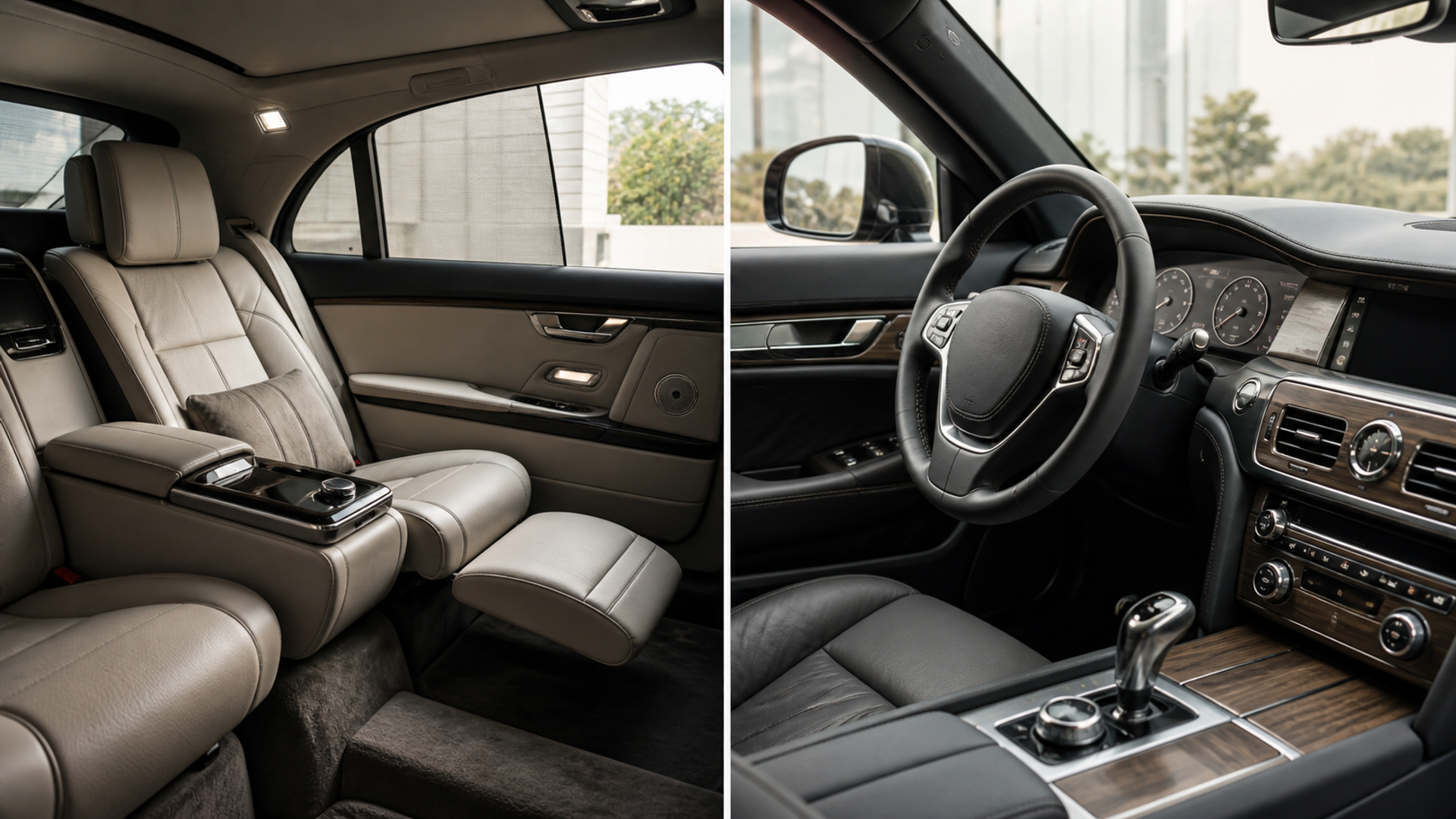
A chauffeur-driven buyer should begin in the rear left or rear right seat, operate the doors, work surfaces, climate and screens, then sit there for at least thirty minutes. An owner-driver should begin with steering, pedal calibration and visibility. The same car can impress from one position and frustrate from another. Do not let the salesperson choose the evaluation seat.
Wheelbase and doors affect daily access
Overall length, rear-door opening and sill height matter in city car parks, hotel porte-cochères and home garages. A long wheelbase can improve space while making tight turns and kerb access harder. Measure the actual garage, turning route and regular passenger's mobility needs. Rear space that cannot be accessed comfortably is wasted specification.
Ride quality must be tested on bad roads
Both cars are engineered for isolation, but wheel size, tyre construction, suspension mode and road surface change the result. Drive over broken urban tarmac, expansion joints and a fast undulating road. Listen for secondary movement and tyre noise from the rear. The most dramatic wheel can be the least luxurious choice for the owner's environment.
Powertrain choice changes the personality
Market availability may include different engines or electrified systems. Compare low-speed smoothness, throttle progression, engine restart behaviour, motorway reserve and refuelling or charging reality. Peak output is less important than how the car responds with passengers. A Flying Spur may invite driving harder, while a Ghost should make pace feel effortless; verify both impressions yourself.
Rear technology should reduce friction
Operate blinds, seat controls, charging, connectivity and climate without assistance. Check whether devices remain secure during acceleration and whether screens can be hidden. A complex interface that requires repeated driver help is not rear-seat luxury. Also test night brightness and whether a confidential call can be conducted without audio leaking through the cabin.
Luggage and airport use reveal packaging
Load the actual suitcases, garment bags, child equipment or golf cases used on trips. Boot litres do not show aperture shape, hinge intrusion or the effect of rear refrigeration equipment. If an airport transfer requires a second vehicle, the nominally more prestigious saloon may be the weaker tool. Include the driver and security team's equipment in the test.
Commissioning can overwhelm the decision
Paint, veneer, embroidery, leather, audio and bespoke details can move the budget far beyond the base car. Freeze the functional specification first: wheelbase, seats, driver aids, climate and storage. Add expressive options only after those needs are solved. A coherent restrained build often ages better than a car ordered from a checklist of individual luxuries.
Model five years of ownership
Include tax, insurance, tyres, scheduled service, warranty coverage, depreciation, secure parking, chauffeur cost and likely downtime. Confirm the nearest authorised workshop and collection support. Ultra-luxury ownership quality is measured when something needs attention, not only at delivery. A slightly less dramatic car with dependable local support may protect far more time.
Match the choice to the owner
Chauffeur-led principal
Start with Ghost rear-seat calm, then verify luggage, access and local support. Turn that recommendation into a testable buying rule: identify the feature that changes the outcome, confirm it on the exact product or service, and set a walk-away condition before the sales conversation. This keeps the decision attached to use rather than status.
Owner-driver
Begin with Flying Spur dynamics but test rear comfort for business passengers. Turn that recommendation into a testable buying rule: identify the feature that changes the outcome, confirm it on the exact product or service, and set a walk-away condition before the sales conversation. This keeps the decision attached to use rather than status.
Single-car household
Prioritise manoeuvrability, luggage and service coverage over ceremonial details. Turn that recommendation into a testable buying rule: identify the feature that changes the outcome, confirm it on the exact product or service, and set a walk-away condition before the sales conversation. This keeps the decision attached to use rather than status.
Collector adding a saloon
Choose the proposition that adds a new use case rather than duplicating an existing car. Turn that recommendation into a testable buying rule: identify the feature that changes the outcome, confirm it on the exact product or service, and set a walk-away condition before the sales conversation. This keeps the decision attached to use rather than status.
These scenarios are intentionally different because one category can serve several jobs. The same buyer may also reach a different conclusion after a move, a change in travel pattern or a shift from occasional to daily use. Re-run the decision when the use case changes rather than defending an old purchase thesis.
The ownership-cost test
Start with the total amount required to acquire and put the choice into use. Add taxes, sizing or alterations, insurance, accessories, service, repair access and any cost created by the buying channel. Then estimate realistic years and occasions of use. A high price can still be rational when use is frequent and the product remains serviceable; a lower price can be poor value when fit, maintenance or duplicated benefits prevent use.
Avoid treating resale as a guaranteed rebate. Secondary-market outcomes depend on reference, condition, documentation, timing, fees and the spread between asking and completed prices. Use a conservative exit value or zero in the first calculation. If the decision only works with an optimistic resale assumption, the budget is carrying more risk than the product page reveals.
Time is another ownership cost. Waiting lists, claims, repairs, international shipping, repeated benefit enrolment and hard-to-source parts can outweigh a modest price difference. Record who will solve the problem, where the item can be serviced and what evidence is required before purchase. Premium should reduce meaningful friction, not merely rename it.
Pre-purchase verification checklist
Configure both cars for the same market and delivery window.
Measure garage, turning route and luggage aperture.
Test from the driver's seat and the principal rear seat.
Drive poor city roads and a representative motorway.
Operate every rear control without salesperson help.
Price the complete build, insurance and five-year tyre/service plan.
Verify authorised support and replacement-mobility policy.
Photograph the final configuration and obtain every option in writing.
Do the checklist with the exact reference, issuer, model, size or material in front of you. Save screenshots or documents for the facts that control the choice. If a salesperson cannot identify the source of an important claim, treat it as unverified until the relevant brand, issuer, certifier or service provider confirms it.
A practical scoring worksheet
Give each option a score from one to five for fit, verified performance, ownership support, daily usability and personal design preference. Multiply only the two factors that genuinely control the decision; leave the rest unweighted. Then subtract one point for every unresolved dependency such as unclear availability, missing policy wording, unknown service access or a specification that belongs to a different reference.
Next, write a one-sentence reason to buy and a one-sentence reason to walk away. The buy reason must describe an outcome, not prestige. The walk-away reason must be observable before payment. This simple discipline prevents an attractive object or benefit from becoming its own justification and makes comparison across retailers or markets more consistent.
Finally, wait long enough for urgency to cool. Recheck the evidence, the full cost and the alternative that already meets the minimum need. Scarcity can be real, but scarcity is not proof of fit. The better luxury purchase is the one that remains coherent without pressure.
Related VERTU guides
These internal guides provide adjacent decision frameworks, not substitute evidence for the current comparison. Use them to understand the wider ownership context, then return to the official source for the exact product, market, policy or service being considered.
Verdict
Choose the Ghost when rear-cabin calm, ceremonial arrival and the Rolls-Royce commissioning experience are the main purchase. Choose the Flying Spur when the owner will drive regularly and wants a stronger blend of performance, luxury and rear-seat usefulness. The correct answer depends on wheelbase, seat specification and local powertrain, so compare configured cars rather than brand stereotypes.
Choose the verified outcome rather than the loudest category signal. Confirm the exact reference and local terms, price the ownership friction, and be willing to wait when the evidence does not yet support a confident purchase.