

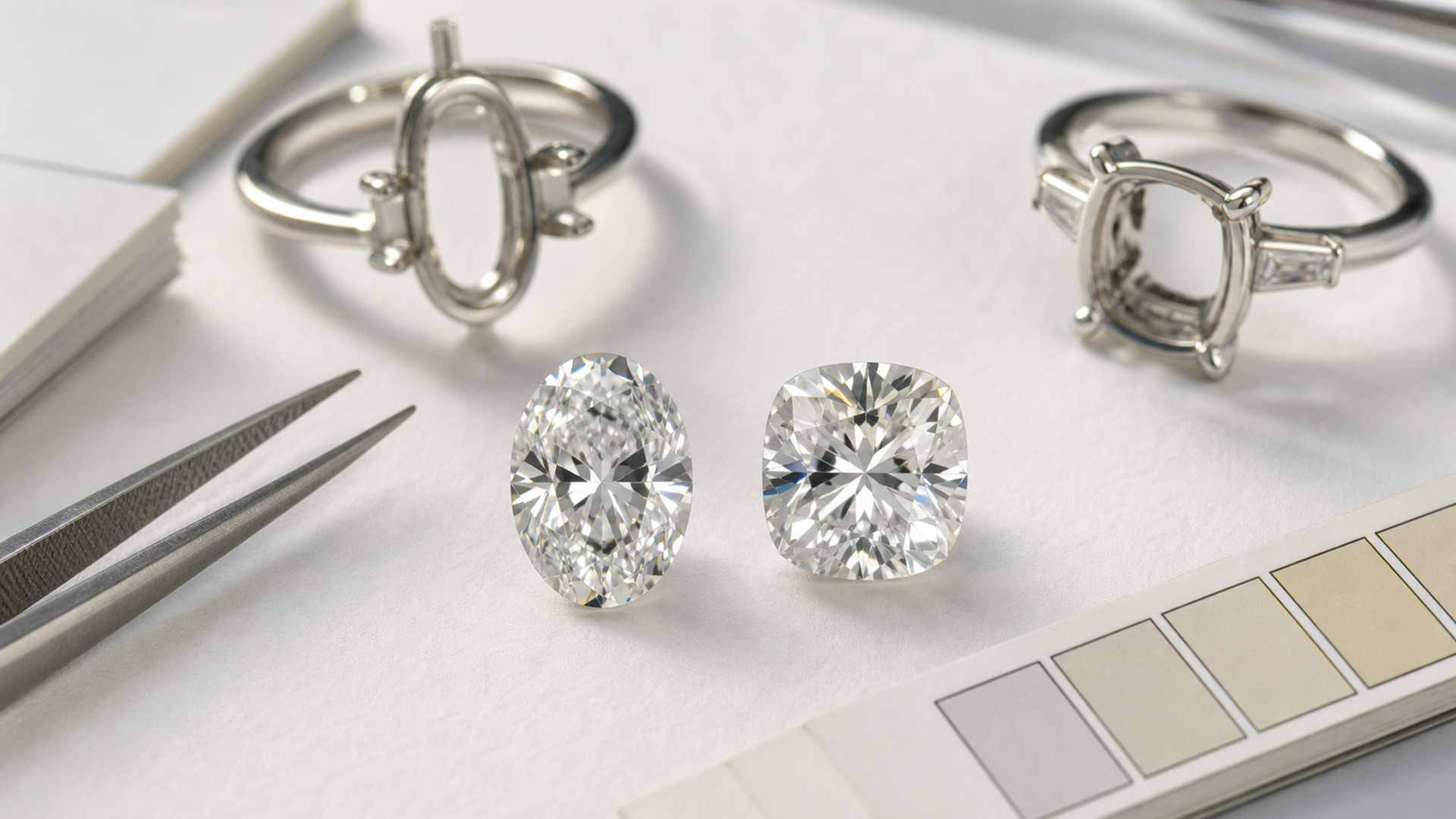
Oval and cushion-cut diamonds can have the same carat weight, colour and clarity yet look completely different on the hand. An oval usually creates an elongated line and can appear larger face-up for its weight. A cushion has a softened square or rectangular outline, with rounded corners and a broader, often more intimate pattern of light. Neither shape is inherently more brilliant, more valuable or more flattering. Proportions and the individual stone matter more than the category name.
The most reliable choice comes from comparing outline, face-up dimensions, light behaviour, setting security and the wearer's hand and lifestyle. Fancy-shape diamonds cannot be purchased intelligently from carat weight and a static certificate alone. This guide uses a repeatable inspection method rather than a single “ideal” ratio.
The short answer
Choose an oval if you want an elongated silhouette, strong finger coverage and a shape that often reads as larger from a distance. Choose a cushion if you prefer softened square geometry, visible corners and a romantic or architectural outline that can range from compact to elongated.
An oval buyer must inspect the bow-tie effect and symmetry. A cushion buyer must decide whether they prefer a chunky broad-flash pattern, a more splintered brilliant look, a square outline or an elongated one. Both should be viewed in motion and in several lighting environments.
Oval versus cushion decision matrix
| Decision factor | Oval | Cushion | What to verify |
|---|---|---|---|
| Overall outline | Elongated ellipse | Rounded square or rectangle | Shape symmetry and personal proportion preference |
| Face-up spread | Often strong for carat weight | Often carries more weight in depth | Millimetre dimensions, not carat alone |
| Light pattern | Can show a central bow-tie | Can show broad or splintered reflections | Video in diffuse, spot and ordinary room light |
| Corner profile | No corners | Rounded corners range from soft to defined | Setting contact and desired visual structure |
| Finger effect | Creates length along the finger | Creates width and soft geometry | Try on using the intended setting width |
| Setting | Four or six prongs, halo, bezel and others | Four prongs often align with corners; halo or bezel can emphasise shape | Security, cleaning access and snag risk |
| Pairing with side stones | Tapers and straight baguettes can extend the line | Trapezoids or compact side stones can reinforce geometry | Balance at actual millimetre scale |
| Buying risk | Dark bow-tie, uneven shoulders, poor symmetry | Excess depth, hidden weight, muddled pattern | Compare multiple stones under the same conditions |
Carat is weight, not visible size
Carat measures mass. It does not describe how much of a diamond is visible from above. Two one-carat stones may have different lengths, widths and depths, and therefore different presence on the finger. Ovals often distribute weight across a broad face, while some cushions retain more weight below the girdle. That does not make a deep cushion defective; it means the buyer should decide whether face-up size or a particular light pattern is the priority.
Record length and width in millimetres. Place the stones beside each other on a neutral card, then view them from the distance at which a ring is normally noticed. A stone that looks marginally larger in macro photography may not create a meaningful difference in real life.
Also compare girdle thickness and setting height. A very thin area can raise durability concerns, while a very thick girdle may hold weight that does not improve appearance. These judgements belong with a qualified jeweller or gemmologist using the actual stone.
Length-to-width ratio is a preference, not a universal grade
An oval's length-to-width ratio influences whether it appears slender or full. A cushion may be nearly square or distinctly elongated. Online guides often present narrow “ideal” ranges, but the right proportion depends on hand shape, setting, side stones and taste. A mathematically similar outline can still differ because of shoulders, corner shape and facet arrangement.
Use ratio as a filtering tool, not a quality verdict. Print or digitally scale candidate outlines to their actual millimetre dimensions. Place them over a photograph of the hand, then confirm with loose-stone trays or temporary holders in person. The goal is not to make the finger conform to a rule; it is to see whether the shape feels balanced with the band.
Bow-tie effect in oval diamonds
Many elongated brilliant-cut diamonds show some degree of darker band across the centre, commonly called a bow-tie. It results from how light and the observer's head interact with the facet pattern. A subtle bow-tie can add contrast and movement. A severe one can dominate the stone and remain dark in ordinary conditions.
Do not judge it from one vendor image. Rotate the diamond slowly under diffuse daylight, jewellery-store spotlights and mixed office light. Watch whether the centre alternates between light and dark or remains persistently blocked. Compare candidates side by side with the same camera exposure; automatic phone processing can brighten one video and hide the difference.
The GIA oval-cut diamond guide explains the importance of outline and bow-tie inspection. A laboratory report provides essential identification and quality data, but it does not replace this visual assessment.
Cushion facet patterns are not one look
“Cushion cut” describes an outline family, not a single optical recipe. Some cushions display broader, chunkier flashes that evoke older cutting styles. Others use modified facet patterns that create smaller, more splintered reflections. One buyer may call the first lively and the second busy; another may see the first as sleepy and the second as brilliant.
Ask the seller to identify the facet pattern shown on the grading report, then compare the stone visually. Terms used in retail marketing are not always standardised. Video should show the diamond moving through a wide angle rather than spinning quickly under intense spotlights.
Look at the centre and corners. A pleasing cushion maintains life across the face without an empty centre or corners that disappear. Yet contrast is necessary for scintillation, so uniform brightness is not the goal.
GIA cut grades and fancy shapes
The familiar overall GIA cut grade is associated with standard round brilliant diamonds, not a universal final cut score for oval and cushion shapes. GIA explains cut grading and its scope in six things to know about diamond cut grade. For fancy shapes, polish and symmetry grades remain useful, but the buyer must integrate measurements, facet pattern and direct observation.
This is why a spreadsheet ranking can mislead. A stone with excellent polish and symmetry can still have an outline or light pattern you dislike. Conversely, a diamond that looks beautiful should still be checked for durability, treatments and consistency with an independent report.
The broader GIA guide to diamond shapes is a useful primary reference before comparing retail descriptions.
Colour and clarity behave differently by individual stone
Elongated and cushion shapes can distribute colour differently from a round brilliant, particularly near tips or corners and in larger sizes. Metal colour also changes perception. A white metal setting may make body colour more apparent to some viewers; yellow or rose gold can make a warmer diamond feel deliberate. There is no requirement to pay for a colour grade that the wearer cannot distinguish in the intended setting.
Clarity should be judged for visibility, location and durability implications. An inclusion hidden near a prong may be unobtrusive, but an inclusion near a vulnerable edge requires professional assessment. “Eye clean” is not a laboratory grade and depends on viewing distance, eyesight and lighting. Obtain high-resolution imagery and an independent opinion for a significant purchase.
Setting architecture
An oval solitaire can use four or six prongs. Six may create additional perceived security and accentuate the length, while four can leave more of the outline visible. Prong placement should not make the shoulders appear uneven. A bezel provides strong edge protection but changes the apparent size and light entry.
A cushion's rounded corners often align naturally with four prongs, though the precise shape and size determine the best design. A halo can enlarge the visual footprint but adds maintenance and a more decorative character. Low settings reduce snagging; high settings may allow a wedding band to sit flush but place the stone at greater exposure.
Try the completed setting profile, not just the loose diamond. Put on a coat, knitwear and gloves if relevant. Check whether the ring turns, catches or presses neighbouring fingers. The diamond size and finger coverage guide can help connect dimensions to presence, while the white gold vs platinum comparison addresses metal weight and maintenance.
Budget allocation that improves the visible result
Start with a maximum total ring budget, including setting, tax, sizing, insurance and future maintenance. Then allocate for the shape you can see: outline, face-up dimensions and light behaviour. Do not automatically maximise carat while accepting a dark centre, unattractive shoulders or excessive depth.
For many buyers, a small move in colour or clarity that remains acceptable to the eye releases budget for a better-cut individual stone or a more secure setting. This is not a formula; it is a reminder that grading categories have different visual impact. Compare options blind where possible, then reveal prices and grades after identifying the preferred appearance.
Avoid language promising investment return. Retail price, replacement value and resale value are different concepts. The economic justification for an engagement ring is personal use, not guaranteed liquidity.
A controlled comparison protocol
Select three ovals and three cushions within the same total budget.
Record carat, length, width, depth, colour, clarity, polish, symmetry and report number.
View all six under the same diffuse light, spot light and normal indoor light.
Take slow, unedited video from the same distance and exposure.
Compare face-up size using millimetres and a full-hand view.
Eliminate persistent dark centres, distracting asymmetry or outlines you dislike.
Place finalists in a temporary holder at the intended setting height.
Obtain independent verification before the return period expires.
This procedure replaces category stereotypes with evidence from the actual diamonds.
Final verdict
An oval is often the better choice for someone seeking elongated finger coverage, an energetic brilliant pattern and a strong face-up presence. A cushion is often better for someone drawn to softened square geometry, visible corners and the choice between broad or more splintered light patterns. The strongest diamond in either category is the individual stone whose outline and movement remain attractive across ordinary conditions.
Choose the shape first with your eyes, then use the grading report and professional inspection to understand what you are seeing and protect the purchase. The right ring is not the one that wins a generic comparison table; it is the one whose proportions, setting and daily wear remain coherent after the showroom lighting is gone.
![How to Scan Receipts and Documents with Your Phone [Full Guide]](https://cdn.sanity.io/images/e0gp1l2g/production/0db13feec1d5e72b8a8a5f976d1f3e86619c9228-3840x1860.webp?w=180&h=180&q=78&auto=format&fit=crop)
![How to Scan Receipts and Documents with Your Phone [Full Guide]](https://cdn.sanity.io/images/e0gp1l2g/production/0db13feec1d5e72b8a8a5f976d1f3e86619c9228-3840x1860.webp?w=800&h=450&q=82&auto=format&fit=crop)
![Top 10 Two-Tone Carbon-Fibre Watches for Men [2026 List]](https://cdn.sanity.io/images/e0gp1l2g/production/18870799ba33fab0e038968359cd5772d7d7db30-1024x576.webp?w=800&h=450&q=82&auto=format&fit=crop)
![Top 10 Luxury Watches with Digital Complication Displays for Men [Latest]](https://cdn.sanity.io/images/e0gp1l2g/production/c4f6bf8c080f291c39f7cc85c7344ecff2fd3799-1024x553.webp?w=800&h=450&q=82&auto=format&fit=crop)